

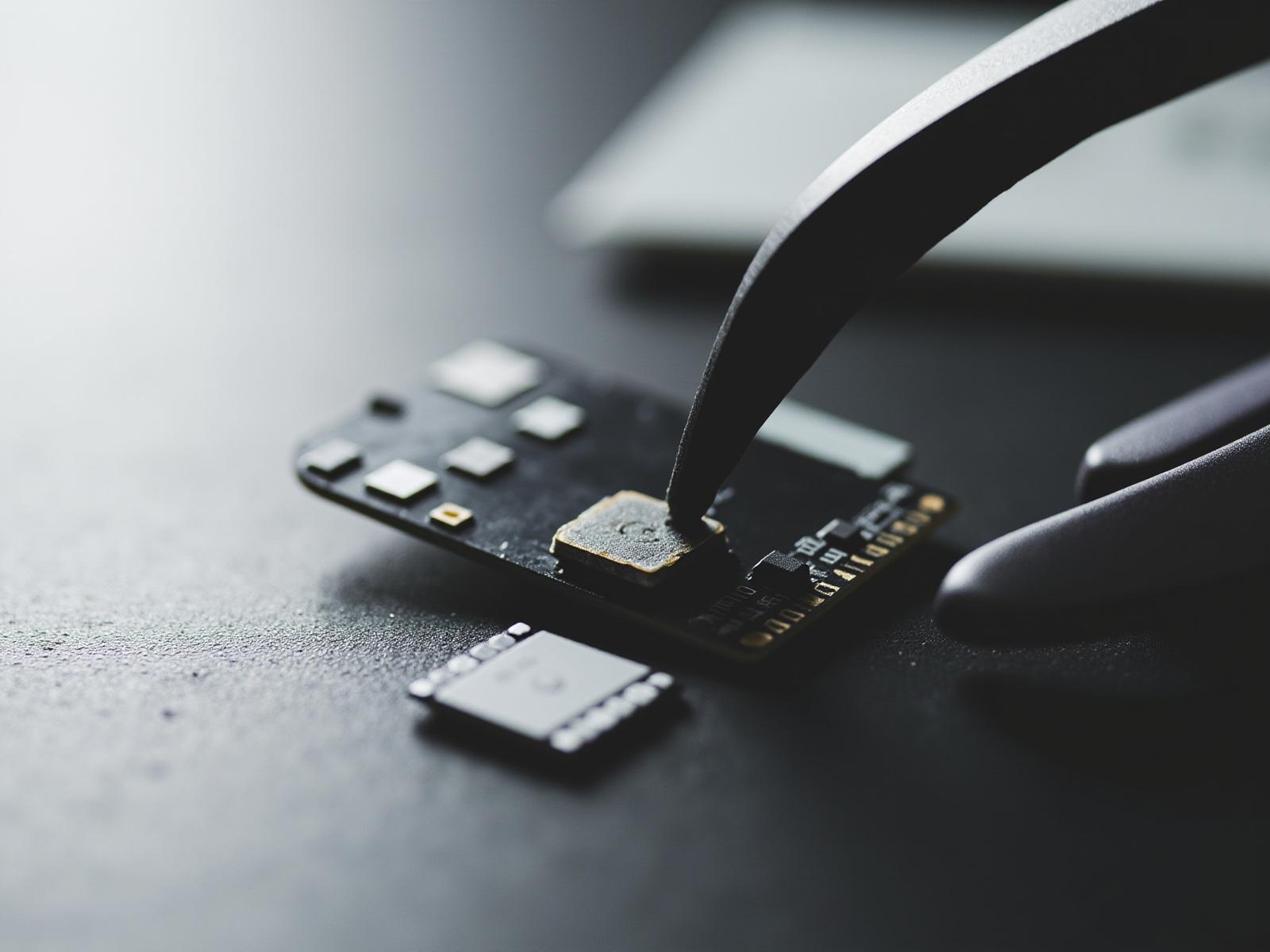
There is exactly one physical claim a brand can make about a camera glasses product in this catalogue, and the MT6 is the model that carries it. It is the only model in the entire range with a published weight — 158 grams for the whole unit — and the only camera model with a published case capacity and a documented foldable case form. Every other model in the camera family, the audio family, the sport family and the specialist categories asks the buyer to take a number on trust. This one does not.
MT6 smart glasses suit a brand whose proposition is comfort and portability, and they suit a brand whose freight model can absorb a second lithium cell in the parcel. They do not suit a brand selling on picture quality, on a photochromic lens story, or on the lowest delivered cost per unit. That is the short version, and it is enough to start a shortlist. The rest of this page is the reasoning behind each branch, the verification route, and the terms worth negotiating before a purchase order is signed.
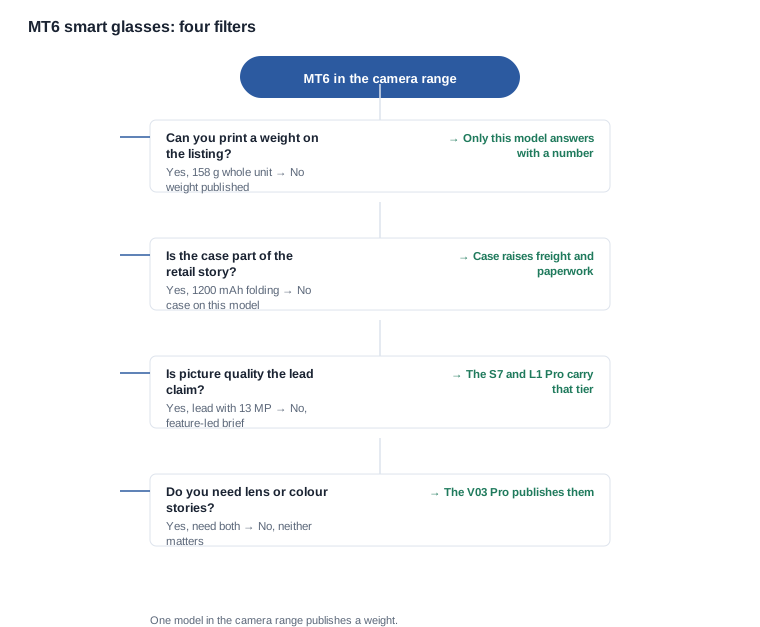
MT6 smart glasses and the three published rows that change what a brand can say
158 grams, whole unit. Not per temple, not excluding the battery, and not an estimate: the whole unit, published. No other model in the catalogue publishes a weight at all. For a product carried on the face, weight is the number that predicts the return rate, and it is the number a customer forms an opinion about within the first ten minutes in a shop. It is also the number most often quietly guessed at by suppliers, which makes it the one a careful competitor can attack. Holding the only measured number in a category is a defensible position, and it survives a comparison table.
A 1200 mAh charging case that folds. Published capacity, published form. The fold does three things at once, and a buyer should evaluate all three rather than the first. It reduces the shipping volume, which reduces the dimensional weight, which reduces the landed cost per unit. It makes the product something a customer puts in a pocket rather than something that lives in a drawer between charges. And it gives the retail story a shape, because a product that folds is a product whose dimensions are part of the pitch — it can be demonstrated in three seconds, and it is the only case form in the camera family that can be.
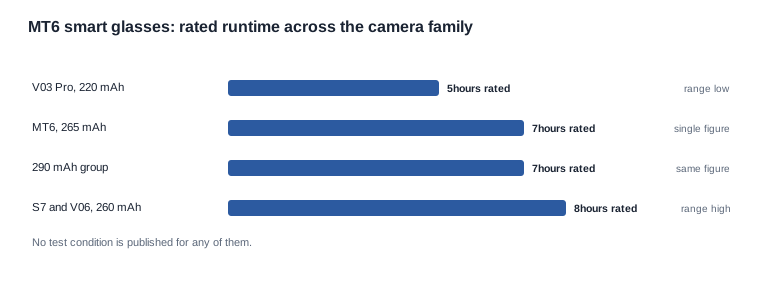
265 mAh with a rated runtime of approximately seven hours. That places the MT6 between the 220 mAh models and the 290 mAh group on capacity, and at the same published runtime as the 290 mAh group. The cell is a reasonable bill of materials and the runtime figure matches a group with a larger cell, which is a plain and useful observation for a buyer who wants a defensible number rather than a competitive one.
The arithmetic that follows from the case. A 1200 mAh case is not free. It is a second lithium cell inside the parcel, which means a battery transport document, a heavier carton, an additional customs line and a certification check on the shipped configuration rather than only on the finished unit. Two of those cost money and one of them costs lead time. The MT6 is the camera model for a brand selling portability, and it is not the camera model for a brand minimising freight cost per unit. The V03 and the V03 Pro, with no published case, sit at the other end of that trade-off, and the shipping weight analysis covers the parcel arithmetic in full.
What the published rows can carry, and what a buyer must still verify
A figure on a catalogue row is a specification. It becomes a proposition only when a customer can check it, and the difference between the two is where procurement time actually goes. A customer can weigh the product on a bathroom scale. A customer can open a case and see whether it holds. A customer cannot check a charge time that was never published, cannot check a weather claim with no test report behind it, and cannot check a resolution figure against a picture.
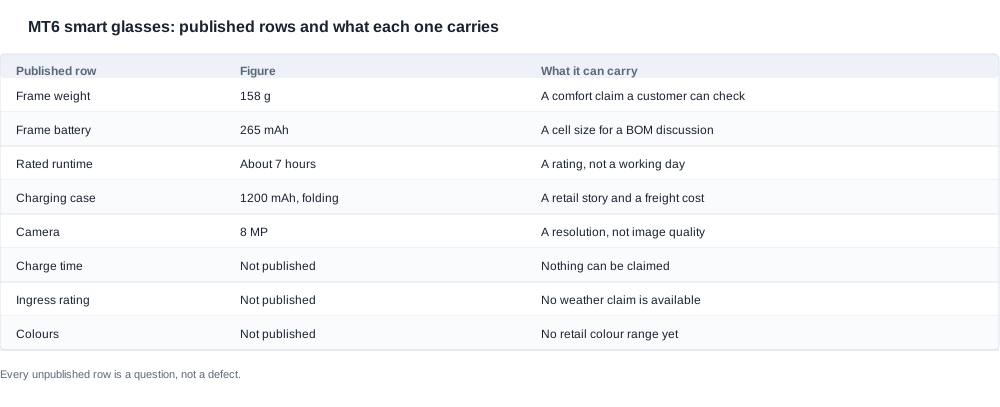
Three rows you can print today. The whole-unit weight, the case capacity and form, and the cell capacity. Each of these survives contact with a customer, a retailer and a reviewer, and each of them can go on a product page, a spec sheet and a packaging panel without a footnote.
One row you can print with a qualifier. The rated runtime. It is a rating rather than a working day, and the difference matters because no test condition is published for any model in the camera family. Publishing the figure with the word rated attached is honest; publishing it as a day is a claim the documentation does not support.
Two rows you can print as a resolution, not as quality. The 8 megapixel figure is a parameter. Without a sensor model, a field of view, a video resolution and a frame rate, it cannot be shown to produce a better image than a competitor's product. That is not a criticism of the model; it is a statement about what the documentation contains, and it is the same statement that applies to every camera model in this catalogue.
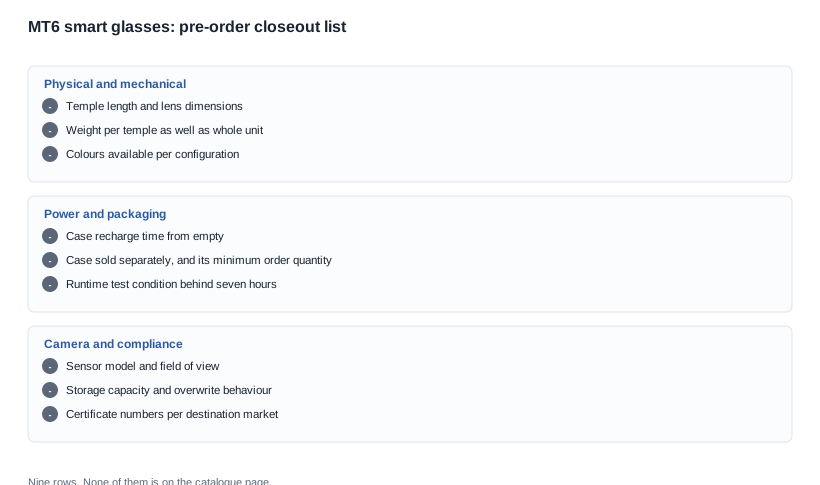
Everything else is a question to ask. Sensor model and field of view, video resolution and frame rate, storage capacity and overwrite behaviour, the charging input, the charge indicator behaviour, the case recharge time, whether the case is sold separately, colour options, ingress protection, and the certificate numbers with their issuing bodies, validity periods and covered model schedules. Nine open rows, none of which is disqualifying and all of which are closeable. The right way to close them is one written request rather than a sequence of calls, because a request list gets nine answers and a conversation gets one paragraph.
The internal documentation conflict you should know about before you ask. Our own records currently hold three conflicting minimum order quantity figures that have not been arbitrated. We would rather tell a buyer that than present one of the three as settled, and it is the reason the MOQ in any quotation should be treated as a number to confirm rather than a number to rely on.
The buyer the MT6 fits: four profiles that close on a sample
A brand selling comfort as the proposition. "You will forget it is on your face" is a real proposition in a market where most competitors publish no weight at all, and it is one a retailer, a reviewer and a customer can all test. It is also the proposition most often faked with an unmeasured estimate, which is exactly why a measured number is worth defending. If your channel competes on the physical product rather than on the specification table, this is the model where that competition is winnable with evidence.
A brand selling the product as something that travels. For a direct-to-consumer model, a product that goes in a pocket has a different cost structure and a different demonstration from one that ships in a fixed box. The folding form is what turns that from a sentence into a demonstration. It also changes the customer's routine, which changes the return pattern, because a product a customer reaches for rather than one they remember to fetch behaves differently over a month.
A brand building a camera range that needs a middle rung. The MT6 sits between the plain V03 and the top tier. It has a case where the V03 and the V03 Pro do not, a published weight where nothing else has one, and a cell below the 290 mAh group. That makes it the natural middle of a three-step ladder, and it means the merchandising structure you build around it survives the later addition of a higher model rather than being rebuilt from the ground up. The model pick guide across the camera range covers how to lay that ladder out.
A brand that intends to publish its own measured figures. This is the buyer who gains the most from choosing this model, and it is the one buyers forget to count. On a model with no published weight, a sample test produces a number that cannot be compared to anything. On this one, your measurement confirms or contradicts a published baseline, which is the difference between a data point and an anecdote in a due diligence file. If your quality control process is going to measure the product anyway, this is the model where the measurement is worth the afternoon.

The briefs the MT6 cannot carry, and the model that serves them instead
Picture quality as the lead claim. At 8 megapixels, the MT6 sits below the L1 Pro and the L2 Utral at 13 megapixels. That is the whole imaging difference, and it cannot be defended on paper for any of the three, because no sensor model and no field of view are published for the MT6 either. A brand selling on image quality needs a sample and a fixed test shot, whichever of the three it picks, and until that shot exists the megapixel figure is a parameter rather than an output. A competitor's lower-resolution product can otherwise be shown to be better in low light, and that demonstration is much cheaper for them than for you.
A photochromic lens story, a flexible temple, a stated Type-C port or retail colour options. The V03 Pro publishes all four: a photochromic lens, a flexible temple, a Type-C interface and three colourways. The MT6's row publishes none of them. If your differentiation plan runs through the lens or through the shelf, this model gives you nothing to write on, and a listing that borrows a sibling's lens feature is the most common error we see in camera-range comparison charts.
The lowest delivered cost per unit. This is the counter-intuitive branch and it is where procurement gets caught. The case improves three things and worsens two, and the two are exactly the ones a landed-cost model cares about. If your brief is a first-price-entry product for a marketplace channel where freight is a large share of the selling price, the V03 and the V03 Pro are the economical entry and this model is not.
An endurance-led proposition. The rated figure sits at approximately seven hours, alongside the 290 mAh group and above the low end of the 220 mAh models' five-to-eight-hour range. No test condition is published for any of them, so a buyer whose customer's whole day is the story should resolve the endurance condition before the model list rather than after. The charging options analysis covers what the case changes about the customer's routine and what it does not.
Verification steps and the criteria for signing the purchase order
The MT6 needs fewer verifications than most models in the catalogue, and the reason is structural: its defining rows are already published, so the open questions are the ordinary ones rather than the load-bearing ones. That is a good position, and it is worth spending the negotiation time on the terms rather than on the specification hunt.

Send the nine open rows in one written request, and get the answers in writing. Ask for the temple length and lens dimensions; the weight per temple as well as the whole unit; the charging input and the charge indicator behaviour; the case recharge time and whether the case is sold separately; the sensor model and field of view; the video resolution and frame rate; the storage capacity, file format and overwrite behaviour; the runtime test condition; and the certificate position per destination market.
Weigh three samples and record the spread, not the average. A published 158 grams is a figure for a nominal unit. What matters to a buyer shipping at volume is the spread across a production run, because that determines whether the second order matches the first. Three samples, three recorded figures, and the spread written into your quality control document is the process that turns a published number into a controlled one.
Shoot one fixed scene and hold it against the 13 megapixel tier. Not a beauty shot — a fixed scene at a fixed light level, so the two outputs are comparable and the test can be repeated by the next person who joins the project. This is the test that converts a resolution tier into an argument, and it is the only way to know whether 8 megapixels is a real constraint for your use case or an irrelevance.
Time the case recharge twice, from empty and from a partial state. Record the starting point each time. A case that takes an hour from empty and twenty minutes from a partial state behaves very differently across a customer's week from one that takes the same time either way, and neither number is published for this model.
Write the listing boundary before the copy exists. The weight, the case capacity and form, the cell capacity, the runtime rating and the resolution figure are published rows. The sensor, the field of view, the video specification, the charge time, the colour list, the ingress position and the certificate coverage are not. Deciding which side of that line each sentence sits on is much cheaper while you can still change the product page than after a listing has been indexed.
Terms worth negotiating, and the position we take
What this model's position is worth commercially. The published weight and the folding case are the two things a reseller can actually sell and a customer can actually check, and neither appears on a specification table. The camera tier is what you build the ladder on, not what closes the sale. If your brief is a middle rung in a three-step camera range, this is the only rung in the range that can carry a physical claim of any kind.
Open to negotiation, and worth the time. Unit price and volume tiers across a bulk order; the case as a separate accessory line with its own minimum order quantity; packaging specification per configuration, which on a folding product is where the carton dimensions actually live; delivery splitting, so a first tranche can be validated before the balance ships; payment terms with nodes against inspection rather than against shipment; the warranty period with a stated response time; return terms for defective units; and the terms of a pilot order. The per-configuration packaging line is the item most often forgotten, and the delivery split is the item that most reduces the risk on a first order.
Quotable in the sense that the number exists but will not move. Certification cost and lead time are a function of the programme and of whoever runs the test rather than any conversation. Tooling is frequently amortised across a first order while certification cost is per product family, and asking which one you are being quoted matters because the two are often bundled into a single line that hides the distinction. Certification cost is not negotiable; the schedule around it often is, and the schedule is where the leverage sits.
The clauses that belong in the agreement. The published rows for the configuration ordered, with the case named as a line item rather than described as included; the measured frame weight and dimensions from your own samples; the sensor and video specification once obtained; the runtime condition; the warranty period with a stated response; and the certificate position per destination market stated as a fact rather than an intention.
The clauses that belong nowhere. Any weather claim, because no ingress rating is published for this model. Any image quality claim not tested on a fixed-scene sample. Any weight not measured on your own units. Any single-figure runtime presented as a working day. And any specification inherited from a neighbouring model in the same family — that mistake produces a listing which describes a product the customer does not have, and it is the most frequent failure in this category.
Where we stand. Our position is that the MT6 is the most brandable product in the camera range, because a brand can say something about it that is published rather than asserted. A published weight and a published foldable case are worth more to a brand than one more megapixel, because the megapixel figure cannot be shown to produce a better image while the weight can be put on a listing and checked by a customer in a shop.
And the limits of that position. We will not extend the 158 gram figure to any other model, because it belongs to this product with this cell and this case. We will not present 8 megapixels as a quality claim. We will not publish a charge time, a colour list or an ingress position that the documentation does not contain. And where our internal documentation holds three conflicting minimum order quantity figures that have not been arbitrated, we will name the conflict rather than pick the convenient one.
Red flags worth naming early. A supplier who quotes a weight without a whole-unit definition, a supplier who offers the folding case without a capacity, a supplier who treats the case as a gift rather than an accessory line, and a supplier who extends a certificate across a model family without a covered model schedule. Each of those is a red flag that costs nothing to raise at the quotation stage and a great deal to raise after the first shipment.
With the models, the order volume, the destination market and the channel in hand, we can tell you what can be supplied and what cannot. The camera family is on our AI camera glasses range page, the published rows behind this model are set out in MT6 compared, and the figures that remain open are collected in MT6 limitations.
Related reading
- The catalogue rows for this model — MT6 compared
- How the entry-level choice is made across the range — entry level options
- The model detail behind the higher tier — KY06 best for
Tell us the channel, the volume and the target market, and we will come back with what is available.


