

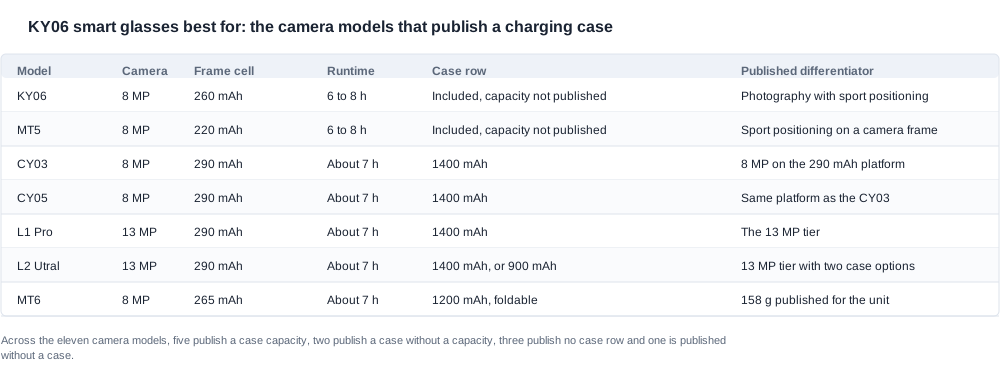
The KY06 occupies a narrow and specific position in the camera range, and stating it precisely is more useful to a buyer than any ranking would be. The published rows are an 8-megapixel camera, a 260 mAh cell, a charge time of two hours or less, a rated runtime of six to eight hours, magnetic charging and a charging case whose capacity is not published, on a frame positioned for photography with a sport emphasis.
The one number that would complete this picture is the case capacity. Our documentation confirms a case is included and does not state what it holds. That is a one-line question with a one-line answer, and it should be answered before the packaging is designed, because the case drives the packed weight, the freight class, the battery transport documentation and the customer's charging rhythm at the same time.
What this article does and does not do. It maps the KY06's published rows against the eleven camera models in the catalogue, names the requirement profiles those rows answer and the ones they do not, and lists the rows still missing. It is not a ranking, and it is not a price comparison — we publish no prices, so any tiering that claims to rank these models by value would be inventing the axis it claims to measure. Every statement here traces back to a published specification row.
KY06 smart glasses best for: the narrow position the published rows give this model
Read the camera models by what comes in the box, and the structure of the range becomes clear enough to navigate.
Seven of the eleven camera models publish a charging case. The KY06 and the MT5 publish a case with no capacity figure. The CY05 and the L1 Pro, and the CY03 publish a 1400 mAh case. The L2 Utral publishes the same 1400 mAh plus a 900 mAh option, which makes it the only model in the range with two published case capacities and therefore the only one that can serve two retail tiers from a single platform. The MT6 publishes a 1200 mAh folding case.
Three models publish no charging-case row at all. The V03 and the S7, and the V06 are published with their charging method and stop there. This is a different fact from being published without a case: the V03 Pro is the single model the catalogue states has no case, while for the S7 and the V03, and the V06 the row is simply absent. The difference matters because an absent row is a request, and a stated absence is a specification.
That is where the KY06 sits. It has a case, it does not sit at the top of the bill of materials, and it does not publish the case capacity. A buyer choosing between it and the 290 mAh group is trading a documented case capacity for a smaller cell and a runtime figure published as a band rather than as a point.
That is a real trade rather than a failure, and it is a trade a buyer can evaluate without a price sheet. The question is not which model is better; it is whether the case capacity is a number your business model needs.
How to choose between them without a price list. Start from the decision the number has to support rather than from the product. If the case capacity drives a freight calculation, a retail tier or a battery transport declaration, then the capacity is a hard requirement, and only the models that publish it can be shortlisted on paper. If the case is simply an accessory that makes the product more presentable at the point of sale, then an unpublished capacity is an open question rather than a blocker, and the shortest route is to close it with one written request before the packaging design starts. The criteria are simple enough to apply in a meeting: does the number change a decision you have already made? If it does not, it does not need to be resolved first.
The total cost consequence is worth a paragraph of its own. A case is a second cell, a second enclosure, a second charging routine and a second item in the parcel. Each of those lands somewhere different in a business model — freight per unit, packaging design, the number of cables the customer needs, the return rate when a customer cannot work out the charging routine, and the battery transport paperwork. A buyer who treats the case as a free accessory is likely to under-price the delivered unit, and the correction usually arrives with the first consignment rather than with the quotation.
Reading the camera range along its published axes
Beyond the case, the range separates along three published axes — cell capacity, runtime disclosure and camera resolution tier — and reading them together explains why different models exist at all.
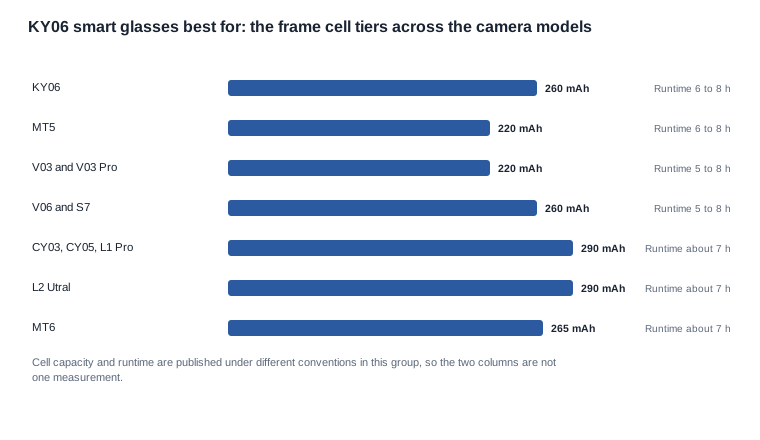
The cell axis has four tiers. 220 mAh carries the V03 Pro and the V03, and the MT5. 260 mAh carries the V06 and the KY06, and the S7. 265 mAh carries the MT6. 290 mAh carries the L1 Pro and the CY03, and the CY05 and the L2 Utral. Cell capacity drives the bill of materials directly, and it is the axis on which the KY06 sits in the middle rather than at either end.
The runtime disclosure axis is separate from the cell axis, and that is the surprising part. The models with the largest cells publish a point figure of about seven hours. The models with the smaller cells publish ranges — five to eight hours on the 220 mAh V03 and V03 Pro and the 260 mAh V06 and S7, and six to eight hours on the 220 mAh MT5 and the 260 mAh KY06. A 220 mAh cell and a 290 mAh cell appearing against different disclosures means the figures were not produced under one protocol. The AI camera glasses battery comparison sets out the full grid, and the KY06 battery life analysis covers why a range is the more informative disclosure.
The resolution axis has two tiers. Eight of the eleven camera models are published at 8 MP — the MT5 and the MT6, the V03 and the V03 Pro, and the V06 and the CY05, and the KY06 and the CY03 — and three at 13 MP: the L2 Utral and the L1 Pro, and the S7. The KY06 sits in the eight-megapixel group, and because no sensor model or field of view is published for it, the resolution tier cannot be demonstrated to produce a better image than the thirteen-megapixel group on paper. The camera imaging notes cover why the sensor and the field of view are the two numbers that decide that question.
A fourth axis sits outside the camera group entirely and belongs in the same comparison: the published charging method. Four camera models — the CY03, the MT6 and the CY05, and the L1 Pro — publish a case capacity but no charging method row at all. The KY06 publishes magnetic charging. A buyer with an existing Type-C cable chain and a buyer with an existing magnetic cradle are making different accessory decisions, and that difference is invisible if the case capacity is the only charging row you read.
When to treat the case as a decision blocker rather than an open question. Three situations make it a blocker. The first is a channel where the customer owns a fixed charging ecosystem and the case has to fit it, because an accessory that does not fit the shelf is an accessory that comes back. The second is a battery transport arrangement where a second cell inside the same parcel changes the classification and the paperwork, which is a freight and compliance problem rather than a product problem. The third is a range with more than one tier, where the tiering depends on the case and the published capacity is the only thing that would let you specify two tiers honestly. In every other case the honest position is that the number is missing, it is one question, and it should be requested rather than assumed.
Why the KY06 publishes a runtime range while the 290 mAh group publishes a point
The camera family publishes two runtime bands and one point figure. Five to eight hours appears on the V06, the S7 and the V03, and the V03 Pro; six to eight hours appears on the MT5 and the KY06; and about seven hours is published as a point figure on the five models carrying the larger cells. The band is what makes the KY06's disclosure more useful than a point figure even though it looks less precise on a comparison table.
The reason a wide range usually appears is that the figure moved with the workload. A camera product's drain depends on whether the camera is running, and a supplier measuring more than one condition and publishing the spread is telling you that the result varies. The KY06's band is the higher of the two ranges the family publishes, with a six-hour floor against the five-hour floor of the other one, but it is not the highest figure available: five camera models publish about seven hours as a point figure, and neither disclosure says what condition produced it.
That band has a condition attached, and the condition is not published. No model in this group publishes the endurance test condition. Ask what the camera was doing during the measurement, whether the radio link was active, and whether the two ends of the range came from one unit under two profiles or from two units. Until that is answered, the six-to-eight-hour range is a rating and not a working time.
How to use the figure commercially. Publish it as a manufacturer rating with the condition attached once you have it. Do not place it next to a single-figure model in a comparison table without a footnote, because the point figure will read as the more precise offer and the reader will draw the wrong conclusion. Plan the product against six hours, which means the design assumption becomes that a customer who wants an all-day product needs the case — and the case therefore becomes a selling point rather than an accessory. That is a positioning decision to make deliberately, not a problem to solve.
The charging case options analysis covers the accessory economics across the group, and the shipping weight breakdown covers the parcel arithmetic that the unknown capacity blocks.

The requirement profiles this model does not answer
A useful way to use a range comparison is to invert it and ask which requirement profiles leave this model out. Four do, and each one leaves it out on a published fact rather than on a judgement.
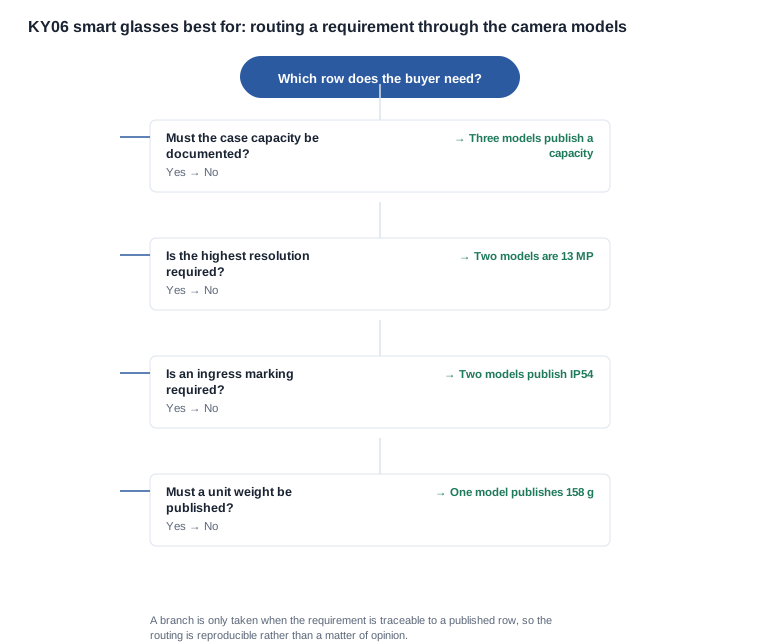
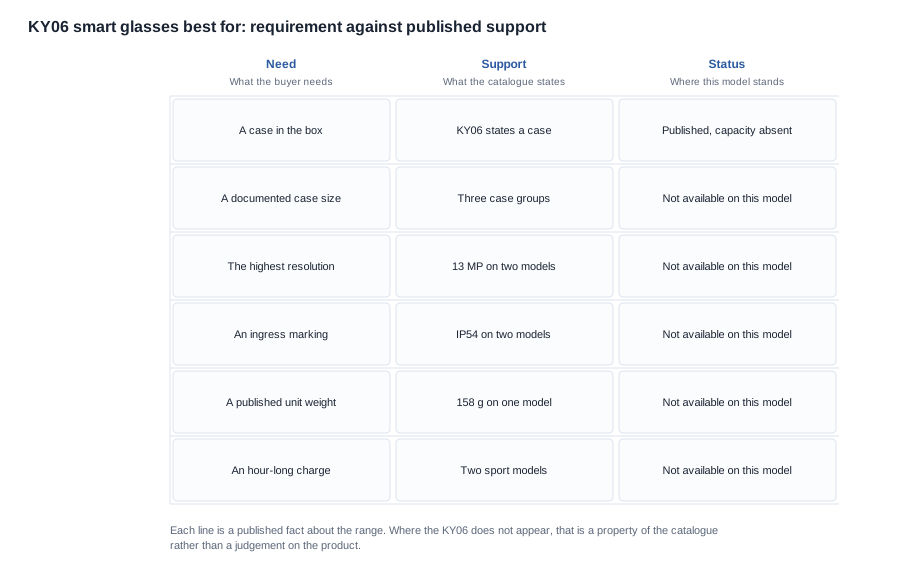
A business model that needs a documented case capacity. Two models publish a case without a capacity; the KY06 and the MT5. The models that publish one are the 1400 mAh group, the L2 Utral's two options, and the MT6's 1200 mAh folding case. If your unit economics, your retail tiering or your freight model depends on that number, this model is not the one to build the plan on.
A product that needs the highest published resolution. The KY06 is 8 MP, and the L1 Pro and the L2 Utral are 13 MP. Since the KY06's own sensor figures are not published either, the resolution difference cannot be shown to produce a better image on paper — it is a difference in the published tier and nothing more.
A product that needs an ingress marking. Only two models in the catalogue publish IP54: the V06 and the S7. The KY06 publishes no ingress row at all. The sport water resistance analysis covers what that marking means where it does apply, and the V06 comparison sets out the sport group in full.
A product that needs a published unit weight. One model in the catalogue publishes a weight — the MT6 at 158 g, which is the glasses body including the battery and the camera and excluding the foldable charging case. No camera model publishes a weight otherwise, and the MT6's figure belongs to a different cell, a different camera and a different case form, so it cannot be used as a proxy.
A fifth exclusion is not about the KY06 at all but about the family it belongs to: a product that needs a photochromic lens, a flexible temple or a published colour list. Those rows belong to the V03 Pro, which publishes photochromic lenses, flexible temples and three colour options. The KY06 publishes no feature rows at all.

The eleven rows still missing for this platform
A gap list is only useful if each item is tied to the decision it holds up. Here is the gap register for this model, in the order a buyer would normally close it.
- The charging case capacity — and whether a second capacity is available. It decides the packed weight, the freight class and the charging routine.
- The case's own charging method and recharge time. If the case is charged over a separate port, the customer needs two cables and there is a second routine to explain.
- The charging input the case and the frames accept, and whether they share one.
- The charge indicator behaviour for the frame and for the case. A charge time published as a ceiling has no published end point without it.
- Sensor model, field of view, video resolution and frame rate for the camera.
- Frame weight, temple length and lens dimensions. The 158 g figure belongs to the MT6.
- The runtime test condition and the charge-time starting state.
- Ingress protection. Not published for this model, so no durability claim is supportable.
- Certificate numbers, issuing bodies, validity periods and covered model schedules. No document in our material names the KY06, and the catalogue's export certification page is a company-level page whose content is images rather than text, with no CE, FCC or RoHS reference anywhere in the catalogue text and no per-model certification row.
- Storage capacity, file format and overwrite behaviour.
- Minimum order quantity, production lead time, unit price and warranty terms. None of these is published, and each is a quotation term rather than a catalogue row.
The KY06 limitations analysis sets out the full gap set with the decision each one blocks, the KY06 charging options analysis covers the accessory questions in detail, and the KY06 certification status covers the document side.
Four pitfalls to avoid while closing this list. The first is filling a gap from a neighbouring model, which is the specific error this platform invites because the MT5 publishes the same rows and the 290 mAh group publishes the same rows with a capacity attached. The second is treating a quoted certification as a certification. A certificate number is a record; an attachment is a claim, and only the number can be checked against the issuing body's register later. The third is accepting a unit weight without knowing whether it was measured with the cell fitted and the case excluded, because the 158 g figure on the MT6 is exactly that case and the mistake is easy to repeat across a comparison sheet. The fourth is letting the gap list become a to-do list rather than a purchase-order term — a row that exists only in correspondence is not a criterion you can enforce, and the entire purpose of closing eleven gaps is that they become enforceable.
The questions to ask the supplier should be sent as one list, in one message. Grouping them matters more than it sounds: a supplier who answers eleven questions in a single response is demonstrating that the answers exist on their side, while a supplier who answers two and goes quiet is telling you that the other nine are hard. Either way the response is evidence, and it arrives before the packaging artwork is approved rather than after the first consignment has shipped.
The boundary we draw around this model
The KY06 is a sensible mid-range camera platform for a buyer who has decided the case belongs in the box and does not want to carry the 290 mAh bill of materials, and we would rather present it that way than pretend it publishes more than it does. The case capacity gap is real, it is a single question, and a buyer who has the answer in hand can use this model confidently.
We will not fill the case capacity from a neighbouring model, which is the specific error this model invites. We will not present a wider runtime range as though it were a measured advantage over a point figure, because it is a different kind of disclosure rather than a better one. We will not present the sport positioning as a protection or a fit claim, and we will not present 8 MP as an image quality claim. The published KY06 specification list is the honest baseline, and the KY06 against CY05 platform comparison covers the platform decision that sits underneath all of this. The camera family sits on our AI camera glasses range page.
Six rows to close before the first order
- The charging case capacity, and the packed unit weight it implies.
- The sensor model, field of view, video format, frame rate and the storage arrangement.
- The endurance test condition behind the six-to-eight-hour range.
- The frame weight and dimensions, and the published colour list.
- The certification position for this model in each destination market.
- The commercial terms — minimum order quantity, lead time and warranty — which belong in the quotation.
What is negotiable and what is not. The commercial terms in item six are the negotiable part of this model, and they are negotiable because they are quotation terms rather than catalogue rows: the minimum order quantity, the production lead time, the payment milestones and the warranty period are all things a supplier can offer different structures on, and a buyer with a real forecast has something to offer in return. What is not negotiable is the specification itself. The cell capacity, the resolution tier and the case configuration are engineering decisions, and no commercial arrangement converts a 260 mAh cell into a 290 mAh one or adds an ingress marking that the design does not have. It is worth keeping that distinction clear before the negotiation starts, because the negotiation space in this model sits in the commercial terms and in the closure of the open rows, not in the published specifications.
Related reading
- How this model compares with the higher tier — L2 Utral against the KY06
- The compliance position for this platform — KY06 certification status
- How a camera product should be tested — camera imaging
Send the channel, the volume and the target market, and we will answer with the model, the published rows and the gaps, in that order.


