
Comparing the YKC02 against the V06 is easy to get wrong, because the two models sit in different sections of the catalogue and therefore answer different parts of the same question. A buyer who treats this as a simple face-off on specifications will end up comparing rows that were never meant to line up, and will end up quoting numbers the supplier has not published.
This guide is built from the published catalogue rows only. Every cell in the comparison tables below is either a published figure or an explicit "Not published" marker. Where the catalogue is silent, we will tell you it is silent, and we will tell you what to ask the supplier to close the gap. We do not fill gaps with estimates, typical values, or figures borrowed from a neighbouring model. That discipline is the whole point of the exercise: a comparison sheet that mixes published numbers with guesses is more dangerous than no comparison sheet at all, because it looks authoritative and travels well inside a brand organisation.
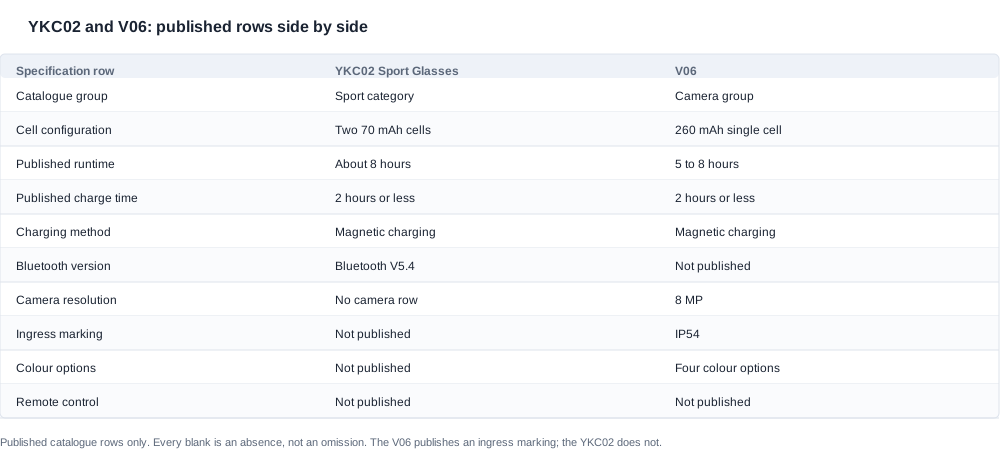
YKC02 and V06 published rows side by side
The table below reproduces only the rows that the catalogue actually carries for these two models. Read it as two columns of published facts plus one column of published absences, which is often the most useful column of all.
| Specification row | YKC02 Sport Glasses | V06 |
|---|---|---|
| Catalogue group | Sport category | Camera group |
| Catalogue product name | YKC02 Sport Glasses | AI Sport Photography Glasses |
| Cell configuration | Two 70 mAh cells | 260 mAh single cell |
| Published runtime | About 8 hours | 5 to 8 hours |
| Published charge time | 2 hours or less | 2 hours or less |
| Charging method | Magnetic charging | Magnetic charging |
| Bluetooth version | Bluetooth V5.4 | Not published |
| Camera resolution | No camera row published | 8 MP |
| Ingress marking | Not published | IP54 |
| Colour options | Not published | Four colour options |
| Remote control shutter | Not published | Not published |
| Sound descriptor | Surround sound | Not published |
| Weight, dimensions, lens material | Not published | Not published |
| Price, MOQ, lead time, warranty | Not published | Not published |
Several rows deserve an explicit note because they are the ones buyers most often misread.
The YKC02 publishes no camera row at all. That means the YKC02 is not a camera model in the catalogue's terms, and it must never be listed in an audio tier, a camera tier, or any enumeration of models with cameras. It belongs to the sport category, which contains exactly three models: the YKC02, the D17 and the ZH12. If a supplier quote lists the YKC02 as a camera model, the catalogue is not being quoted accurately, and the quotation should go back for clarification before a purchase order is raised. The same discipline applies in the other direction: the YKC02 must not be placed into the eight-model audio tier, which is a fixed list and does not include it. Every published row that does exist for this model is collected in the YKC02 specifications and features reference, which is the right place to confirm what is stated versus what is absent.
The V06 is a camera-group model with a sport-photography descriptor in its name. Its product name reads "AI Sport Photography Glasses", which is where most of the confusion originates. The word describing sport appears in the marketing name; the catalogue classification is camera group, one of eleven camera models. So the two models do not share a group, and a group-level comparison is not available. A buyer who assumes the V06 is a sport-category model because of its name will build a shortlist against the wrong reference set. The V06 specifications and features reference sets out the camera-group rows in full.
The V06 is one of only two models in the whole catalogue that publish an ingress marking. The other is the S7. That makes IP54 on the V06 a distinguishing published row rather than a common one. It also means the V06 cannot be marketed in a way that implies the range holds more IP-rated product than it does. If your channel strategy depends on a weather-resistance story, this is a genuine two-model pool, not a range-wide property. Our article on sport smart glasses water resistance options maps every published ingress marking across the catalogue, which is the reference to use when a claim has to be defended.
The Bluetooth version is published on the YKC02 and not published on the V06. This is a category fact, not a defect. Bluetooth version is published for 14 models in the catalogue; it is not published for the eleven camera models, nor for the A05, the A06, nor the bone conduction entry. The V06 is a camera model, so it falls inside that group. Reading this row the right way matters: the YKC02's V5.4 is a positive published fact, and the V06's blank is a publishing convention, not evidence of an older radio.
Runtime is published for both, but on different terms. The YKC02 publishes a single figure of about 8 hours. The V06 publishes a range of 5 to 8 hours. A range is not interchangeable with a point estimate, and any comparison sheet that flattens 5 to 8 hours down to a single number loses information a buyer needs at the quoting stage. If you write "8 hours" in a campaign brief for the V06, you are asserting the best case of a published range as if it were a guaranteed figure.
Both models share the same published charge ceiling of 2 hours or less, and both use magnetic charging. Charge time across the catalogue is at most 2 hours for 26 of the 28 models; only the D17 and the ZH12 publish an approximately one-hour figure. That places both models in the same charge-time band, which is a genuinely useful equality to carry into a comparison sheet. It also means charge time is not a differentiator for this pair, and a buyer who picked one of these two over the other purely on charging speed has made an error. The dedicated YKC02 versus V06 battery and charging comparison handles the charge-side detail in more depth, including what the magnetic charging arrangement means operationally for a channel partner.
Colour options are published on one side only. The V06 publishes four colour options. The YKC02 publishes no colour row. When a buyer builds a merchandising plan that depends on colour breadth, only one of these two models has a published answer.
Remote control shutter is published on neither model. Across the catalogue, a remote control shutter is published only on the D17 and the ZH12. Both the YKC02 and the V06 fall outside that set, so a programme that depends on a physical shutter button on the temple is not served by either of these two models.
One row deserves special attention because it is the one buyers misquote most often. The published runtime of the YKC02 is about 8 hours and the published runtime of the V06 is 5 to 8 hours. Those are not two versions of the same number, and they are not comparable without naming the assumption behind each one. We will keep them exactly as published in this guide, and we will ask the supplier to state the test profile behind each figure, because a runtime number without an assumption is a claim rather than a specification. If your channel plan assumes an all-day wear pattern for either model, that assumption has to be confirmed against a stated test profile before the number travels into any campaign material, shelf talker or channel partner deck. A figure that survives scrutiny internally is worth far more than one that only reads well in a comparison table, and the difference between the two is entirely down to how the row was recorded in the first place.
Catalogue groups and the YKC02 comparison
The most useful thing this guide can do is explain what a catalogue group actually controls, because it decides which comparisons are legitimate and which are invented.
The catalogue divides into twenty-eight models: eight audio models, three sport models, eleven camera models, three kids models, and three entries without a model number. A group is not a marketing tier with a feature list attached. It is a classification of what the product is principally for, and it is the axis that decides which rows the catalogue bothers to publish for a given model.
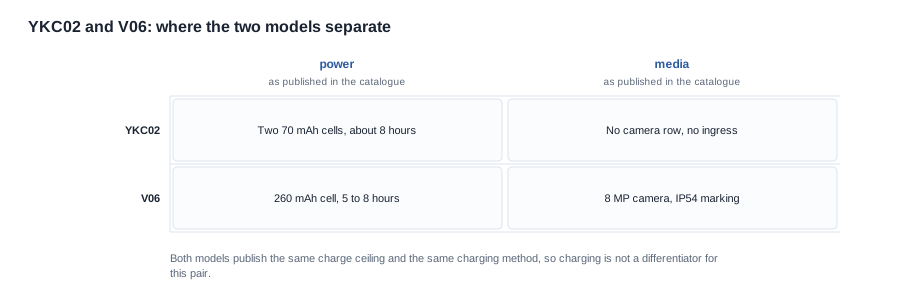
Three practical consequences follow for a buyer comparing the YKC02 and the V06.
First, the YKC02 sits in the sport category, which is a three-model group: the YKC02, the D17 and the ZH12. That is the comparison set the catalogue's own classification supports. A comparison that reaches outside this set is a cross-category comparison, which is legitimate, but it has to be labelled as such, because the rows published for the two sides will not match. Our guide to choosing between the sport-category models explains how that shortlist should be structured when programme fit, rather than a single specification row, is the deciding factor.
Second, the V06 sits in the camera group of eleven models. Its published rows are camera rows: 8 MP, an ingress marking, a single 260 mAh cell, and a 5 to 8 hour runtime window. A buyer looking at camera-facing requirements, such as stills resolution or weather exposure, is reading the V06's natural row set.
Third, and this is the point most often missed, the two models publish different row sets. The YKC02 publishes a Bluetooth version and a cell configuration of two cells. The V06 publishes a camera resolution and an ingress marking. Neither publishes weight, dimensions, lens material, colours, ingress, certification status, price, MOQ, lead time, sample policy or warranty for the YKC02, and neither publishes certification status, price, MOQ, lead time, sample policy or warranty for the V06 either.
Certification evidence is worth singling out because it comes up in almost every procurement conversation. Across the whole catalogue body, the certification strings a buyer would normally look for do not appear. We will not claim certification status for either model, and we will not imply it by omission of a contrary statement. Here we will state the rule plainly instead: certification is a document, not a descriptor, so it belongs in the supplier's response and in your file, not in a comparison cell that either model fills by default. Ask the supplier for certification evidence in writing as part of your quotation request, and treat the answer as a separate deliverable from the specification sheet, with its own document reference and its own scope.
The consequence for comparison work is straightforward: a legitimate YKC02 versus V06 comparison is short. It is a cell-configuration comparison, a runtime comparison, a charge comparison, a Bluetooth publication comparison, and an ingress-publication comparison. Anything beyond that is an exercise in asking questions, not in reading rows. Buyers who find this disappointing should note that the disappointment is itself useful information, because it tells you how much of the decision rests on information you have to actively obtain rather than information you have already read.
There is a second-order effect on how you brief internal stakeholders. When you bring a six-row comparison to a brand director who expected a two-column feature war, the room tends to assume the short list means the supplier was vague. It does not. It means the catalogue publishes different rows per category, and the YKC02's strength is that its published rows are clean and specific: two cells, about 8 hours, 2 hours or less, magnetic charging, Bluetooth V5.4. Those five facts are enough to open a pilot order conversation. Building the sheet with those facts at the top, and the open questions underneath, is what keeps the conversation moving.

The YKC02 rows you have to ask for
Here is the working list of unpublished rows for both models. We are keeping it in one place so that your request for quotation carries all of it at once, rather than discovering item by item over three rounds of email.
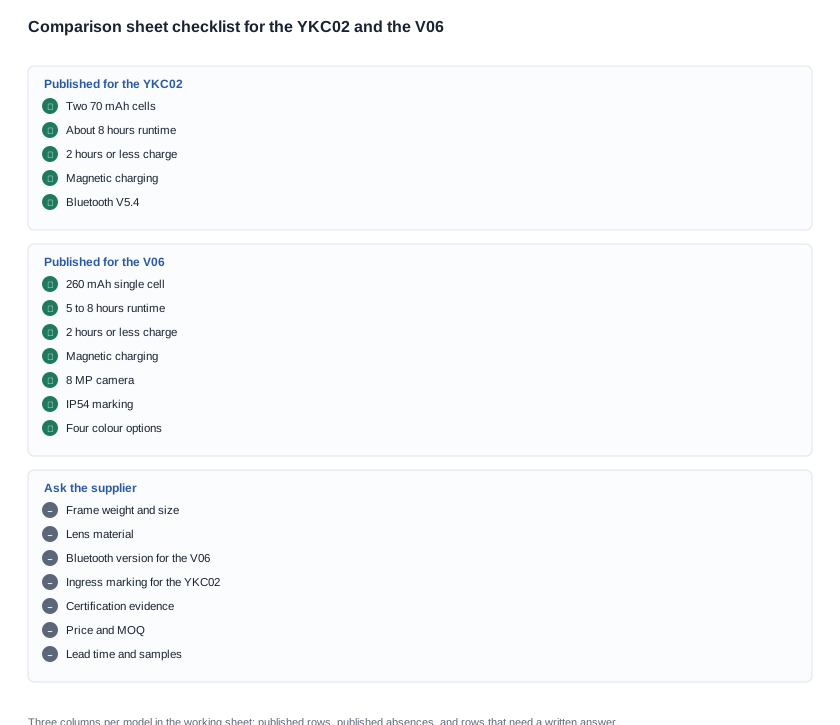
For the YKC02, the unpublished rows are: camera resolution, because there is no camera row published at all, so confirm whether the model is intended as a camera-free audio and control device; frame weight; frame dimensions; lens material; colour options; ingress or IP rating; certification status; price; MOQ; lead time; sample policy; and warranty terms.
For the V06, the unpublished rows are: Bluetooth version; frame weight; frame dimensions; lens material; exact colour option names and any colour-to-MOQ relationship; certification status; price; MOQ; lead time; sample policy; and warranty terms.
The single heaviest published fact on the YKC02 side is the cell configuration. Two 70 mAh cells is a different physical arrangement from the single 260 mAh cell in the V06, and it is the kind of row that changes what you can do with a magnetic charging dock in a retail programme. Ask how the two cells are arranged, whether they charge together or independently, and what dock or cable set ships with each configuration. If your merchandising includes a counter display that assumes a single charging cradle, the answer to that question determines whether the display design survives contact with the product.
The heaviest published fact on the V06 side is IP54. IP54 is a marking with a specific meaning, and its boundary condition matters for the buyer: it is not a submersion rating. Before you build any marketing or merchandising claim around it, work through the practical steps in how to test before ordering IP-rated smart glasses, which covers the difference between a marking and a claim, what a sample can and cannot tell you, and what to request as certification evidence from the supplier. If the campaign creative implies protection beyond the marking, you are creating a compliance exposure that has nothing to do with the product's actual quality.
The other pair worth asking about together is the runtime under load. Both models publish a runtime figure, but the YKC02 publishes a single point of about 8 hours while the V06 publishes 5 to 8 hours. Ask what the published figure assumes: continuous streaming, intermittent use, or a stated test profile. That single question resolves most of the ambiguity in a runtime comparison and saves a sample round-trip later. Our dedicated YKC02 battery life article covers the runtime assumptions in more depth.
We will also flag a point that catches out experienced buyers: the catalogue contains only one public weight figure across all twenty-eight models, and it belongs to a different product entirely, not to the YKC02 or the V06. Weight-based arguments for either of these two models are therefore unsupported by published data, and we will not supply a number to fill the cell. The same rule applies to frames, dimensions and lens material. If a channel partner asks for a weight to put on a shelf talker, the answer is that the supplier must provide it, and it should be recorded as a quotation line rather than a marketing assumption.
A useful discipline here is to write the question list as questions, not as blank fields. "What is the frame weight in grams?" is answerable in one line. "Weight" as a table heading is not. The catalogue experience we would expect a buyer to have after two rounds of supplier email is that specification questions phrased as blanks get partial answers, while specification questions phrased as sentences get complete ones.
A YKC02 comparison sheet you can order from
A comparison sheet is a procurement instrument, not a marketing artefact. It should be readable in one pass, it should make the absences visible, and it should end in a list of questions that a supplier can answer without interpreting your intent.
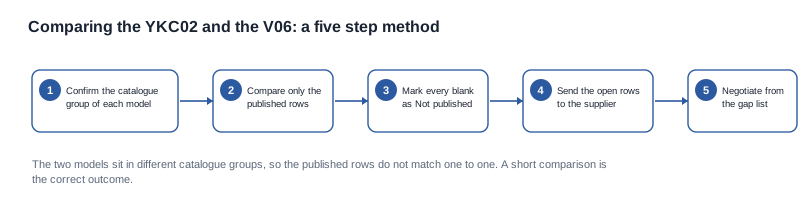
Follow these steps to build one that you can actually order against.
- Split the sheet into three columns per model: published specification rows, published absence rows, and rows that require a written answer from the supplier. Do not merge the last two, because "not published" and "not applicable" are different answers.
- Enter each published value with its exact form, including the source terms. Write "about 8 hours" rather than 8, write "2 hours or less" rather than 2, write "Bluetooth V5.4" rather than 5.4, and write "Two 70 mAh cells" rather than a compact cell string. A range stays a range.
- Mark every blank as "Not published" rather than leaving it empty. An empty cell reads as an oversight in a room full of buyers; an explicit marker reads as a decision.
- Add a group column, so the reader sees at a glance that the YKC02 is a sport-category model and the V06 is a camera-group model with a sport-photography descriptor in its name.
- Add a "what to ask the supplier" column on the right-hand side of each row, with the question phrased so it can be answered in a sentence.
- Add a note row for certification evidence, price, MOQ, lead time, incoterms, samples, tooling, packaging, spares and warranty, all of which sit outside the published specification rows on both models.
- Run a final pass to remove any ranking language. If the sheet contains a "better", a "winner" or a score, it has gone past what the published rows can support, and a value comparison that depends on unpublished data is not a comparison a buyer should put in front of a purchase order.
Two commercial points close this out. First, a comparison sheet built this way is short enough to send with a request for quotation, which means the supplier answers everything in one reply instead of drip-feeding, and the pilot order conversation starts from a shared document rather than from two separate brochures. Second, the sheet becomes the basis of your negotiation, because each row you cannot answer is a row you have not yet priced. When you are ready to negotiate trade-offs, MOQ, lead time, incoterms, samples, tooling, packaging, spares, warranty and certification evidence, you will want the gap list in front of you rather than a marketing sheet.
For buyers building a wider shortlist rather than a two-model comparison, the sport smart glasses buying guide covers how to structure a category-level evaluation, and the sport smart glasses model selection article covers how to choose on programme fit once the published rows are in front of you.
Finally, keep the sheet under version control once it starts circulating. Published rows change, and a stale sheet that still says "Not published" for a row the supplier has since confirmed is worse than no sheet, because it invites a buyer to ask a question that has already been answered. Mark each sheet with the date of the supplier response it was built from, and note which rows remain open when the first purchase order is raised. That way, the next shortlist for another channel starts from a record rather than from zero, and the trade-off conversation with the supplier moves on to MOQ, lead time and incoterms rather than restarting at specification basics.
There is one last habit worth building into the process, and it costs nothing. Before the sheet leaves your desk, read it once as if you were the supplier. Every "Not published" cell should be a cell you could answer from the catalogue in one sentence, and every question in the ask column should be answerable without a follow-up conversation. Sheets that arrive in a supplier inbox that way get answered in a single reply, which is what turns a comparison exercise into a quote. Sheets that arrive as a list of headings get answered in fragments, and a fragmented answer is where the gaps hide. We will keep returning to that gap list at every stage of the pilot order, because the rows that stay open at the purchase order stage are the rows that turn into a dispute at the delivery stage, and we will raise each open row by name rather than asking the supplier to confirm the specification as a whole.


