
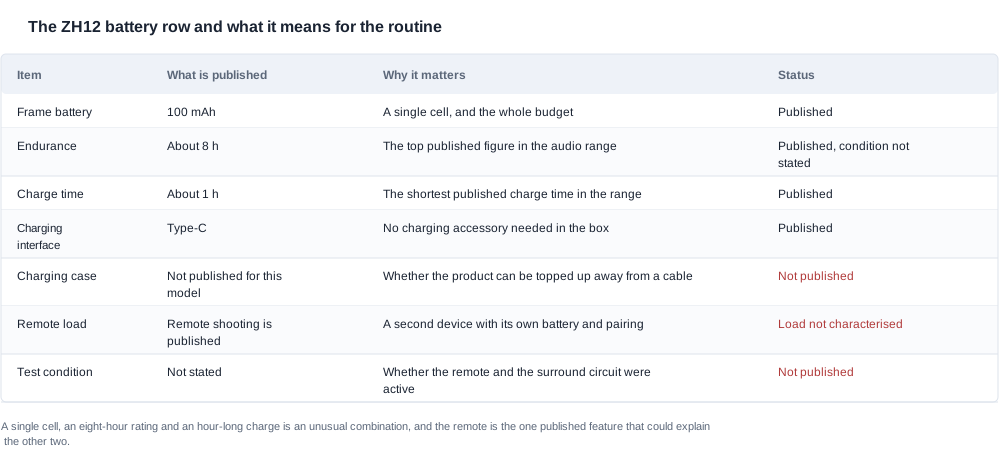
Most buyers arrive at the ZH12 with a simple question: how long will it run, and how fast does it recharge? The published answer is 100 mAh of internal battery, about eight hours of runtime, and roughly one hour of charge time over USB-C. That is a clean, attractive pair of numbers, and on paper it looks like the strongest runtime-and-recharge combination anywhere in the catalogue.
We will spend the rest of this article taking that pair of numbers apart, because a buyer who treats them as finished facts will make the wrong purchasing decision at least twice: once when they compare the ZH12 against other models on charge time, and once when they write an expectation into a purchase order that the supplier never agreed to. The good news is that the ZH12 is genuinely differentiated on charge time. The bad news is that "differentiated" and "safe to promise" are not the same thing.
What the ZH12 specification sheet actually says about battery life
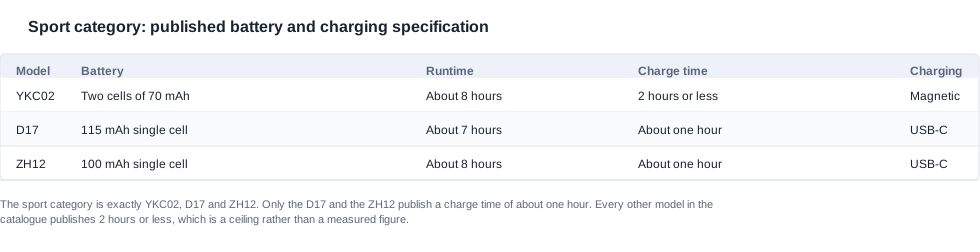
The ZH12 is published in the catalogue as a sport-category model, sitting alongside the YKC02 and the D17. The sport category is a small one, and its membership is worth understanding before you read any specification, because the three models in it are not variations of one design. The YKC02 carries two battery cells and uses magnetic charging. The D17 and the ZH12 each carry a single cell, use USB-C, and are the only two models in the whole catalogue that publish a one hour charge time.
There is a structural reason why the sport category is worth separating out in your own product catalogue, even if you only plan to stock one model from it. The catalogue as a whole covers 28 models across four groupings: eight audio models, three sport models, eleven camera models, three children's models, and three entries that carry no model number at all. The audio group and the camera group are large enough that a buyer can shop by feature set inside them. The sport group is three models deep, and those three models differ on cell architecture, charging method, charge time, and remote-shutter inclusion. Comparing the ZH12 to the audio group would tell you almost nothing useful, because you would be comparing a sport build against products with a different audio architecture and a different intended use pattern.
For the ZH12 itself, the published specification row gives you a short set of parameters that matter for a purchasing decision:
- Battery: 100 mAh, single cell
- Runtime: about 8 hours
- Charge time: about 1 hour
- Charging interface: USB-C
- Bluetooth: V5.4
- Headline features: remote control photo, stereo surround sound
Two of those deserve immediate comment, because they are the ones that most often get mis-stated in downstream listings.
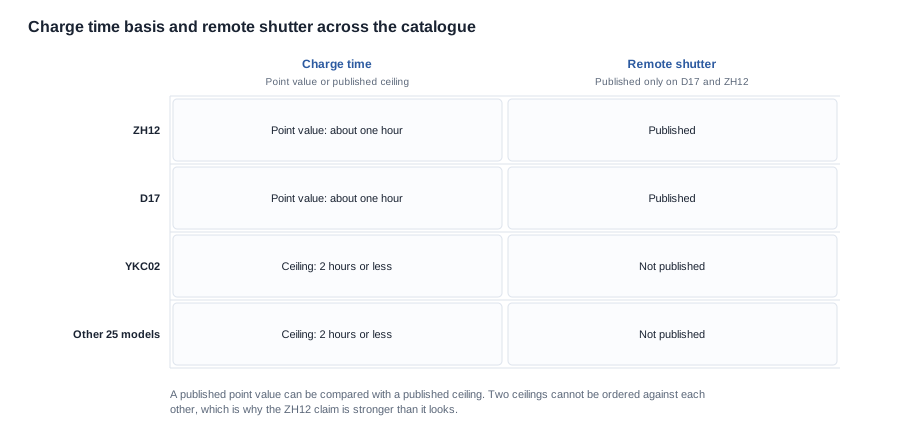
First, the remote control shutter. Across the entire catalogue, remote control photo is published on exactly two models: the D17 and the ZH12. If a supplier quotes you a "remote shutter" smart glasses model, it is one of those two. That is a useful filter when you are comparing seller pages, and it is also a useful filter in the reverse direction: if a competitor listing claims a remote shutter and quotes a two hour charge time, they are describing a different product, or they are describing this one and have copied the generic figure from the catalogue ceiling. Either way, the pair of claims is inconsistent and worth a direct question.
Second, the feature set. The ZH12 is a sport-category model with stereo surround sound and a remote shutter. It is not an audio-tier model in the sense that the eight audio models in the catalogue form, and it is not a camera-tier model. There is no camera resolution row published for the ZH12. It has no camera specification published at all, and we will not describe it as a camera product, because doing so creates a specification claim that the supplier has not made and that you would have to defend in a dispute with a customer who expects a camera to exist. The same reasoning applies to every other capability that does not appear in the published row. There is no capacitive-touch entry for this model and no translation entry either, because no such row exists anywhere in the catalogue for any model. A supplier who offers you a "touch control" version of the ZH12 is offering you a variant of the product, not a feature of the published one.
That is the entire published ZH12 specification. Notice what is not in that list: weight, dimensions, lens material, colour options, ingress protection rating, certification status, price, MOQ, lead time, sample policy, warranty, and any second cell capacity. All of those remain unpublished, and they are the subject of the second half of this article, and of the buyer checklist at ZH12 smart glasses buyer review checklist.
The practical method, then, is this: build your specification sheet for the ZH12 out of published rows only, and mark every other field as unpublished rather than as absent. The distinction matters more than it sounds. "Unpublished" is a question you can take to a supplier and get a written answer to. "Absent" suggests the feature does not exist, which is a different and much harder thing to establish. Most of the commercial damage in this category comes from buyers quietly converting the second into the first, and then discovering at inspection stage that the retailer packaging has promised something the unit cannot do.
Bluetooth V5.4 is published for 14 models in the catalogue and is not published for the eleven camera models, nor for the A05, the A06, or the bone conduction entry. The ZH12 is in the published group, so you can quote V5.4 on a product page. That is worth one sentence of copy, because a stated radio version is a signal to a technically informed buyer that the spec sheet was written from real data rather than assembled from generic copy.
If you want the full picture before you commit to a supplier conversation, the ZH12 smart glasses specifications and features reference collects the published row in one place, and the sport category overview at Sport Smart Glasses shows the ZH12 next to its two category siblings.
How the one hour charge time compares across the catalogue
Here is the comparison that matters. The catalogue contains 28 models. Of those, 26 publish a charge time of "2 hours or less" as an upper bound. Two models — the D17 and the ZH12 — publish about one hour.
We will be precise about what that means, because the distinction is the difference between a comparison you can defend and one you cannot. "2 hours or less" is a ceiling. A ceiling tells you that the model will not take longer than two hours to reach a usable charge state under the manufacturer's stated conditions. It does not tell you how long it actually takes, and it does not tell you that it takes longer than the ZH12. It only tells you it is not worse than two hours. The ZH12 publishes a figure of about one hour, which sits below that ceiling and is stated separately for exactly this model.
So when a competitor page says "fast charging, 2 hours", and your ZH12 page says "one hour charge time", you are not comparing two measurements. You are comparing a published point value against a published ceiling. That is still a strong commercial argument, and the ZH12 argument is stronger than it first appears, because the ZH12 figure is the only kind of figure the catalogue publishes for these two models at all. A buyer whose competing model only has a ceiling to work with cannot make the reverse claim, and that is a real asymmetry you can use in a retail listing, a sales conversation, and a price negotiation.
Across the charging method split in the catalogue, seventeen models use magnetic charging, seven use USB-C, and four do not publish a charging method at all (MT6 and L1 Pro, and CY05 and the CY03). The ZH12 is one of the seven USB-C models. Magnetic charging is the dominant convention in the catalogue, and it has a real operational advantage for a buyer: it is harder to lose a proprietary magnetic puck than a USB-C cable, and it tends to be more forgiving of a dirty or worn port. USB-C is more convenient for a traveller because one cable covers everything they already own, including the laptop they are working from. The trade-off is the ordinary one, and for a sport model sold to people who are already carrying a phone, either answer is defensible as long as you specify which one you mean and confirm the accessory is in the box.
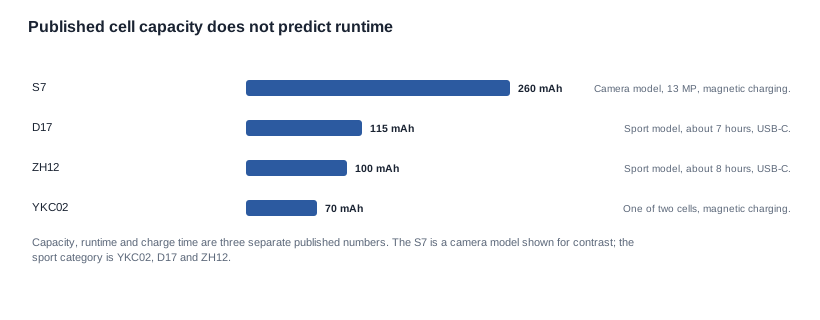
The cell capacity picture is less tidy, and it is the place where casual comparison goes wrong most often. The D17, sitting in the same sport category, carries a 115 mAh single cell against the ZH12's 100 mAh, and publishes about seven hours of runtime against the ZH12's about eight. A buyer looking at capacity alone would pick the D17. A buyer looking at runtime would pick the ZH12. Both numbers are published; the two cells simply do not scale the way the runtime figures would suggest, which is exactly what you would expect once you account for the two models having different speaker configurations and different power draw from their audio stages.
That is the point worth holding onto. Runtime is not capacity, capacity is not runtime, and charge time is neither. Three independent variables, one published number each, and no combination of them predicts the fourth. Any buyer who writes a "battery comparison" table that puts these numbers in one column and draws a conclusion from the ordering of that column has made an arithmetic error.
There is one more structural point about the sport category specifically, and it affects how you sequence a sourcing conversation. Because the ZH12 and the D17 are the only two models with a published sub-two-hour charge time, and because they also happen to be two of the three sport models, the sport category is effectively split by charge strategy. The YKC02, with its two 70 mAh cells and magnetic charging, publishes a charge time of two hours or less, so a buyer who wants magnetic charging in a sport program is looking at a different recharge experience from the one the ZH12 delivers. That trade-off is real: you are choosing between accessory convenience and turnaround speed, and for a channel where the same unit goes out to a customer on a short cycle, turnaround speed is often worth more.
The commercial consequence is that the ZH12's charge time is a leverage point in a negotiation, but only if you use it correctly. Claiming "one hour versus two" against a catalogue that mostly publishes a ceiling is a strong claim. Claiming "one hour versus a measured two" is a claim the other side can dismantle in a single message. Know which one you are making.
What the ZH12 runtime figure does not tell you
The "about 8 hours" runtime figure is the number you will put on a product page, and it is the number your customer will read. It is also the number with the least context attached to it anywhere in the published row, and we will not pretend otherwise.
What the figure does not tell you is under what load it was measured. A runtime published without a stated workload is a best case in the way that all battery claims are best cases. Continuous stereo playback at moderate volume is one workload. Intermittent use with the audio stage off for long stretches is another. Use with a remote shutter triggering short capture bursts is a third, and it is the one that most resembles actual sport use for this category. Each of those produces a different real-world number from the same hardware, and the catalogue does not state which one it measured.
What the figure also does not tell you is the degradation curve. A single-cell lithium battery does not deliver its rated capacity evenly across its discharge range, and a buyer who promises "8 hours" to a customer in a retail listing is making a flat-line promise that the chemistry will not honour in the last portion of the discharge. If the ZH12 sells as a sport model to people who will use it through a full session, the honest commercial framing is "about 8 hours" with a stated test condition attached in the marketing copy, not a bare number in a comparison table. The cost of getting this wrong is not abstract: a retail listing that claims a runtime the unit cannot deliver produces returns, and returns on a single-cell wearable are expensive to process because every returned unit needs inspection, a firmware check, and a decision on whether the cell is merely tired or actually faulty.
There is a related variable that sits entirely outside the published data and is worth raising early with any supplier who sells into markets with seasonal temperature swings. Cell behaviour changes with ambient temperature, and a sport model is the category most likely to be used outdoors. Ask whether the eight hour figure was measured at room temperature or at a range, and ask whether the one hour charge time holds at low ambient temperature. These are ordinary questions that any competent supplier should be able to answer, and the answer materially affects whether you sell this as an all-season unit or as a warm-weather unit with a seasonal marketing calendar.
The same discipline applies to the charge time. "About one hour" is a fast figure and it is exclusive to this model and the D17. But charge time is not charge throughput, and a buyer should be careful about the two ideas. The catalogue publishes a charge time. It does not publish a fast-charge protocol rating, a charge-current figure, a charger inclusion statement, or a charger wattage. Those four facts determine whether the buyer gets one hour with a low-wattage wall plug or one hour with the right cable and the right adapter, and none of them are published. A retail listing that says "one hour charging" without stating whether a charger is included creates a customer-service conversation that has nothing to do with the hardware.
One more operational point belongs here rather than in the appendix. The ZH12 is a single-cell model with no published second cell, and it is not one of the models with a published charging case. The catalogue publishes case capacity for only five models — the CY03 and CY05 at 1400 mAh, the L1 Pro at 1400 mAh, the L2 Utral at 900 and 1400 mAh, and the MT6 with a 1200 mAh folding case. The KY06 and the MT5 have a case with no published capacity. The V03 and V06, and S7 rows state no case, and the V03 Pro explicitly states that it has none. For a buyer planning a sport retail program where a case might be a giveaway item, the case situation for the ZH12 needs to be confirmed with the supplier rather than assumed from its neighbours, because its category siblings use different approaches.
That is a real packaging line item. A folding case for a single-cell model is a different tooling and a different bill of materials from a pouch, and if the case is not part of the published configuration, its inclusion belongs in the quotation as an explicit line, not as an assumption. On the same logic, the retail box contents are worth specifying in the purchase order: the unit, the charging cable, a printed guide in the languages your channel sells into, and whatever spare protection you have decided to include.
Finally, the runtime claim and the weight claim interact, and neither is published together. The catalogue publishes a weight for only one model in its entire 28-model range, so if your retail program is built around a low-weight promise, that promise currently has no catalogue basis for this model and needs a measured figure from the supplier, ideally with the packaging and the case excluded and that exclusion stated.
What to ask a supplier before ordering the ZH12 for battery life
Everything in the last three sections points at the same conclusion: the ZH12's published specification is strong and genuinely differentiated on charge time, and everything around it is either unpublished or stated as a ceiling. The commercial move is to convert the unpublished items into contractual ones before you sign, which means writing the questions down rather than letting them sit as implied expectations.
Here is the list we will put in front of a supplier. We will lead with the battery questions, because they are the ones that decide whether the retail claim you are planning survives contact with a customer.
- What test condition produces the eight hour runtime figure? Ask for the load: continuous audio at a stated volume, or mixed use. If the supplier will not state it, the figure cannot be used on a product page without qualification, and that is a commercial condition, not a technicality.
- What does the one hour charge time assume? Ask for the input current or the minimum adapter and cable rating required to achieve it. Then ask whether a bare device in a retail box with a standard USB-C cable reaches that figure, or only a unit on a bench with a specific adapter.
- What is the cell specification and the cycle life? Ask for the cell chemistry, the rated cycle count, and the retention behaviour at end of life. The catalogue publishes capacity but no cycle life, and cycle life is the number that decides whether the margin between the ZH12 and the D17 still exists at the far end of a warranty period.
- Is the cell user-replaceable, and what is the replacement procedure? Single-cell designs vary enormously here, from a bonded pack to a screw-in cell. This determines whether a returned unit is a repair or a write-off, which sets your spare parts and warranty cost.
- What is the MOQ per colour and per configuration, and what is the lead time from purchase order to shipment? Both are unpublished. A single-cell sport model with a one hour charge claim can look identical on two different supplier sheets while sitting behind completely different minimums.
- What is the sample policy and cost? Ask whether samples are free, refundable against a pilot order, or charged, and how long sample lead time is relative to production lead time. A pilot order is a different commitment from a sample, and the terms differ.
- What incoterms do you quote, and what tooling or packaging charges apply? Tooling is a real line item for a product with a distinct optical housing. Get it quoted as a number, and get the amortisation into the purchase order terms, not into a side conversation.
- What certification evidence can you provide for this configuration? Ask for the test reports that actually cover the ZH12 as a shipped configuration. Do not accept a generic statement that the factory holds certain approvals, and see OEM-ready platforms and certification coverage for why a model-level answer is the only acceptable one.
- What is the warranty period on the cell and on the unit, and what does the return process look like? Ask who pays the freight on a battery-fault return. This is where most smart-glasses programmes lose money quietly, and it belongs in the purchase order.
- What spares do you commit to, and for how long? Ask for the cell, the charging cable, and the case to be available for a defined period after the last production run. A model that is discontinued with no spare supply cannot be reactivated for a second sales season.
- What is the retail box configuration, and is the charging cable included? Ask for the exact box contents, the cable specification, the guide language count, and whether a charger is included. It is the cheapest way to prevent the most common post-shipment complaint.
- What is the quality control process for cells and the burn-in policy? Ask how incoming cells are screened, what the burn-in or soak test is for the audio stage, and what the acceptable rejection rate is at incoming inspection. For a program with a large volume, a small percentage point of incoming rejection is a real number in your landed cost.
- What volume break structure can you offer? Ask for the price at the MOQ tier, at a mid tier, and at a tier above it, and at what quantity each tier starts. This is the trade-off you negotiate with the other terms: a lower unit price against a higher MOQ, a longer lead time for a better price, or a shorter lead time for a shorter payment window. The point of a quotation is not one number, it is a ladder that shows you where the next tier begins.
- What payment terms, and what is the tooling ownership position? Ask whether tooling is refunded at a stated volume, and put the answer in the purchase order rather than in a quotation footnote.
For the wider commercial frame, the guide to comparing smart glasses battery life sets out the general method behind the runtime and charge-time distinctions used here, and the shipping and weight question is covered separately at smart glasses shipping weight, which matters for a sport retail program where the unit travels by parcel and the volumetric weight of the box is a shipping cost line, not a rounding error.
Finally, if you are still deciding whether the ZH12 is the right model at all, the use-case comparison at ZH12 smart glasses how it compares is the right next read, and ZH12 smart glasses best for works through the scenario fit. The sport category landing page at Sport Smart Glasses remains the anchor for anything you have not yet specified.
The short version: the one hour charge time is real, published, and exclusive to two models in the catalogue, which makes it the ZH12's strongest commercial argument. The eight hour runtime is a single unqualified figure that needs a test condition attached before you put it on a retail page. Everything else you need in order to order safely — capacity verification, cell spec, cycle life, MOQ, lead time, samples, incoterms, tooling, packaging, certification evidence, warranty, and spares — is unpublished and belongs in the purchase order as a written term. That is where the margin is protected.


