
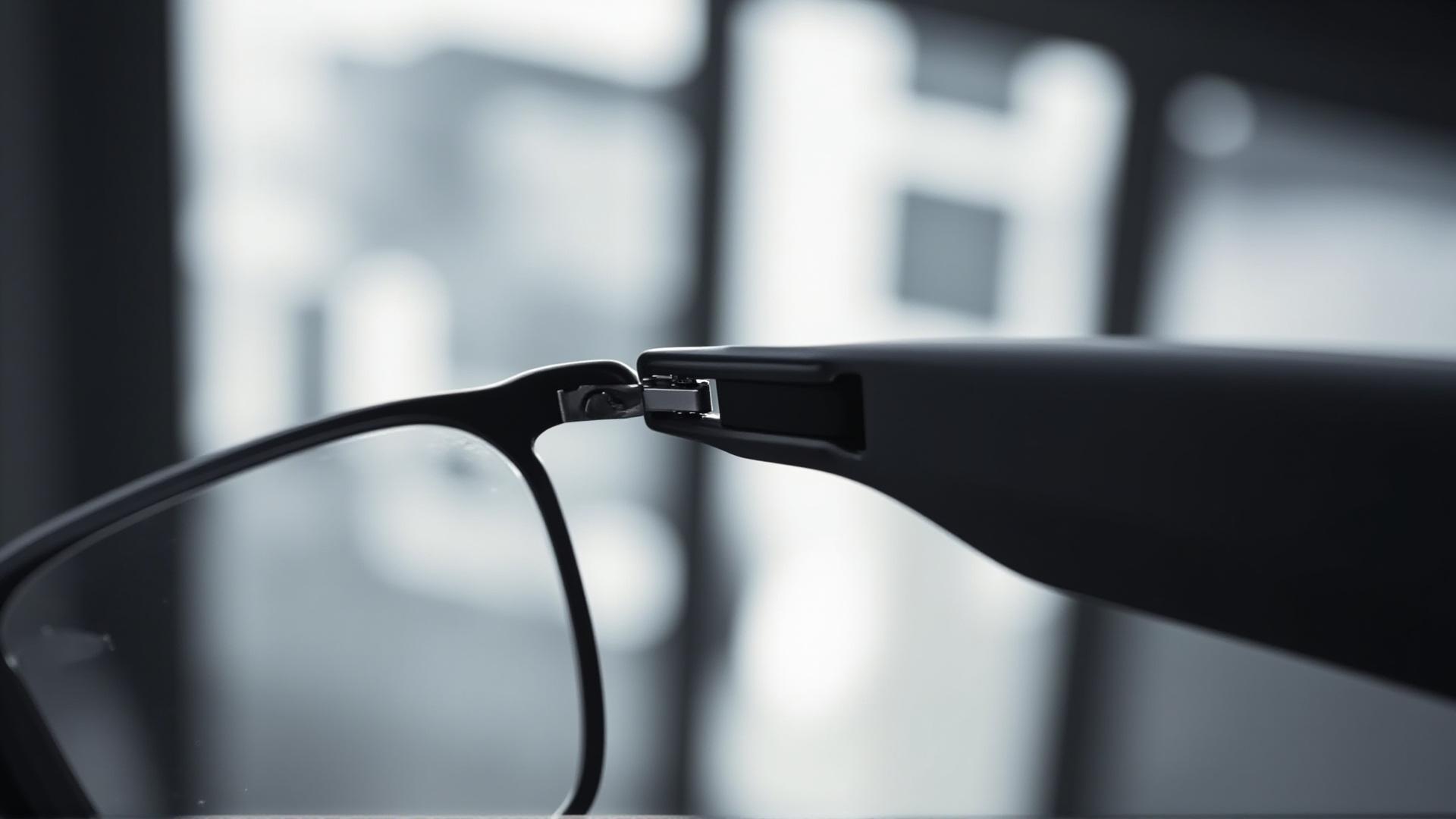
The review of a children's sensing product is mostly about behaviour rather than hardware, because behaviour is what a parent judges in the first week. Does the reminder fire at a useful moment or at an irritating one? Can the child dismiss it? Does the device work without the phone? And does the child still have it on at the end of day ten? None of those questions is answered by the published specification, and all of them are answerable on a sample — provided you wrote the pass conditions before the samples arrived.
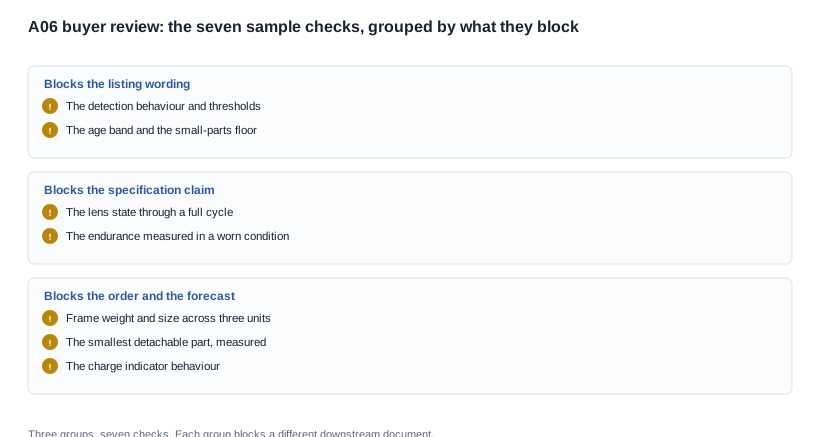
That last clause is the whole difference between a sample review and a demonstration. A buyer who arrives with a written pass condition for each check gets a finding. A buyer who arrives with the units in one hand and the specification in the other gets an impression, and an impression cannot be turned into an acceptance criterion, a warranty clause or a listing.
A06 buyer review: write the pass conditions before the samples arrive
The published rows for the A06 are complete enough to describe the product and too thin to accept it. A 40 mAh cell, a charge time of two hours or less, roughly twenty hours of rated use, magnetic charging, a lens-type electronic fogging element, posture and distance detection. Every one of those is a fact about the hardware, and none of them tells you what happens when a child puts the frame on.
That is why the sample stage carries the weight in this category, and why it needs the same discipline as any other acceptance step. Three rules, and they are worth stating before the checks themselves.
Write every pass condition before the units arrive. Not the question — the condition. "Ask whether the reminder is too frequent" is a question and it has no answer. "The interval between reminders is at least twenty minutes and configurable by the parent application" is a condition and it has one. A written condition can fail; a written question cannot.
Use units from the production batch, not a showroom sample. The interesting failures in this category are batch failures: a tolerance that has drifted, a supplier change that has not been notified, a firmware revision that behaves differently. A showroom unit will not show you any of them, and it is the batch unit that determines what your customers receive.
Record the batch code with every finding. A finding without a batch reference cannot be re-tested, cannot be escalated and cannot be used in a quality claim. It is also the cheapest possible habit to build into a review process, and the one most often skipped.
What the sample stage costs, and what it saves
The sample stage is a budget line before it is an engineering step, and it is worth sizing it before a procurement manager is asked to approve it. The inputs are the sample units themselves, the freight to move them, the labour to run the protocol, and the elapsed time of the people who have to be on site for the two checks that need a child. None of these are large compared with a production order, and all of them are far smaller than the cost of discovering the same problem after a launch.
The two checks that need a child are the expensive ones in time rather than in money, and they are the reason the protocol needs a written schedule. A school session, two children of the target age, and a reviewer who is prepared to observe rather than to demonstrate — that is a half-day arrangement, and it is the half-day that decides whether the product's central feature is usable or merely present.
The comparison that justifies the spend is straightforward. A defect found in the sample stage is a conversation with a supplier. The same defect found after the launch is a returns queue, a channel conversation, a packaging and artwork reprint, a listing correction and a complaint from a parent whose child was affected. In a children's product the reputational cost of the second path is the larger of the two, and it is the one that does not appear on the purchase order.

Seven checks and the pass condition for each
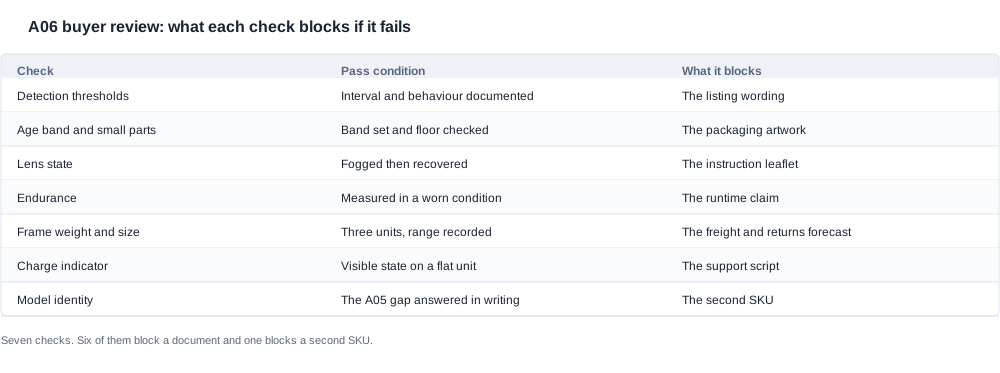
The seven checks below are grouped by what they block, because that is how they appear on a real programme: each one stops a specific downstream document from being finished. The group is the priority order, not a ranking of importance.
Why the checks are grouped by what they block
A checklist organised by department is easy to write and hard to use, because it tells a reviewer nothing about the order of work. A checklist organised by blocked document tells them the order, because the document waiting on the finding is the thing with a launch date attached to it.
The first group blocks the listing wording, because the detection behaviour and the age band determine what the product page is allowed to say. The second group blocks the specification claim, because a lens that does not recover and a runtime that does not hold both turn a published figure into a false statement. The third group blocks the order and the forecast, because the frame weight, the smallest detachable part and the charge indicator behaviour set the freight class, the age band floor and the returns rate.
That ordering also tells you what to do when the schedule is short. The first group cannot be skipped, because the listing wording is what the product is sold on and it is the part a compliance reviewer reads first. The third group is where a supplier's written answers can substitute for sample work, and in a first programme where the sample budget is one unit rather than three, that is the sensible trade to make.
The detection behaviour
The A06 publishes a lens-type electronic fogging element with posture detection and distance detection. It does not publish the thresholds, the intervals, the sensitivity, or what the child actually sees when a reminder fires.
The pass condition: the reminder interval is at least long enough not to become irritating over a school session, the interval is configurable, there is a daily limit, and the child can dismiss a reminder. Test it by running the product through a full day with the notification path active and logging the interval between every wake-up.
A reminder that fires every few minutes is switched off within a week, and a switched-off reminder is a product that no longer does what it was bought for. That is the failure mode this check exists to catch, and it is not visible in any specification. The posture monitoring analysis covers what the two detection functions are designed to observe.
The parent-side function
Our catalogue does not document an application for this model, whether one is required, what data the detection produces, whether any of it leaves the device, who operates the application, or where anything is stored. The app and firmware customisation capability for this tier is recorded as awaiting verification.
The pass condition: the frame functions without the phone in aeroplane mode, the user sees a clear state when the phone is absent, and the supplier states in writing what data is produced and where it goes. Test it by putting the phone in aeroplane mode for half a day and by asking the question directly, because a supplier who cannot answer the second question has told you the first one is unresolved.
This is the largest single gap in the model's documentation, and it decides whether the product is a simple device or an operating commitment. The privacy considerations piece sets out the questions in full, and the operating routine guide covers the handling side.
The lens state
The source for this category includes functional illustrations contrasting a clear lens against a fogged one, which tells you the lens state is visible to the user and therefore something a customer will inspect and photograph.
The pass condition: the lens fogs and then returns to clear within the supplier's stated response time, and a repeatable instruction exists for the user if it does not. Test it through several cycles rather than one, because the failure that matters is the one that happens on day four. A lens that stays fogged is an immediate return, and the instruction that prevents that has to exist in the pack rather than in a support script.
The endurance
About twenty hours of rated use on a 40 mAh cell, which is the highest published rated-use figure in our catalogue and the smallest cell in it. The figure describes a duty cycle rather than continuous operation, and the test condition is not published.
The pass condition: the product runs through a full day in the worn condition a child will experience, and the measured hours are recorded next to the condition that produced them. Measure it worn, with the phone nearby, and record the condition alongside the number. The A06 battery analysis covers why the published figure should not be read as continuous use.
The sizing and the weight
Frame weight, dimensions, temple length and the recommended age band are not published for any model in this category, and the A06 is a fixed frame with no published adjustment range.
The pass condition: the weight and the temple length are recorded from three units of the batch, and the sample stays on a child of the target age for a full session without adjustment. Weigh three units rather than one, and record the range. A fixed frame suits a narrow age band, and that band is a decision a buyer has to make rather than a figure to read from a sheet; the age suitability analysis covers the seven items that decide it.
The smallest detachable part
A detachable accessory sets a floor on the age band independently of everything else.
The pass condition: the smallest detachable part is identified, measured, and checked against the rules for the destination market, and the answer is written into the packaging brief. This is the check that most often moves the age band downwards after the artwork is finished, which is why it belongs in the sample stage rather than the design stage. The safety requirements piece sets out the item list.
The documents that name this model
Request the documents that name the A06 specifically, the applicable children's product standards for the destination market, the age grading, the small-parts assessment, and the technical file index.
The pass condition: every document in the set names the exact model designation you are ordering, and each reference carries an issuing body and an expiry date. The A06 certification status sets out the request list and the reading method.

The two checks only a child can settle
Six of the seven checks can be run by a technician. Two cannot, and those two are the ones that decide whether the product works in the field.
The reminder quality. A reminder that arrives at a genuinely useful moment and a reminder that arrives at an irritating one are the same product with different thresholds. The technician can record the interval; only observation of a real child can tell you whether the interval is calibrated to a posture and a viewing distance that a real child actually has. Run it with two children of the target age if the budget allows, because the useful signal is often that the first child adapts and the second does not, and that difference is invisible on a bench.
The sizing over a session. Five minutes on a child's face tells you whether the frame can be put on. It does not tell you whether it stays in place, whether it slides, or whether the child removes it and forgets about it. An hour, in the conditions the product will actually be used in, is the shortest session that produces a reliable answer, and it is the shortest session that produces a return-rate number you can put in a forecast.
Both of these are uncomfortable tests for a buyer, because they are slow and they are subjective. Both are also the tests whose failure is invisible to every other instrument in the process, including a complete compliance file and a correct specification sheet.


Recording the result so it survives the launch
A review that produces a document is worth more than a review that produces an opinion, and the document is not hard to build.
The review sheet has four columns and one attachment rule. The columns are the check, the pass condition, the observed result, and the batch code the result came from. The attachment rule is that every observation that is not a number gets a photograph or a short video, timestamped with the batch code — because the observations that fail are the ones that get disputed.
Three habits make the sheet worth having six months later. Record the negative results as carefully as the positive ones, since a check that was not run is indistinguishable from a check that failed in a re-run. Record who ran it and when, because a finding without a date expires when the firmware changes. And record the condition next to every measured number, because a measured figure without its condition is the same problem as the rated figure without its condition.
Turning the findings into terms you can negotiate
Once the review sheet exists, it has a commercial use that is separate from the launch decision, and a buyer who knows that gets more out of the sample spend.
The defect categories you observed become the basis for the warranty terms. A supplier who agrees a warranty against a specific list of defect categories — a lens that will not clear, a charging contact that will not seat, a temple that fails at the hinge — has accepted something measurable, and the claim you make later will be a reference to a list rather than an argument about intent. A warranty written against a generic return window protects nobody and settles nothing.
The measured weight and the measured size become the freight and returns basis. If you are quoted a carton or a pallet that does not match what the sample weighed, you have a documented discrepancy to raise, and a supplier who knows the sample weight is on file will be careful with the shipping figures.
The two checks that failed on the sample become the change-control trigger. If the reminder interval was outside what you will accept, then a change to the notification logic is a change you need to be told about in advance, and that is a clause rather than a courtesy.
None of these terms is unusual, and none of them is available without the sample work. What is unusual is arriving at them with a sheet that says what was observed, on which units, under which condition — which is what turns a warranty conversation from a disagreement into a negotiation.
The output of the sheet is then written into the purchase order. The measured weight becomes a tolerance. The measured endurance at your reminder interval becomes an acceptance criterion. The age band you validated becomes a specification on the packaging. The lens recovery behaviour becomes a quality clause. This is the step where a sample review turns into a contractual position, and it is the step most programmes stop short of.
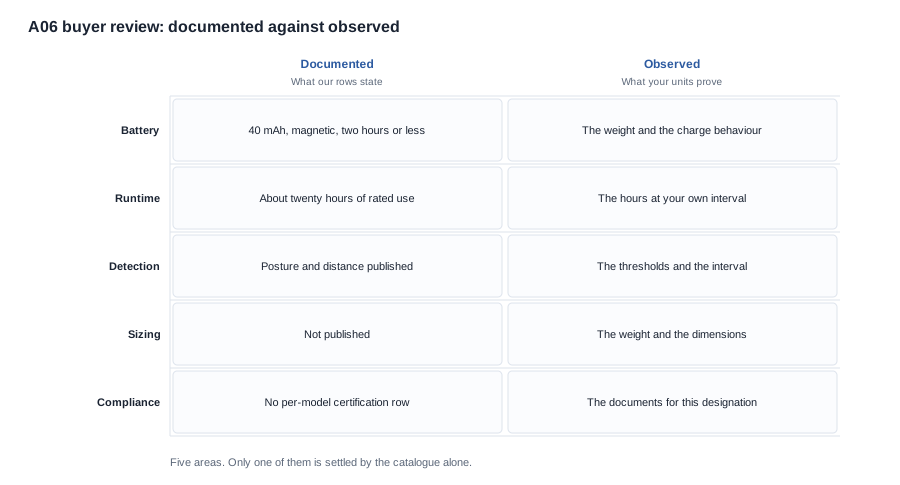
That matrix shows the division of labour the sheet is recording. The published rows settle the hardware description and leave the behaviour, the sizing and the compliance to the sample and the supplier. Only one of the five areas in it is closed by the catalogue alone, and a buyer who expected the catalogue to close more of them will be disappointed.
What a sample review cannot tell you
Three things a sample cannot establish, and it is worth naming them so that nobody treats a passing review as a complete acceptance.
Long-term drift. A week of samples tells you how the product behaves now. It does not tell you how the cell ages across a season, how the detection thresholds behave as a child grows, or whether the fogging element's cycle life holds up. The cycle life is not published, and the only way to approach it is to ask for the supplier's own figure with its failure criterion stated.
Certification scope. A document you were shown is evidence that a document exists. It is not a check of that document against your destination market, your model designation and the standard applied, and it is not a substitute for the children's product scope, which has to come from a test house.
Supply consistency. Three units from one batch tell you about one batch. They do not tell you whether the next batch is the same, and the mechanism for that question is change control rather than sampling: a written obligation to notify before a cell, a lens element, a radio module or a firmware baseline changes, with your right to refuse the change or to re-approve the sample.
There is a fourth item that is not a sample question at all, and it is the one that would have blocked this order. Our catalogue publishes identical rows for the A05 and the A06 and does not state what separates them. A sample review cannot establish a commercial difference, and the difference question has to be answered in writing before a second SKU is created.
The A06's behaviour has to be tested before it is sold, because the published specification describes the capability and not the experience, and in this category the experience is what a parent judges. We will not present the detection functions as producing any vision, health or prevention outcome, we will not present the twenty-hour figure as an active-use figure, and we will not state a certification status, an age band or a weight that our documentation does not support. The published A06 specification list is the honest baseline, and the who should buy the A06 analysis covers the model decision.
Send us the buyer, the age band and the markets, and we will tell you which of the seven checks we can answer from documentation and which have to be closed with a child using the sample.
Related reading
- The rows published for this model — A06 specifications and features
- The behaviour in detail — kids smart glasses posture monitoring
- The data question — kids smart glasses privacy considerations
Send us the buyer, the age band and the markets, and we will say which of the seven checks we can answer from documentation and which have to be closed with a child using the sample.


