
The A06 smart glasses earn their money when the product is a behaviour tool, and they stop earning it the moment the indication functions are not the point. The published configuration is a lens-type electronic atomiser with correct and incorrect posture-and-distance states and clear and fogged lens states, a 40 mAh cell, about twenty hours of rated endurance and magnetic charging — and the value calculation is not really about the hardware at all.
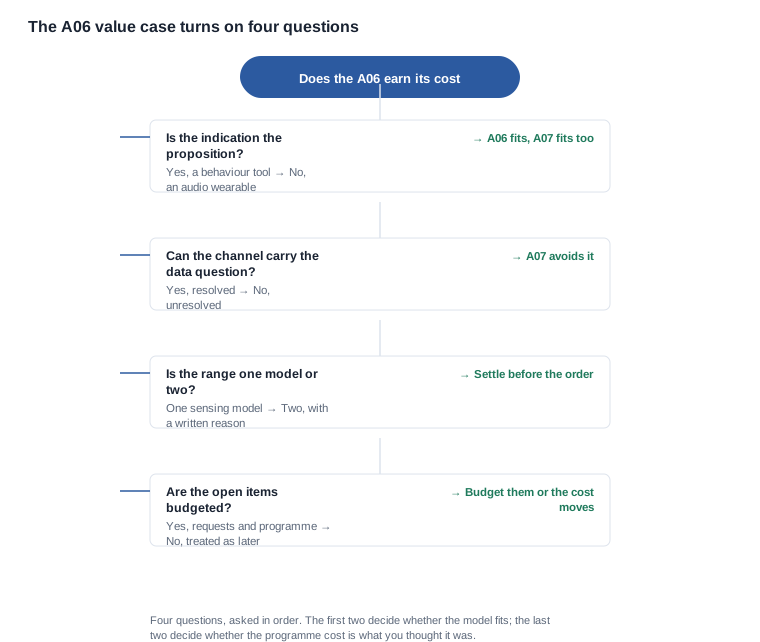
That is the argument of this article in one line: the value of this model is a function of what your channel is trying to sell, and of how much of the programme cost you have budgeted. A buyer who has decided to own a behaviour-tool proposition and has funded the compliance work gets a defensible case. A buyer who has priced the unit and discovered the rest of the programme afterwards does not.
A06 smart glasses value for money, as a total cost
The four branches, in the order they matter
Is the indication capability the proposition? If yes, the A06 is the product, because it and the A05 are the only models in this range that publish an atomiser with posture-and-distance states. A parent buying a behaviour tool, an optometry practice building a programme, or a school running a routine has no alternative here, and that is where the value sits.
Does the channel need a camera-free product? Both the A06 and the A07 qualify. Neither publishes a camera, which in a children's category removes the largest single source of parental and institutional concern. That is the same in each model, so it does not separate them.
Is the data question acceptable to this channel? This is where the value calculation actually happens. The A06 carries active indication, and the catalogue does not document what the indication produces, whether any of it leaves the device, who operates the application, where anything is stored, or what the parent-side function would show. A channel that can absorb that owns the answer; a channel that cannot should consider the A07, which raises none of it.
Is the brand building a range? Then the A05 versus A06 question has to be answered before anything else, because the two publish identical specifications. The A05 versus A06 specification comparison works through what the possible answers mean.
The order of those four is not arbitrary. The first decides whether the model fits. The second and third decide whether the channel can sell it. The fourth decides whether the range around it makes commercial sense. A buyer who works them in a different order ends up negotiating on price for a model that was never the right one.
Where the unit price misleads
The unit price is the smallest of the four cost lines in this programme, and it is the only one that gets quoted as a number. That asymmetry is where value arguments go wrong.
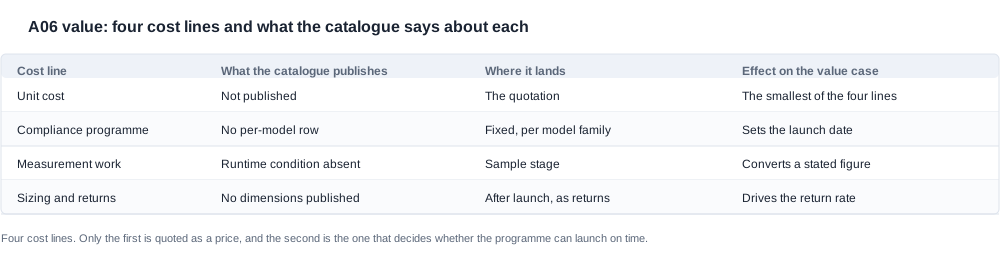
The compliance programme is the largest of the four, and it is not published for this family at all. A company-level export certification page is carried in the catalogue as images rather than text, and the catalogue text refers to no CE, FCC or RoHS. There is no per-model certification row anywhere. A value case built on a unit price, in a category where the compliance programme is the larger number, is a value case built on the wrong variable. The child product compliance framework is where that work is scoped.
The measurement work is the second, and it converts a stated figure into a usable one. The twenty-hour runtime is published without its test condition, so it can be quoted but not compared, and not written into an acceptance criterion. A sample, a protocol and your own readings turn it into a number you can defend — and they are cheap relative to everything else in the plan.
The sizing and returns exposure is the third, and it lands after launch. No frame weight, temple length or lens dimension is published for any model in this family, and a product worn by a growing head cannot be sized from a catalogue. That exposure arrives as returns, and returns are a channel cost rather than a factory cost, which is why it does not appear in a quotation and is still real.
Only the unit price is quoted. Which means a value comparison that uses quoted numbers alone is comparing the cheapest line and calling it the total.
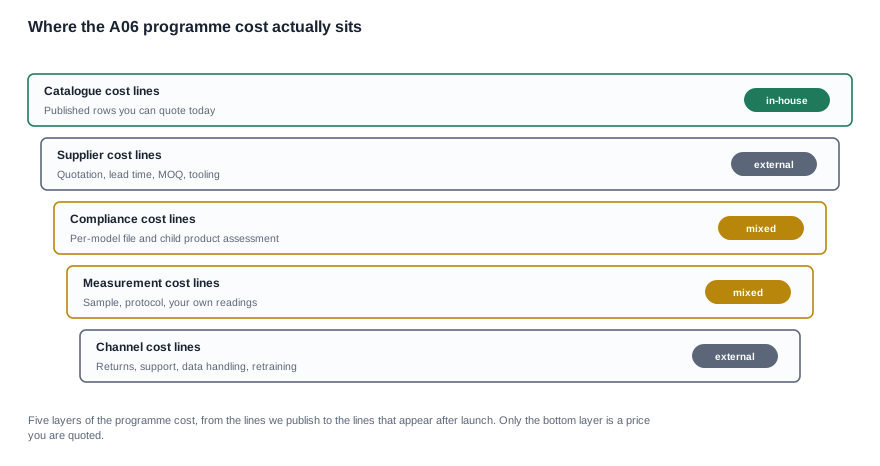
The five layers above are the honest structure of the programme cost, from the rows we publish down to the costs that only appear after the first shipment lands. The bottom layer is the one a supplier quotes. Everything above it is either a decision the buyer makes or a workstream the buyer funds, and both of those are more influenceable than the price.

What the value case can be built on
The endurance. About twenty hours on a 40 mAh cell, the longest published figure in the catalogue and the smallest cell in the kids range. That combination is the strongest single argument in the category, because it means the product survives a school day and an evening without a nightly charge.
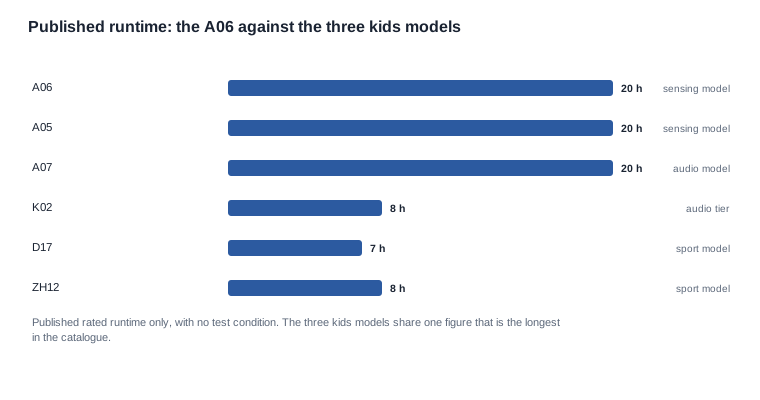
The runtime chart above puts the three kids models against two from elsewhere in the catalogue. The gap is large enough to matter commercially, and the important reading is not "twenty hours is a lot" but "twenty hours is a duty-cycle figure, and the duty cycle is the product's own design". The A06 and the A05 publish the same twenty hours on the same 40 mAh cell, and the A07 publishes the same twenty hours on a 70 mAh cell. A buyer who reads that as "small cell, long runtime, excellent engineering" has drawn a conclusion the published rows do not support, and a buyer who reads it as "small cell, long runtime, uncertain in real use" has drawn one they do. The correct reading is that the product is built for intermittent operation with long idle periods, which means a nightly charge and a dock, and which means the charge ceiling of two hours or less can absorb that pattern rather than being tight against it. The A06 battery life analysis covers this reading in more detail.
The capability. A function the A07 does not publish at all, which is what makes the two models different products rather than two options. The indication communicates through the lens, which means the output channel is visible to the person using it without a device in the hand and without a screen.
The simplicity of the hardware. No camera published, no radio version published, no remote, and no application named in the published description. A 40 mAh cell and a magnetic charger are a low-failure product, and a product with no published radio is a product with no published connection problem.
The operational cost that belongs in the price
The A06's real cost of ownership is not the unit, it is the questions that have to be answered before the product can be listed: the data position, the age band, the standards per market, and the instruction sheet. A brand that has not budgeted for those treats the hardware price as the whole cost and then discovers the real one late.
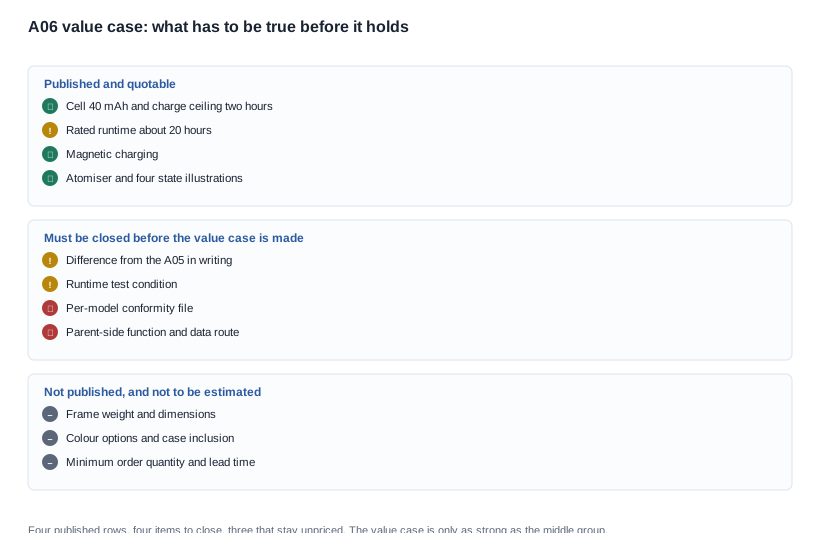
The checklist above separates the value case into what is published, what has to be closed before the case can be made, and what stays unpriced. Four rows are published and quotable. Four items have to be closed — the A05 difference in writing, the runtime test condition, the per-model conformity file, and the parent-side function with its data route. Three rows are not published and are not to be estimated: frame weight and dimensions, colour options and case inclusion, and minimum order quantity and lead time.
The middle group is where the value case is actually decided. A value argument that rests on the published group alone is arguing about the cheapest 40 per cent of the programme.

What the value case cannot be built on
The weight, the sizing and the age band. None of the three is published for any model in this category, and a fixed frame without a published size range is a product with a narrow band that nobody has stated. The age suitability analysis covers the items that decide it, and the A06 buyer review checklist covers the sample-stage tests.
The certification. The per-model conformity position is not published, and for a children's product that is the first gate rather than a formality. The A06 certification status sets out the request list.
Any health or vision claim. There is no published evidence that the indication functions produce any outcome for a child's eyes, and the category carries real regulatory risk. The value of the product is that it indicates; it is not that it prevents. We make no claim about myopia, vision development, vision protection or eye health, we hold no clinical data, no test protocol and no regulatory assessment for this category, and the boundary is set out in our medical boundary guidance.
A price gap against the A05. Since the two publish identical rows, a price gap between them cannot be justified on specification, and the A06 versus A05 price positioning analysis works through what a defensible gap would rest on instead.
A worked example: a channel deciding whether the case holds
This is a worked case rather than a client project. It shows how decisions fall.
Assume a regional brand planning a kids line for a parent-facing retail channel, with a launch window of roughly two quarters and a plan to sell one sensing model and one audio model.
The first question is whether the indication is the proposition. In a parent-facing retail channel, it is not — the parent is buying a screen-time and routine product, and the A06's advantage over the A07 is a feature the shopper may not notice. That is not a reason to drop the A06; it is a reason to price the indication as a differentiator rather than as the reason to buy, and to check that the listing can describe the fogging and posture states in a sentence.
The second question is the data position. A parent-facing channel with an app, an account and a data controller cannot take on an undocumented data route for a child's behaviour data without a legal view. That is a real gate, and it is the gate the A07 does not have. The brand's conclusion is to launch the A07 first and treat the A06 as a second line once the parent-side function is documented.
The third question is the range. The brand drops the A05 from consideration, which removes the duplicate-SKU problem and halves the number of per-model conformity files it has to fund.
The fourth question is the budget. With one sensing model and one audio model in the plan, the brand funds the two per-model files, a child-product assessment in its two required markets, a sample measurement programme, and a listing whose claims are limited to what the published rows support. The unit price was never the largest line, and it was the only line that was a number on day one.
The outcome is a smaller range than the buyer first considered, a later A06, and a costed programme — which is a better position than a larger range with an unfunded compliance line and a claim the listing cannot support.

Where the value case holds and where it does not
Value arguments for a model like this one are usually won on enthusiasm and lost on arithmetic. The honest test is whether the case still stands after the four unpriced lines are added, and it helps to know in advance which propositions survive that and which do not.
The case holds when the indication is the proposition. A buyer whose channel exists to sell a behaviour-monitoring product has something the A07 does not publish at all, and the capability is worth a premium because there is no substitute inside the range. The value argument in that case is capability plus endurance plus the absence of a camera, and the compliance programme is the price of doing that business at all.
The case holds when the compliance programme is already funded for the category. The A06 shares that programme with the A05, so a buyer running a children's product line already has the assessment cost in the plan. Against that background, the A06's incremental cost is small and the incremental capability is real.
The case does not hold when the product is bought as a general-purpose kids device. In that case the A07 publishes a radio version, a larger cell and the same runtime, and raises no data question at all. Choosing the A06 for that channel means paying for an indication the channel will not use.
The case does not hold while the range question is open. Two designations publishing identical rows mean two per-model files, two artwork sets and two inventory lines for one set of capabilities. Until the difference is documented, the second designation is a cost with no published benefit, and any value case that includes it is counting a capability twice.
And the case does not hold on the twenty-hour figure alone. It is a rated figure with no test condition, and a value case that rests on endurance is resting on the one published number in this category that cannot be compared with anything else.
What a buyer should ask us about the value
Three questions get a useful answer, and they are worth having in writing before a quotation is discussed.
What does the price include? Specifically: whether the quoted price covers the unit only, or the unit plus the accessories plus the documentation package, and whether the documentation package is scoped for one model designation or for the range. The answer changes the comparison against any other supplier, because most quotations in this category are unit-only and the difference has to be added back before a comparison means anything.
What is the actual timeline to first shipment? A buyer who is told a lead time without the compliance step is being told a production lead time, and the compliance step is the one that moves. The honest answer is a timeline with the assessment on it, and it is the only timeline that survives contact with a launch plan.
What would make this a repeat order? This is a sharper question than it sounds. It asks whether the product in the field generates the evidence that a second order needs — returns data, support contacts, whether the indication is used, whether the twenty-hour figure holds in real conditions. If the answer is "we cannot tell you yet", then the first order is also the measurement campaign, and it should be priced as one.
How to defend the number you do quote
Whichever of these applies, there is a defensible version of the case, and it looks like this.
Lead with the published capability, not the published endurance. The atomiser, the posture-and-distance states and the absence of a published camera are all quotable without qualification. The endurance figure is quotable but must be labelled, and a value conversation that starts with the labelled figure invites the question that ends it.
State the programme cost in the same sentence as the unit price. A buyer who hears "40 mAh, twenty hours, and here is the per-model compliance line" is having a different conversation from one who hears a unit price and later receives an assessment invoice. The second conversation is where value arguments go to die, because the first number was never the total.
Name what the price buys. With the A06, a defensible price buys the published indication set, the endurance headroom, the magnetic charging system and the compliance programme as scoped. A price that buys none of those is a price for a catalogue entry.
Keep the unpriced lines out of the argument entirely. Minimum order quantity, lead time, frame weight, age band, colour options and case inclusion are not published for this model, and they are not to be estimated. A value case that quietly assumes them is a case that will not survive its own finance review.
The value position we will put in writing
The A06 is a good product for a channel that has decided to own a behaviour tool, and a poor value proposition for a channel that wants a camera-free kids device, because the A07 delivers that with a larger cell and none of the operational weight. We will describe the published indication functions and we will not attach any health, vision or prevention claim to them. We will present the twenty hours as a rated figure rather than an active-use figure, and we will not state a conformity status, an age band or a weight that our documentation does not support. The published A06 specification list is the honest baseline, and the who should buy the A06 analysis covers the buyer suitability question.
Five things to close before the value case is made
- What differs between the A05 and the A06, in writing.
- Where the parent-side function runs, and whether the device works without it.
- Frame weight, dimensions and the recommended age band.
- The per-model conformity position for the A06 in each destination market.
- The endurance test condition behind the twenty-hour figure.
The kids buying guide covers the category decision, the privacy considerations piece covers the data work, and the export considerations covers the paperwork.
Related reading
- Who should buy it — who should buy A06 smart glasses
- The alternative product — A06 versus A07 use case fit
- The category call — kids smart glasses buying guide
Send us the buyer, the age band and the markets, and we will tell you whether the behaviour-tool proposition survives the operational cost in your channel.


