

Bluetooth audio glasses fail in a small number of predictable ways, and the order you check them in decides whether you diagnose the fault or destroy the evidence. The sequence below is built for a support team or a distributor handling returns, not for an engineer on a bench. It assumes the model is one of the published platforms in this range, where charging is magnetic on six models and Type-C on two, the radio is Bluetooth 5.3 or 5.4, and the frame carries a single cell or a pair of them.

Bluetooth audio glasses troubleshooting: the order decides the answer
Diagnosing a fault and destroying a fault appear identical from outside
A support agent who receives a unit that will not work has one decision in front of them, and it is made in the first ninety seconds: reset the device bond and re-associate, or establish the charge state first. The two actions appear equivalent, and one of them is irreversible.
Resetting the device bond clears the bonding state, and with it most of the diagnostic information the unit was carrying. A unit that arrived flat will, after a reset, resemble a unit whose radio is faulty — and a radio fault is a warranty replacement, while a flat unit is a customer service call. The two outcomes have completely different costs, and only one of them is real.
This is not a marginal effect. A large share of the "dead" units in this category are not dead; they are flat. The published cell configurations are 55mAh2 on the YK12 and the LC-105-2, and the LC-105-1 and the G07, 90mAh2 on the K01 and the K02, and a single 100mAh cell on the D11 and the D12. Cells of that size, in a unit that has spent weeks in a warehouse, in a customer's bag or in a drawer, will read as a unit that does not hold a charge. A magnetic contact that has been pressed against another magnet or against a steel shelf may also not have seated at all.
What the published rows let a support team assume, and what they do not
The five published rows for these models are useful in exactly one place: the bench. The charging method tells you whether the unit seats on a dock or takes a Type-C lead, and the Bluetooth version tells you which generation of radio the unit is expected to carry.
Everything else a support team normally reaches for is absent. There is no published reset procedure, so a distributor has no documented sequence and each agent will invent one. There is no published indicator behaviour, so nobody can say what a charging unit resembles and a working unit gets reported as faulty. There is no published acoustic reference — no driver size, no frequency response, no microphone count, no leakage figure — so a support agent has no definition of what normal sounds like. There is no ingress rating, no frame weight, no charging case capacity, no firmware policy and no warranty period. The microphone testing notes cover what to listen for; the rest has to be established by the buyer before the first shipment.
A support operation that runs without those numbers is not diagnosing faults. It is guessing, and then replacing.
Who this sequence is actually for
The order below is written for three readers, and they need it for different reasons.
A support team needs it because the order determines the accuracy of the diagnosis, and the diagnosis determines the cost of the return. A distributor needs it because the distributor is the party that decides whether a unit is a warranty claim or a customer fault, and that decision is defensible only if the evidence was captured in a fixed order. A channel buyer needs it because the returns rate is an input to the landed cost model, and a returns rate built on replaced-before-diagnosed returns is a number that is both too high and unattributable.
Why a reset destroys the evidence, and what the evidence is worth
The four facts a returned unit is carrying
A unit that comes back carries four pieces of state, and each one is destroyed by a different action.
The charge state is destroyed by a reset only indirectly, but it is destroyed by time and by the customer's own troubleshooting: a unit that was charged once by the customer and then left for three weeks is flat for reasons that have nothing to do with the fault being investigated. The bonding state is destroyed by a reset. The software state — the firmware and the app version on both the unit and the phone — is destroyed by an update, and the customer often updates without saying so. The environment is destroyed by the delay between the fault and the return, and it is the only one that is never recoverable after the first call.
The first call, and the four questions in it
A support team that spends two minutes on the first call avoids most of the diagnostic work later, because the customer's answers eliminate two of the six fault families before the unit is even opened.
What were you doing when it stopped working? This separates a fault during a call from a fault during playback, and it separates a fault from an interruption.
Does it charge at all? Not "does the light come on" — does the unit take a charge and hold it for a period. This one question eliminates the flat-battery family outright.
Which phone, and which system version? The most common cause in this category is on the phone side: a new handset, an operating system update, or a permissions change. A support team that assumes the fault is in the glasses will replace a working unit.
What changed in the last fortnight? New phone, new system update, new case, new charging cable, a long period of storage, a trip, a drop, heat, cold or moisture. Any one of these reframes the fault.
The does rain affect the speakers analysis covers the environmental factors in more detail, and the cold weather and battery notes handles the temperature case.
The order that keeps the facts
Establish the charge state, then clear the device from the phone's list and associate again, then test the audio path in isolation from the app, then check the interface, then record the environment, and only then escalate. Every step assumes the previous one passed, and a failure at any step tells you which family the fault is in before the unit reaches a bench.
The point is not that the sequence is clever. The point is that it is defensible in a claims conversation, because each step has a written pass condition and each step's result is recorded.
The six fault families a returned unit actually falls into
One: the charge path
Symptom: the unit does not charge, or it charges and dies within a day.
What it rules out: for the magnetically charging models — the LC-105-2 and the LC-105-1, the G07 and the K02, and the K01 and the YK12 — a mis-seated dock is the first thing to exclude, and the deliberate misalignment test is the cheapest way to exclude it. For the Type-C models — the D11 and the D12 — the port and the cable tolerance are the first things to exclude, because lint in a receptacle presents exactly like a dead unit and because a customer will use a cable that was not in the box.
What the published rows add: a charge time of two hours or less, which is a ceiling rather than a typical figure, and which comes without a starting state or a termination criterion. It is not a diagnostic aid. What is diagnostic is whether a flat unit recovers after a full charge, and that behaviour is not published for any of the eight models.
Two: association failures that are not radio failures
Symptom: the unit will not connect to a second device, or it connects and drops, or it is still attached to a phone the customer no longer has.
What it rules out: nothing yet, which is the problem. This symptom is the one most often misdiagnosed as a hardware fault, because it is identical to a failed radio.
The action: clear the device from the phone's list, power the unit down and up, and associate again with a known-good second device. The battery specification guidance covers the charge-state side of the same question.
Three: the audio path
Symptom: the unit associates, the indicator works, and there is no sound, or the sound is one-sided, or it crackles, or it cuts out when the frame moves.
What it rules out: the radio and the device bond, which means the fault is downstream of them and is a hardware fault rather than a configuration fault.
The action: test in isolation and compare against an approved unit rather than against an expectation. A unit with a cracked driver, a partially detached enclosure or a mis-seated amplifier will associate normally, will pass every published row, and will be returned by a customer within a week. There is no published acoustic reference, so the comparison has to be against a sample, not against a specification.
Four: the microphone and the call path
Symptom: playback is fine, and calls are poor.
What it rules out: the speaker path, which is why this family is often misrouted into the audio family above.
The action: test on a call, with a second person, in background noise rather than in a quiet room. Call quality in noise is the claim most likely to be tested by an end customer and least likely to be captured by a specification sheet, and no microphone specification is published for these models.
Five: mechanical faults, and the removable temple
Symptom: a hinge that plays, a temple that has moved, a dropped unit.
What it rules out: the electrical path, which is usually intact. A dropped unit that still associates and still plays may have a displaced microphone inside the frame, which is a fault that only the customer will report as "the call is bad".
The action: photograph the unit before anything else, and record how it was damaged. The G07 publishes an ultra-slim detachable temple, which creates a specific service question: is the temple user-replaceable, and is a replacement available at all? A detachable part with no replacement path is a channel cost rather than a channel asset, and it is a question worth asking before the first order rather than after the first break.
Six: environment and storage
Symptom: a unit that worked and then did not, with no obvious cause.
What it rules out: often nothing, and that is the point — this family exists because these units are small enough to be left in a car, small enough to be forgotten in a bag, and small enough for a protection circuit to trip and refuse to reset until the unit cools.
The action: establish the environmental history in the first call, because by the time the unit arrives it is unrecoverable.
The table above, and how to use it
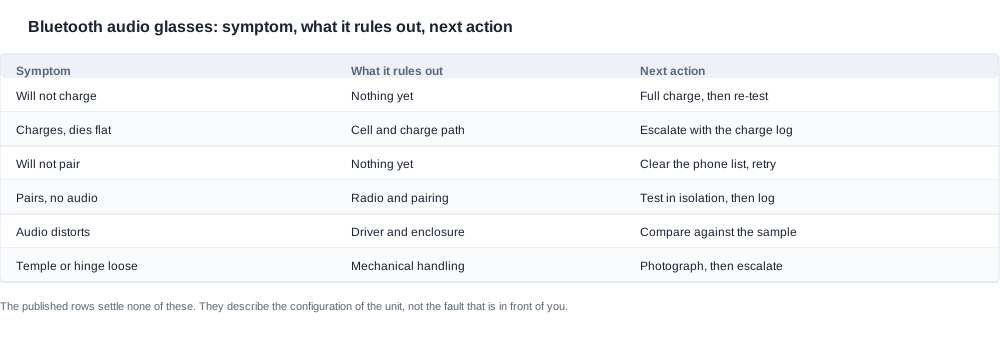
The published rows settle none of the symptoms in that table, because they describe the configuration of the unit rather than the fault in front of you. That is the point of writing the rules-out column: it is the fastest way to separate the six families before anyone opens a bench drawer, and the how-to-evaluate sequence in the table is the same sequence as the flow above, expressed per symptom.
Two of the entries are worth reading twice. "Will not charge" rules out nothing, and it is the entry most often skipped, because charging is the obvious first question and a unit that appears not to charge is usually a unit that appears not to charge because the dock is not seated. And "Charges, dies flat" is the entry that ends the argument: a unit that reaches a full charge and then dies has a cell or a charge-path problem, and it is the only symptom in the table that a published row can support, because the cell configuration and the charging method are the two facts the catalogue does hold.

Triage, escalation, and the record that ends the return
The escalation packet, and what happens without it
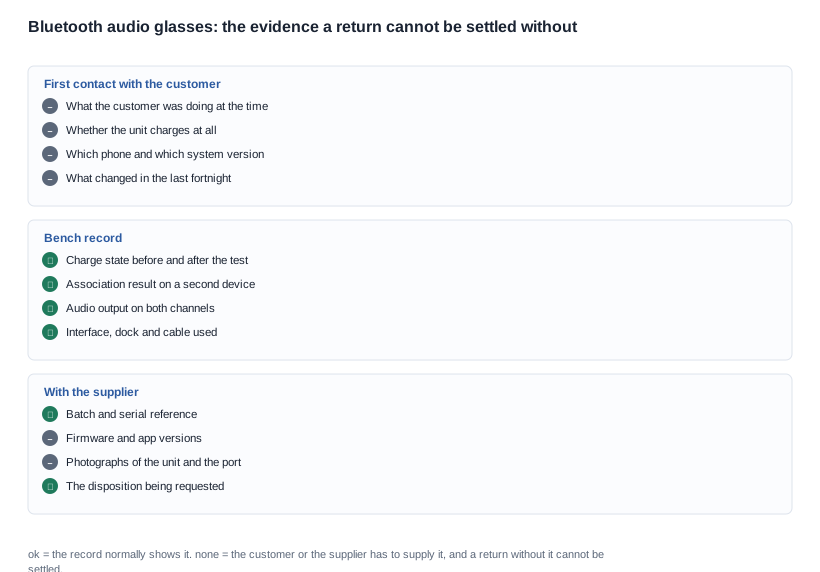
If the unit survives the full sequence, it is a warranty case, and the quality of the escalation determines how long it takes.
The packet contains: the model designation and the batch or serial reference; the charge state after the first step; the association behaviour at the second; the result of the isolation test at the third; the firmware and app versions at the fourth; the environment at the fifth; and the specific disposition being requested — replacement, repair, spare part, or refund.
A return without that information comes back as "no fault found". That single phrase is the most expensive sentence in the returns process, because the unit then goes back to the customer, the customer then complains again, and the second complaint is the one that escalates. The returns and warranty notes cover how to structure the agreement that backs this, and the returns packaging guide covers what to ask a customer to send back.
Three dispositions, each with a threshold
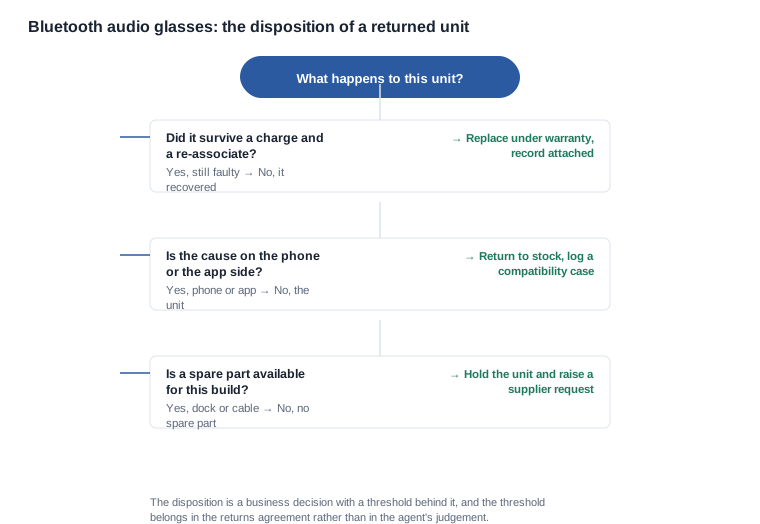
The disposition should be a rule with a number in it, not a judgement made at the bench.
Replace under warranty when the fault survives a full charge and a successful re-associate, and the cause is on the unit side of the evidence. The threshold is the rate at which replacements become acceptable; it is a commercial number and it belongs in the returns agreement.
Return to stock and close as a compatibility or usage case when the cause is on the phone, the app, the account or the customer's environment. The unit is not faulty and the cost of a replacement is a cost with no return on it. The action here is a compatibility case, and the useful output from it is a note for the listing rather than a unit back in the warehouse.
Hold the unit and raise a supplier request when a spare part is needed — a dock, a cable, a temple — and no spare is held. This disposition exists because it is the one that keeps the relationship intact: the unit is not scrapped, the customer is not left waiting, and the supplier receives a specific, photographable request.
What the supplier owes you, and what you owe it
A returns agreement that leaves the supplier's obligations undefined will be settled on their terms, by default, in the first difficult month. The supplier owes a diagnosis sheet, a turnaround commitment on a claim, a defined DOA rate threshold, a spare-parts arrangement for the accessories in the configuration, and a firmware policy that says how a unit in the field receives an update. The buyer owes an accurate claim rate, an evidence pack that meets the standard, and payment on the accepted claims. The OEM ready platform quality consistency piece covers the production-side equivalent, and the physical-side analysis of this family covers the balance and geometry complaints that account for a large share of the remainder.

What the returns agreement has to settle before the first shipment
Negotiating an RMA turnaround and a parts pool
The RMA turnaround, stated in days and measured from the moment the claim meets the evidence standard rather than from the moment the unit is received. The DOA rate threshold at which a batch-level investigation is triggered rather than a unit-level replacement. The spare-parts pool for docks, cables and, where the configuration includes one, a replacement temple. The diagnosis sheet, supplied per model, with the fields a claim cannot be settled without. The returns packaging kit, so that a unit arrives with the evidence intact rather than in whatever box the customer had. The split of the return shipping cost between the parties, which is a small number per unit and a large number in aggregate. The warranty period with a stated response time, and the process when the response time is missed. The firmware policy, including whether an update can reach a unit already in the field, and what the customer is told to do when it cannot.
The questions to ask before you order are therefore not technical questions at all. They are the terms above, asked as a checklist in one message, and the red flags in a returns agreement are structural rather than dramatic: no evidence standard, no threshold, no turnaround, and no named owner for the claim queue. Each one of those four is cheap to fix before the first shipment and expensive to fix afterwards, and each one of them is a source of total cost that appears nowhere in the unit price.
Four terms that stay fixed when a buyer negotiates: defect evidence, written acceptance, repeat inspection, statutory warranty
The classification of a defect follows the evidence, and a clause that overrides it will be unenforceable in practice. The acceptance criteria, once written into the agreement, are the acceptance criteria, and changing them mid-programme invalidates the history without improving the product. The cost of inspecting a returned unit that fails a second time follows from the process. And the statutory minimum warranty position in the destination market is a legal fact, not a commercial term.
The documents to request before the first shipment
The documented reset and re-associate sequence, per model. A return diagnosis sheet with the fields set out above. The acoustic and microphone reference for the model being sold, or a written statement that it does not exist. The firmware version policy and how updates reach an end customer. And the RMA route, the turnaround, and the evidence needed to claim a replacement.
A hypothetical return, worked through, and the limits of our documentation
A hypothetical return, worked through
The scenario below is invented for the sake of the reasoning: it is not a client project, and it shows the order of steps rather than an outcome.
Assume a distributor handling returns on a magnetically charging model from the 55mAh*2 group, with a customer reporting that the unit stopped working after a trip.
The first call establishes that the unit does not charge, that the customer's phone is new, and that the unit was in a suitcase for a fortnight. No reset has been performed.
The bench takes the unit, seats it on the dock and confirms the indicator. The unit is flat. It is given a full charge and re-tested. It works. The fault was two faults: a flat cell and a customer expectation that a unit stored for a fortnight is still charged.
The disposition is a return to stock with a closed note. The replacement cost that would have been spent is not spent, the customer gets a working unit back, and the compatibility note — a stored unit that reads as dead — is worth more than the unit, because it is the same fact that the monitoring and the listing copy need.
Now the second return, from a different customer, on a Type-C model, reporting that calls are poor.
The first call establishes that the unit charges, that the phone has not changed, and that the unit was dropped. The bench finds the unit associates, plays, and the customer reports the call as poor.
The isolation test passes. The environment step is where the answer is: a dropped unit can have a displaced microphone inside the frame while still associating and still playing. The disposition is a replacement under warranty, with photographs, and the claim goes to the supplier as a mechanical fault rather than as an audio fault.
The two returns appear the same in a spreadsheet. The difference between them is entirely in the order the facts were captured.
What we publish, and what we will not describe
Most returns in this category are not hardware failures, and a distributor who resets and replaces before checking the charge state will end up with a higher failure rate than the product has.
We will not publish a reset procedure for a model where the documentation does not contain one, and we will not describe an acoustic characteristic — driver size, frequency response, leak rate — that is not published. We will not publish a frame weight, an ingress rating or a charging case capacity for these models either, and a support team without those numbers is guessing at the physical side of a return.
We will say plainly where our own documentation is thin. The five electrical rows and the model designations are what we hold. The Bluetooth audio glasses buying guide covers what to request before the first order, and the range is on our Bluetooth audio glasses page.
Six items to request from your supplier
- A documented reset and re-associate sequence, per model.
- The charging indicator behaviour, per model, including what a flat frame resembles.
- A return diagnosis sheet, with the fields we have listed above.
- The acoustic and microphone reference for the model you sell.
- Firmware version policy and how updates reach an end customer.
- The RMA route, the turnaround and the evidence you need to claim a replacement.
Related reading
- The physical complaints in this category — the physical-side analysis
- Building the support agreement — after-sales support warranty policy
- The sample-stage checks that prevent returns — OEM ready platforms quality consistency
Send us the model, the volume and the markets you support, and we will tell you which of the six items we can supply and which have to come from the factory.


