

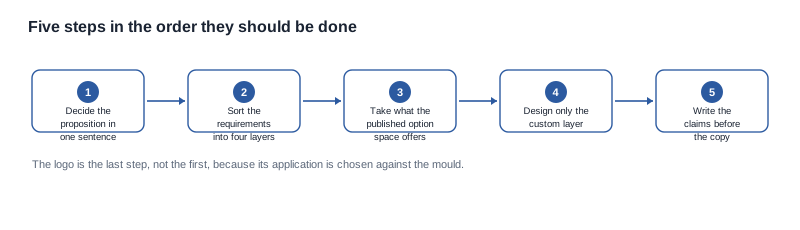
Starting a customisation programme in this category is mostly a question of sequence, and the sequence is not the one people expect. The customisations that feel like branding — a color, a logo, a finish — are the ones most likely to turn out to be structural, and the ones that feel structural — a new temple, a new app — are frequently just a configuration that has not been identified yet. Getting the customization options sorted in the first conversation is what separates a programme that can be quoted from a programme that can only be discussed.
The good news is that the published option space is wide and specific. Our catalogue records a separate set of customisation routes for each category rather than one list across the range, and it publishes the product rows that describe which configurations already exist: magnetic charging on seventeen of the models and Type-C on seven of them, with four models publishing neither; case capacities on five models at 900, 1200 and 1400 mAh; charge time as "2 hours or less" on twenty-six models, with only the D17 and the ZH12 publishing approximately one hour; camera resolution at 8 MP on eight models and 13 MP on three; an ingress rating on the V06 and the S7 only; a frame weight of 158 g on the MT6 alone; color options on two models; and a Bluetooth version on fourteen of the twenty-eight entries.
Most of what a first programme needs is already in there. The work is finding it.
Customization options and what to send in the first message
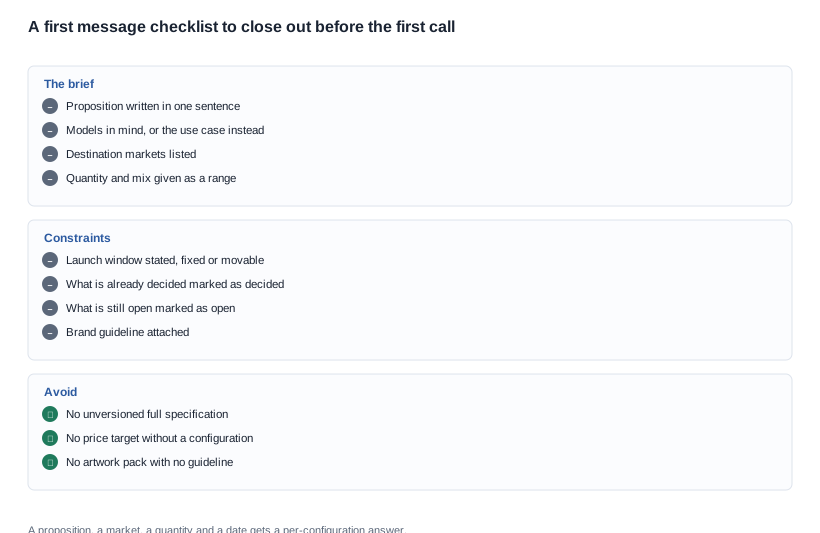
The first message decides the speed of everything that follows. A message with a proposition, a market, a quantity and a date gets a per-configuration answer. A message with a wish list gets a brochure.
Six things are worth sending, and none of them is a full specification:
- The proposition in one sentence. Not the features. What the product is for, who wears it, and why it should exist. This is the sentence that lets a supplier identify the closest published configuration, which is where most of the savings are.
- The models you have in mind, if you have any. If not, say what the product has to do — camera, audio, sport, kids — and let the range do the work.
- The destination markets. The documentation scope, the labelling and the language count follow from the markets, and they are a larger part of the work than the hardware.
- The quantity and the mix, even as a range. A first number and a later number are both useful, because the second one tells the supplier which configurations you are serious about.
- The launch window, and whether it is fixed. A fixed date and a movable date produce completely different programmes, and the supplier should know which one it is.
- What is already decided, and what is still open. Especially the things that are still open. A requirement that is described as "probably permanent" is a different question from one that is described as permanent, and it is worth saying which it is.
What not to send in the first message: a complete specification with no version on it, a price target without a configuration, or a file pack of artwork with no brand guideline attached. Each of these makes the first reply harder, because each one looks more final than it is.
A note for buyers who are not the brand owner. A distributor or a channel partner starting a customisation programme has a different first message, because the decision to customise is often not theirs to make. The useful message in that case describes the market, the customer and the price band the channel will bear, and asks what is possible inside those constraints. The answer is more useful than a catalogue, because the constraint is what determines the configuration, and the configuration is what determines the price.

Customization options: the published space you can start from
The published customisation list names the routes, but the useful starting point is the configuration rows, because those describe products that already exist and can be produced.
Start with the row that matches your proposition most closely and read across it:
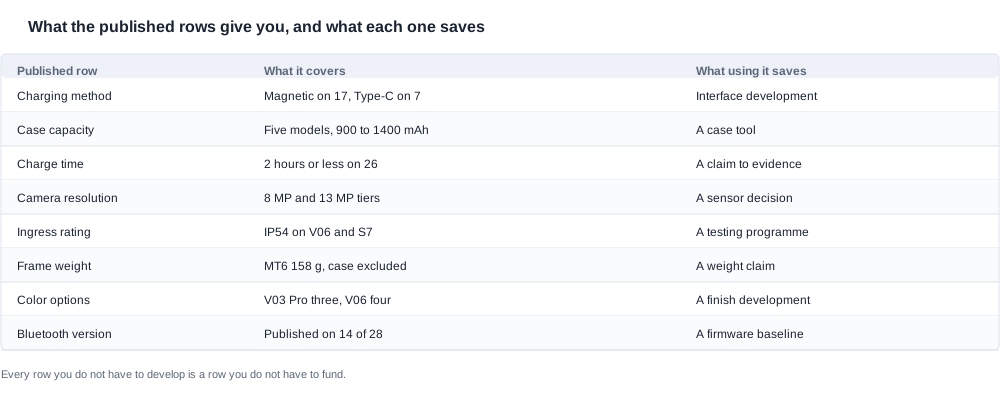
The point of this exercise is that every row you do not have to develop is a row you do not have to fund. A camera programme that accepts magnetic charging from the published set has no charging-interface development. A programme that accepts a model with a published case capacity has no case tool. A programme that accepts 8 MP rather than 13 MP has no sensor decision.
A practical way to use the published rows is to compare two candidate models side by side before choosing, rather than after. Two models can both satisfy the proposition on paper and differ sharply in how much of it is already published. One of them may publish its charging method, its case capacity, its charge time and its ingress rating, while the other publishes a charge time and nothing else — and the second one is the model whose manual, label and claim list have to be written rather than adapted. That comparison takes ten minutes with the catalogue open, and it is usually the highest-value ten minutes in the first week.
Some specifics worth knowing before you start counting what you would have to develop:
- Case presence is published per model, and it is uneven. Capacity is published for five models: the MT6 at 1200 mAh in a foldable case, the L2 Utral at 900 or 1400 mAh, and the L1 Pro and the CY05, and the CY03 — each at 1400 mAh. A case exists for the KY06 and the MT5, with no capacity published for either. No case row appears for the S7 and the V03 Pro, and the V06 and the V03 is published as having no case.
- Charging method is published for twenty-one of the twenty-five named models. The MT6, the CY05 and the CY03, and the L1 Pro publish neither magnetic nor Type-C, which makes them the four models whose charging story needs an answer before a manual can be written.
- Ingress is published for two models. If a programme needs a published ingress rating, the V06 and the S7 are the anchors; anything else is a testing conversation.
- Weight is published for one model. A lightness proposition has almost nothing behind it unless the product is the MT6.
- Surround audio is published for the D11, with the D17 publishing Surround Sound and the ZH12 publishing 立体环绕音.
- The catalogue has no capacitive-touch row and no translation row. Both are development items, not features to claim.
The customization options overview sets out the full structure, and what can be customised works through the boundary between configuration and development. The point of both is the same: the boundary is knowable before the first quotation, and knowing it is the cheapest work in the programme.
Customization options and the decisions that have to be fixed early
Six decisions are expensive to reverse. None of them belongs to the factory, and all of them belong to the first two conversations.
The model and the configuration, at part level. Documents, packing lists and line setup all work at part level, and a programme that is specified as model names has to be translated into parts at the first production meeting. Decide the part-level configuration once.
The destination markets. Documents, labels, languages and the conformity scope all follow. A market added in month three is a document set, a print run and a lead time.
The quantity and the mix. The setup cost per configuration is what the unit price amortises against, so the mix decides the price. A first order that is one model and one colour is a different commercial conversation from a first order that is four models and six colours.
The date, and what is fixed. The tooling path, the print slot and the approval cycles are all planned around it. A fixed date and a movable date produce different programmes.
The permanence of the identity. A logo that will not change can be carried by the mould; a logo that might change should not be. This is the decision that determines whether a branding programme also becomes a tooling programme, and the tooling requirements page is where the consequences are set out.
The level of software involvement. A skin, a white-label build, a custom application or none of them — four levels with four different maintenance tails. The app branding article sets out what each one commits you to, and the development cost is the smallest part of what it commits you to. The NRE and tooling discussion covers the cost side of the same decisions.
And one decision that sits alongside all six: who owns the artefacts. The design, the tooling, the software and the data are four different assets with four different answers. The IP ownership discussion sets out how they are usually separated, and it is a conversation to have before the work rather than after it.
Two of these six deserve a note, because they are the ones that decide the shape of the programme rather than its details.
The model and configuration decision is also the decision about what you are giving up. Every requirement that is not on the selected configuration is not a line item in the budget; it is a decision to develop something. Buyers often arrive expecting a requirement list to be priced line by line, and they are right to expect that — but the price of a line is not the same as the effect of a line on the schedule, and the second is usually larger. A configuration with no published charging method, for instance, is not a line item; it is a set of questions about a manual, a label and a charging story.
The date decision is a decision about which requirements are allowed to exist. A fixed date with an open scope is the combination that produces the programmes nobody can deliver. If the date is fixed, the scope has to be a function of it, and the way to express that is to fix the date first and then ask which requirements fit inside it. The reverse order — fix the scope and then hope for the date — is how programmes end up with a launch in week nine and a golden sample in week fourteen. The lead time article sets out how each requirement type moves the date, which is the information a scope-versus-date decision needs.

Customization options and the paperwork that has to exist before a sample
A sample without a specification behind it produces feedback, not a decision. Six documents should exist before the first sample is built, and they are cheap to produce:
- The requirement list, sorted by layer, with every line marked as an existing configuration or a development. The customization options checklist is the form for this, and the sorting method is described in the overview.
- The brand guideline, or at least the artwork rules: the logo files, the minimum sizes, the clear space, the colour definitions and the placement rules.
- The market list, with the language count per market and the documents each market needs.
- The claim list. What the product will be said to do, and what evidence supports each statement. This is the document that protects you, and it should be written from the published rows: the ingress rating exists for the V06 and the S7, the weight exists for the MT6, the charge-time figure exists for twenty-six models, the runtime figure has no published test condition, and the catalogue carries no per-model certification row and names no certification scheme in its body. A claim without a row behind it is a claim you cannot defend.
- The draft acceptance criteria, even at draft stage: what the sample has to demonstrate and what it has to be measured against.
- The ownership note, recording who owns the artwork, the design files, the tooling and the software, and who holds the confidential information. A confidentiality agreement is easier to sign before the files move than after.

The sequence above is short on purpose. Every document in it exists to answer one question before the next stage starts, and every one of them is a document rather than a meeting, which means it can be reviewed asynchronously and does not consume anyone's calendar.
One discipline to add to that list, because it is the cheapest habit in the whole programme: version every document, including the requirement list. A requirement list without a version has no approval and no freeze, which means every comment in the first review cycle silently becomes a change, and every change has to be argued about again at the sample. A dated version with a named approver turns a discussion into a state, and it costs nothing to set up.
A second habit is worth one line: keep a decisions log separate from the requirement list. The requirement list says what the product is; the decisions log says why each contested point was settled the way it was, who settled it and when. When a sample comes back and someone asks why the charging method was left open, the answer takes thirty seconds instead of an afternoon.

Customization options and the questions that make a first call useful
If you get one call, these are the questions that make it count:
- Which model and configuration in the published range comes closest to our proposition?
- Which of our requirements are existing configurations, and which are development items?
- What is the smallest configuration we could launch with, and what does it leave out?
- Which of our requirements need new tooling, and what does the tooling decision involve?
- What would the development and NRE position be for the custom layer?
- What are the levels of app involvement, and what does each one commit us to after launch?
- Which documentation would we receive per model and per market, and from whom?
- What are the sample sequence, the sample cost and the sample lead time?
- What would the unit price, minimum order quantity and lead time be per configuration?
- What would the first order need to contain, and what would the second order inherit?
Questions 3 and 10 are the two that most often change a programme. The first asks whether the scope can be reduced to something that already exists, which is the single most effective cost control in this category. The second asks what the programme looks like when it repeats, because a launch that is cheaper per unit than its follow-on order is a launch that was badly structured.
Customization options and what a first response should contain
A useful first response is specific, and it is specific in a way that makes the next step obvious. It should contain:
- The configuration identification. Which published model and configuration sit closest to the proposition, with the published rows that apply to it: how the device charges, whether a case is listed, the charge time, the resolution, the ingress rating, the weight, the colour options and the Bluetooth version.
- The gaps, as questions. Everything the published catalogue does not cover for that model becomes a question with an owner, rather than a silence.
- The layer assignment for each requirement, and the development items flagged separately from the configuration items.
- The tooling and NRE position, stated as a position rather than as a number, with what the number would depend on.
- The sample plan, with the number of samples, the sequence, the cost and the lead time.
- The commercial terms that can be quoted, and an explicit statement of which are not yet quotable and why.
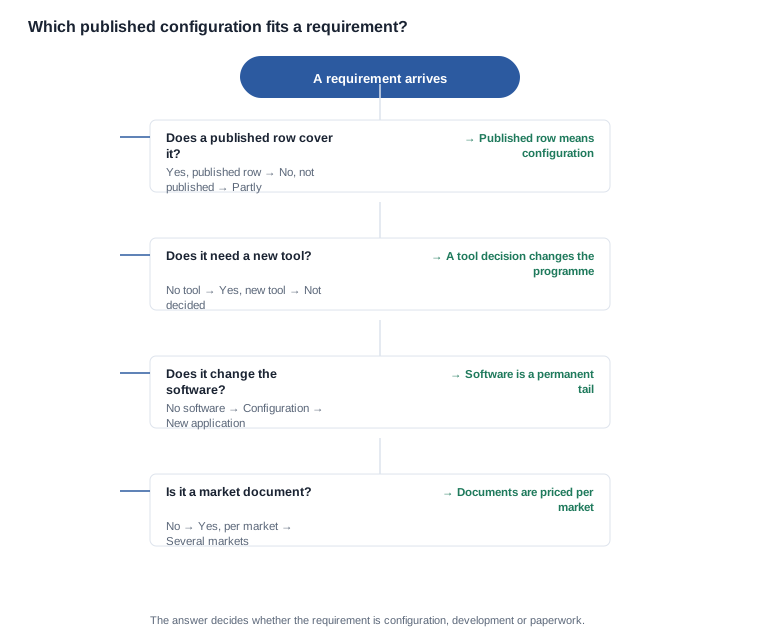
The decision chart above is a simplified version of the conversation. It is not a product selector; it is a way of finding out which configuration question needs to be asked first.
What you will not get from us, and should not expect, is a price list, a single minimum order quantity or a standing lead time. None of those numbers is true across an option space that includes four models with no published charging method, two models with no published case, one model with no published weight and a colour option on two models out of twenty-five. The useful form of the answer is per configuration, and it is available as soon as the configuration is known.
What a first response should also contain is a short list of what it cannot yet answer, with the reason and the date it expects to be able to. A supplier who returns a confident answer to everything on day one is telling you something, but it is rarely that the answer is right. A first response that says "the charging method for the MT6 is not published, and I will have the answer from engineering by Thursday" is more useful to a buyer than a rounded figure, because a buyer can plan around a named gap and cannot plan around a rounded figure.
The schedule that follows from this is the same one described in the lead time article: tooling separated from production, external queues named, and the buyer's own approval cycle counted as part of the programme rather than assumed to be zero. The full option space sits under customization options.
The fastest route through a first programme is unglamorous. Send the proposition, the markets, the quantity and the date. Ask which published configuration is closest. Then decide, in this order, what is fixed, what is negotiable and what is not in the programme at all — and we will work from the same three lists, with the published rows filled in against them, and the gaps written down as questions with owners and dates attached.
Related reading


