
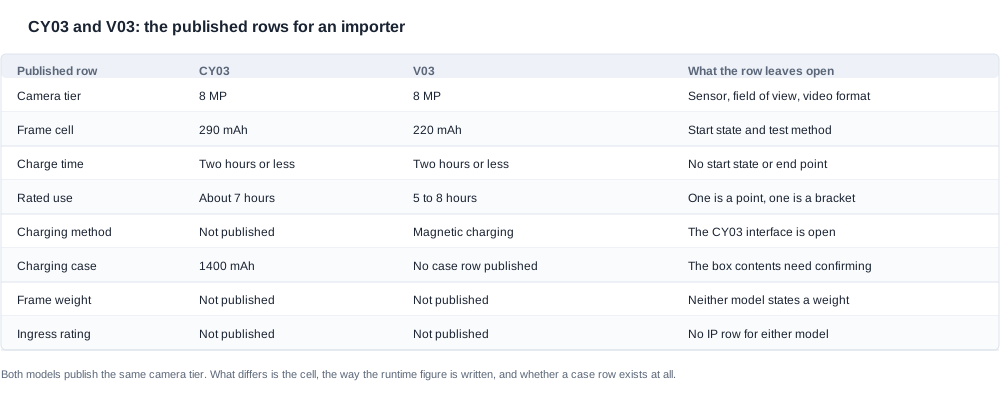
The cy03 smart glasses vs v03 spec comparison is frequently set up on the wrong axis. Both models publish an 8-megapixel camera, so there is no resolution decision to make here — the camera tier is identical. What differs is the power platform and the box: the CY03 carries a 290 mAh cell and publishes a 1400 mAh charging case, while the V03 carries a 220 mAh cell, charges magnetically and has no charging-case row published for it.
That reframing is the whole point of this article. For an importer, a comparison that leads with image quality on a pair of same-tier models is a comparison that answers a question nobody asked and misses the one that moves the delivered cost: what is in the carton, how heavy is it, and how many cells travel with it.
So the working conclusion is a screen rather than a ranking. If your retail model needs a case in the box, the CY03's published configuration is the one of the pair that carries a case capacity figure. If your channel is built on freight cost per delivered unit and on a single-cell carton, the V03's platform is the smaller one. And if either of those is decisive, the camera tier does not enter into it, because both models sit in the same tier.
The rows that differ and the rows that do not
Cell. The CY03 carries 290 mAh, the top cell tier in the camera range. The V03 carries 220 mAh, the smallest tier. That is a 70 mAh difference, about a third of the cell, and it is the largest published difference between the two models.
Runtime. The CY03 is published at approximately seven hours. The V03 is published as five to eight hours. This looks contradictory next to a 70 mAh difference and it is worth pausing on, because it is exactly why no single runtime figure should be quoted for either model without the test condition attached. Two platforms with different cells arriving at overlapping figures almost certainly reflect different duty cycles or different test conditions, and no test condition is published for either.
Case. The CY03 publishes a 1400 mAh charging case. The catalogue publishes no charging-case row for the V03 at all, and that is a different statement from a published case without a capacity figure. Three camera models sit in the same position — the V06 and the S7, and the V03 — and the V03 Pro is a fourth, with no charging-case row published for it either. An importer who writes "the V03 has no case" into a specification sheet is making a claim our documentation does not make, and it needs to be confirmed from the box contents before it becomes a costed assumption.
Charging method. The V03 publishes magnetic charging. The CY03 publishes no charging-method row, along with the CY05 and the MT6, and the L1 Pro. Four camera models in the range leave the interface open.
What matches, and why an importer cares
Four rows match exactly: the camera tier at 8 MP, the charge-time ceiling of two hours or less, the absence of any published sensor model, field of view, video format, frame rate or ingress rating, and the absence of any published frame weight.
Those matches are not a coincidence of documentation. They describe two points on a shared architecture, and for an importer the shared architecture is where the money is:
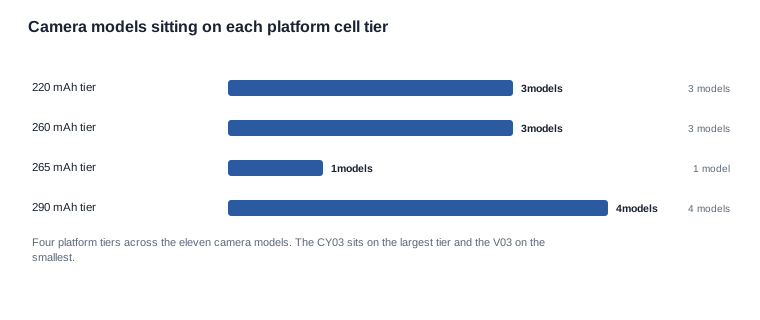
- One qualification exercise can cover both, if the documents allow it. The 220 mAh tier covers the MT5 and the V03 Pro, and the V03; the 290 mAh tier covers the L1 Pro and the CY05, and the L2 Utral and the CY03. A document naming one designation does not cover another, so the question to ask is whether one file covers the tier or whether each model needs its own.
- One accessory and packaging structure covers the tier. Anything you buy once for the V03 — the carton, the insert, the artwork, the cable — is reusable across the 220 mAh models, and the same applies on the 290 mAh side.
- One firmware and support path covers the tier, which is the largest recurring saving in a multi-model range.
What the two tiers mean for a mixed order
The most useful thing an importer can do with these two models is stop treating them as a pair and start treating them as two platform tiers, because a shipment that contains both is not a single-product shipment. It is two products with two cell configurations, two carton designs, two qualification scopes and two sets of documents, arriving in one consignment.
That is not a reason to avoid mixing them. It is a reason to price the mixing. Three costs appear when the two tiers share an order:
- Two carton designs. The 290 mAh tier's configuration includes a published 1400 mAh case; the 220 mAh tier's configuration has no published case row. Two box structures means two artwork approvals, two master carton dimensions and two sets of freight calculations — and, if the packing volumes differ, a mixed carton that does not stack as neatly as a single-product one.
- Two qualification scopes. If the documentation covers each platform separately, the file for a mixed order has to cover both, and the cost of the second scope is not the same as the cost of the first. A buyer who assumes one qualification covers the whole order will find out at the booking stage, which is the worst time to find out.
- Two battery transport declarations. One configuration travels with two cells in the carton and the other with one, and the declaration has to describe what actually travels. A declaration written for the single-cell configuration does not cover the case configuration.
The alternative is to keep the order single-tier and let the two platforms live in separate purchase orders. Which of those two approaches is cheaper depends on quantities, freight rates and the supplier's own qualification scope, and none of those three is published — which is why the question belongs in the request list rather than in an assumption.
Because both models publish 8 MP, a comparison that ends at "the CY03 has a better camera" is describing something the documentation does not contain. The catalogue publishes eight camera models at 8 MP — the MT5 and the MT6, the V03 Pro and the CY03, and the KY06 and the V03, and the V06 and the CY05 — and three at 13 MP, the S7 and the L1 Pro, and the L2 Utral. Both models in this comparison sit in the larger group.
Even within a tier, the published row is a count of pixels and nothing behind it. No sensor model, no aperture and no field of view is published for either model, so there is no published row that would let a buyer decide between them on image quality, and there is no row that would let a buyer decide whether a 13 MP model is worth more than an 8 MP one. Our fuller treatment of why that is so is in how to read a camera datasheet, and it is the reason "megapixels" appears so often in competitor listings and so rarely in ours.
The practical consequence for an importer is that a camera-tiers argument cannot be used to justify a price difference between these two models. Any price difference has to be justified on the platform, the box, the freight class or the commercial terms — and those are the rows worth negotiating.
The commercial case that does hold
Where the comparison becomes genuinely actionable is in packaging and logistics, and it is worth working through in the order the costs actually accrue.
The case is the carton. A 1400 mAh case against a 290 mAh frame cell is close to five times the cell in stored energy, it ships in every unit of that configuration, and it changes the volumetric weight, the freight class, the warehouse space per unit and the battery transport scope. A configuration with two cells in the carton and a configuration with one are different transport products even when the device inside is identical. The charging case options analysis covers the accessory arithmetic and the shipping weight breakdown covers the parcel.
The smaller platform amortises a qualification investment across more SKUs. The 220 mAh tier is carried by three camera models and the 290 mAh tier by four, and both figures exclude the models that would join those tiers if a later configuration were added. A qualification exercise, a packaging design and a support process built on one tier therefore spread further. That is a real argument, and it is an argument about portfolio design rather than about either model.
If your retail model needs a case, the platform screen matters more than the model screen. The MT5 sits on the same 220 mAh cell as the V03 and is published with a charging case, though that case's capacity is not published either. The four camera models publishing a case capacity are the CY03 and the L1 Pro, and the CY05 — each at 1400 mAh, the L2 Utral at 900 mAh or 1400 mAh, and the MT6 at 1200 mAh folding. Which one to take is a commercial question the catalogue does not answer, and the screen worth running is the one below.
The freight class is not published, so it has to be measured. No frame weight and no case weight is published for either model, and the only camera model in the catalogue with a published weight is the MT6 at 158 grams for the glasses body with the cell and camera fitted, excluding its folding charging case. Using that as a proxy for either model would be wrong. Weigh a packed unit of each configuration on the sample and put the figure on your freight sheet.

The importer's document and configuration checklist
Before either of these configurations is quoted, eight things have to be settled in writing. None of them is published, and every one of them either moves a cost or closes a compliance gap.
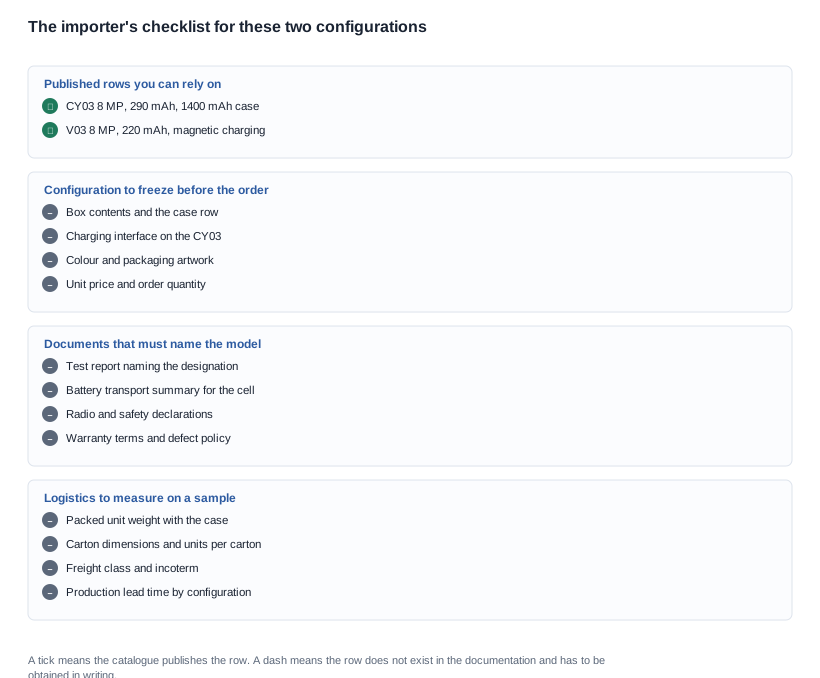
- The exact box contents for the configuration. Whether the 1400 mAh case ships in the carton for the CY03 configuration, and what is in the carton for the V03 configuration, since the catalogue publishes no case row for the latter.
- The charging interface on the CY03, and the input current and voltage accepted by both models.
- A test report naming the exact designation, with the issuing body and the validity date, and confirmation that it covers the configuration ordered rather than a sibling on the same platform.
- The battery transport documentation for the actual carton contents, which for a case configuration means two cells rather than one.
- The packed unit weight and the carton dimensions, for the freight class and the units per carton.
- Unit price at your planned quantity, with the price breaks at the two tiers above it, and the minimum order quantity per configuration.
- Lead time and monthly production capacity per configuration, and whether capacity is shared with the rest of the range.
- Warranty terms, the defect policy and the payment terms, including whether the charging case is covered on the same basis as the frame.

What our catalogue does and does not say about certification
Because this is an importer-facing comparison, the certification position should be stated exactly rather than described loosely. The catalogue carries a company-level export certification page whose content is images rather than text: ten patent certificates, eight appearance-design patents and two utility-model patents. The catalogue text contains no reference to CE, FCC or RoHS marking, and there is no per-model certification row anywhere for the CY03, the V03 or any other model.
Three implications follow for an importer. There is no certification evidence to attach to either model from the catalogue today, so the request has to be made in writing before the order. No status can be inferred for either model from the company-level page, which means a supplier who infers one is making an inference we have not made. And the request is a commercial term with a cost and a lead time, not an administrative formality — it belongs in the quotation. The export documentation checklist covers the paper that travels with the goods, and the camera range certification note sets out the document set for the camera models.
The frameworks a buyer will be working against are ordinary ones. A wireless product with a cell falls under the radio equipment framework, the Radio Equipment Directive (EU) 2014/53/EU, and the battery transport rules that UN38.3 testing supports. Naming them in the request makes the request precise, and a precise request is answered faster than a general one.
Reading a quotation against these rows
A quotation is easy to accept and hard to audit. The discipline that works is to read it line by line against the eight rows above, and to mark each line with one of three statuses: it matches a published row, it is a new commercial term to be accepted or negotiated, or it is a claim about a row the catalogue does not publish.
The third category is the one worth watching, because it is where a buyer's own assumption quietly becomes a supplier's representation. A line that says "magnetic charging" for the CY03 is a claim about a row that does not exist in our documentation, and it may well be true — but it is true by the supplier's assertion rather than by the published record, and the two are different footing. The same applies to a quoted weight, an ingress rating, a case weight or a charge indicator.
The practical test is simple and it is worth applying before the signature rather than after the first shipment: for every line in the quotation that describes the product rather than the price, ask whether it traces to a published row. Where it does, it is a specification. Where it does not, it is either a commitment you are relying on the supplier for, or a row you should have asked about. Recording which of the two it is, in writing, is what stops the distinction from being lost in the handover to the shipping team.

The four surfaces where a designation has to stay identical
An importer carries a model designation on more than one document, and the number of surfaces is what makes a small inconsistency expensive. There are four of them: the commercial invoice, the carton and its artwork, the product listing the channel publishes, and every conformity document in the pack that travels with the goods.
The moment the string is not identical across all four, the exposure is not abstract. A mismatch between the invoice and the document pack is a customs query. A mismatch between the carton and the listing is a channel rejection or a mis-shipped line. A mismatch between what a document names and what the carton says is a quality dispute in which the manufacturer can legitimately point at the paperwork. None of these is catastrophic alone; all of them cost time, and all of them trace back to a designation that was changed or duplicated somewhere without a decision behind it.
There is a specific reason this pair deserves the attention. Two platforms that publish the same camera tier, the same charge-time ceiling and no sensor, field of view, video specification, weight or ingress rating are two products that look identical on a specification sheet. That makes a mix-up easy, and it makes a mix-up invisible until a customer or an inspector finds it. A screenshot, a product photo and a specification sheet for these two models are almost interchangeable, which is an argument for making the designation the only thing a buyer has to read carefully.
Two practices keep this under control at low cost. First, treat the designation as a controlled field on the purchase order rather than as part of a description, so that a substitution is caught at goods-in by a person comparing a string rather than by a customer comparing a photograph. Second, keep the published rows for both models in one controlled reference sheet, so that the invoice, the carton artwork and the listing are all checked against the same document instead of against each other.
How the CY03 and V03 import decision runs
The sequence is short because the published position is narrow, and the order matters more than the detail. Work the configuration and the documents before working the price, because a price quoted against an unfrozen configuration is not a price you can sign.
Screen the two models as one camera tier and two platform tiers. Freeze the box contents, since the case row is the largest single difference between them. Request documents that name the exact designation, and confirm in writing that the file covers the configuration ordered. Weigh a packed unit of each configuration. Price the platform rather than the model. Record the frozen configuration in the purchase order, so that a substitution is caught at goods-in rather than at a customs query six weeks later.
The final decision that follows is a portfolio decision rather than a model decision. If the channel needs one configuration in the 220 mAh tier, the V03 is the model on that tier with the fewest published rows, which means the fewest assumptions in the file and the smallest qualification surface — and the V03 published specification list is the starting point. If the channel needs a case in the box, the CY03 and the models publishing 1400 mAh cases are the screen, and the CY03 published specification list sets out that side. Either way the rows that decide it — price, order quantity, lead time, capacity and warranty — are unpublished, and they are the rows to ask for.
Related reading
- The flagship tier in full — CY03 specifications and features
- The entry platform in full — V03 specifications and features
- The endurance question — CY03 battery life
Send us the destination market, the quantity and whether your listing depends on a charging case and we will tell you which platform fits.


