
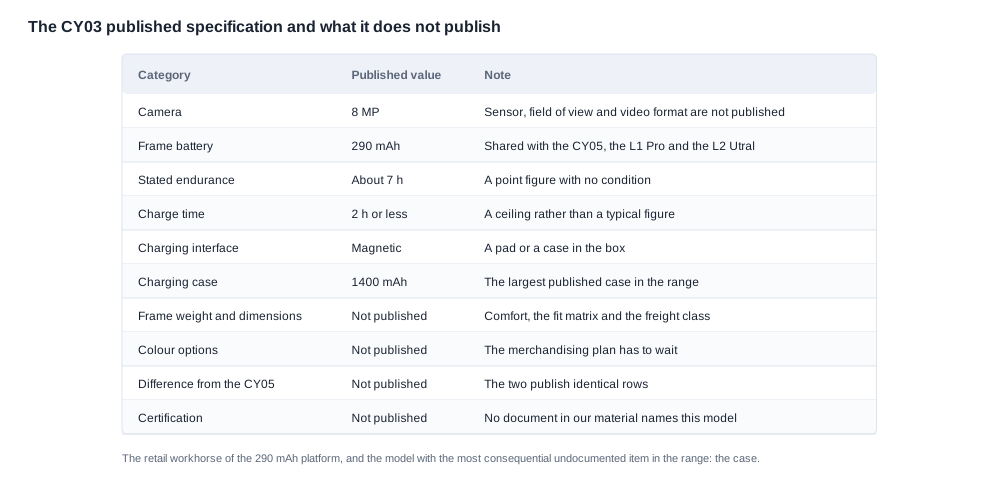
The CY03 is published as 8 megapixels, a 290 mAh cell, a charge time of up to two hours, about 7 hours of rated use and a 1400 mAh charging case. Eight checks stand between that sheet and a safe purchase order, and the first of them is not on the specification sheet at all.
A cy03 smart glasses what to check before ordering question is mostly about the two components the specification row treats as one. A camera and a charging case are two products in one box, with two supply chains, two sets of failure modes and two compliance questions, and a published row that lists five figures does not tell you where the boundary between them sits.
And there is a second structural problem, which is the identity one. Another model in this range publishes the same rows — the same camera figure, the same cell, the same charge time, the same rated use, the same case capacity. A range in which two products are indistinguishable on paper is a range where the buyer's real work is documentary, not technical. That is the honest characterisation of this model, and it is why a checklist built around the specification rows alone would be the wrong document.
The first check is therefore an identity one, and it is free. Ask which product you have been quoted, and record the answer. Everything downstream depends on it.
CY03 smart glasses: the published row and what it leaves open
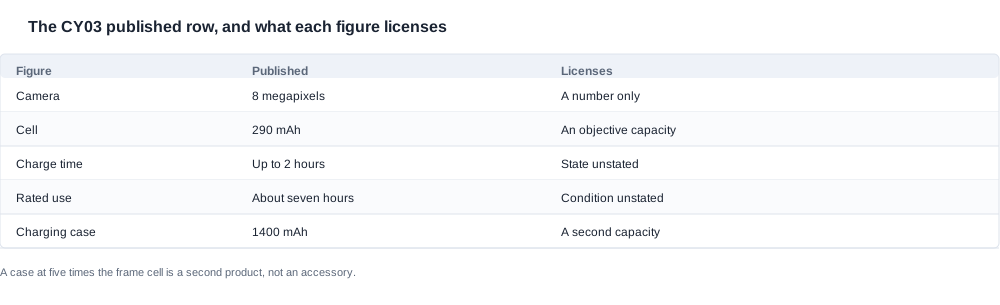
Five figures are published, and they are worth reading as a package rather than as a list.
| Figure | Published | What it licenses |
|---|---|---|
| Camera | 8 megapixels | A resolution number, nothing more |
| Cell | 290 mAh | An objective capacity |
| Charge time | Up to two hours | An objective figure, state unstated |
| Rated use | About seven hours | A rated value, condition unstated |
| Charging case | 1400 mAh | A second capacity, not a battery claim |
Three observations that a buyer who reads quickly will miss. Each of them is the kind of thing that is obvious in hindsight and invisible on the page.
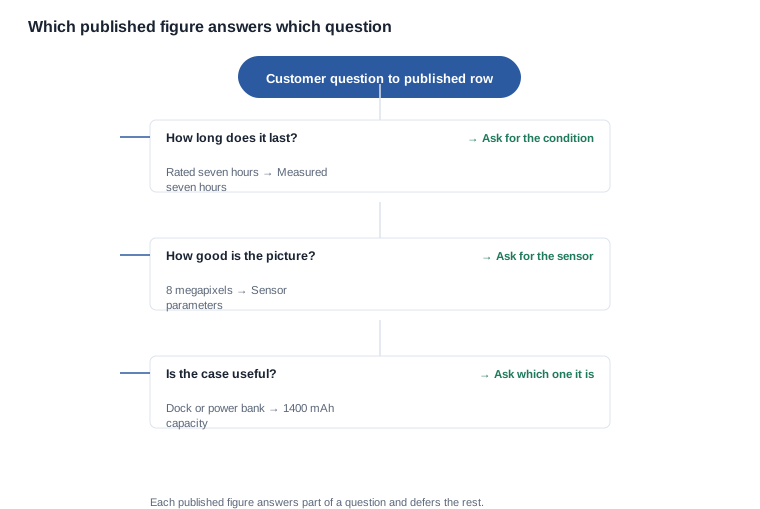
First, the case is not an accessory. A 1400 mAh case is roughly five times the capacity of the cell in the frame. That is not a carrying case; it is a second power source with its own charging time, its own cell, its own transport position and its own failure modes. When a specification row lists it without qualification, the natural assumption is that it holds spare charge, and that assumption has to be tested.
Second, the rated runtime is a rated value. About seven hours is a figure produced under a condition our documentation does not publish. Until you know whether the frame alone was measured, or the frame with the case, and at what audio and camera duty, the number cannot be converted into a capability your customer will recognise. The battery life page sets out the rows in full and battery guidance covers why the condition matters.
Third, the camera figure is the least informative number on the sheet. Eight megapixels describes a sensor class, not a picture. No sensor model, field of view, video resolution, frame rate, aperture or pixel size is published, and each of those is what would let you describe the product to a customer who asks. See camera imaging.
One more structural observation before the checklist. This model publishes a case where several other camera models in the same range publish one too, but at different capacities, and the range includes models without a case at all. So "does it come with a case" is a range-level question with a model-level answer, and a buyer who asks it of the range rather than of the model will get an answer that is true of the category and false of their product. Ask about the specific model.
The absent rows, gathered in one place, because they are the actual checklist. Frame weight, temple length and lens dimensions. Certificate numbers, issuing bodies, validity periods and the model schedule each certificate covers. Sensor and video parameters. The runtime test condition, and the charge-time measurement state. Ingress position and the report behind it. MOQ, lead time, unit price, packaging specification, warranty terms and the defect categories treated as returns. And the identity of the model against the one that publishes identical figures.
A note on why the identity item sits at the end of that sentence and at the top of the process. The identity gap is the cheapest question in the entire list to ask and the most expensive one to discover late. It costs one sentence in an enquiry email, and if the answer turns out to be the wrong model it costs a purchase order, a packaging artwork approval and a lead time.
The charging case is a second product with its own checks
This is where the CY03 differs most from a single-device product, and it is the section most checklists in this category skip.
Four questions about the case, and each one has a different answer depending on how the supplier builds it. The published capacity tells you how much energy the case holds; it tells you nothing about what the case does with it, and the difference is the whole of this section.
- Does the case recharge the frame, or does it hold charge for later? These are different products. A case that recharges is a charging dock; a case that holds charge is a power bank that happens to be shaped like a case. The published row does not distinguish them, and the distinction changes the customer's usage pattern completely.
- What is the case's own charge time? Not published. A 1400 mAh capacity with an unstated charge time tells you nothing about whether the case is ready when the frame is.
- How many full frame charges does the case deliver? Not published. Capacity in milliamp hours is not a count, and the conversion depends on the frame's real consumption — which depends on the duty cycle that is itself unpublished.
- What is the transport and regulatory position for the case cell? Two cells cross a border, not one, and the battery transport position is a different document from the one covering the frame.
And the commercial consequences, which are larger than they look. A case adds packaging volume, which adds freight cost, which changes the landed cost more than a cell change ever will. It adds a second SKU to the spare part plan and a second set of failure modes to the quality control route. And it adds an after-sales position: a customer whose case fails has a product that is unusable, even though the frame is perfect.
One question that settles a surprising amount. Ask whether the case is included in every shipped configuration or is an optional line. If it is optional, your MOQ is per configuration and your packaging is per configuration; if it is included, you are buying two products in one carton and your inspection route should treat it that way.
And two more that belong in the same conversation, because both are decided before production and impossible to change after it. Ask what the case adds to the carton dimensions and shipping weight, since freight is priced on volume and a case is a volume decision disguised as an accessory decision. And ask whether the case is a separate SKU for spare parts purposes — because if the case fails, the frame is stranded, and a customer with a working frame and a dead case has no path forward unless a replacement case exists as a stocked item.
Two questions about how to evaluate the answers when they come back. How to evaluate a supplier on this model comes down to two things: whether they answer the identity question directly, and whether they attach a test condition to the runtime figure. A supplier who does both is running the same due diligence you are. A supplier who fills the gaps with confident numbers instead is telling you something about their paperwork that you should weigh before you commit a volume order — and how to ask the follow-up question that distinguishes the two cases is covered on our supplier evaluation page.
A third question that costs nothing and prevents a common dispute. Ask whether the case is covered by the same warranty as the frame, and for how long. A case that is included in the box and excluded from the warranty is a position that will eventually reach a customer, and it is better to know at the quotation stage than at the first complaint.
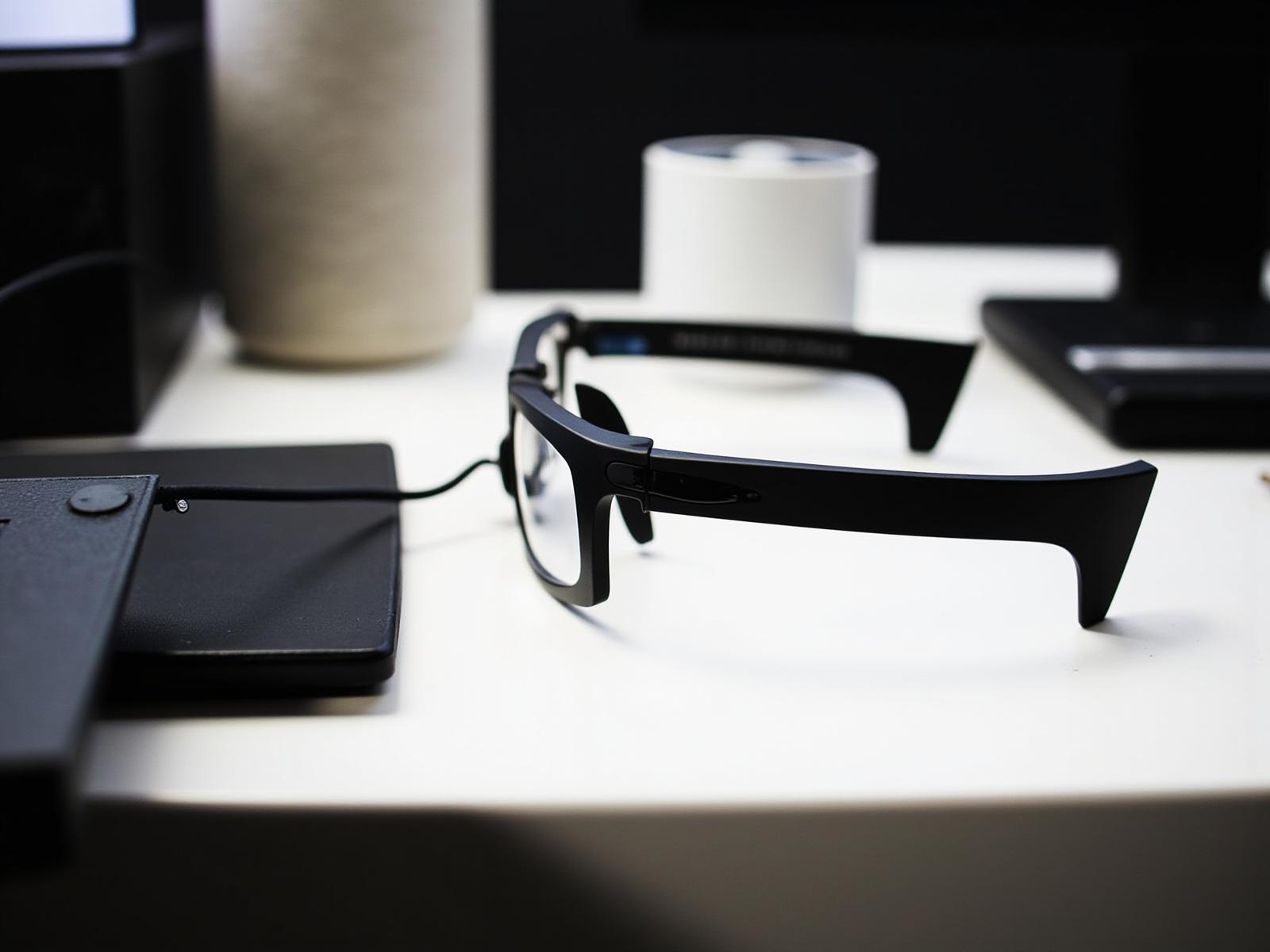
Camera claims and the evidence chain behind them
In a category where most models publish no camera parameters at all, the CY03 publishes one — and that single figure is where the largest documentation gap sits.
The distinction to hold onto. The number on the sheet tells you what to write in a specification field. It tells you nothing about what you may claim in a listing. A camera claim that a customer can test — picture quality in low light, motion capture, video rather than stills — is a claim that has to survive a test, and the test has to happen before the listing goes live rather than after the first return.
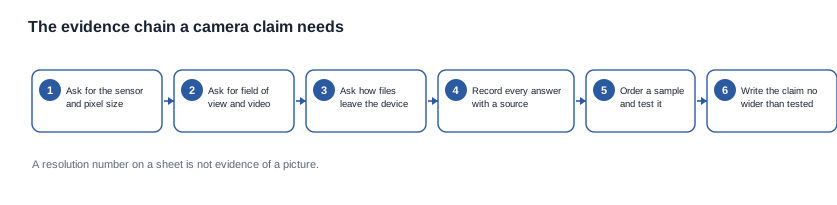
What to ask, in order. The sensor model and pixel size. The field of view, because it decides whether the product is a point-and-shoot at arm's length or something wider. The video resolution and frame rate, since a consumer expecting video will ask and the published figure describes stills. Then the storage route: where the files go, in what format, and how they leave the device. None of these is published, and the last one is the one that most often surprises a buyer.
What to do with the answers. Record them, and use the narrowest wording they support. A listing that says "8 MP camera" and stops there is defensible. A listing that says "capture every moment in stunning detail" is not, and the gap between those two sentences is the whole of the evidence chain.
And a note on comparing against competitors. Our own documentation is explicit that a parameter advantage of this kind should not be claimed externally until it has been checked against a competitor's unit in the hand. A resolution number copied next to a competitor's smaller number is a comparison you have not performed.
A caution specific to a product with a case. Because the case is the endurance story for the customer, the camera claim and the endurance claim end up competing for the same product page. A page that promises both a long runtime and demanding capture is making two claims that pull against each other, and a customer who tests one will quietly conclude the other is false. Decide which claim leads, and let the other be secondary.
And a closing note on the sample stage for a camera product. A sample tells you about a unit, not about a production run, so it closes the product question rather than the supply question. What it does give you is the wording: if you cannot describe the picture quality in two defensible sentences after holding one, the supplier's documentation is unlikely to be richer than your own observation.
Terms, MOQ and the case inside the landed cost
The commercial conversation for this model has one unusual feature, and it is the case.
A landed-cost calculation for a camera product with a case has three terms that a single-device product does not have: the case cell, the extra packaging volume and the second failure mode. All three are real costs and only the first is obvious. Buyers routinely calculate the cell and forget the carton, and then discover the freight position at the point where it cannot be changed.
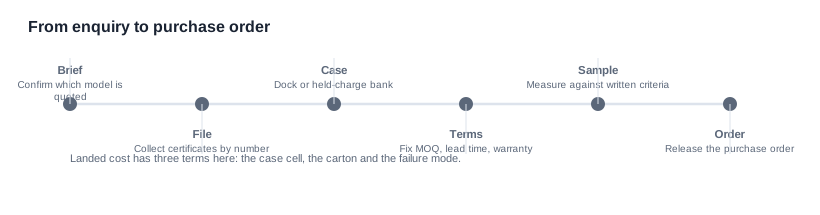
Six terms to fix, none of them published.
- MOQ, per configuration. Ask whether it is a stock or a production quantity, and whether the case configuration has its own minimum. The MOQ page covers the distinction.
- Lead time, and specifically what it is measured from — deposit, artwork approval, sample confirmation or order entry. Two suppliers quoting the same number from different starting points are quoting different products. See lead time.
- Unit price at your actual volume, including the case and including packaging. Ask for the breakdown rather than the total, because a total conceals which of the two you are being quoted on. See pricing.
- Payment terms and deposit structure, and what changes on the second order. See payment terms.
- Warranty terms and defect categories, with the case named as its own category rather than folded into the frame.
- Acceptance criteria, covering the frame and the case separately. See contract terms and quality consistency.
And the certification position, which for this model is entirely open in our documentation. No certificate number, issuing body, validity period or model schedule is published, and we will not imply that they exist. The certification checklist sets out the structure of the file you need, and the model-level position is in CY03 certification status.
One last commercial question with a large answer. Ask what the lead time to replace this platform is, not merely to reorder it. The case makes the platform more complex than a single-device product, and complex platforms are harder to replace when a supplier changes position.
A question about the supplier rather than the product that belongs in the same conversation. Ask what proportion of this model's volume comes from which channels, and whether the case configuration is a different production line. A model whose volume is concentrated in one channel is a sourcing risk that no specification row will reveal, and the risk page covers how to record it alongside the commercial terms.
The eight checks, in order
Here is the sequence, condensed, for a buyer who needs one page.
- Which product have I been quoted? The range contains a second model with identical published rows. Ask this first and record the answer.
- What is the case — a dock, or a held-charge power bank — and what is its own charge time?
- What are the camera parameters behind the 8-megapixel figure, including the storage and transfer route?
- What is the runtime test condition, and does it describe the frame alone or the frame with the case?
- Which certificates cover this model, by number, with model schedules and validity dates?
- What are the physical parameters — weight, temple length, lens dimensions, lens material — and the ingress position?
- What are MOQ, lead time baseline, price at volume, payment terms and warranty defect categories, in contract language?
- What are the acceptance criteria for the frame and for the case, and what remedy applies to each?
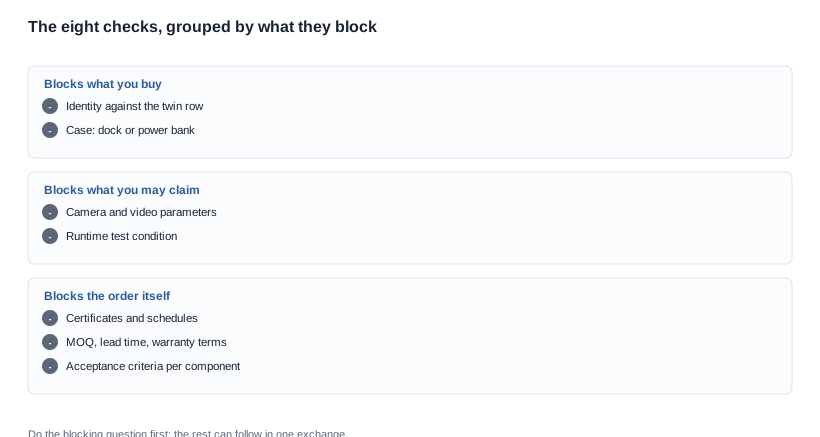
Before the sequence, one framing note. The eight checks fall into two groups: the ones that describe the product and the ones that describe the transaction. Buyers usually do the first group carefully and the second group late, and the second group is where the money is. The case makes the split unusually visible here, because the case is simultaneously a product feature, a packaging decision, a freight term, a spare part and a warranty category, and each of those is a different conversation with a different counterparty.
Why this order. Checks one and two decide what product you are buying. Checks three to six decide what you can say and where you can ship it. Checks seven and eight decide what the order costs and what a return costs. Doing them in a different order does not fail — it simply means discovering the blocking question after the non-blocking ones have already taken a week.
What to do with a partial answer, which is the most likely outcome. Each unanswered item is either something you can carry into the first shipment or something that blocks it. Write that decision down, with a reason and a date, at the moment you make it. The reason matters because at the second order someone else will review the decision, and a decision without a reason is a decision that gets reversed.
And a final discipline that costs nothing. Keep one file per model, holding every published row, every supplier answer, every certificate number and every gap, each with a date and a source. When a customer question arrives twelve months after the first shipment, that file is the difference between an answer and a search. Our position on this model is that the published row is usable and the identity gap is the real risk. We will not present 8 megapixels as a picture-quality claim, we will not present about seven hours of rated use as a measured endurance without its test condition, and we will not resolve the question of which of two identically specified models has been quoted inside a sales conversation. Tell us the channel, the volume and whether the case is standard or optional, and we will tell you which of these eight checks blocks the order and which can follow the first shipment.
Related reading
- Where the model sits in the camera family — CY03 compared across the range
- Where the documentation gaps sit — CY03 limitations
- The power rows — CY03 battery life and charging options
- Which job the model suits — CY03 best for


