

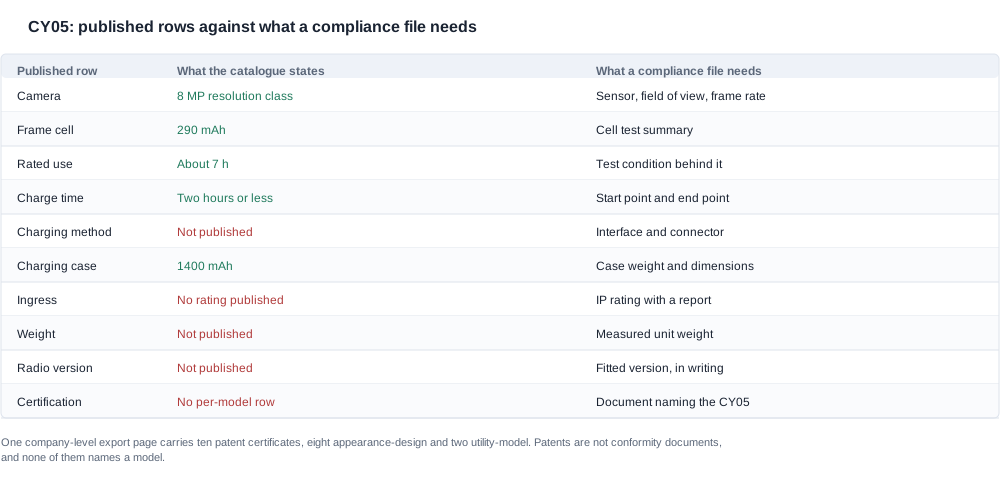
The certification status of the CY05 is not a list of certificates, because no per-model certification row exists anywhere in our catalogue. What the catalogue carries is one company-level export certification page whose content is images rather than text, and the images on it are ten patent certificates — eight appearance-design patents and two utility-model patents. A patent certificate records that a design or a mechanism was granted protection. It says nothing about whether a product conforms to a requirement in a market. The catalogue text carries no conformity-mark reference of any kind, and there is no table anywhere that maps a model string to a certificate number, an issuing body, a validity date or a covered-model schedule.
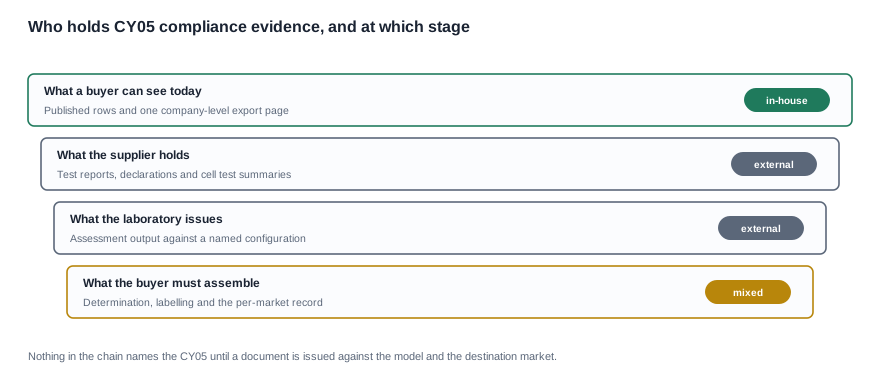
For this model that leaves a specific position rather than a vague one. The published rows describe a product; the compliance file for that product has to be requested, assembled and assessed by the buyer and their compliance function. What follows sets out what the catalogue does hold, what the applicable framework actually asks for, which specification rows keep blocking claims even when every document is in hand, and what the CY03 twin does to the scope of any document you eventually receive.
CY05 certification status: what is documented and what is open
One company page, ten patent certificates
The export certification page is a single page in the catalogue, and it carries ten patent certificates. Eight of them are appearance-design patents and two of them are utility-model patents. These are the only compliance-adjacent artefacts anywhere in the document, and the distinction between them and what a compliance file holds is the single most useful thing this page can tell a buyer.
A patent certificate establishes that a right was granted over a design or a mechanism. It carries a number, a grant date and a jurisdiction. It does not establish conformity with a requirement, it does not establish anything about radio performance, and it does not establish anything about the goods a buyer receives. The commercial consequence of that distinction is straightforward: a buyer who sees a page of certificates on a supplier's cover and assumes conformity evidence has been supplied is drawing a conclusion the page does not support. We are not stating that the CY05 lacks conformity evidence. We are stating that none has been provided to us, and we will not declare a certification status that we cannot evidence.
No model row, in either direction
There is no per-model certification row for the CY05, and there is none for any of the 28 models in the catalogue. There is no table that maps a model string to a certificate number, an issuing body, a validity date or a covered-model schedule, and there is no "pending confirmation" list either, so nobody is left with the impression that some models are documented and others are simply awaiting a document.
That absence is symmetrical, and the symmetry matters because this kind of gap is frequently misread in both directions. The catalogue is not publishing conformity evidence for some models while withholding it for others; it publishes a company-level page and no model-level rows at all. For a buyer, the practical effect is that the question "which of your models are certified" cannot be answered from the catalogue for any model, and every answer has to arrive in writing. Any listing line that says this product comes with certification needs a document behind it that names the CY05, its configuration and the market it was assessed for.
What this model does publish
The catalogue publishes the eight-megapixel camera resolution class, a 290 mAh frame cell, roughly seven hours of rated use, a charge time of two hours or less, a charging method that is not published, and a charging case of 1400 mAh. None of those rows is a compliance document. They tell a buyer what the product is; they do not tell a buyer whether it can be sold in a given market. A compliant product and a documented product are different things, and only the second one closes a retailer's file.
One further row belongs in the same list, because it is a published fact and it has a documentary consequence. The CY05 publishes the same rows as the CY03 — the same resolution class, the same cell, the same rated use, the same charge ceiling, the same unpublished charging method and the same 1400 mAh case. Nothing in the published specification separates the two models, which is a commercial question and a document-scope question at the same time.

The framework a CY05 file has to satisfy
The absence of a catalogue row is not the same as the absence of requirements. The framework below is named as text, without any claim attached to it, and it is written so that a procurement team can turn it into a document request rather than into a general worry.
Radio and electromagnetic compatibility are two separate instruments
The Radio Equipment Directive, (EU) 2014/53/EU, governs radio equipment. The Electromagnetic Compatibility Directive, (EU) 2014/32/EU, governs electromagnetic compatibility. They are separate instruments with separate scopes, and a product carrying a radio module ordinarily sits within the scope of both. A file that names one of them does not cover the other, which is why a request for "the radio certificate" is not a usable request: it does not say which instrument the buyer means, and it says nothing about the EMC position at all.
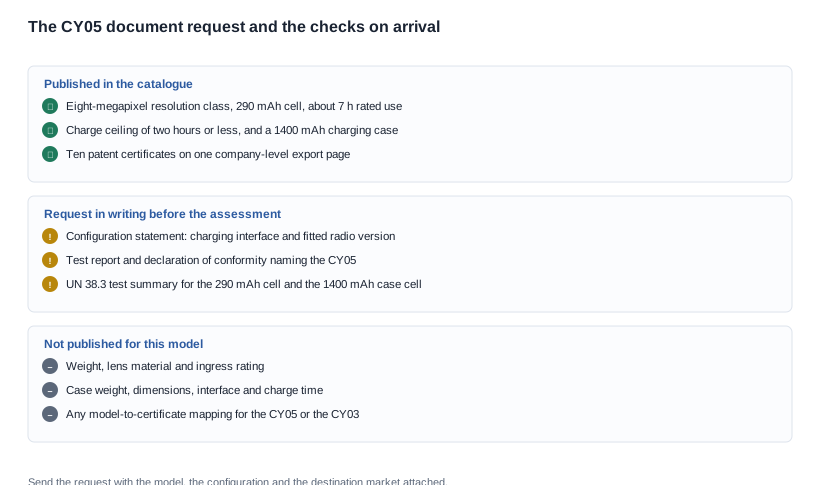
For this model there is a sharper version of that problem. The catalogue publishes no Bluetooth version for the camera models, so the radio configuration against which this model would be assessed cannot be identified from the catalogue in the first place. The radio version fitted to this configuration has to arrive as a written statement, and it has to arrive before a test programme is scoped, because a programme scoped against the wrong radio configuration is a cycle spent for nothing. The Bluetooth qualification checklist sets out the document set that a radio file normally holds.
Harmonised standards are the yardstick, not the certificate
EN 301 489 and EN 300 328 are harmonised standards. A harmonised standard is a reference against which conformity is demonstrated; it is not a certificate, and nobody holds one. What a file actually holds is a test report from a named laboratory, which states the standard and the configuration assessed, plus a declaration of conformity that the manufacturer issues, which references that report, the model designation and the market.
For the CY05, no test report and no declaration of conformity is published. The status is Not published, and the row has to be closed by request. The distinction is what stops a product page from carrying a phrase like "certified to the Bluetooth standard", which is a claim the standard itself cannot support and which a competitor's compliance team can dismantle in one message. The wording that survives scrutiny names the test report, the laboratory, the standard reference and the assessed configuration.
The general product safety regulation is a regulation, not a document you hold
Regulation (EU) 2023/988, the General Product Safety Regulation, applies to consumer products made available on the EU market and imposes obligations on the economic operator responsible for them: a documented risk assessment, technical documentation that can be produced on demand, traceability of the batch, instructions and warnings in the language of the destination market, and a route for reporting incidents.
It is a regulation, not a certificate, and no supplier can hand you "a GSPR certificate". What can be produced is the record showing the obligations were met, per destination market. The GPSR obligations route sets out the per-market pattern, and the general product safety regulation guide covers the documentation set in full.
For a camera product with a lithium cell and a radio there are three documentation subjects running at once — product safety, radio and transport — and the product-safety record is the one that binds the labelling. The label is a test input in that regime rather than a decoration, which is why this record has to be settled first: a label change after the assessment is a re-evaluation, and a re-evaluation is another calendar cycle.
Transport documentation for two cells in every unit
The frame cell is 290 mAh and the charging case holds 1400 mAh, so the shipping unit contains two lithium cells rather than one. Transport documentation rests on the UN 38.3 test summary, and for this model that summary is Not published and has to be requested for both the frame cell and the case cell.
The case is what changes the answer. A two-cell package moves the transport class and the permitted charge percentage, and for ecommerce fulfilment that can decide whether a unit is allowed to move by air from an overseas warehouse at all or has to be routed differently. A buyer who has planned the shipment on the frame cell alone has planned a shipment the product does not make. The battery transport route covers the classification questions, and the battery transport compliance guide covers the file that a forwarder will ask for.
The rows that are not documents, and the claims they still block
A compliance file can be complete and the product page can still be wrong, because several of the specifications a tender asks about are not in the catalogue at all. These are the ones that come up repeatedly, and each of them turns into a claim that someone has to make somewhere downstream.
Ingress protection: this model has no rating
IP54 appears on exactly two models in the range, the V06 and the S7. The CY05 carries no ingress rating, which means there is no basis for a water, sweat or rain claim anywhere — not on the product page, not on the packaging, not in the instructions and not in a channel listing. This is the most common accidental claim in this category, and it is easy to make by carrying a sentence across from a neighbouring product page in the same range. It is also the claim most likely to be made where a product is used near a sink, on a site with outdoor work, or in a market where retail buyers assume an eyewear product is at least splash-resistant. None of that is supportable from what we publish for this model.
Weight, lens material and the rows that carry a claim
Weight is Not published for the CY05. The only published weight anywhere in the catalogue is the MT6's 158 g, and that figure is the glasses body including its 265 mAh cell and its camera and excluding its folding case. It belongs to a different model in a different cell class, and it cannot be used as a proxy. A number that travels between models inside a conversation is exactly the kind of number that ends up on a product page, so the weight has to come off a sample unit and be recorded with the configuration it was taken from.
Lens material is Not published as well. Any statement your labelling or your listing will make about skin contact, allergenicity or lens durability has to be answered before the artwork is approved, because a claim about a material that has not been declared is a claim that cannot be evidenced, however plausible it sounds. The radio version, as noted above, is Not published for the camera models and needs the same written answer.
The camera row is a resolution class, not a specification
The CY05 publishes the eight-megapixel resolution class and nothing further about it. There is no sensor model, no field of view, no frame rate, no video format, no stabilisation information, no low-light behaviour, no storage capacity and no file format. A claim at the level of the resolution class is defensible from what we publish. A claim about the quality of the image, the smoothness of a recording or the behaviour in low light is not, and each of those needs either a published row or a sample measurement before it reaches a listing.
The wider context is useful for a buyer writing a tender. The eight-megapixel class covers eight of the eleven camera models in the range, and the thirteen-megapixel class covers three — the L1 Pro and the S7, and the L2 Utral. The resolution class therefore locates the CY05 inside the range rather than identifying it. If a tender requires a particular pixel class, the CY05 meets it. If a tender requires something about the imaging module itself, the class does not answer the question and the answer has to be requested. The camera resolution options analysis sets out the structural grouping.
A configuration you cannot name is hard to assess
This is the sequencing problem that is specific to this model, and it is worth stating separately from everything else above. The charging method is not published for the CY05, and it is not published for three other camera models: the MT6 and the L1 Pro, and the CY03. All four publish a charging case capacity. So the physical configuration of the product you would assess is not fully identified by the catalogue.
A conformity assessment is performed against an identified configuration, and a sample unit shows one interface rather than the platform's options. The first step of a CY05 programme is therefore not a laboratory booking; it is a written statement of the configuration, because a test report against the wrong configuration costs a full cycle and evidences nothing. The CY05 charging options analysis sets out the four branches that a charging brief runs on and where this model sits in them.


The CY03 twin as a document-scope problem
The CY05 and the CY03 publish identical rows: the eight-megapixel resolution class, a 290 mAh cell, roughly seven hours of rated use, a charge time of two hours or less, a charging method that is not published, and a 1400 mAh charging case. Nothing in the published specification distinguishes them. The L1 Pro shares the cell, the rated use, the charge ceiling and the same 1400 mAh case, but it sits in the thirteen-megapixel class, so the CY03 is the actual twin here and the L1 Pro is not.
Three consequences follow if that stays open, and only the first is obvious.
Document scope. A document that names one model string does not name the other. A buyer carrying both models needs to know whether the documents name both; if they do not, the second model is a second document set, a second assessment programme, a second cost and a second schedule, and none of that was visible when the range was planned as a single product family.
Configuration control. The model string has to be identical on the purchase order, the label, the test report, the declaration of conformity and the packing list. A mismatch between those surfaces at customs or during a quality claim, which is the worst possible moment to discover it, and it is a risk that is created entirely by the twin rather than by the product.
Range economics. Two models that a channel cannot tell apart fragment the inventory and the merchandising for no commercial gain. A buyer carrying both is making a range decision, and it should be taken deliberately rather than by default. The CY05 versus CY03 positioning analysis covers the range structure that the two models share.
A fourth consequence is specific to the compliance file, and it is the one most often missed. The unpublished charging method row runs through four camera models, and the twin question is a different gap from the interface question. The first is about model identity; the second is about a missing row. Closing one does not close the other, and a buyer who resolves the twin question and assumes the interface question has gone with it is holding an open item that has to be settled before the assessment is scoped.

Sequencing the CY05 programme and its cost centres
The order that keeps the schedule moving
Compliance work is slow for structural reasons rather than because anyone is being difficult. The categorisation has to be decided before a test programme can be specified, the programme has to be specified before a laboratory can be booked, and the labelling and instructions have to be final before the goods are produced. Every one of those steps waits on the one before it, which is why a buyer who opens the conversation at the certificate stage has already lost a cycle.
For the CY05 the sequence carries one extra step at the front, and that step is unusual enough to be worth naming: the written configuration statement covering the charging interface and the fitted radio version. The configuration determines which assessment applies, so it has to precede the scoping. After that the order runs as market, intended use and claims; the applicable requirements list; the test programme scope; the labelling and instructions; then production with the model string matched to what was assessed.
The unit price appears at the end of that sequence rather than the beginning, and the reason is worth putting in front of a supplier: a price agreed before the configuration is fixed is a price agreed against a guess. A buyer who has the whole sequence in front of them can put the commercial discussion at the point where both sides know what is being settled.
Three cost centres to keep out of one line
The cost of an open compliance position is real, and it sits outside the unit price. Three centres are worth keeping distinct in any quotation.
The assessment and test programme for this model in this market. This is a per-model, per-market cost, and it does not amortise across the range. Pressing on it produces a longer schedule rather than a shorter one.
The documentation and labelling work your market requires. This is the technical file, the instructions, the label content and the translation. It is a documentation cost, and it is a different line from the test cost even when a supplier quotes them together.
The transport file for the two lithium cells. The frame cell and the case cell each need their own test summary, and the case is what makes the package different from a single-cell unit.
Ask whether these are quoted as one line. A single bundled figure hides which is which, and the amortisation question is real for any programme that may be discontinued, because an assessment is a per-model cost while packaging and tooling are amortised across the first order. This is a negotiation point, not a complaint. Several things are negotiable without difficulty: the number of units per model in a single production run, a delivery split that lets one tranche carry the documentation check, the warranty period with a stated response, the payment nodes, and the instruction and label content your market requires. The contract terms route sets out where these usually sit.
What goes in the order rather than in the plan
Three things belong in the purchase order or the agreement rather than in a plan, because a plan does not bind anybody.
Write the assessed configuration and the label version onto the order. That makes the goods that arrive checkable against the documents. A purchase order that does not leaves a buyer comparing a shipment against an email.
Place the inspection node at the document review, not only at the goods-in check. In a category with an open compliance position the document review is the step that can still stop the programme, and it is the step that happens earliest.
Ask for the re-issue obligation in writing. If the configuration, the labelling or the model string changes after the assessment, the obligation to re-issue the documentation should be contractual. Without it, the buyer absorbs a re-evaluation that the supplier caused, and in this category a re-evaluation is measured in months. The certification checklist is the right place to build the request, and the supplier verification guide covers how to test the answers once they arrive.
What we can state today about the CY05
Concretely, for this model we publish the eight-megapixel resolution class, the 290 mAh cell, roughly seven hours of rated use, a charge time of two hours or less, the 1400 mAh charging case capacity, and the fact that the charging method is not published. We do not publish a weight, a lens material, an ingress rating, a Bluetooth version, the charging method, the case weight, the case dimensions, the case's own charging interface, the case's own charge time, a battery indicator, a UN 38.3 test summary, or any conformity document naming this model.
The company-level export certification page in our catalogue is real, and it is a page of ten patent certificates — eight appearance-design and two utility-model — rather than a set of conformity documents. No per-model certification row exists anywhere in the catalogue, and we will not state a certification status that we cannot evidence.
We will also not make a medical, a hearing or a vision-protection claim for this model, and no such claim appears anywhere in this article. A camera product is consumer electronics, and we hold no clinical data, no test protocol and no regulatory assessment for any such purpose. If a programme requires one, that requirement has to be met on its own terms; nothing in this catalogue meets it, and the camera certification analysis sets out the same boundary for the wider camera range.
What we will do is answer every question about the product itself in writing, tell you which questions are ours to answer and which belong to your compliance function or your appointed test house, and state item by item what we hold and what we do not. Send us the destination markets, the quantities and the required configuration for the CY05, and we will come back with which questions can be answered from documentation today, which need a document request, and which need a determination on your side.
Related reading
- The document set a compliance file should hold — certification checklist
- The per-market safety record — GPSR obligations
- Lithium transport for a two-cell unit — battery transport
- The published rows for this model — CY05 specifications and features
Let us know the target market, the quantity and the required configuration, and we will come back with what is available and what is not.


