

The CY05 and the KY06 are both 8-megapixel camera glasses, and on the published rows they differ by 30 mAh of battery capacity, one charging case capacity and one line of positioning language. If you are choosing between them on how the product looks and feels, the published data will not get you there, because the frame weight and the frame dimensions are not published for either model — and those are the two numbers that decide how a frame feels.
What the published rows do settle is worth stating precisely, because it is more than most buyers assume and less than the framing of the question suggests. The KY06 publishes a magnetic charging method and a charging case whose capacity is not stated. The CY05 publishes a 1400 mAh charging case and no charging method row at all. The KY06 publishes an endurance range of 6 to 8 hours; the CY05 publishes a single figure of about 7 hours. And the KY06 carries a photography-and-sport positioning line in its catalogue entry while the CY05 carries none.
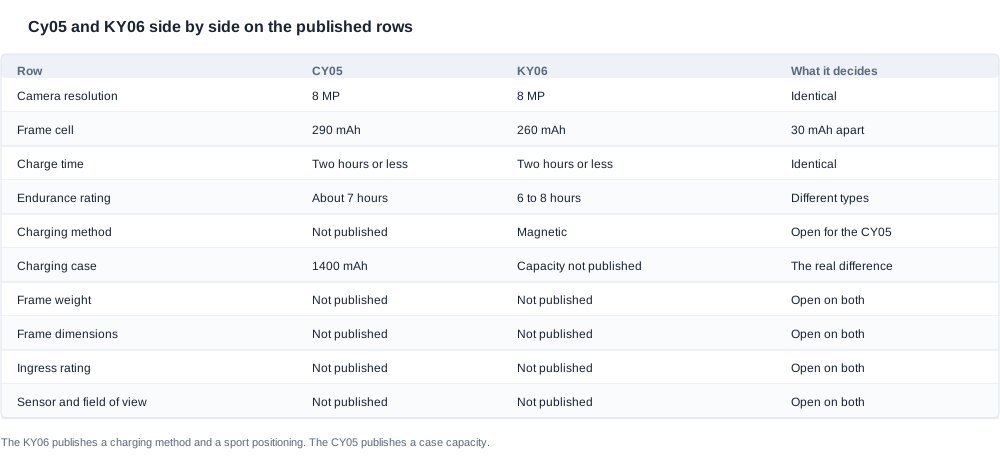
That is the real comparison. The form factor question is a separate question, and it stays open on both models.
Cy05 and KY06 form factor: what the published rows can actually tell you
Three rows in this catalogue decide how a product feels to hold and to put on, and neither the CY05 nor the KY06 publishes any of them. They are the frame weight, the frame dimensions and temple length, and the frame profile. The catalogue publishes exactly one frame weight anywhere in the camera family, and it belongs to the MT6: 158 g for the glasses body including its battery and camera, excluding its folding charging case.
That figure is not a proxy for either model in this pair. The CY05 carries a 290 mAh cell and a 1400 mAh case; the KY06 carries a 260 mAh cell and a case whose capacity is not published. A camera module, a cell and the battery management electronics all sit in and around the temples, and that is where a camera glasses product becomes heavy. A 30 mAh cell difference between the two models is unlikely to be visible on the head, but it is not the only weight in the product and it is not the largest.
So the honest position on the form factor question is this: the published rows tell you about the power block, the accessory and the positioning, and they tell you nothing at all about the physical frame. A buyer who wants a form factor comparison has to arrange a measurement, and the measurement is the deliverable, not the catalogue.
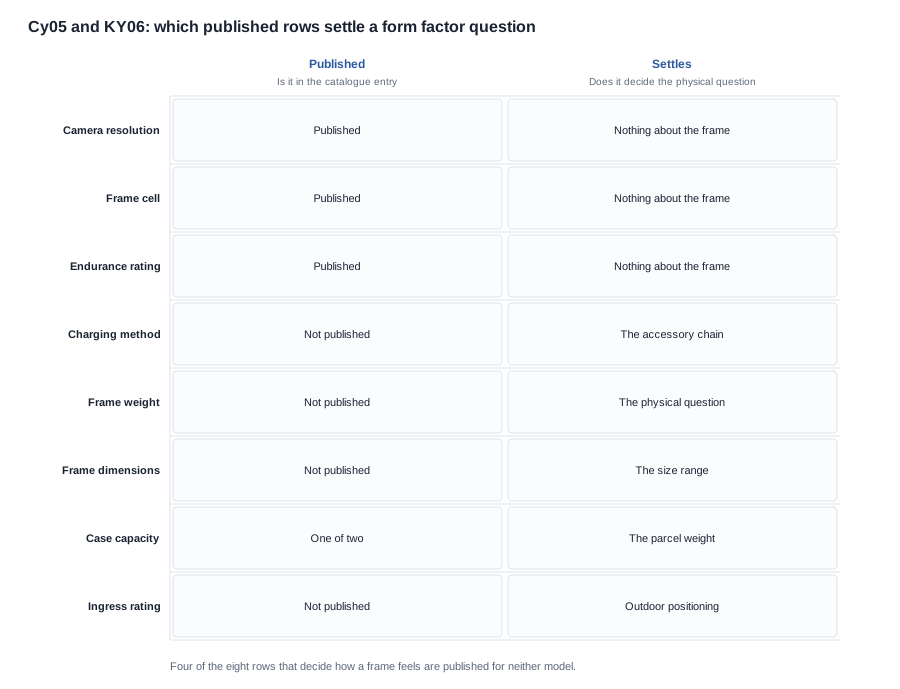
The rows that do matter for a physical purchase, and what each one blocks
Frame weight. Not published for either model. It decides how the product sits across a working day, and it decides the freight class of every shipped unit. For a brand selling into an optical channel where the frame profile determines the size range, this is the blocking number.
Frame dimensions and temple length. Not published for either. If your business is optical-channel distribution, where fit across a size range is the whole game, these are the numbers that make the difference between a range and a single size.
The charging method. The KY06 publishes magnetic charging with a case. The CY05 publishes no charging method row — the row is absent from its catalogue entry rather than filled with a different value, which is a detail worth holding onto because it is the difference between a published value and an open question. A magnetic interface needs a dock or a pad in the box and a charging orientation the customer has to learn; an open question means the box contents are also open.
The ingress rating. Neither model carries an IP marking in the catalogue, so neither may be described as water resistant. Our catalogue publishes IP54 on the V06 and the S7 only.
The camera specification. Sensor, field of view, video format and frame rate are not published for either. Both are 8 megapixels, and neither tells you what the image looks like.
The one structural difference between the CY05 and the KY06
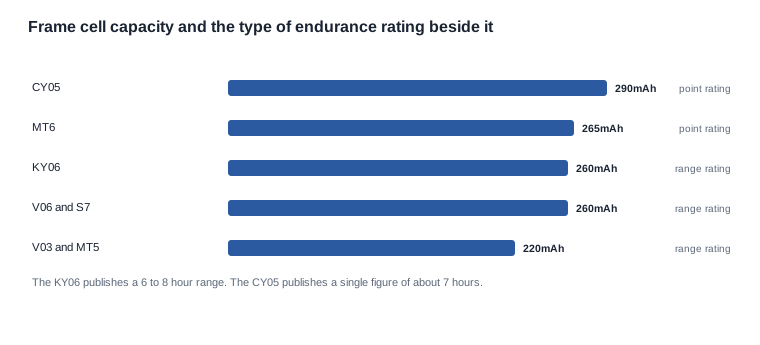
The KY06 carries a 260 mAh cell and publishes an endurance range of 6 to 8 hours. The CY05 carries 290 mAh and publishes about 7 hours.
A smaller cell publishing a wider range is a meaningful detail and it is worth reading carefully. It indicates that the KY06 was measured under more than one condition and that the result moved by two hours, while the CY05's single figure came from one profile. If you are choosing a number to print, a range is the more honest thing to publish and the more useful one to work from, because it tells a reader that the figure moves with conditions rather than that the figure is a constant.
The 30 mAh of extra capacity in the CY05 is worth less than that disclosure. On its own, capacity tells you the size of the energy budget and not the length of the day, and the day is what the buyer is actually buying.
The case is the second difference, and it is the larger one. The CY05 publishes a 1400 mAh charging case. The KY06's case capacity is not published. That is a packaging and freight difference, it is a customer-experience difference, and it is the difference a buyer actually feels when the product arrives: the CY05 arrives with a documented reserve of power, the KY06 arrives with an undocumented one.
The third difference is the charging method, and it is the one that catches people out. The KY06 publishes magnetic charging. The CY05 publishes no charging method row at all. Across the catalogue, seventeen models publish magnetic charging and seven publish a Type-C interface, and four camera models — the L1 Pro and the MT6, and the CY03 and the CY05 — publish nothing. The CY05 is one of those four. Treating it as magnetic by analogy is an assumption, and the accessory chain, the box contents and the in-box cable all depend on it.
Where the positioning language diverges
The KY06 is described in the catalogue as a photography and sport positioning model, with sport scene recording named as a capability. The CY05 carries no sport-specific description — no ingress marking, no removable inner frame, no ergonomic sport frame language.
The sport models in this catalogue, the V06 and the S7, carry the IP54 marking and the removable inner frame. The KY06 sits between the general camera models and the sport models without carrying the sport features, and it is easy to assume that a camera glasses model described in sporting terms inherits the sport treatment. On the published evidence it does not. The KY06 specification notes list the published rows in full, and the sport smart glasses range guide covers where the genuine sport platforms sit.
What a form factor comparison cannot settle
It is worth being explicit about the limits, because the question arrives with an expectation that the specification sheet can satisfy it and it cannot.
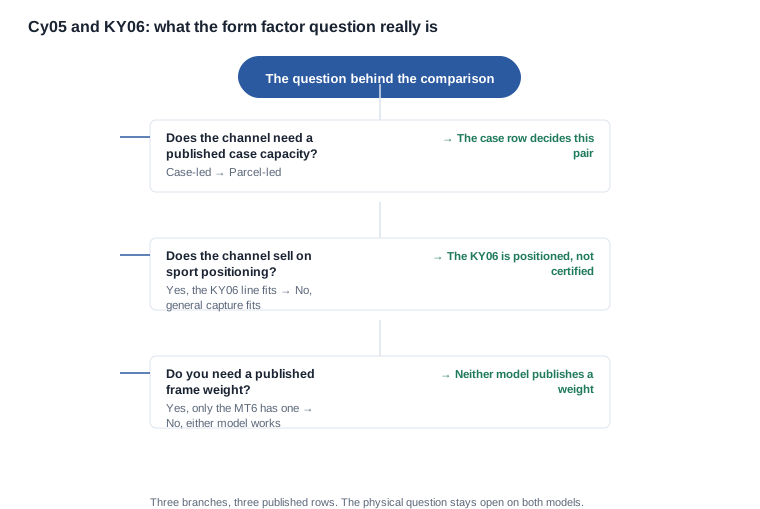
Neither model publishes a weight. So neither can be sold on a comfort figure with a number behind it, and neither can be compared to the 158 g the MT6 publishes without an estimate that would have to be labelled as one.
Neither model publishes dimensions. So a buyer cannot build a size range, cannot write a fit guide, and cannot answer a channel partner asking which face shapes the product suits.
Neither model publishes a sensor, a field of view, a video format or a frame rate. Both publish 8 megapixels, and megapixels do not describe an image.
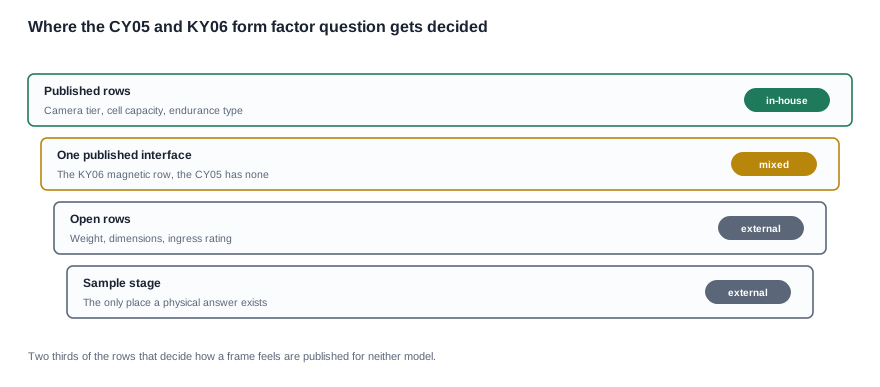
Neither model publishes an ingress rating. So neither may be positioned for outdoor or all-weather use.
Neither model publishes a certification position. Our catalogue carries a company-level export certification page whose content is images rather than text, and its text contains no reference to CE, FCC or RoHS anywhere. There is no per-model certification row for either model, so the market access position for both has to be requested in writing for each destination market.
Neither model publishes a colour list. The KY06's catalogue entry does not name colourways for this model, so the merchandising plan waits on a conversation with the factory rather than a selection from a list. A new colour is a cost and a lead time rather than a preference.
How to measure what the catalogue will not publish
Since the form factor question has to be answered with instruments rather than with documents, it is worth setting out a measurement protocol that produces comparable numbers for both models. The point is to run the same procedure on each, because a number measured one way on one model and another way on the other is worse than no number at all.
Weight. Weigh the frame with the battery fitted and the case out of the box, and record the configuration on the same line of the record. Repeat on three units rather than one, because a single unit tells you nothing about the spread across a production batch, and it is the spread that a buyer who is planning a channel needs. Note separately whether the case is included in the figure or excluded, because our one published weight in this family is the MT6 glasses body excluding its folding case and the two conventions are routinely confused.
Dimensions. Measure the overall frame width, the lens width and height, the bridge, and the temple length along the arm. Those five figures determine whether you can merchandise the product across a size range or whether you are selling a single size with a single tolerance. Add the temple's adjustment range if the temple is adjustable, because a temple that adjusts is a different product from a fixed one and the adjustment figure is not published for either model here.
The case. Weigh the case separately, measure it, and record the charging interface and the recharge time. The recharge time is the number that tells you whether the case is a desk accessory or a travel accessory, and it is the number that decides how often a customer has to find a socket.
Suitability across a size range. Put the frame on a set of heads from the size range you intend to serve and record which subjects need an adjustment or a different temple. This is a five-minute exercise with a sample unit and it produces the kind of evidence that a channel partner will accept, whereas a catalogue sentence will not.
The case: the real difference and the cost that follows
A 1400 mAh case is a large accessory. It is roughly five times the frame cell in the CY05 — a derived comparison, not a published figure — and it is what makes an all-day proposition work. It is also the reason the parcel is heavier, the freight class is higher, and the battery transport documentation has to cover a second cell.
If you are pricing the CY05 against a competitor with a smaller case, or against the KY06 whose case capacity is not published, the comparison has to be made on the delivered parcel and not on the frame. Our shipping weight analysis covers the arithmetic, and the charging case options piece covers how the presence of a case changes the packaging specification.
For a reseller buying in volume this is a real decision and not a small one. A heavier carton per unit changes the cost per delivered unit, the warehouse space per unit, the return-handling cost per unit, and the documentation that has to travel with the consignment. It also changes what a customer can be told about the product: a documented case capacity supports an all-day story, and an undocumented one supports nothing at all.
The arithmetic of the case, stated as a sequence. The case capacity is published for the CY05, so the reserve it represents is a known quantity. The case's own mass is not published, so the packed weight per unit is unknown. The carton dimensions follow from the packed weight, so the carton is unknown. The volumetric weight follows from the carton, so the freight class is unknown. And the battery transport documentation has to describe the second cell, which is a per-model cost that appears because the case exists. Five steps, one published number at the front and four unknowns behind it. That sequence is the reason the case has to be weighed and measured before a delivered-cost model can be built, and it is why the shipping weight analysis starts from the accessory rather than from the frame.
And the same sequence runs in reverse for the KY06, where the capacity itself is not published. There the reserve is unknown, so the customer-facing proposition is unknown as well, and the carton and freight questions cannot even be posed until the capacity is known. A buyer comparing the two models is therefore comparing a documented accessory chain against an undocumented one, and the reasonable conclusion is that the KY06 needs one more measurement before it can be compared at all.

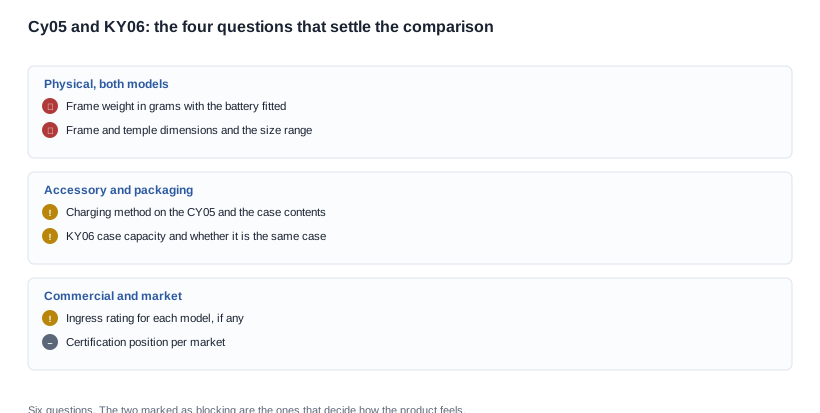
Four questions that settle the CY05 and KY06 comparison
These are the questions to ask, and each one is attached to a decision it unblocks.
- What does each model weigh, with the battery fitted and the case excluded? This is the question that answers the form factor comparison, and it is the one a sample unit settles fastest.
- What are the frame and temple dimensions, and is there a size range across which the product can be merchandised?
- What is the case capacity for the KY06, and is it the same case as the CY05's? If it is the same case, the two models converge on packaging; if it is not, the difference is a real product difference that can be written into a listing.
- What is the endurance condition for each — the KY06's range of 6 to 8 hours is the more honest number to work from, and it needs its conditions.
A fifth question belongs alongside them, and it is about the CY05 specifically: how does the CY05 frame charge? The catalogue publishes no charging method for this model, and the answer determines the box contents, the accessory list and whether the customer can replace a lost cable anywhere. It is a single line in a written reply and it sits on the critical path for packaging.
The criteria for evaluating the answers are the same across all five: each must be tied to the model designation, each must state the configuration it was measured on, and each must say what it excludes. A reply that answers at the family level has not answered, and the reason it matters is that the L1 Pro and the CY05, and the CY03 all publish identical power rows, so a family-level answer for any of them is a plausible answer for all of them.
The criteria to apply before you order
Writing down what a good answer looks like is what turns a comparison into a due-diligence exercise rather than a conversation. These are the five items with the standard each one has to meet.
- How to evaluate the weight answer: a figure in grams for the frame with the battery fitted, the case excluded, and a note of how many units were measured.
- How to evaluate the dimensions answer: frame width, lens width and height, bridge and temple length, with the temple's adjustment range if the temple adjusts.
- How to evaluate the case answer: the capacity for the KY06, the case's own mass and dimensions for both, the charging interface and the recharge time.
- How to evaluate the charging method answer: a stated interface for the CY05, because our catalogue publishes no charging method row for this model at all.
- How to evaluate the endurance answer: the workload behind both ratings, so that the CY05's point figure and the KY06's range can be read against each other rather than merely counted.
The red flags are the same ones that appear throughout this range: an answer that applies to the family rather than to the model, a figure with no date, a capacity given for one configuration and assumed for another, and a case described by what it does rather than by what it holds. When you assess a reply against a written standard you can show your reasoning to a colleague, and when you assess it against an impression you cannot.
Our Cy05 position on form factor
The CY05 and the KY06 are not a form factor pair in any useful sense, because the numbers that would tell you how they feel are not published for either model, and the published differences are a cell size, a disclosure type and a positioning line. We will not describe the KY06 as a sport camera or imply that it carries the sport treatment, and we will not substitute the MT6's 158 g for either model in this pair. Where our data is thin, we will say it is thin.
We will also say that the KY06's 6-to-8-hour range is a better disclosure than the CY05's single figure, that the KY06's published magnetic charging method is a more useful row than the CY05's absent one, and that the CY05's published 1400 mAh case capacity is the largest in the camera family. Those are the structural differences, and they are what the comparison actually rests on.
The CY05 specification list sets out exactly what is published for this model, and the CY05 and CY03 price positioning analysis handles the harder question of running two specification-identical products in one range.
Related reading
- This model's published figures — CY05 smart glasses specifications and features
- A model with a published weight to compare against — MT6 smart glasses specifications and features
- Building a camera range — AI camera glasses which model to pick
Tell us the channel, the target market and the volume, and we will confirm which configurations exist and which physical details still have to be measured.


