

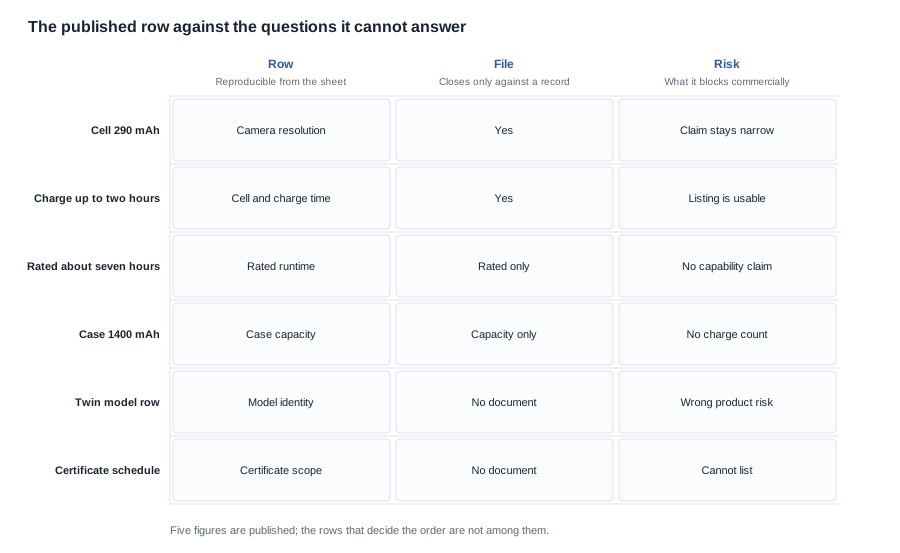
The published row for this model is an 8-megapixel camera, a 290 mAh cell, a charge time of up to two hours, roughly seven hours of rated use, and a 1400 mAh charging case.
Another model in this range publishes exactly the same rows. Not a similar cell, not a comparable case — the same numbers in the same order. That makes the first and most important question a buyer can ask about this product not a specification question at all, and this checklist is built around it.
So a cy05 smart glasses what to check before ordering question has an unusual answer: the specification table is the least useful document in the file. It tells you what the product contains and almost nothing about whether you have been quoted the product you want, whether you may describe what it does, or what an order will cost. The first check decides which product you are buying. The rest decide what you can say about it and what happens when it arrives.
CY05 smart glasses: the identity question that outranks the sheet
Ask first: which product have I been quoted?
That is not a rhetorical question. When two models publish the same camera figure, the same cell, the same charge time, the same rated use and the same case capacity, a specification comparison cannot distinguish them, and neither can a listing built from that comparison. A buyer who orders "the 8 MP model with the 1400 mAh case" has ordered an ambiguous product.
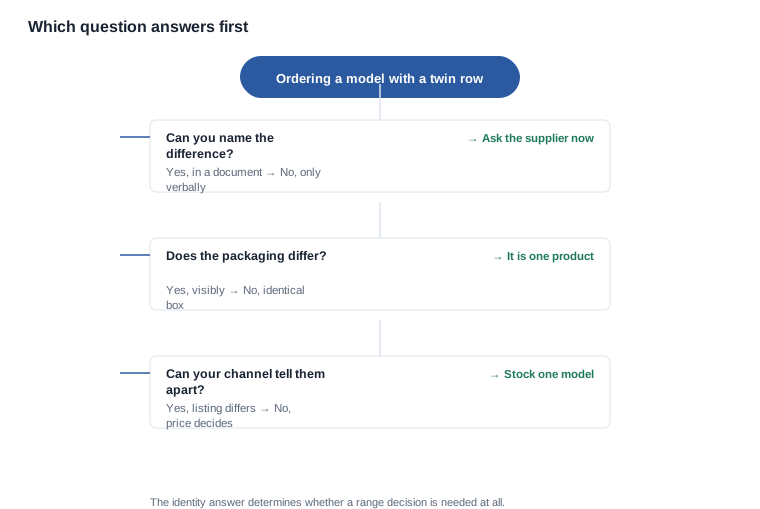
Three questions, asked together, resolve most of the ambiguity.
- What distinguishes this model from the other one in the range with identical rows — in writing, in a document you can file.
- Does the distinction appear on the packaging and the label? Two products that ship in identical boxes are the same product, whatever a catalogue says.
- Is the difference one of bill of materials, of certification scope, or of intended market? Each of the three produces a different answer to the question "should I stock both".
There is a version of this check that is nearly free and one that is nearly impossible. Ask before the purchase order and it is a sentence in an email. Ask after the first shipment it is a range withdrawal, a retailer conversation and a write-off. The asymmetry is enormous, and the reason it is easy to get wrong is that nothing about it feels urgent at the moment the enquiry is written.
And a practical way to make it non-urgent-proof. Put the identity question as item one in a numbered list, and make every later item conditional on the answer. A numbered enquiry is self-ordering: if item one comes back ambiguous, the rest is not wasted work, because the whole list is now a single follow-up.
Why the identity check has to come first rather than sit in a list. Everything else depends on knowing which product you are buying. A certificate schedule applies to one product; a defect category applies to one product; a sample measures one product. Answering all eight other questions against the wrong product produces a complete file describing something you have not ordered.
What to do with an ambiguous row, concretely. Treat it as a documentation defect to be closed by the supplier rather than a puzzle to be solved by you. Ask for a single sheet that names the model, the model variant and the bill of materials revision it describes, and ask for the date of that revision. A supplier who can produce that in one message has a documentation system you can work with for the rest of the relationship. A supplier who cannot has told you something important about how the second order will go, and you have learned it for the cost of one email.
And a boundary worth stating. Our documentation records the identity question as open. We are not going to publish a difference that our own comparison does not contain, and we are not going to describe two models as one product if they are not. What we will do is tell you the question, tell you why it matters, and tell you which document closes it.
And the reason this is worth writing an article about. It is the most common structural failure in a small catalogue: rows are reused, models are added, and the documentation does not catch up. The result is a range that cannot be planned from its own published data. That is not a reason to avoid the product. It is a reason to buy the file rather than the spec sheet.
What the identical rows mean for a range and for your channels
Assuming you have resolved the identity question, the identical rows still shape the rest of your decision — sometimes more than any difference would.
If the two models are one product, then your range decision is commercial, not technical. You are choosing how many SKUs to carry, how many markets to serve and how much volume to place with one supplier. In that case, negotiate MOQ and price across both, plan a single packaging system, and be honest with your own team about what the second SKU is for. A second SKU with a second listing and no second product is a price point, and treating it as a product line costs you in inventory carrying and in channel confusion.
If the two models differ in certification scope, then the compliance answer is the purchasing decision. The model you may legally list depends on which documents cover it, and the two may not be interchangeable in the same market. That is a much harder position than a price difference, and it is the reason the certificate schedule check is repeated rather than assumed.
A diagnostic that separates the first two cases quickly. Ask whether the two models are quoted from the same production line on the same schedule. Same line and same schedule means the difference is commercial rather than physical. Different lines or different schedules means the two are genuinely different products, and the identical published rows are simply the level at which our documentation describes them.
And the question that settles it permanently. Ask whether the supplier can add a distinguishing line to the specification sheet. If they can, the problem ends for every buyer who orders after them. If they cannot, the ambiguity is structural, and your own file is the only place it will ever be recorded — which is a good reason to write it down carefully.
If the two differ in bill of materials, then the identical rows are a documentation coincidence and you need the rows that actually differ. Ask for them specifically, because our published comparison does not contain them and we are not going to manufacture a difference to fill the gap.
A fourth consequence, which is the one that shows up in the numbers. A specification table that cannot distinguish two products makes price the only visible variable, and price is the variable you have the least control over. Any differentiation you build that is not in the specification row — a bundle, a colour schedule, a warranty term, a packaging format — is differentiation the competitor cannot answer with a lower number. Decide which of those you will build before you build the listing, because the packaging artwork is the item with the longest lead time in the whole process.
Three commercial consequences of the identical rows, whichever answer you get.
- A specification-led listing strategy does not work here. If your channel decides on parameters, two identical products compete on price and the higher-margin SKU loses. Decide whether you can differentiate on something other than the row — colour, packaging, bundle, warranty — before you build the listing.
- Channel training has to name the difference explicitly. A retailer who cannot tell the two apart will sell whichever is cheaper, and the channel's own discounting behaviour becomes the mechanism by which your range collapses.
- Your inventory has to treat them separately. Separate listings, separate barcodes, separate stock lines, and separate reorder decisions — otherwise the sell-through of one will silently reorder the other.

Closing the gaps, one document at a time
The published row is five figures. Everything that determines whether you can sell the product is outside them, and each gap closes against a specific document.
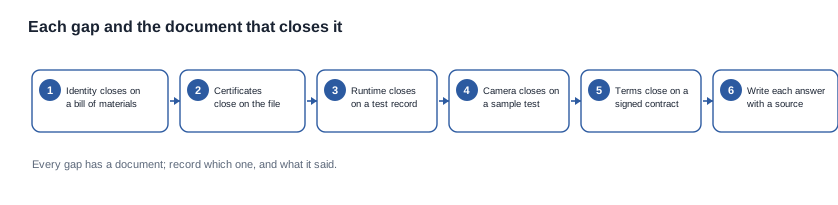
The list, with the source for each.
- Model identity — closes against a bill of materials, a product name or a packaging specification. Ask first.
- Certificate numbers, issuing bodies, validity periods and the model schedule each covers — closes against the certificate file itself. Our documentation publishes none of these for this model, and we will not imply that they exist. See certification checklist and CY05 certification status.
- Runtime test condition — closes against the test record behind "roughly seven hours". A rated figure with no stated condition cannot be repeated as a capability.
- Charge-time measurement state — closes against the same kind of record: from empty or from partial. Our documentation does not state which applies.
- Camera parameters — sensor model, pixel size, field of view, video resolution, frame rate, aperture, and the storage and transfer route. None is published, and the storage route is the one most often discovered late. See camera imaging.
- Physical parameters — frame weight, temple length, lens dimensions, lens material, and the ingress position with its report.
- Case position — whether it is a charging dock or a held-charge power bank, its own charge time, and how many frame charges it delivers. The published 1400 mAh figure is a capacity, not a count.
- Commercial terms — MOQ, lead time baseline, unit price at volume including packaging, payment terms, deposit, warranty terms and defect categories. None is published. See MOQ, lead time, pricing, payment terms.
Two further gaps that belong in the same document and are usually raised a year too late. First, whether the case is included in every shipped configuration or is an optional line, because that decides whether your MOQ is one number or two and whether your packaging is one artwork or several. Second, whether the case is covered by the same warranty as the frame. A case that ships in the box and falls outside the warranty is a position that will eventually reach a customer, and it is much cheaper to learn at the quotation stage.
And a third, which is a compliance question rather than a commercial one. Two cells cross a border, not one, and the transport position for the case cell is a separate document from the one covering the frame. See battery transport. A buyer who treats the case as an accessory will treat its cell as an accessory too, and accessories get missed.
A note on how the runtime and charge rows interact with the case. The frame's rated use, the case's capacity and the case's charge time are three figures describing a system, and a customer will combine them into a single number. Ask what combination the supplier's own documentation supports, and state it that way, rather than letting the customer's arithmetic produce a claim you have not checked.

Building the file so the second order is cheap
This section is about a file rather than a product, and it is the part of the checklist that pays back fastest.
A technical file for one model should contain, in one place and dated: every published row with its source. Every supplier answer, attributed and dated. Every certificate number with its validity date and the model schedule it covers. Every gap, with a note of whether it was closed, carried or abandoned. And every decision you took about a gap, with a reason.
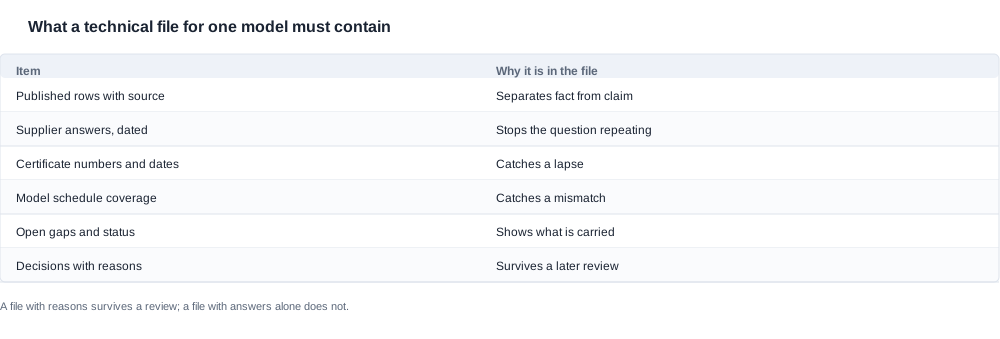
Why the reason matters more than the answer. A gap that was carried into the first shipment because the destination market did not require it yet will be reviewed at the second order by someone who was not present when it was decided. A file that says "carried, because the market does not require it yet" survives that review. A file that says "carried" does not.
Two more, for a total of five. Record who answered, not only what they said — a specification sheet from a factory and a specification sheet from an agent carry different weight when you are trying to establish whether something is documented or merely repeated. And date the file's review points in advance, because the review that happens by accident never happens.
Three habits that make the file real rather than decorative.
- Write the source next to the claim, not the claim alone. "1400 mAh case" is a number; "1400 mAh case, model row, publish date" is evidence.
- Record refusals as carefully as answers. A supplier who declines to state a test condition has given you information, and the next person should not have to ask again.
- Review the file before each new market and before each reorder. A certificate that lapses mid-range stops a product that is otherwise fine, and nothing else in the process will tell you.
One more habit, and it is the one that costs the least. Keep the file in the same format as the questions were asked — a numbered list — so that a follow-up enquiry is a copy of the previous one with the unanswered numbers repeated. A supplier who skipped item four will recognise item four immediately on the second message, and the elapsed time on a stalled documentation exchange collapses from weeks to days.
And a note on what the file is not. It is not a compliance dossier that makes the product sellable, and it is not a substitute for the certificate itself. It is the record of what you were told, by whom and when, which is the thing that is missing when a customer question arrives two years later and nobody can reconstruct why a claim was written.
What to write the listing from. The file, and only the file. A listing built from the file will be narrower than one built from ambition, and it will be defensible when a customer or a regulator asks where a claim came from.
The order of work, and what holds the purchase order
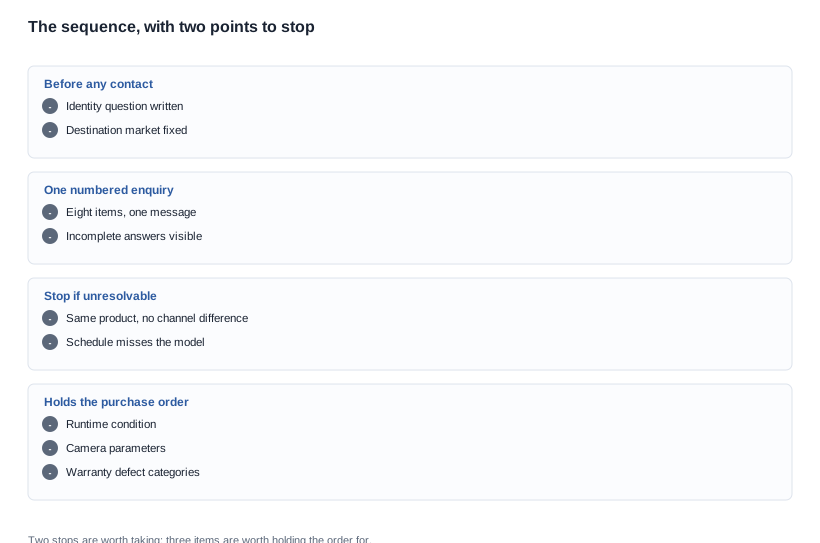
Here is the sequence, with the two points at which it is reasonable to stop and reassess.
Before any supplier contact. Write the identity question. Write the destination market. Write the three sentence shortlist criteria. Write the claim you intend to lead with, because it determines which gaps block you and which do not.
In one enquiry. Ask all eight items, numbered, in a single message. A numbered enquiry makes an incomplete answer visible, which a conversational one does not, and it lets you quote the numbering back when you ask again.
The first stop. When the identity answer arrives. If the answer is that the two models are the same product and your channel cannot differentiate them, stop there — the commercial answer to that is to buy one, not two, and that decision is cheaper now than after an artwork approval.
A short note on running two enquiries in parallel without creating a mess. If you are also shortlisting the other model in the range, send both enquiries from the same document, with the model name changed in item one and nowhere else. Anything else you vary between them destroys the comparison, because the differences you are trying to observe are differences in the answers rather than in the questions.
The second stop. When the compliance answer arrives. If the certificate schedule does not name the model you have been quoted, stop, because nothing downstream is worth completing until that is resolved.
What holds the purchase order after that. The runtime test condition, the camera parameters, and the warranty defect categories. All three can be closed after the order in a well-run negotiation, and none of them should be, because each of them changes what you may write on a product page.
For completeness, the three items that are usually safe to defer, and the conditions under which they are. Physical dimensions are safe if your channel does not publish sizing guidance and your listing makes none. Packaging detail is safe if the artwork is already approved and unchanged. Secondary camera parameters are safe if your listing states only the resolution figure and makes no picture claim. Each of those conditions is a constraint on your own behaviour rather than on the supplier, which is exactly why they are safe — and why they stop being safe the moment you decide to add a benefit-led sentence to the page.
And what is genuinely safe to defer. Physical dimensions, if your channel does not publish sizing guidance. Packaging detail, if the existing artwork is approved and unchanged. And the secondary camera parameters, if your listing states only the resolution figure. Each deferral should be written into the file with the reason it was safe.
Our position on this model is that the published row is usable and the identity gap is the real risk. We will not present 8 megapixels as a picture-quality claim, we will not present roughly seven hours of rated use as a measured endurance without its test condition, and we will not resolve the question of which of two identically specified models has been quoted inside a sales conversation. Tell us the channel, the volume, the destination market and whether you intend to stock one model or two, and we will tell you which checks hold the purchase order and which can follow it.
Related reading
- Where the model sits against its twin — CY05 compared across the range and the price positioning view
- Where the documentation gaps sit — CY05 limitations
- The power rows — CY05 battery life and charging options
- Which job the model suits — CY05 best for


