

The CY05 publishes five rows a buyer can quote without hesitation: an 8-megapixel camera resolution, a 290 mAh frame cell, a charge time of two hours or less, a rated runtime of about seven hours, and a 1400 mAh charging case. Seven further rows that a buyer would reasonably expect to find are missing, and two of the seven are the ones that stop a deal being closed on paper — the difference between the CY05 and the CY03, and what the camera actually is.
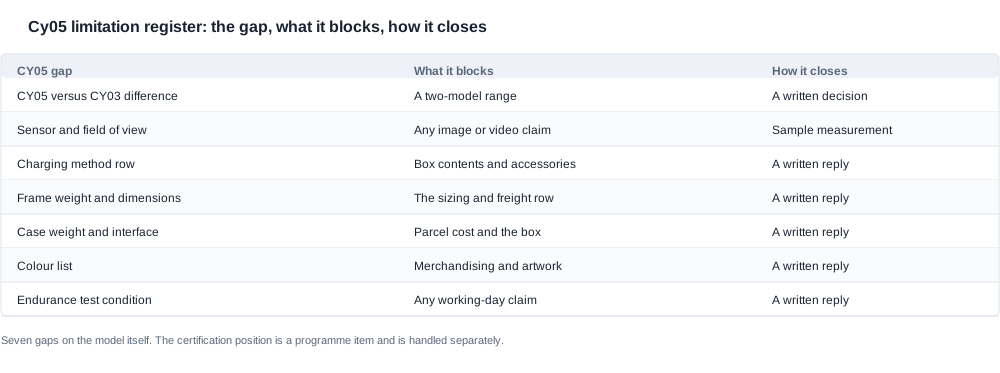
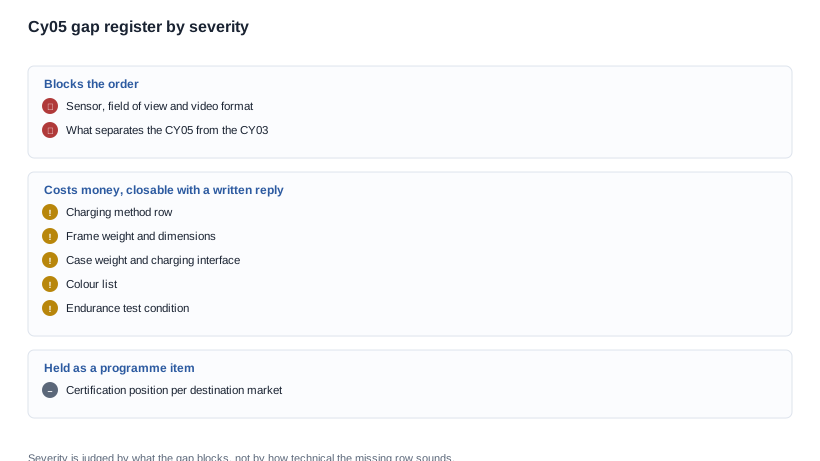
The useful way to read a limitation list is not as a list of complaints but as a register of decisions. For each missing row, ask one question: what does this gap actually prevent? Two of the CY05 gaps prevent a decision being taken at all. Five of them cost money and delay, but none of them prevents the order. One further item, the certification position for this model in each destination market, is not a specification gap at all — it is a programme item with the longest timeline in the list, and it should be started earlier than the others rather than later.
Cy05 limitations: the two that stop an order on paper
The first is the difference between the CY05 and the CY03. The two models publish identical specifications — 8 megapixels, 290 mAh, two hours or less, about seven hours, a 1400 mAh case — and our catalogue does not state what separates them. Not "the difference is minor", and not "the CY05 is the upgraded version": nothing at all.
A brand that intends to run both is running two stock-keeping units of one product with an undocumented difference. The customer cannot tell them apart either, and the channel partner will ask. A document that names the CY03 does not automatically cover the CY05, even where the two are electrically identical, so this gap sits on the compliance side as well as the merchandising side. Get the answer in writing before either model is ordered. The CY03 versus CY05 price positioning analysis sets out what each possible answer means commercially, and the A05 versus A06 specification comparison covers the same problem in the children's category, where the pattern of two models sharing published rows is identical.
The second is the camera. Eight megapixels is published, and nothing else about the imaging is: no sensor model, no field of view, no video format, no frame rate, no low-light behaviour, no storage arrangement.
This model is a camera product, and the value of a camera product rests on the picture. A resolution figure with no sensor model behind it is a shelf argument rather than a quality argument, because a 13-megapixel sensor with small pixels produces a worse image than an 8-megapixel sensor with large ones. The field of view decides whether the product works for first-person video at all. The storage arrangement decides whether it stops recording silently in the middle of a session, which is one of the most common reasons a camera glasses unit comes back. The camera imaging notes explain why those are the numbers to chase, and the CY05 buyer review checklist turns them into a sample-stage plan.
Why these two are on the critical path
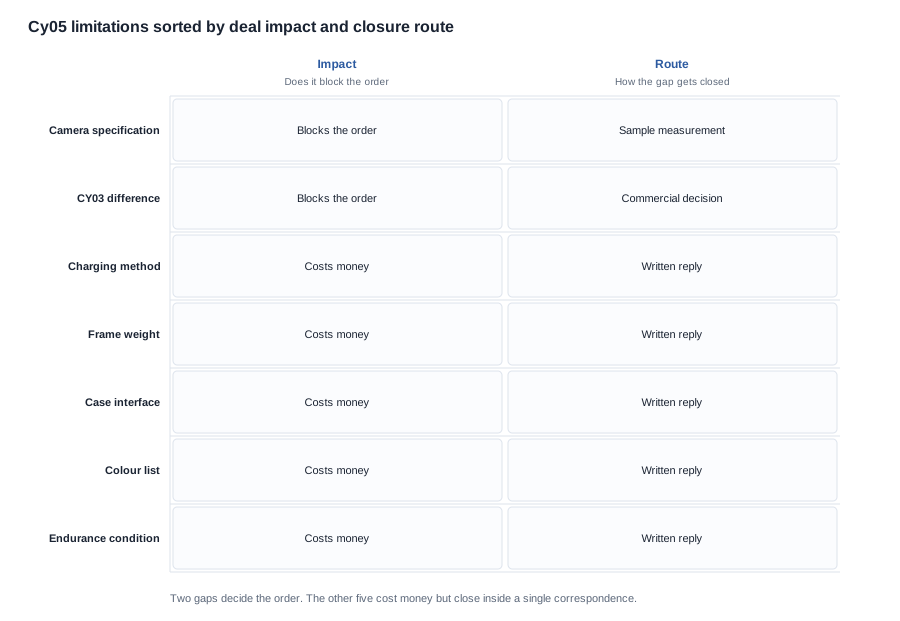
The reason these two gaps stop an order, while the other five do not, is that they change what is being bought rather than how it is described.
The CY03 difference changes the quantity and the shape of the range. If the answer is that nothing differs, the order should contain one model. If the answer is a colourway or a packing format, two models are legitimate and the packaging artwork needs to reflect it. Either way the answer changes the purchase order, and it changes it before the goods are made rather than after.
The camera specification changes the product itself. If the field of view turns out to be narrow, a first-person video brief has to be rewritten or a different model chosen, and that is a change to the marketing plan and the channel plan at the same time. Both gaps are therefore decision gaps, and both are closed by a single exchange of correspondence or a single sample unit rather than by a long qualification.

The five CY05 gaps that cost money but can be closed
The charging method row is absent. This one surprises buyers, because seventeen models across our catalogue publish magnetic charging and seven publish a Type-C interface, so the reasonable assumption is that one of the two applies to the CY05 as well. It does not follow. The CY05 catalogue entry publishes a pixel row, a cell capacity, a charge time, a runtime and a charging case capacity — and no charging method row. The same absence applies to the CY03 and the MT6, and the L1 Pro.
It matters more than it looks. A magnetically charging frame needs a dock or a pad in the box and the customer has to learn a charging orientation; a Type-C frame lets a customer replace a lost cable anywhere and needs no proprietary accessory. A buyer designing the accessory chain on an assumption is designing a box that may have to be reworked, and box rework late in a programme is one of the most expensive hours a buyer can spend. One line in a written reply closes it.
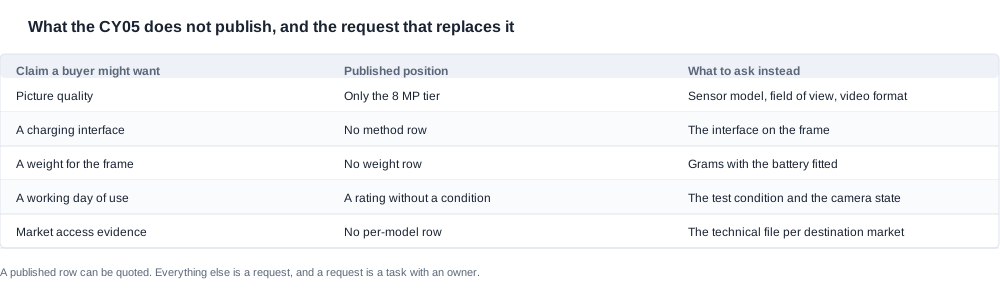
The frame weight and dimensions are not published. Neither is a row in the CY05 entry. Our catalogue publishes exactly one frame weight anywhere, and it belongs to the MT6: 158 g for the glasses body including its battery and camera, excluding its folding charging case. The CY05 carries a larger cell and a different case configuration, so that figure is not a proxy for this model.
Weight and dimensions decide three things at once — the sizing of a range for a brand selling across a size band, the freight class of every shipped unit, and the return rate that follows from a product that does not suit the customer. The shipping weight analysis covers the parcel arithmetic, and the MT6 specification list covers what that model's published weight does and does not tell you.
The charging case's own mass, dimensions, charging interface and charge time are not published. The 1400 mAh capacity is published; nothing else about the case is. The case is the heaviest item in the box, and whether it needs a separate cable is the difference between one accessory and two for the customer. A case that is charged by the same cable as the frame and a case that needs its own lead are two different retail experiences and two different accessory lists. The CY05 charging options analysis works through the economics of that choice.
The colour list is not published. No colourway is named for the CY05 in our catalogue. For a brand with a merchandising plan that is not a preference, it is a lead time: a new colourway means new tooling, new samples and new packaging artwork, and none of that appears on a lead time that was quoted against a standard configuration. It also decides whether the packaging can be shared with the CY03, which is the question that sits underneath the range question in the first section.
The endurance test condition is not published. The rated figure is about seven hours, and what was running during that measurement is not stated. On a product with a camera in it, the camera is the dominant load, so the condition is not a technical footnote — it is the difference between a figure that describes continuous capture and one that describes a mixed workload. The method for comparing battery life sets out the question to ask and the way to write the answer into a specification.
Which of the five to chase first
Order matters here, because a buyer with limited supplier goodwill — and a supplier with limited time — will not answer five questions in the order they were asked.
The charging method comes first because it is the cheapest question to answer, the shortest to reply to, and the one that changes the box contents, the accessory list and the customer instruction card. It also determines whether the second question, about the case interface, is even relevant: if the frame charges magnetically, the case may be the dock.
The frame weight comes second because it feeds the freight model, the size range and the return exposure, and because the answer is a single number that a supplier can state without opening a document.
The colour list comes third, because the answer determines artwork, and artwork is the item with the longest downstream tail in a launch plan.
The case details come fourth, because they are only fully meaningful once the charging method is known, and the endurance condition comes fifth, because it is the item most likely to arrive with the sample data rather than with a written reply.
The item that is not a limitation but a programme
Certification is different in kind from the other seven. It is not a missing specification row; it is a piece of paperwork whose absence blocks market access rather than a purchase decision. Our catalogue carries a company-level export certification page whose content is images rather than text, and its text contains no reference to CE, FCC or RoHS anywhere. There is no per-model certification row for the CY05 or for any other model, and there is no record of a pending confirmation either.
That means the certification position for this designation has to be requested as a formal file for each destination market, and it has to be requested at the start of a programme rather than at the end of one, because its timeline is the least compressible item on the list. The certification status for the camera range sets out the route we would follow for this model, and the export documentation checklist lists the paper that has to travel with the goods.

The CY05 rows that are strong enough to build a range on
A limitation list that only lists gaps is not useful, because a buyer still has to decide. Here is what the CY05 genuinely gives you, stated at full strength.
The platform. The CY05 sits on the 290 mAh group with the L1 Pro and the L2 Utral, and the CY03, and that sharing is what makes a multi-model camera range affordable to qualify: one app, one firmware branch, one accessory family, one box structure and one certification file for the family. The model readiness overview covers how the sharing works, and the scaling piece covers what each extra model costs once the platform is qualified.
The case. 1400 mAh, and roughly five times the frame cell — a derived comparison rather than a published figure. It is the reason the product can be sold on an all-day proposition rather than on a session, and it is the largest single line in the delivered cost, which is the trade the price comparison across the camera range works through.
The resolution tier. Eight megapixels places the CY05 in the larger of the two camera tiers in our range, alongside the MT5 and the V03 Pro, the MT6 and the V03, and the V06 and the KY06, and the CY03. That is not a quality claim, but it is a positioning fact: the model sits with the entry and volume tier rather than at the top of it.
A clean published charge ceiling. Two hours or less is stated, and a ceiling is a better thing to have than an estimate because it bounds the overnight turnaround without over-promising.
Turning each CY05 gap into a purchase order clause
The practical value of a limitation list is what it lets you put in writing. Each of the seven gaps converts into a clause, and a clause that names a value and a verification method survives the handover from the procurement desk to the quality desk.

The rule is simple. For every gap, write the value you are relying on, the evidence you will accept, and the consequence if the evidence does not arrive. For the charging method, that is: the interface in writing, confirmed visually on the first delivered unit, with any accessory mismatch reworked at the supplier's cost. For the frame weight, that is: the weight in grams with the battery fitted, verified on a sample against a stated tolerance, with a re-weigh clause on the first shipment. For the camera, that is: sensor model, field of view and video format stated before the listing copy is written, with a sample capture retained as the reference file.
Two of the clauses need a decision rather than a measurement. The CY03 difference clause records the supplier's own answer, attached to the product file and referenced by the purchase order, and it should also state what happens if the answer changes. The certification clause records the file per market, its issue date and its validity period, because a certification document that names one designation does not automatically cover another.
The clause that gets forgotten is the endurance condition. Write the runtime with the workload next to it — camera active or not, radio connected or not, and the starting state for the charge figure — so that the number in your specification and the number in your customer-facing copy are the same number with the same qualifier attached. The CY05 battery life analysis takes the rated figure in more detail.
A contingency if the two blocking gaps stay open
It happens that a supplier will not answer, or will answer a family-level question that does not settle the model-level one. A buyer needs a plan for that situation before it arrives, because the default response is to proceed anyway and hope the gap does not matter. It usually does.
If the CY03 difference stays open, the fallback is to run one model. A single stock-keeping unit from this platform is a defensible position: the case and the cell are the same, and the published rows give a customer nothing to compare. The cost of running one model is a narrower range and a lost second price point; the cost of running two indistinguishable models is freight on every unit, an artwork revision when the difference is eventually disclosed, and a channel partner asking why your two listings are the same. If the gap is still open when the first purchase order is drafted, write the single-model decision into the purchase order as a stated assumption rather than leaving it implied.
If the camera specification stays open, the fallback is to change what is being claimed rather than to guess. There is a version of this product that can be marketed on the case, the runtime and the resolution tier, with no picture quality claim anywhere, and that version is viable in a channel where the customer buys the accessory story. What is not viable is a listing that says eight megapixels and implies the picture is good. If the sensor model and field of view cannot be established, the safe route is a sample capture retained in the product file as the only visual evidence — not a written claim, but a file that can be shown internally and, where the channel allows it, used as the source of the product imagery.
Both fallbacks have a cost, and both are cheaper than discovering the gap after the goods are made. Write them down while you still have the choice.
How to score the answers when they arrive
Before you order, write down what a good answer looks like for each of the seven items. That step is what separates a due-diligence exercise from a shopping list, and it is what lets you evaluate a reply rather than react to it.
Use these criteria as the scoring frame, and require the answers to be attached to the CY05 designation specifically rather than to the camera family.
- How to evaluate the CY03 difference answer: it must name the difference in the supplier's own words, and it must say whether it applies to the current production configuration or to an earlier batch.
- How to evaluate the camera answer: it must include a field of view figure and a video format, and it must state whether the value applies to stills, to video, or to both.
- How to evaluate the charging method answer: it must name the interface and say whether the frame can be charged without the case, because that is the question the box contents depend on.
- How to evaluate the weight answer: it must be a number in grams with the battery fitted, and it must say whether the case is included, because our one published figure in this range is 158 g for the MT6 glasses body excluding its folding case.
- How to evaluate the colour answer: it must list the colourways in production, and it must say whether the tooling is shared with the CY03.
- How to evaluate the endurance answer: it must state the workload, the starting state and whether the figure is a mean or a best case.
- How to evaluate the certification answer: it must name the market, the document, the issue date and the model designations covered.
Any answer that arrives as a family-level statement rather than a model-level one should be treated as unanswered rather than as partially answered, because a family-level answer is what produced the gap in the first place. Treat that as one of the red flags to watch for, and treat a supplier who volunteers the missing context — which model a figure applies to, which configuration it was measured on, what a figure excludes — as evidence that the rest of the documentation will hold up under a sample inspection.
What our CY05 documentation will not fill in for you
We publish the CY05's five rows and we publish them as the rows they are. We will not present 8 megapixels as an image quality claim, because the sensor model and field of view that would support it are not in our documentation. We will not present the about seven hours as a working day, because the condition behind it is not published. We will not quote a frame weight, a case weight, a colour list, an ingress rating or a certificate number for this model, and we will not fill an unpublished row with a typical value from elsewhere in the range.
We will also not treat the 158 g figure as a substitute. It is the MT6 glasses body, including its battery and camera and excluding its folding case, and the CY05 is a different object with a different cell and a different case configuration.
What we will do is give you the register, the closure route for each item, and a straight answer about which two of them have to close before an order can sensibly be placed. The published CY05 specification list is the honest baseline for this model, the commercial case for the CY05 covers what the published rows are worth once they sit inside a range, and the CY05 common questions page sets out the same gaps as a buyer question list.
Related reading
- The specifications this model publishes — CY05 smart glasses specifications and features
- The unresolved duplication — CY03 versus CY05 price positioning
- Why it makes commercial sense — CY05 smart glasses value for money
Send us the target market, the volume and the range you are planning, and we will tell you which of the seven items are on the critical path for your order.


