
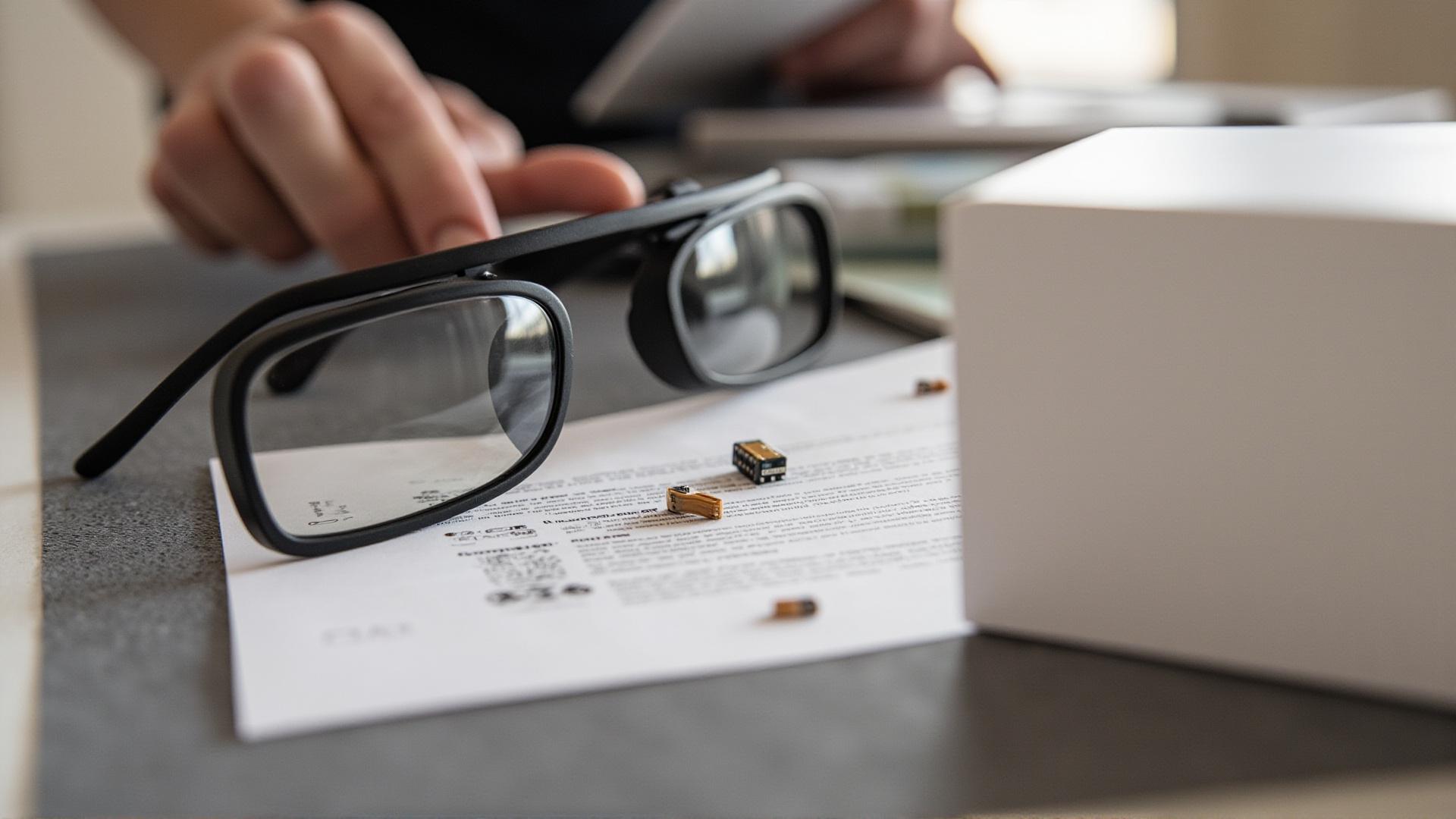
A d17 smart glasses buyer review checklist is a bench document, not a reading document. It exists because a sample shipment carries a limited amount of evidence, the evidence has to be extracted in a particular order, and the order matters more than it appears. Open the box and start photographing before anything else is done, and the accessory position is fixed for good. Weigh the frame before the first charge cycle, and the weight figure is fixed for good. Test the remote shutter after the battery has run down, and the test tells you nothing. The checklist below is the order we would use.

What the D17 is, for the purposes of the bench. A sport model with a 115 mAh cell, a charge time of about one hour, a use time of about seven hours, charging over Type-C, Bluetooth V5.4, a remote control photo row and a surround sound row. It publishes no camera row, no frame weight, no ingress rating, no charging case row and no per-model certification row. Every one of those absences becomes either a check on the sample or a document request, and the two are never the same thing.
D17 buyer review checklist: the order of the checks, and the order of the failures
A review fails in a predictable order, and the sequence below is built around that order rather than around convenience.
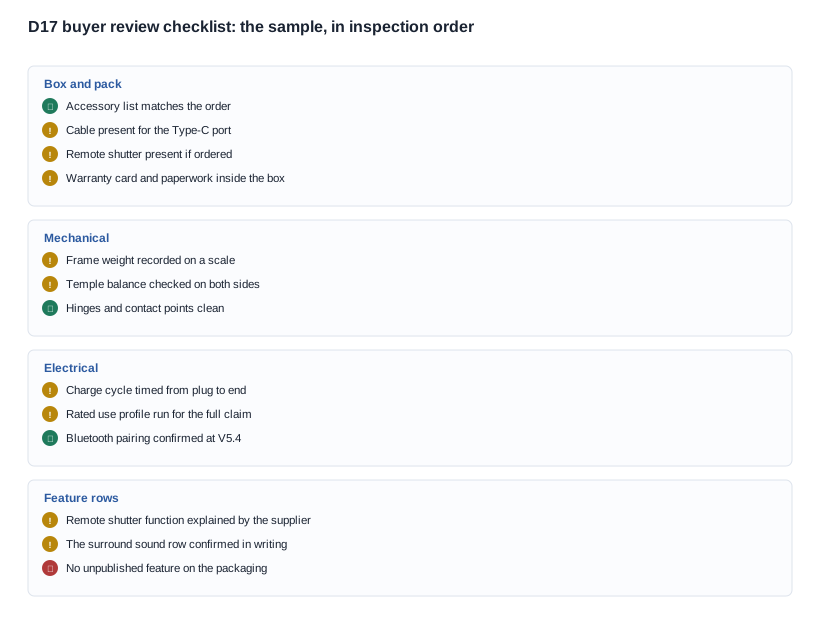
The failures that cost a channel money arrive in this order: the wrong thing in the box, then a mechanical fault, then an electrical fault, then a feature that does not do what the page says, and last a documentation gap that surfaces after the goods have shipped. The first three are visible in the first hour of a sample inspection. The fourth needs a conversation with the supplier. The fifth needs a document request that should have started before the sample was ordered.
The rule that protects the rest of the inspection
Photograph the sealed carton and the contents before anything is unpacked, and do it in the order the items come out. Every later check depends on the pack position being recorded rather than reconstructed. A missing accessory discovered on day nine of an inspection is an argument; the same accessory discovered on day one, in a photograph, is a finding. This is the cheapest rule on the list and the one most often broken, usually because someone opened the box to get at the device and did not think of the carton as evidence.
The second rule follows from the first: record what is present, not what is absent. A list of observed items is a fact. A list of missing items is an inference that becomes harder to defend as the days pass.
The document checks that happen before the carton is opened
Some of the acceptance work happens before the goods arrive, and doing it first saves a supplier conversation that would otherwise take a week.
The order document itself. Check that the model name on the purchase order matches the model name on the specification sheet, and that the specification sheet is the version that was signed. In a range where three models sit close together, a one-character difference in a model number is a common and expensive error, and it is invisible once the goods are on the bench. The D17 is the sort of model where that error happens: it shares a single-cell Type-C architecture and a remote-photo row with the ZH12, and the published row differences are small enough to be misread.
The certification trail. The catalogue has no per-model certification row for any of the 28 models, and its export certification page is a company-level page made of images rather than text. So nothing about the D17's compliance position arrives with the goods, and it has to arrive with a document request. What to ask for, and in what order, is set out in the D17 certification status piece, and the working list is on the certification checklist.
The transport file. The catalogue publishes nothing about the cell's transport documentation, and a UN 38.3 test summary is a document that a freight forwarder or a carrier will ask for at the shipping stage, usually at the worst possible moment. The battery transport compliance pages cover what that file normally contains and who holds it.
The commercial record. The minimum order quantity, the delivery plan, the warranty term and the payment milestones should all be on the same document as the specification sheet, so that the sample you are about to inspect is the sample the order refers to. The contract terms page covers how that document is usually structured, and the factory audit page covers what to ask for when a channel wants to see the production line rather than the paperwork.
None of these four checks needs the carton, and all four are cheaper to run before the shipment than after it.
The sample request itself, and what to specify on it
A sample order is a small transaction with an unusually large informational value, and most of that value is lost when the request is treated as a formality. A request that says "one D17 sample please" will arrive as a device in a bag. A request that says what the sample is for will arrive as evidence, and the difference is two paragraphs of writing.
Four things belong on the sample request.
The purpose, in one line. State what the sample is being used to decide: a launch date, a packaging decision, an acoustic description, a compliance file, a production tolerance. The supplier can then include what supports that purpose, and a supplier who cannot satisfy the purpose in writing is telling you something useful about the channel.
The unit count. Three units is the minimum worth paying for, because a single unit cannot show a spread and a spread is what a production order needs. If the budget allows for more, take them from more than one production batch if that is possible, because a tolerance measured inside a single batch is narrower than the tolerance the channel will actually receive.
The measurements to be made, not the opinions to be given. A request that asks the supplier to confirm a figure is different from a request that asks the supplier to supply the figure and the condition behind it. The second one produces information; the first produces an echo of the catalogue.
The documents to be sent alongside. The declaration of conformity for this model, the test report numbers behind it, the transport file for the cell, the cell supplier's identification, and the patent numbers behind the export certification page. Attaching them to the sample request rather than raising them separately costs one line and saves a cycle.
The sample ordering page covers the commercial side of the request, and the sample order procedure sets out the wider set of checks that a broader programme would run on this model. What matters for this checklist is that the sample request and the inspection plan are written as one document, so that the person who receives the carton knows what the person who wrote the request wanted to learn.
On the bench: power, pairing and the remote shutter
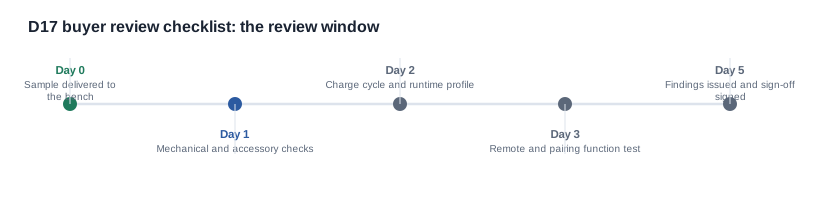
Once the carton is opened and photographed, the electrical checks follow, and the order within them is the part that matters.
Step one, the mechanical pass
Weigh the frame on a scale and record the figure. The catalogue publishes no weight for this model, and it publishes a weight for exactly one model in the whole range, so the measured number is the only number that will exist. Do it before the first charge cycle, because a frame that has been on charge is a frame that has been handled more than a frame that has not, and the difference is small but the record is cleaner without it.
Check the temple balance on both sides, the hinge play, the condition of the charging contacts and the seating of the pads. These are the observations that correlate with returns in this category, and they take three minutes on a sample and would take a year of returns to establish from sales data.
Step two, the charge cycle
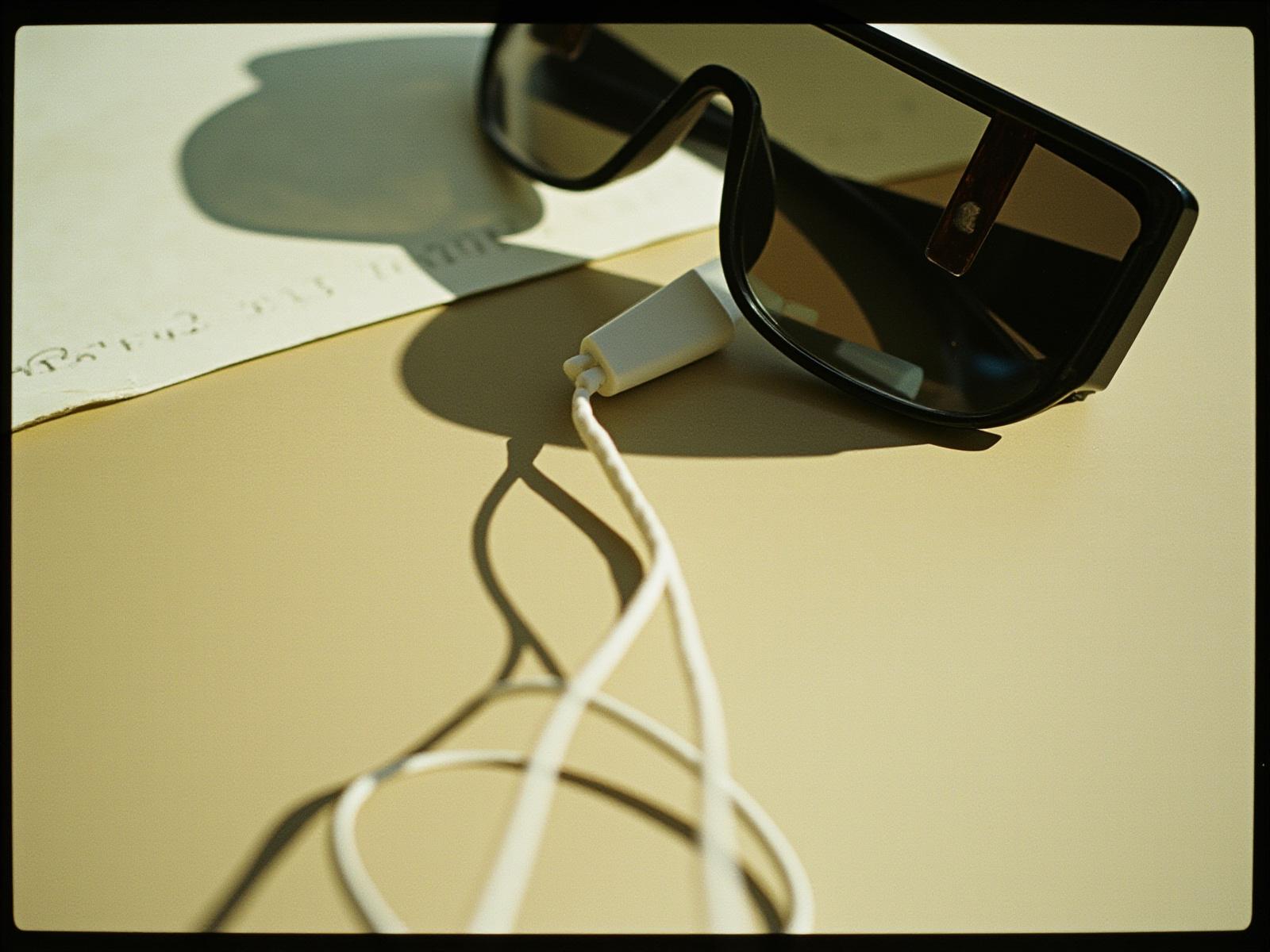
Plug in the Type-C cable and time the cycle from connection to the end criterion. The published figure is about one hour; what you record is the time your units actually take, with the start state and the end criterion written alongside it.
Two questions have to be settled while the cycle runs. First, what the end criterion is, because the catalogue does not state it, and a device that reports full at a different point from the one the supplier used will produce a different time. Second, whether the remote shutter is connected during the cycle, because the catalogue does not say whether the remote is separately powered or draws from the frame, and the answer changes the frame's idle draw. Both of those belong in the same paragraph as the timing, and both of them are questions to ask in writing.
Step three, the pairing and the audio path
Pair the device and confirm the connection at V5.4, the published version. Then play audio at a stated volume for a stated period, because a runtime claim measured at low volume is not a runtime claim that describes a customer. Record the volume level with the result. The D17 battery life piece sets out the use profile in full, and the D17 charging options piece covers the cycle itself from the specification side.
Step four, the remote shutter
This is the check most likely to fail, and it fails for a documentation reason rather than a hardware reason. The D17 publishes a remote control photo row and publishes no camera row, because the D17 is an audio product in the sport group. So the device carries a shutter control and does not record, and the catalogue does not explain what the control operates.
There are several possibilities — triggering a paired phone, operating a separately sold unit, or an artefact of a shared platform — and every one of them is speculation until the supplier answers in writing. So the bench step is not really a function test. It is a question asked in front of the supplier, with the answer recorded, in the supplier's own words, with a date. A supplier who cannot answer it does not have an answer to give, and that is a finding in itself. Do not put a shutter claim on a product page for a device that does not record, because a reviewer will ask within a week of launch.
Step five, the surround sound row
The D17 publishes a surround-sound row. Nothing further is published about it: no driver size, no response, no description of the acoustic construction. On a bench you can confirm that the feature behaves differently from the device with it off, and that is the limit of what a sample can establish. A written acoustic description is a document request, and it belongs on the same list as the remote shutter question.

The failure signatures worth catching on a sample rather than in the field
Some defects are visible in an afternoon and invisible in a spreadsheet. These are the ones worth the bench time.
The contacts that do not seat. A Type-C port on a frame is small, and the failure mode is a cable that charges intermittently at a particular angle. The check is to charge from three or four cable positions and to move the cable while connected. This is the single most common field failure in this category and it is nearly impossible to see from a sales report, because the customer tries a different cable, or a different angle, and then it works.
The remote that arrives without the unit. Whether the remote shutter ships in the box, and whether it is a separate order line, is not published. A sample that arrives with a remote and an order that arrives without one is a supply chain failure that looks like a product failure in the customer's hands. The D17 common questions article treats the same row as a question to close before the order.
The case that is not in the pack. The catalogue does not publish a charging case row for this model. That is an absence of a published row, not a statement that no case exists, and the difference matters commercially: a channel that promised a case in the copy and then discovers there is none has a returns and a reputation problem, while a channel that asked the question first has a packaging decision. Ask it, get it in writing, and record the answer.
The weight that turns out to be wrong for the use case. The measured frame weight is the only figure available, and it becomes decisive the moment a channel knows its own ergonomics requirement. A single cell in the frame concentrates the mass rather than distributing it across the temples, which is a different balance from the two-cell models. The materials and ergonomics page covers how to record the measurement so that it can be compared later.
The packaging that does not survive the channel. A mailer, a retail box and a marketplace pouch are three different shipping environments, and the protection a sample arrives in is often not the protection the channel will use. Record the packaging as it arrives, and make the production packaging a separate line in the specification sheet.
Recording the outcome so the next order moves faster
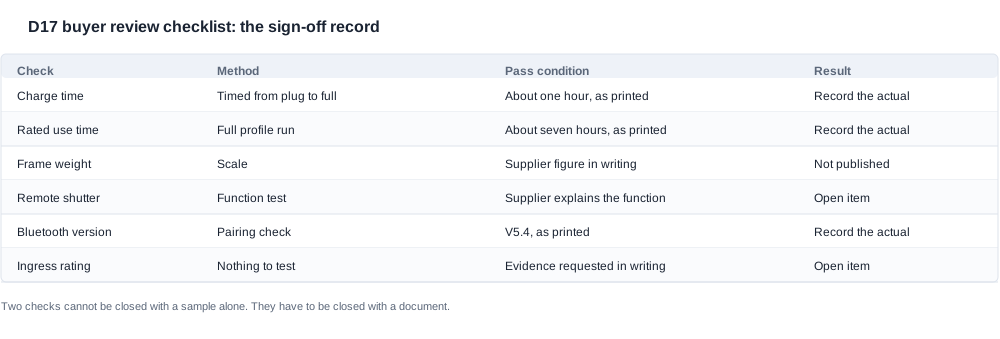
The value of a sample inspection is only realised if the output is a document rather than a memory, and the document has to be reusable. The sign-off record above is the minimum, and it is designed so that the next order can be checked against the same fields without rebuilding anything.
Three habits turn a sample inspection into a repeatable process. Record the unit identifier against every measurement, so a later outlier can be traced to a specific unit and a specific date rather than to a batch in general. Keep the photographs, because they are the only record of the pack position and the only defence if a later shipment arrives differently. Separate the findings from the decisions, because a finding is a fact about the sample and a decision is a judgement about the channel, and mixing them in one sheet is how a specification sheet acquires clauses nobody agreed to.
Then close the loop in the two directions that matter. Feed the measured results into the production order, so the tolerances you measured become the tolerances the factory is asked to hold, which is what the quality consistency page is about. And feed the open items back into the document request, so the next quotation is answered with a fuller file than the last one.
The two items a sample can never close
Some of the acceptance work cannot be done with a sample in the room, and a checklist that pretends otherwise is worse than one that says so. The frame weight can be measured, so that one is closed. The certification scope cannot: it needs a document that names this model, and the catalogue has no per-model row for any of the 28 models, so the scope has to be read against the model name on the document rather than against the family name. The transport file cannot be closed either, because it is a cell-level document the buyer does not hold. Both of these are on the pre-shipment list, and both should be in the file before the first booking rather than after the first shipment.
The commercial pass, done at the same time
A sample inspection is also the cheapest moment to close the commercial questions, because everything is live and everyone is in the room. The minimum order quantity, the production capacity, the delivery plan, the warranty term, the return rate assumption, the payment milestones and the incoterm all get easier to settle while the sample is on the bench than they will in a month of email. The lead time page, the payment terms page and the risk page cover how those conversations usually run.
On the D17 sample, our position is that it is worth more as a measurement instrument than as a demonstration unit, and that the two things a buyer most wants from a sample, the weight and the documentation, are the two the catalogue cannot supply. We will not put a figure in a record that we did not measure, and we will not describe a document we do not hold as a certificate. Send us the model, the quantity, the markets and the pack you intend to ship, and we will tell you which of the checks on this list can be closed by a sample, which has to be closed by a document, and which has to be closed by a negotiation.
Related reading
- Where this model sits — the D17 product page
- The document side of the review — D17 certification status
- The energy checks in detail — D17 battery life
- The order and inspection process — sample ordering
Send us the model, the quantity, the markets and the pack, and we will tell you which checks close on the bench and which close on paper.


