
A d17 smart glasses charging options comparison is worth doing carefully, because the D17's charging situation is unusual in three separate ways and each of them tends to be read wrongly. The charging method is Type-C, which puts the model on the cable side of a range that is mostly magnetic. The charge time is about one hour, which is an approximation rather than the two-hours-or-less ceiling that 26 of the 28 models in this catalogue publish. And the catalogue prints no charging case row for this model, which is an absence of published information rather than a statement that no case exists.
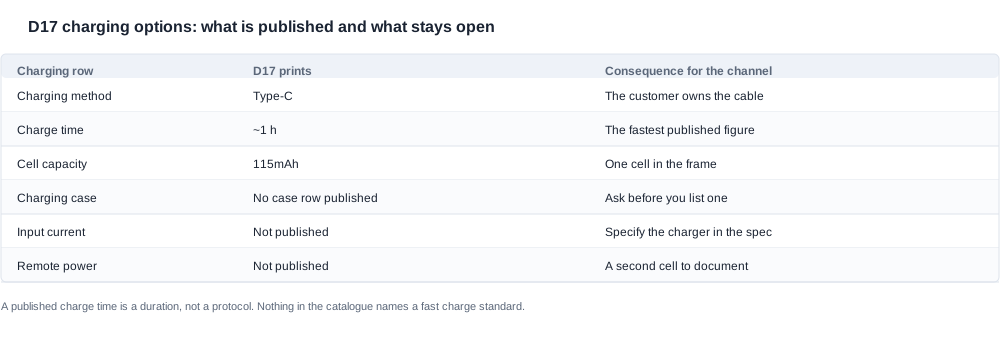
The published position. The D17's page carries a 115 mAh cell, a charge time of about one hour, a use time of about seven hours, Type-C as the charging method, Bluetooth V5.4, a remote control photo row and a surround sound row. There is no charging case row, no input current, no charger rating, no charge end criterion and no statement about the remote's own power. Four of those are things a channel has to live with; one of them, the case, is a question worth asking before the product page is written.
D17 charging options: one published method and the rows around it
A comparison of charging options for a single model sounds like an odd exercise, and the reason it is worth doing is that the model sits inside a range with a strong magnetic convention. A buyer who looks at the range and assumes the convention applies will mis-pack the product.
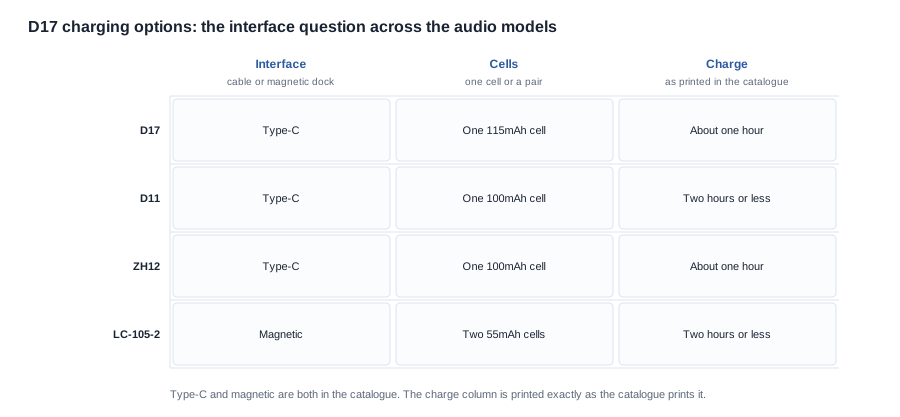
The matrix above sets the D17 against the models it is most often compared with, and the charging column is where the differences sit. Type-C and magnetic are both established in this catalogue: seventeen models charge magnetically and seven charge over Type-C, and the D17 is on the Type-C side alongside the D11 and the ZH12, and the L2 Utral and the V03 Pro and the bone-conduction entry. That is a meaningful minority, not an exception.
The four rows that describe the D17's charging situation
The method. Type-C. One connector, one cable type, one charging behaviour, and the customer supplies the cable or you supply it in the box.
The duration. About one hour. An approximation, published on the model page in a catalogue where almost every other model publishes a ceiling.
The cell. A single 115 mAh cell, the largest single cell in the sport group and one of the larger cells in the range.
The gap. No charging case row, no input current, no charger rating, no end criterion, and nothing at all about the remote shutter's power source.
What the comparison is actually for
The point of comparing charging options is not to find the best interface. It is to establish which of the decisions on the table are already made for you by the model's published rows, and which are still open. On the D17, the method is decided, the duration is decided, and the accessory, the charger and the case are open. That is a useful summary, because three of the five questions a channel would normally have to ask are already answered on one page.

Type-C in the box and in the channel
The interface decision on this model is not really a decision, which is worth saying plainly to a channel that expected to make one. The D12 and the K02 and the LC-105-2 all offer a genuine choice, because a buyer can go with the dock their channel already carries or change the accessory. On the D17 the cable is a given, and the work shifts to what a cable means downstream.
The in-box cable is a specification. If a cable ships, it has a length, a current rating, a connector standard and a unit cost, and each of those can be set rather than inherited. The cable is also the one component a customer judges the whole product by, because it is the first thing in the box and the thing most likely to be used every day. Specify it deliberately: the length that suits a customer's pocket rather than a warehouse carton, the rating that supports the charge time, and whether a spare is included.
The customer-supplied cable case is a support and a return driver. If no cable ships, the customer uses one they own, and a customer whose own cable is marginal at the contact point will blame the product. A Type-C connector on a frame is small, and the failure mode is a cable that charges at one angle and not another. That is a real return category in this segment and it is invisible in a sales report, because the customer tries a different cable and it works.
The charger is the open item. The catalogue publishes no input current for this model and names no charger. A buyer who wants a published charge time to be reproducible has to specify the charger as part of the acceptance protocol, because the same device on a different adapter is a different test. The D12 charging options piece covers that argument from the other side of the range, and the LC-105-2 charging article covers the magnetic case with its two-cell geometry.
What Type-C does not decide. It does not decide anything about endurance. There is no published relationship in this catalogue between the charging method and the use-time row, and a buyer who assumes a cable implies a shorter run, or a dock implies a longer one, is reading a relationship into the table that the table does not contain. The D17 publishes about seven hours, the D11 publishes about seven hours over the same Type-C interface, and the LC-105-2 publishes about eight hours over a magnetic one. The rows sit next to each other and say nothing about each other.
The charger, the accessory line and the retailer requirement
Three more decisions sit behind the interface, and each of them is a separate conversation with the supplier rather than a line in the catalogue.
The charger itself. A channel that does not ship a charger has to tell the customer what to use, and that sentence ends up on the product page, in the support script and in the retailer's packaging guidelines. It is worth getting right. Write the input current, the connector standard, and whether a cable is acceptable in place of a wall adapter. Where the published charge time is reproduced on the page, reproduce the charger alongside it, because a reader who tests with a different adapter will produce a different number and will not know why.
The accessory line. The cable is a candidate accessory sale, and a channel that treats it as one gets revenue and a lower return rate. The three decisions are the length, the packaging and the price point, and they are commercial rather than technical. Where the channel already has an accessory programme, the cable joins it; where it does not, deciding whether to build one is a separate question with a separate cost model. The D17 common questions article covers the pack questions in the format a buyer uses with a supplier, and the Bluetooth audio charging options page covers the range-level version of this decision.
The retailer requirement. Many retail and marketplace programmes impose their own packaging and labelling rules on anything sold with a lithium cell, and those rules are not the supplier's rules. A channel that has worked out the retailer's requirements before it orders has a far better chance of a first shipment that clears inspection, and one that has not will discover the requirement in a returned consignment. The requirement usually covers the packaging declaration, the labelling of the cell, the documentation that has to travel with the goods and, in some programmes, the registration of the importer. The logistics page and the battery transport compliance pages are where those two strands meet, and the contract terms page is where the obligation to supply the documentation gets written down rather than assumed.

About an hour: an approximation, not a ceiling and not a protocol
The charge time on this model is the figure that goes on the product page, and it is the one that most often gets described in a way our documentation does not support. Three distinctions have to survive the marketing review.
It is an approximation, not a ceiling. The catalogue prints about one hour for the D17 and about one hour for the ZH12. The other 26 models print two hours or less, which is a ceiling: a maximum, allowing a charge that takes exactly two hours. An approximation is a different kind of claim, and the wording has to stay different. A page that says "charges in about an hour" is faithful. A page that says "charges in under an hour" is making a stronger claim that the published figure does not support.
It is a duration, not a protocol. Fast charging is a description of a system: a named standard, a defined current profile, a defined thermal envelope and usually a device-side handshake. The catalogue names no protocol, no input current and no charger rating for this model, so the phrase fast charging cannot be used in copy on the strength of the published row. The claim has to be the time, and the time has to carry its condition.
It is a duration, not a recharge interval. How often the device has to be charged depends on the use time and on the condition behind the use time, and neither is published with a condition. A channel that wants to plan a field deployment has to build the schedule from both figures with its own conditions attached, and that is a modelling exercise the buyer does and the supplier cannot do. The D17 battery life piece works through the endurance side of that model.
The three conditions the charge time needs
- The start state. From empty, or from part-charged, and whether the cell was cycled before the test.
- The end criterion. What the device reports as full, and at what point the charge actually stops.
- The input current and the charger. The same device on a different adapter is a different test.
Ask for all three in writing, once, and put them in the specification sheet. The technical battery life page covers the general treatment of duration claims, and the battery transport compliance material covers the cell-side documentation that a logistics partner will ask for alongside it.

The charging case question the catalogue leaves open
This is the item most often misread, and the misreading is expensive, so it is worth being precise.
What the catalogue does. The D17's page prints no charging case row. Across the catalogue, the camera models fall into three states, and the distinction between them is instructive. Five camera models publish a case capacity, two publish that a case exists without publishing its capacity, and four publish no case row at all, which is the same position this model is in. The D17 is in the second of those positions in spirit: no case row is printed, which is an absence of published information, not a published statement that no case exists.
Why the distinction matters commercially. A channel that has built a proposition around a case in the box, and has put it in the product copy and the photography, has a different problem to solve from a channel that has not. One has to find the case, establish its capacity, its cost, its minimum order quantity and whether it is included at the quantity being ordered. The other has a decision to make about whether the absence is acceptable. Both are workable; neither is workable by assuming.
The questions to ask. Does a charging case exist for this model? If it does, at what capacity, is it included at my quantity, what is its own minimum order quantity, and what is the price of the pack with and without it? Does the case add a second cell to the transport documentation, and if so, whose cell is it and whose test file covers it? The last question is the one that connects this to compliance, and it is the one most often forgotten. The camera case options piece covers how the case capacity is published on the models that publish it.
And the one that connects to the remote. The D17 publishes a remote control photo row, and the catalogue says nothing about how the remote is powered. If the remote holds its own cell, it is a second cell in the pack and in the transport file, and it needs its own accessory line. If it draws from the frame, then a connected remote is part of the frame's idle draw, and the published about-seven-hour figure may or may not have been measured with a remote attached. Both questions are the same question in different words: what is the complete set of cells in this product, and who has tested them.
What to write into the order sheet
The value of working through the charging options is that the outcome can be written down. These are the lines a specification sheet for this model needs, and each one corresponds to a decision the catalogue leaves to the buyer.
- The charging method as published. Type-C, quoted in the catalogue's own words, with no protocol attached to it.
- The charge time as published. About one hour, with the start state, the end criterion and the input current recorded beside it as the conditions under which it was measured.
- The use time as published. About seven hours, with its own conditions, and with the two figures kept separate so that neither is read as the explanation for the other.
- The pack contents. The cable specification if one ships, the remote if one ships, and the case question answered in writing either way.
- The charger specification. The input current and the charger used for the published figure, and the one the channel will recommend.
- The acceptance test. The charge cycle timing, the use profile, the number of units and the recording method, so the next order is measured the same way.
- The transport file. The cell documentation and the documentation for any second cell in the pack.
- The commercial terms. The minimum order quantity, the delivery plan, the warranty term and the return rate assumption, all negotiated rather than read.

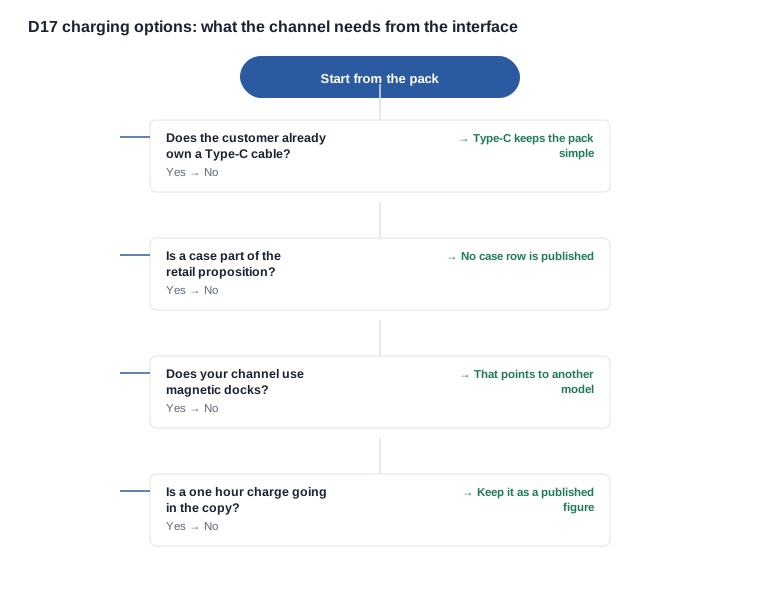
The flow above is the operational version of the same content, and it is what a technician follows on the bench. The D17 buyer review checklist is the wider inspection pass, the D17 certification status piece is the document trail, and the sample procedure covers the order and the shipping window.
Which of those lines are negotiable, and which are not
A specification sheet mixes two kinds of statement, and confusing them is what makes a charging discussion take three rounds instead of one. The published rows are not negotiable, because they are what the catalogue prints and a buyer either designs around them or asks for a different model. The commercial terms are entirely negotiable, because they are agreements rather than facts. The evidence behind both is negotiable in a third way, as a matter of timing.
Not negotiable: the method, the cell value and the published durations. Type-C is Type-C, 115 mAh is 115 mAh, and the published figures are about an hour and about seven hours. A quotation that reads as though the charge time were a target rather than a published figure is misusing the row, and it is worth correcting in writing at the point it enters the document rather than after the goods are on the shelf.
Negotiable, and worth negotiating: the commercial set. The minimum order quantity, the pack size, the sample cost, the production capacity, the delivery plan, the warranty term, the payment milestones, the incoterm and the return rate assumption are all agreements, and all of them are more favourable when they are negotiated in the order rather than assumed in advance. The minimum order quantity page, the production capacity page and the pricing page cover how that conversation is usually structured, and the payment terms page covers the milestones side.
Negotiable in timing: the evidence. The test conditions behind the published durations, the measured frame weight, the charger rating, the case position, the remote power source and the whole document set are all obtainable, and the useful question is not whether they can be obtained but when. A supplier who will supply the conditions at the sample stage, in the same conversation as the sample, is a supplier whose file will still be in order at the reorder stage. The quality consistency page covers the production side, and the risk page covers how the open items are usually recorded so that a buyer can see which are still outstanding.
On the D17's charging specification, our position is that the published rows are unusually favourable and unusually thin at the same time. An about-one-hour charge over Type-C on a 115 mAh cell is a good number to work with, and it is the one the channel can lead on. What it is not is a protocol, a guarantee or a recharge schedule, and we will not describe it as any of those three. We will not tell you a charging case does not exist, and we will not tell you one does. Send us the channel, the pack you intend to ship, the markets and the quantity, and we will tell you exactly which of the eight lines above the catalogue settles, and which one you have to obtain before you can print it on a product page.
Related reading
- Where this model sits — the D17 product page
- The endurance side of the same cell — D17 battery life
- The interface argument in full — D12 charging options
- The document side — D17 certification status
Send us the channel, the pack, the markets and the quantity, and we will tell you which charging lines are settled and which one you have to obtain.


