

D17 smart glasses common questions from buyers fall into a small number of groups, and every one of them has a three-part answer: what the catalogue publishes, what it does not publish, and what has to be asked of the supplier. The three-part structure is not a stylistic preference. It is the only way to answer a procurement question about this model honestly, because the D17's catalogue page is unusually complete on the electrical rows and unusually silent on everything else, and a buyer who gets only the first part will either over-claim or stall.
The D17 in one paragraph. A sport model with a 115 mAh cell, a charge time of about one hour, a use time of about seven hours, charging over Type-C, Bluetooth V5.4, a remote control photo row and a surround sound row. It publishes no camera row, no frame weight, no ingress rating, no charging case row and no per-model certification row. It sits in a three-model sport group alongside the YKC02 and the ZH12, and in an eight-model audio group that it is not part of, since the sport group is counted separately.
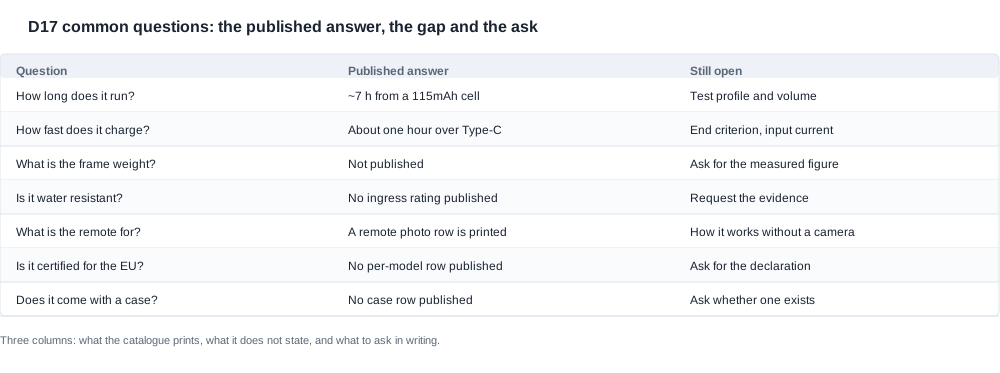
D17 common questions: the published answer, the gap and the ask
Most of the questions buyers bring to this model have already been asked and answered somewhere in the channel's own history, which is why the first question is not about the device at all.
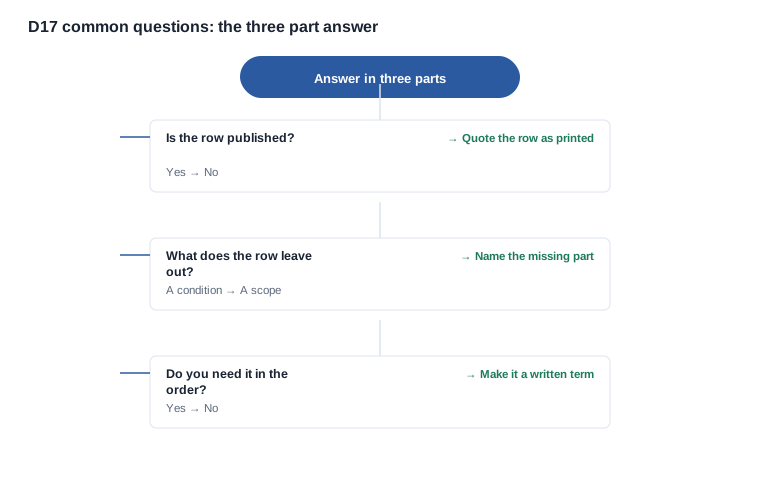
Question: is there a published answer at all, or is this a conversation? There is, for the electrical rows. The catalogue publishes the cell, the charge time, the use time, the charging method, the Bluetooth version and the two feature rows, and for those six the answer is a citation rather than a negotiation. For everything else, the catalogue is silent and the answer has to come from the supplier.
Question: what does the published row leave out? Two kinds of gap. The first is a missing condition: a duration without the start state, the end criterion or the test profile. The second is a missing scope: a claim that covers a family rather than a model, or a document that names a different model. Both gaps are closed the same way, by asking, and the difference between them only matters when the answer arrives.
Question: does it have to be in the order? Only if the channel is going to rely on it. A runtime figure that appears in a marketing page and nowhere else can be a catalogue description. A runtime figure that appears in a product page, a retailer listing, a support script and an acceptance schedule has to be a written term with a condition attached, and the effort of getting there is a small price for not having the argument later.
The question that arrives before the device does
Most buying conversations about this model open with the device, and the first question is usually about the market rather than the product: can this model be sold where we sell, with the paperwork we will need, and does anyone in the chain have to register it.
What the catalogue settles. The catalogue's scope is a set of specification rows for 28 models: the audio group of eight, the sport group of three, the camera group of eleven, a child group, a photochromic entry, a bone-conduction entry and an AR entry. The D17 sits in the sport group. That is the whole of the catalogue's reach, and the reach is the answer to the question "is this model covered by the documentation", because the answer is no: there is no per-model certification row for any of the 28, so the catalogue covers none of them.
What has to be established separately. The destination market, the radio and chemical position, the transport position for the cell, the labelling and packaging requirements, and the registration obligations that fall on whoever places the product on the market under their own name. Each of those is a different conversation with a different holder, and each has a different lead time. The market compliance hub is the index for the routes, the certification checklist is the request list, and the risk page is where a buyer usually records which of those items is still open when the order is placed.
Why it belongs at the front of the conversation. Two reasons, and both of them are about time rather than about the device. The first is that the documentation items have the longest lead times in the whole transaction, so a channel that raises them after the pack is designed and the photography is shot has already spent the money it was trying to protect. The second is that the answer can remove the model from consideration, which is expensive to discover late and cheap to discover early. A channel that has spent three weeks on a launch and then learns that a document does not cover the model has a very different conversation with its supplier than one that asked in week one.
The D17 best for framework is the piece that handles the scenario side of the same decision, and the customisation page covers the packaging and branding layer that sits between the supplier and the customer.

The charge time and the cell behind it
Q: how long does the D17 run? A: The catalogue publishes about seven hours, from a single 115 mAh cell. The gap: no start state, no volume level, no audio content, no radio state and no ambient temperature. The ask: the test condition behind the published figure, in writing, plus a measured figure from your own sample units.
Q: how fast does it charge? A: About one hour, over Type-C. That is an approximation, and it is the only kind of duration published for this model apart from the ZH12's; the other 26 models in the catalogue publish a ceiling of two hours or less. The gap: no start state, no end criterion, no input current, no charger rating and no named charging protocol. The ask: the condition behind the published hour, and a specification for the charger your customers will use.
Q: is that a fast charge? A: No, and this is the question that most often produces a claim the documentation cannot support. Fast charging is a description of a system with a named standard, a defined current profile and a defined thermal envelope. The catalogue names no protocol and no current for this model, so what is published is a duration. The gap: the protocol is not published because it is not stated. The ask: if a protocol is to be named in copy, ask for it in writing, with the current profile and the charger it requires.
Q: why is the charge time so short if the cell is not large? A: The 115 mAh cell is not large in the absolute sense; it is the largest single cell in the sport group, and the D17 publishes the shortest use time in that group at about seven hours against about eight for the other two. The gap: nothing in the catalogue links capacity to runtime, and the pattern across the range actively breaks that link. The G07 and the YK12 publish the same two-cell configuration as the LC-105 pair and a shorter use time; the D11 and the D12 publish a single 100 mAh cell and about seven hours. The ask: do not let anyone in the buying group explain the D17's runtime with its capacity. The D17 battery life piece works through the condition set, and the D17 charging options article covers the accessory and the case question.
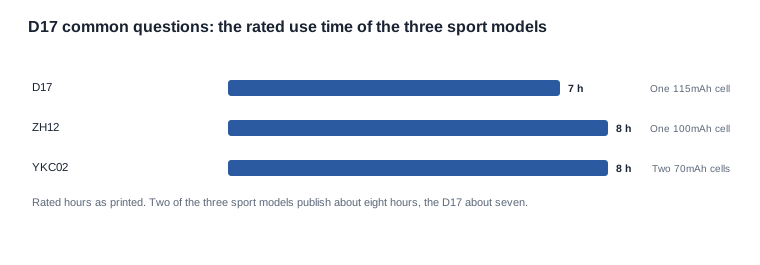
The chart above is the whole sport group on one row, and it is the fastest way to see why a buyer should not treat the D17's about-seven-hours as a competitive disadvantage or a competitive advantage. It is one figure in a three-model group, published without a condition, on a model that offers something the other two do not, which is a charge time of about an hour.
Q: is the D17 the fastest-charging model in the range? A: It is one of two. The D17 and the ZH12 both publish about one hour. The YKC02, the third sport model, publishes a ceiling of two hours or less, and so does every audio model in the range. If a listing is going to lead on charge time, that lead is a lead over the audio models rather than over the sport group.

The remote shutter on a model with no camera
Q: what does the remote shutter control, on a model that has no camera? A: The catalogue publishes a remote control photo row for the D17, and it publishes no camera row, because the D17 is an audio product in the sport group. The gap: the catalogue does not explain what the control operates, and it is the one row on the page that a customer is likely to ask about. The ask: an explanation from the supplier, in writing, of what the shutter triggers and what happens if the paired device is not present.
This is the question where a buyer has to be most careful, because the plausible answers are all speculation. A shutter control could be triggering a paired phone, could be operating a separately sold unit, or could be an artefact of a shared platform design. All three are reasonable and none of them can be printed on a product page without being confirmed. A product with a shutter button and no camera invites the question from a reviewer within a week of launch, and the answer has to exist before that, not after.
Q: is the remote in the box? A: The catalogue does not say, and the absence of a statement is not a statement of absence. The gap: the pack contents are not published for this model, and the remote's own power source is not published either. The ask: whether the remote ships, whether it is a separate order line, and whether it holds its own cell. The third question matters twice over: a separately powered remote is a second cell that has to be covered in the transport documentation and the pack, and a remote that draws from the frame contributes to the frame's idle draw, which means the published about-seven-hour figure may or may not have been measured with one connected.
Q: what does the surround sound row tell me? A: That the model has a published surround-sound row, and nothing more. The gap: no driver size, no frequency response, no leakage figure, no microphone pickup distance and no description of the acoustic construction. The ask: a written acoustic description, and the same information the page will eventually need. The open-ear audio page covers why that specification is a substantial item in this category, and the noise control page covers the call-quality question that no audio model in the range publishes either.
Durability, weight and ingress
Q: is the D17 water resistant? A: There is no ingress rating published for this model. The gap is complete on this point, and there is one detail that is easy to misstate: the only two models in the whole catalogue that carry an IP54 marking are the V06 and the S7, and both of those are camera models rather than sport audio models. The ask: if a durability claim is required by the channel, request a test report, and until it arrives describe the model as a sport-positioned audio product rather than a water-resistant one. The IP ratings page covers what a marking would and would not establish if one were ever published for this model.
Q: how much does it weigh? A: Not published. The catalogue publishes a weight for exactly one model in the range, the MT6 at 158 g for the eye glasses body excluding its folding charging case, with the 1200 mAh case capacity listed separately. For the D17 there is no figure, and a single data point in 28 models is a useful reminder of how rarely it exists. The gap: no weight, and no statement of whether a quoted figure includes the cell. The ask: a measured figure on the sample, and the condition it was taken under. Because the D17 carries a single cell in the frame rather than a pair, the mass is concentrated rather than distributed, which is exactly the balance question a sample answers in five minutes. The D17 buyer review checklist includes the weighing step for that reason.
Q: what colours does it come in? A: Not published for this model. The gap: no colour, finish or variant rows. The ask: the colour and finish list, and the packaging specification, both of which a channel normally has to source separately from the product data.
Q: is there a charging case? A: No case row is published for this model, which is an absence of published information rather than a published statement that no case exists. The gap: whether a case exists, its capacity, and whether it ships. The ask: all three, in writing, before the pack is designed. The D17 charging options piece treats that question in full, and the camera case options article shows how case capacity is published on the models that publish it.
Certification, transport and the paperwork to request
Q: is the D17 certified for the European Union? A: The catalogue carries no per-model certification row for any of the 28 models, and its text contains no mention of CE, FCC, RoHS, REACH, RED or the directive numbers. The export certification page in the catalogue is a page of images, and its content is ten patent certificates, eight appearance-design patents and two utility-model patents. The gap: everything. The ask: the declaration of conformity naming this model, the test reports behind it, the harmonised standards used, the chemical declarations, the Bluetooth qualification evidence and the transport file for the cell. The D17 certification status article sets out the full request list and the order to send it in, and the certification checklist is the working document for it.
Q: what about transport documentation for the battery? A: The catalogue publishes nothing, and a UN 38.3 test summary is normally held by the cell supplier rather than by the device assembler. The gap: the cell supplier's identity, the test summary, and the documentation for any second cell in the pack, which on this model means the remote if it is separately powered. The ask: those three items, plus the packaging and labelling requirements of the destination market. The battery transport compliance pages cover the file and the marking, and the logistics page covers the shipping side.
Q: what should be in the quotation? A: The published rows are already known, so the quotation should be about the things that are not: the minimum order quantity, the pack size, the sample cost, the production capacity, the delivery plan, the warranty term, the return rate assumption, the payment milestones and the incoterm. The gap: none of these is published, and all of them are negotiable. The ask: all of them, in one document, with the specification sheet attached. The pricing page, the minimum order quantity page and the payment terms page cover how that conversation usually runs, and the contract terms page is where the documentation obligation and the claims get written down.
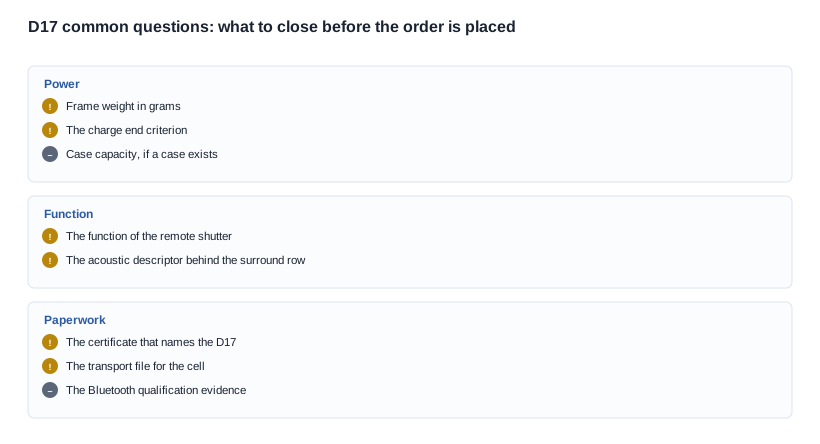
The checklist above is the consolidated version of the asks from this article, in the order they usually have to be answered. The first group has to be closed before the pack is designed, the second before the product page is written, and the third before the purchase order is placed. A buyer who sends the whole list in one request, rather than in three, will usually get all three answers in one reply and will have the file complete before the sample arrives.
The short version to keep on the desk
- Published and citable: the 115 mAh cell, about one hour, about seven hours, Type-C, Bluetooth V5.4, the remote control photo row, the surround sound row.
- Published but unconditioned: both durations, because neither has a start state, an end criterion or a test profile behind it.
- Not published, and needed for a claim: frame weight, acoustic figures, ingress rating, colour options, control method, charging case position, the remote's power source and pack position, the per-model certification scope and the cell's transport file.
- Not published, and negotiable: everything in the commercial set, from the minimum order quantity to the warranty term.
On the D17, our position is that it is a well-specified model in its electrical rows and an open book in everything else, and that the questions above are answerable by any supplier who is prepared to answer them in writing. We would rather a buyer ship without a feature claim than ship with one a reviewer can disprove, and we would rather leave a page short than print a figure we cannot source. The D17 specifications page collects the published set, the D17 limitations page lists the blanks, and the who needs the D17 piece covers the demand side of the same decision.
Send us the market, the channel, the quantity and the questions you need answered, and we will give you the published answer, the gap and the ask for each one, in that order.
Related reading
- Where this model sits — the D17 product page
- The published set in one place — D17 specifications and features
- The document trail — D17 certification status
- How to close the open items — D17 buyer review checklist
Send us the market, the channel, the quantity and the questions you need answered, and we will give you the published answer, the gap and the ask for each one.


