

The d17 smart glasses battery life figure is about seven hours, and the charge time is about one hour, and neither number comes with a condition attached. A buyer who stops at that sentence has two figures and no way to test them. A buyer who wants to write a claim, brief a support team or defend the number in a compliance file needs the reading method as well, and that is what this piece is for: how to read the published rows, what the 115 mAh cell actually contributes, and the acceptance protocol that turns a catalogue description into a number you can put your name against.
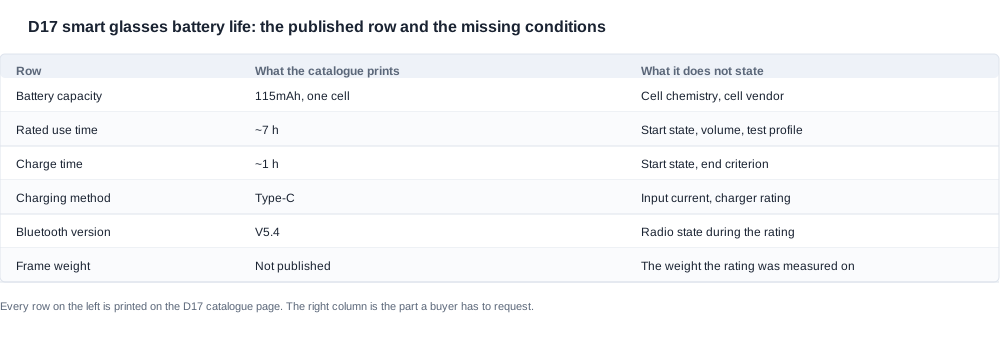
The published position in one paragraph. The D17 is a sport model. Its catalogue page prints a 115 mAh cell, a charge time of about one hour, a use time of about seven hours, Type-C charging, Bluetooth V5.4, a remote control photo row and a surround sound row. It publishes no frame weight, no ingress rating, no charge input current, no charging case row and no per-model certification row. Those last two absences matter more than they look, and both are questions for the supplier rather than gaps to be filled with an assumption.
D17 battery life: reading a published figure that has no condition attached
A use-time figure without a condition is a description, not a deliverable, and the difference matters in a specific, practical way. A description tells a buyer what the catalogue says. A deliverable tells a supplier what they will be held to. Channels that want the second need to convert the first, and the conversion is a short, well-defined piece of work.
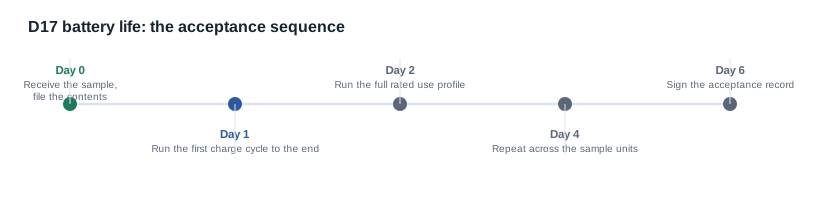
The sequence above is the shape of that work: receive and file, run a full charge cycle to a stated end criterion, run the full use profile, repeat across the sample units, then sign. The repetition step is the one that gets dropped, and it is the one that turns a single observation into a consistency claim, which is what a production order actually needs.
The four things a use-time claim has to state
Every published runtime figure, in this catalogue and in every other, is a compression of at least four decisions. Write them down separately and the compression becomes readable.
- The start state. Full, part-charged or freshly cycled. A cell that has been through several cycles behaves differently from a new one, and a figure taken from a new cell is not a figure that describes a customer holding the product in month six.
- The volume level and the content. Audio output is the largest single draw on a device like this, and a figure measured at a low volume is not a figure that describes a customer on a train. Ask for the level, and ask whether the content was speech or music, because that changes the amplifier's behaviour.
- The radio state. Whether the Bluetooth connection is held open for the whole session changes the draw. A device that is repeatedly disconnected will do more work to reconnect, and a device that stays paired does less. Neither the D17 page nor any other page in the catalogue states which condition applies.
- The ambient temperature. A lithium cell in a hot car in summer is a different cell from the same cell on a desk. This is the condition most often left out of every supplier's test description, and it is the one a customer will experience.
A claim that names all four is reproducible. A claim that names none is a marketing sentence, and a marketing sentence is exactly what a market authority or a retailer's compliance team will ask you to substantiate.
What the D17 figure is, and what it is not
About seven hours is a rated figure. It is not a minimum, it is not a guarantee, and it is not a measurement your customer can reproduce from the box. It is what the catalogue prints. Our position on this is straightforward: we will quote it as the catalogue prints it, with the word "about" attached, and we will not promote it to a round number, to a minimum, or to a contractual figure on a product page without a condition behind it.

What the 115 mAh cell does and does not tell a buyer
The D17 publishes a 115 mAh cell. That figure is larger than the 100 mAh cells on the D11 and the D12 and larger than the 55 mAh cells on the LC-105 pair, and it is a single cell in the frame rather than a pair.
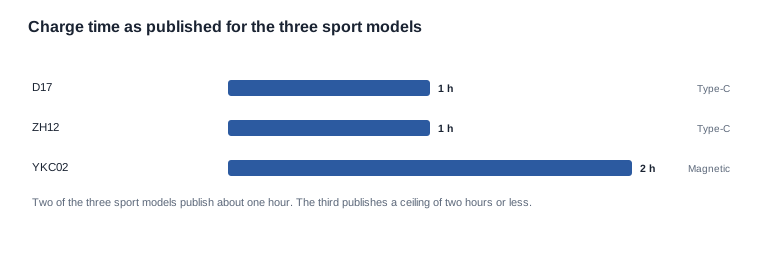
The chart above is the sport group, and it is included here because the D17's charging figure is unusual and the comparison shows exactly how unusual. Two of the three sport models publish a charge time of about one hour. The third, the YKC02, publishes a ceiling of two hours or less, like almost every other model in the catalogue. So the D17's about-one-hour figure is not a one-off, and a buyer should not treat it as an exclusive property of this model. It is a property of the sport group, and the ZH12, its closest neighbour on the page, shares it.
What capacity contributes and what it does not
Capacity is a purchasing input. It tells a buyer how much energy the device carries, which is a component of the answer to "how long can it run", and it tells an engineer something about the design intent. It is not a runtime figure, and in this catalogue it is not even a reliable predictor of one.
Read the audio group and the pattern breaks in several places. The LC-105 pair publishes two 55 mAh cells at about eight hours, while the G07 and the YK12 publish the same two-cell configuration at about six hours. The K01 and the K02 publish two 90 mAh cells at about eight hours. The D11 and the D12 publish a single 100 mAh cell at about seven hours. The D17 publishes a single 115 mAh cell at about seven hours. The same cell figure appears with two different use-time figures, and different cell figures produce the same use-time figure. A buyer who quotes capacity as though it explains runtime is making an argument the catalogue contradicts.
The single-cell question, which the D17 and the D11 share
One cell in the frame means one charging path, one set of contacts, one component to diagnose and one to replace. It also means the mass is concentrated rather than distributed across the temples, and because the catalogue publishes no frame weight for this model, the balance question cannot be closed from documentation. It is a two-minute measurement on a sample and a line in the specification sheet.
The D17 shares this single-cell architecture with the D11 and the ZH12, and it shares the 100 mAh figure with the D11 while carrying a larger cell. The D17 specifications page collects the full published set for this model, and the D17 limitations page sets out the rows that stay blank.

The one hour charge and why it is a duration rather than a protocol
The about-one-hour charge time is the D17's most quotable number and the one most likely to be misused. Three distinctions have to be held, and a channel that confuses any two of them will end up with a claim it cannot support.
A duration is not a protocol. Fast charging is a term that describes a charging system, with a named standard, a defined current profile, a defined thermal envelope and usually a device-side handshake. What the catalogue publishes for the D17 is a duration. It names no protocol, no input current, no charger rating and no thermal behaviour. The word "fast charging" therefore cannot be used in copy on the strength of this row alone.
An approximate figure is not a ceiling, and a ceiling is not a measurement. The about-one-hour figure on the D17 page is an approximation, and it is a different kind of statement from the two-hours-or-less ceiling that 26 of the 28 models in this catalogue publish. Neither of them tells you the start state or the end criterion. The practical consequence is the same for both: a claim built on either one needs a condition before it can be contractual.
A charge time is not a recharge interval. The published figure says how long the device takes to charge. It says nothing about how often it has to be charged, because that depends on the use time, the condition behind the use time, and the customer's own pattern. A buyer who wants to plan a field deployment needs the use-time condition and the charge-time condition together, and then has to build the recharge schedule from both. That is a modelling exercise a procurement team does once and a supplier cannot do for them.
The remote shutter is a second question about power
The D17 publishes a remote control photo row, alongside the ZH12. Nothing in the catalogue states how the remote is powered, whether it holds its own cell, or whether it is a separate item in the box. This matters for the energy argument in a specific way. If the remote is separately powered, it is a second cell that your transport documentation has to cover, separately from the frame, and it is a second item in the pack and the packing list. If it draws from the frame, then a connected remote contributes to the frame's idle draw, and the about-seven-hour figure may or may not have been measured with a remote attached. Nobody can answer that from the catalogue, and it is a question that has to be asked in writing. The D17 common questions piece covers the same row from the question-answering angle.

The acceptance protocol that turns a catalogue claim into a testable one
A runtime claim becomes testable when the protocol is written before the test, not after it. The protocol below is what we would hand a supplier with the sample order, and it is deliberately short enough to be followed by a technician rather than read by a lawyer.

The five steps, and the record each one produces
- Define the use profile. Volume, content, radio state, and the temperature the units are used in. The output is one paragraph, and it is the paragraph that goes into the specification sheet.
- Charge to a stated start condition and time to a stated end criterion. Record both the start state and the end criterion, because without them the timing is not comparable with anything, including a second run.
- Run the profile for the full published claim. Log the last ten minutes specifically, because a runtime that collapses late in the session is a different product experience from one that tapers gradually, and the log is what tells them apart.
- Repeat across the sample units. Three units is the minimum worth doing, and the purpose is not to find a defective one but to measure the spread. A channel that publishes a runtime claim needs to know its own tolerance, and a spread of an hour between units is a commercial fact as much as an engineering one.
- Write the protocol into the specification sheet. The next order, the next supplier and the next product page revision all inherit it, and the record does not have to be rebuilt from scratch.
The acceptance criteria to agree before you sign
- The charge cycle must complete within the published about-one-hour figure, measured from the agreed start state to the agreed end criterion. A cycle that needs longer is a finding, not a failure, and it is recorded either way.
- The use profile must reach the published about-seven-hour figure under the agreed conditions. The result is recorded as measured, with the conditions attached.
- The spread across units is recorded, and the channel decides internally whether the published claim should be the best case, the typical case or the conservative one. That internal decision is a commercial choice, and it is better made before the product page exists than after.
- The frame weight is measured on a scale, because the catalogue publishes none for this model.
- The pack contents are recorded against the order, including whether the remote shutter and a charging case are present.
The buyer review checklist is the full inspection pass, and the sample procedure covers the order, the shipping and the inspection window. The quality consistency page covers how the measured spread is supposed to feed the production order rather than living in a spreadsheet.
Where the D17 specification stops, and what to request instead
There is a point in every catalogue where the rows stop, and knowing where it is prevents a buyer from filling the gap with an assumption that later becomes a dispute.
Published for the D17. The 115 mAh cell. A charge time of about one hour. A use time of about seven hours. Type-C charging. Bluetooth V5.4. A remote control photo row. A surround sound row.
Not published for the D17. The frame weight. The cell chemistry and the cell supplier. The charge input current and the charger rating. The charge end criterion. The test conditions behind either duration. The charging case capacity, or whether a case exists. The ingress rating, and note that the only two models in the whole catalogue carrying an IP54 marking are the V06 and the S7, both camera models. The number of stored Bluetooth profiles. The certification scope, because the catalogue has no per-model certification row for any of the 28 models and its export certification page is a company-level page made of images. The transport file for the cell, which is a UN 38.3 document and is not published here. The battery transport compliance pages cover what that file normally contains.
The request list to send with the enquiry. The test conditions behind both published durations. The measured frame weight. The charge input current and the end criterion. The charging case position. The remote shutter's power source and whether it is in the box. The cell supplier's test file. The declaration of conformity for this model, and the report numbers behind it. The warranty term and the return rate assumption. The certification checklist is the right starting point for the document side, and the D17 certification status piece sets out why the catalogue's own pages cannot answer it.
What a runtime claim does to the commercial terms
The energy specification is not only a product page question. It is the row that appears in the agreement, in the acceptance schedule and in the return-rate assumption, and each of those three places treats the number differently.
In the agreement, the published figure is a description, not a deliverable. A contract that says "battery life of about seven hours" with no conditions attached is a warranty term that nobody can measure, because two competent engineers can run that model for six and a half hours and for seven and a half hours under conditions that both satisfy it. If a runtime figure is going into an agreement at all, the conditions have to be attached to it, and the acceptance test has to be the same one the supplier ran. Writing the conditions into the clause costs a paragraph and removes a category of dispute.
In the acceptance schedule, the internal figure is the one that matters. Once the sample units have been measured, the channel has a better number than the catalogue does, because it has a spread and a condition. That internal figure is the one to brief the support team with, the one to use for the return-rate model and the one to quote in a retailer conversation. The catalogue figure stays on the product page, because that is where the published claim belongs, and the two are allowed to differ as long as nobody confuses them.
In the return-rate assumption, the spread is the risk. A channel whose product page leads on a runtime figure will receive a return from every customer who expected a different one, and the rate at which that happens is a function of the gap between the published figure and the customer's actual session, not of the figure itself. This is why the tolerance decision belongs to the commercial side of the business and not to the catalogue. The risk page is where that assumption usually gets documented, and the payment terms page is where the acceptance schedule and its consequences are usually written.
The practical sequence is therefore: measure first, decide the internal tolerance second, and only then write the published claim, using the catalogue's wording, in the places where a published claim belongs.
On the D17's energy specification, our position is that it is strong on the surface and thin underneath, and that a buyer who treats it as thin will build a specification sheet that matches the catalogue and a channel that cannot defend it. We would rather you have the conditions than the adjectives. Send us the profile your customers actually run, the markets and the quantity, and we will tell you exactly which of the seven published rows survives your conditions and which of them needs a document before you can put it in a contract.
Related reading
- Where this model sits — the D17 product page
- The full published set — D17 specifications and features
- The charge side in full — D17 charging options
- The inspection pass — D17 buyer review checklist
Send us the use profile your customers run, the markets and the quantity, and we will tell you which published rows survive it.


