

How do i know you are not a trading company faq has an answer, and the answer is a procedure rather than a promise. A claim cannot settle the question, because a claim costs nothing to make and nothing to repeat, whereas six questions asked in a fixed order produce a record you can file and compare against the next supplier's record. The purpose is not to catch anyone out. The purpose is to find out, before a purchase order is raised, which party actually controls the work that the order assumes somebody is doing.
The six are worth running as the first stage of due diligence, before the first quotation rather than after the first sample, because the answer decides what the sample is worth. A buyer who has established that the counterparty controls assembly and final test is testing one thing; a buyer holding only a specification sheet is testing another, and the two sample outcomes are not comparable even when the units look identical on the bench. Asking in a fixed order also matters, because answers accumulate into a picture when they arrive in a planned sequence and dissolve into six unrelated anecdotes when they arrive in whatever order the conversation happens to produce.
One caution before the list. These six questions are not aimed only at other suppliers. The third section turns the same ruler on our own documentation and names the categories where it lands on us, including the ones we publish nothing about. A method that only ever points outward is a rhetorical device rather than a verification method, and most of the writing in this category does precisely that.
Why the question cannot be settled by a claim
The reason the question keeps recurring is that the two structures in this market look identical from the outside. Both quote a unit, both hold stock, both present a specification sheet, and both can produce samples that arrive on time and survive a bench check. Nothing in those four artefacts reveals the difference between them. It sits in who performs the steps that turn components into a finished unit, and no rule obliges either party to disclose that.
That is not a complaint about suppliers; it is a description of how the arrangement works, and it has a direct consequence for the buyer. The question "are you a factory" has no answer a sentence can carry, because a sentence is not evidence of anything. Three consequences follow, and they are the reason a method is needed rather than a slogan.
- A claim cannot be checked. It can only be repeated, and repetition raises confidence without adding a single fact.
- A claim cannot be compared. One supplier's description of itself is measured against nothing, so there is no threshold it can fail.
- A claim does not locate the risk. Even a genuine manufacturer subcontracts part of the work, and a claim of wholly in-house production is precisely the wording that conceals a partial answer.
The third point is where buyers go wrong in the opposite direction. Treating the absence of a capacity figure as disqualifying applies a standard the category cannot meet, because capacity moves with the order book and says little about the configuration actually being ordered. Our own documentation applies the same logic in the opposite direction, and that position is set out in the third section.
There is a second reason a claim fails, and it is the practical one. The questions a manufacturer answers accurately and an intermediary cannot are the questions about objects. An address, a document, a machine, a named process step, a date, a serial reference — each of these either exists in a specific place or does not. Both kinds of supplier can produce a fluent paragraph about quality, responsiveness and partnership, and neither paragraph survives a request for a specific artefact. The test of a usable answer is therefore easy to state and hard to fake: it names an object that somebody else can check.
Three conditions have to hold for the six questions to work, and it is worth setting them out first because they explain why the questions are answerable by email and why none of them is objectionable.
- They concern process and documents rather than commercial terms. Nobody is being asked to reveal a price, a margin or a customer list.
- They can be answered in writing. A supplier who cannot answer in writing has told you something about the record-keeping behind the answer.
- They can be recorded. Every answer, including the ones that never arrive, has a place in a file a colleague can pick up and use.

The six questions and what each one can actually prove
These six are not the same set that appears in the material about outsourcing decisions, which asks who signs, who owns the design and who may authorise a component substitution. Those questions belong to a later stage, once a supplier is on the shortlist and a structure is being negotiated. These six belong to the first stage, before a shortlist exists, and they are aimed at establishing what kind of counterparty is on the other end of the email.
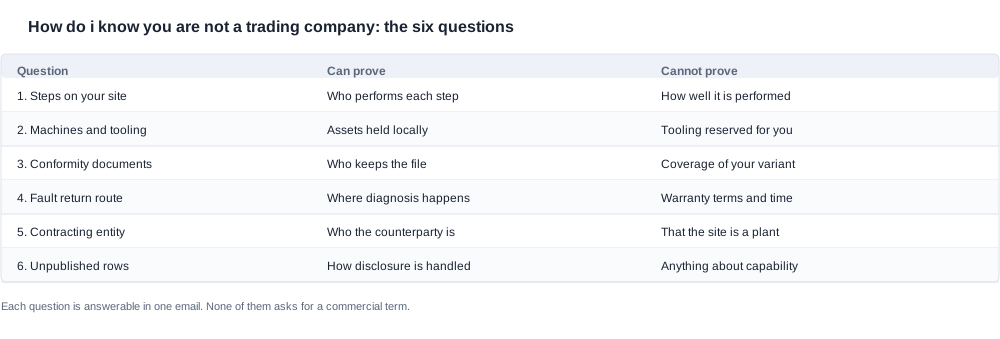
Each question is set out in the same three-part structure used throughout this answer, because the structure works on any supplier: what is published, what is not published, and what has to be asked.
- Which production steps happen at your own site, and which happen somewhere else? Published: the catalogue records a magnetic charging method for five camera entries, a Type-C charging method for two, and for four — the L1 Pro and the CY03, and the MT6 and the CY05 — it publishes no charging method at all, so even at the level of a single interface the buyer can see which rows the publisher chose to describe and which were left open. Not published: nothing in the catalogue says which production steps are performed in house, which are performed at partner sites, or how the two are split for any configuration. Ask a supplier: to name the steps performed at the site where the contract is signed, to name that site, and to name where the remaining steps take place.
- Which machines and tooling does the company own, and who owns the tooling for my configuration? Published: the catalogue publishes one weight anywhere in the range — 158 g for the MT6 glasses body, excluding its foldable case — and exactly two entries carry an ingress marking, the V06 and the S7. Not published: tooling ownership, machine inventories and the process steps that need capital equipment are all absent from the documentation. Ask a supplier: who owns the tooling for the configuration being quoted, where that ownership is recorded, and what happens to the tooling if the programme ends.
- Whose name appears on the conformity documentation for the exact model I intend to buy? Published: nothing in the catalogue text names CE, FCC or RoHS, and no entry carries a certification row of its own; the frameworks that can be cited in writing are the Radio Equipment Directive (EU) 2014/53/EU and the EMC Directive 2014/32/EU. Not published: certificate numbers, the model designations any document covers, and the identity of the legal entity holding the file. Ask a supplier: whose name is on the document, which designations it lists, and whether a copy can be sighted at the sample stage.
- When a unit comes back with a fault, where does it physically go, and who diagnoses it? Published: the catalogue publishes a runtime for all eleven camera entries, and the removable parts it lists are the inner frames of the V06 and the S7 and the temple of the G07, which tells a buyer that some units are published as separable at the frame rather than as sealed objects. Not published: warranty terms, the return destination and the diagnostic route are all absent, and no policy of any kind appears. Ask a supplier: the physical address that receives returns, who inspects the unit when it arrives, and whether the diagnosis is made against the process that produced it.
- Which legal entity signs the contract, and at which address does the work happen? Published: the catalogue carries one company-level export-certification page whose body is a set of images rather than extractable text, holding ten certificates — eight appearance-design patents and two utility-model patents — with nothing tying any of them to a model. Not published: no contracting address, no site address, and no statement of how the two relate. Ask a supplier: which entity signs, at which address the work is carried out, and whether a site visit can be arranged.
- Which specification rows do you deliberately not publish, and why? Published: the catalogue lists a colour range for two models only — the V03 Pro in three options and the V06 in four — and it publishes no capacitive-touch row for any entry in the range. Not published: no sensor model, no field of view, no frame rate, no acoustic measurement and no storage capacity appears for the camera entries. Ask a supplier: which parameters they would normally publish for this configuration and do not, and whether each gap is a commercial decision, a documentation gap or a pending confirmation.
The last of the six does more work than its position suggests, because a supplier who answers it precisely has described their own disclosure practice. A supplier who answers "we publish everything" has given an answer that can be checked against any published specification sheet they send, and it will not survive that check. A supplier who names four gaps and explains each one has told you how their documentation behaves, which is a fact you can rely on when the contract is signed.
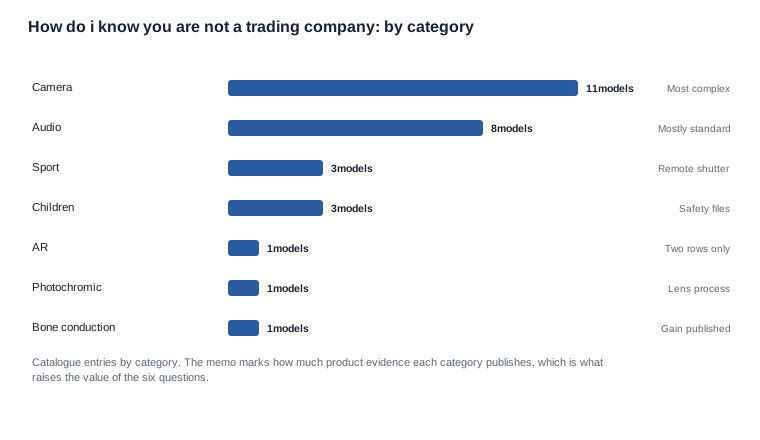
The question bites hardest where the product has the most stages and the most rows to describe. The catalogue holds twenty-eight entries in seven categories, and they are not equally demanding to verify. The eleven camera entries are the sharpest case, because each publishes a resolution class — eight megapixels across eight of them, thirteen megapixels across the L1 Pro and the L2 Utral, and the S7 — together with a runtime and a cell capacity, so the published material is rich enough to check a supplier against. The eight audio entries are simpler: each publishes a Bluetooth version, a cell configuration and a charging method, and two of them publish a fifth row for a charging case capacity. The three sport entries add a remote shutter on two models, which is a hardware feature rather than a data row. The three children's entries and the three entries carrying no model designation at all sit at the other end, where so little is published that a buyer has almost no row-level material to set against what a supplier says. That asymmetry is the point. Where the published rows are dense, verification is a matter of asking questions the rows make answerable. Where they are thin, verification has to start from the object rather than the specification, which is why these six aim at things that can be seen, read or visited rather than at adjectives.
What each question can and cannot prove
Taken one at a time, the six produce different kinds of evidence, and mixing them up is how buyers end up over-reading a good answer. The first question establishes control: it maps the steps to places, and a supplier that names its own steps and its own site has produced something checkable. It cannot establish that those steps are performed well, because a split process performed competently and a split process performed badly look identical in an email.
The second question establishes assets. Tooling is the part of an operation that cannot be described into existence, because it either carries an asset number in a rack or it does not. It also cannot establish capacity, and it cannot establish that the tooling will be allocated to your configuration rather than held for another programme.
The third question establishes a document chain, and it is the question with the most scope for confusion. A certificate held by a third party is not disqualifying; it is a common and legitimate arrangement, and it is also a fact you need, because it determines who maintains the file and what happens to it when the relationship ends. What this question cannot prove is that the document covers the exact variant and the exact destination market you intend to ship.
The fourth question establishes a diagnostic route, which is a different thing from a warranty. The physical destination of a defective unit tells you where the failure will be examined, and an examination performed by the party that performed the original work can be tied back to the process that caused the failure. It settles nothing about warranty terms, response time or replacement policy, because those are commercial terms and are not published.
The fifth question establishes the counterparty and separates an office from a site, which is a distinction buyers routinely collapse. It cannot prove that the address given is a production address rather than a registered one, which is why the site visit remains a separate step in any credible procedure.
The sixth question establishes nothing about capability at all, and it is included for that reason. It is the only one of the six that asks about the supplier's behaviour rather than its assets, and it is the one most likely to be answered well by an intermediary, which is itself a signal.

The limits of our own published position
The ruler has to be applied to us first, or it is not a ruler. Our documentation publishes no headcount, no floor area, no capacity figure, no line count and no daily output. Every one of those sits on our internal list as an open item awaiting confirmation, so we cannot answer the question with numbers, and a supplier who does put a number for that in a specification sheet is handing you a figure rather than a verification.
This article does not claim that we are a factory, and it does not claim that we own production lines. We do not make either claim because we cannot evidence either one in a document a buyer can hold, and a claim of that kind is exactly the kind this article is about. Our position is deliberately modest: we publish the rows a catalogue can carry, we leave the rest empty rather than filling them in, and we would rather be judged on what we publish than on an adjective we cannot support.
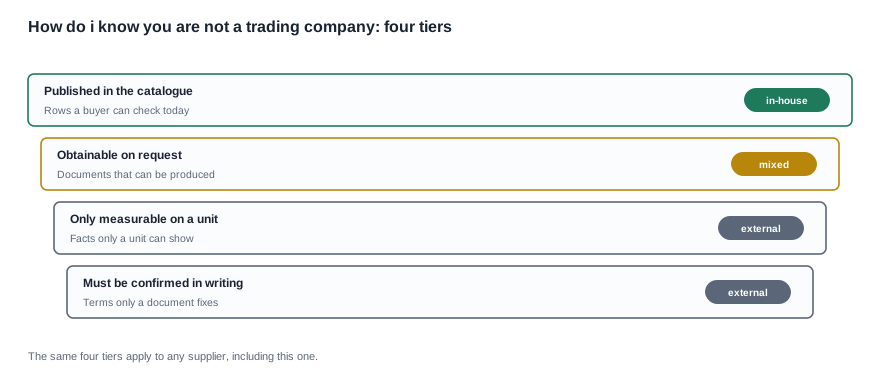
What we do publish is substantial, and a buyer can use every line of it. The catalogue holds twenty-eight entries in seven categories. All eleven camera entries publish a resolution class and a runtime, and the charge time is published for every entry in the range, with twenty-six of them at two hours or less and the D17 and the ZH12 at about one hour. Case capacity appears for five of the eleven camera entries: 1400 mAh for the CY03 and the CY05, and the L1 Pro, a choice of 900 mAh or 1400 mAh for the L2 Utral, and a foldable 1200 mAh case on the MT6. Two more, the KY06 and the MT5, are published with a case but no capacity given for it. The S7 and the V06, and the V03 have no case row at all, and the V03 Pro is stated explicitly as having none. Two entries carry an ingress marking, two publish a colour range, two publish a remote shutter, one publishes a weight, and the removable parts are named for three entries.
What we do not publish falls into two families, and it is worth keeping them apart because they are refused for different reasons. The first is the capacity family: headcount, floor area, capacity, line count and daily output. Those figures are programme-specific, they move with the order book, and a number quoted without that context is not a number a buyer can plan against — so a figure printed on a website tends to be quoted back as a commitment it was never meant to be. The second is the commercial family: unit price, price tier, minimum order quantity, lead time, warranty period, tooling fees, sample fees and certificate identifiers. Each of those depends on configuration, quantity, documentation scope and the current schedule, and each is confirmed per enquiry. A certificate identifier is a slightly different case, because publishing a number for a document nobody can retrieve is worse than silence.
The consequence for a buyer is not that our position is weak. It is that our position is comparable. A buyer who applies the six questions to us will find that the answer to the first five is, in most parts, a description of the same gaps found in any supplier who publishes only what a catalogue can carry: which steps happen where, who holds the file, where a returned unit goes, and which rows were never published. The buyer who wants a photograph of a floor, a figure for capacity and a certificate identifier has to ask for them, exactly as they would with any other counterparty, and the answer we would give is the same one this article recommends them to demand: a name, a place, a document, a date.

How to record the answers so they stay comparable
A single good answer is worth little. What carries the weight is a set recorded in the same format for every supplier, because a set can be compared against the same criteria and a story cannot. The record does not need to be elaborate. It needs to be consistent, dated, and specific about what did not arrive, and the common pitfalls are all about how it is kept rather than about what is written in it.
| Question | Evidence it produces | What it cannot prove | Escalate when |
|---|---|---|---|
| Steps on your own site | A site name and a process split | Whether those steps are run well | The split is not named |
| Machines and tooling | An asset and an ownership record | Whether the tooling is reserved for you | Ownership is described as joint |
| Conformity documentation | A document and a legal name | That it covers your variant | Designations are absent |
| Fault return route | An address and a person | The warranty terms | The route is a PO box only |
| Contracting entity | A named entity and an address | That the address is a production site | Two entities appear |
| Unpublished rows | A list of gaps | Anything about capability | The answer is "everything" |
The six-step recording routine below is what turns six emails into a file. It is deliberately dull, because the value comes from doing it identically for every candidate rather than from doing it well once.
- Write the requirement set before the first enquiry — the configuration, the destination markets, the documentation scope you need and the quantity band you are working to. A question set written after reading a supplier's catalogue is a question set shaped by that supplier's catalogue.
- Send all six in one numbered message and ask for the answers in the same order. A supplier who can see the whole set has to answer the set, and the answers arrive in a comparable shape.
- Keep the reply unedited. Record the supplier's own words rather than a summary, because the difference between "our partner in X handles this" and "we work with partners" is the difference you are looking for.
- Write the non-answers as non-answers. A blank cell is read as an absence of data; a cell reading "not provided" is a finding.
- Date every entry and note the channel. A verbal answer given in a call and the same answer given in writing are not the same evidence, and the difference matters later.
- Assign an owner and a date to each gap. A gap with an owner is a manageable item; a gap with neither is a risk nobody has looked at yet.
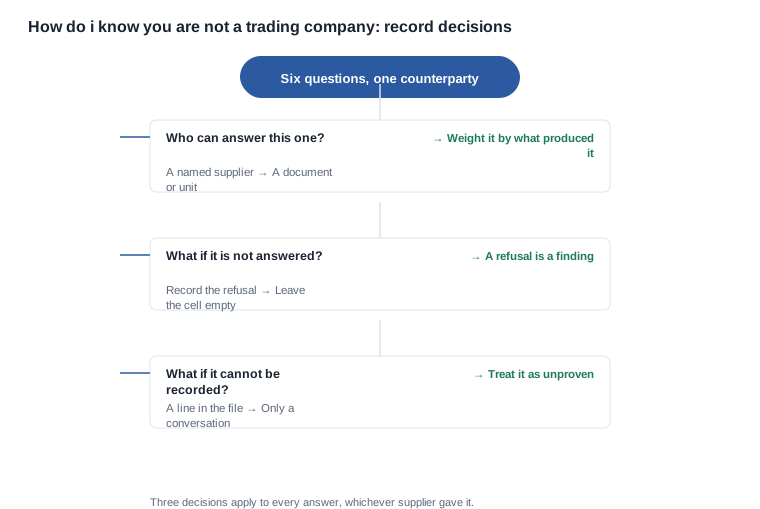
Three questions decide what happens next, and they apply whichever answer you were given. Who can answer it — if the answer must come from a supplier, a document or a physical unit, write down which one produced it, because the three carry very different weight. What to do if it cannot be answered — record the refusal or the silence in the supplier's own terms and move the item to the gap column with a date attached, rather than leaving the cell empty and hoping someone remembers. And what to do if it cannot be recorded — if the answer arrives only as a conversation and cannot be reduced to a line in a file, treat it as unproven and score the supplier accordingly, because a conclusion that cannot be written down cannot be defended later.
Two habits make the difference in practice. The first is to require the answer in writing even when it was given verbally in a call, because a spoken answer can be reinterpreted and an email cannot. The second is to keep the list of unanswered questions, which is more informative than the list of answers, because it tells the next buyer exactly where this relationship is thin. The red flags are also easier to name in a file than in a conversation: an answer that points to a partner where the question asked about your own site, a second answer that contradicts the first, and a document that covers a family rather than which model you are buying. The audit questions material is the natural companion to this file, since the audit is where the entries that could only be answered in person finally get closed.
The how do i know you are not a trading company answer
The answer, in the three-part form used throughout this article, is short enough to state in one place.
Published. The catalogue holds twenty-eight entries in seven categories, and every product row is published in the same shape: cell capacity, runtime, charge time, charging method, and where the model has them, a resolution class, a case capacity, an ingress marking, a colour range, a remote shutter or a removable part. That is a real specification set, and a buyer can check a supplier's claims against it line by line.
Not published. The capacity family — headcount, floor area, capacity, line count, daily output — and the commercial family — unit price, price tier, minimum order quantity, lead time, warranty period, tooling fees, sample fees, certificate identifiers. These are absent because they are programme-specific, and a number published without its context becomes a commitment nobody intended to make.
Ask the supplier. The six questions, in the order given above, followed by the recording routine. The purpose of the first two is to find out who performs the work; the purpose of the third and fourth is to find out who holds the documents and who does the diagnosis; the purpose of the fifth is to find out which entity is the counterparty; and the purpose of the sixth is to find out whether the supplier tells you the truth about the limits of what it publishes.
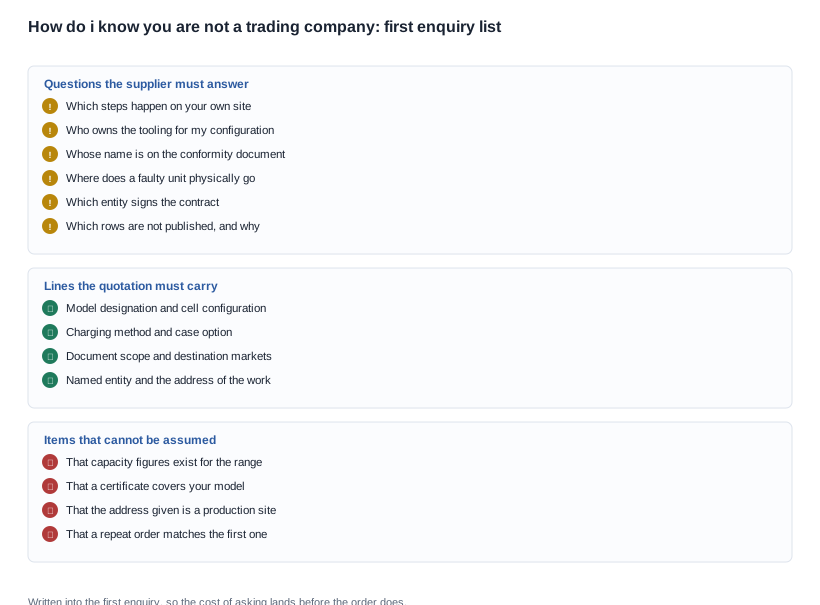
The checklist below is what to put in the first enquiry rather than what to ask in the third, and it exists because the trade-offs at this stage all run in one direction: the questions cost nothing now and are expensive later. Notice what is on it and what is not: no capacity figure is demanded, because we publish none ourselves and a buyer who insists on one will be told the same thing twice — once by us and once by a supplier with the same honest gap. What is demanded is an object. A site, a document, a machine, an address, a name, a date.
A last symmetry, because it is the part most writing on this subject omits. The six questions are constructed so that they can be pointed at any counterparty, including this one, and we have answered them against our own documentation above rather than against a supplier's. We do not publish capacity figures, we do not publish a certification identifier, and we do not publish a price. A buyer who reads this article and asks us for a number we have not published will get the same answer we would ask anyone else to give: the name of the row that exists, and a clear statement that the row does not exist. Where that answer is unsatisfying, the right response is not to distrust the method but to ask for the artefact — and the factory versus trading company page sets out the structural difference these six questions are designed to expose.
The method is the answer to how do i know you are not a trading company. Not because it produces a verdict, and not because any of the six questions can be answered once and for all, but because six answers recorded in the same format produce a document, and a document is the only form of this question that survives a procurement review, a supplier change and a second buyer arriving two years later with no memory of the first conversation.
Related reading
- Where the structural difference sits — how factories differ
- The commercial side of the same question — cost implications
- The operational checks — production line questions
- Where the split between in-house and partner work is normal — why some factories outsource
- Keeping the file after the order — how long to keep documentation


