
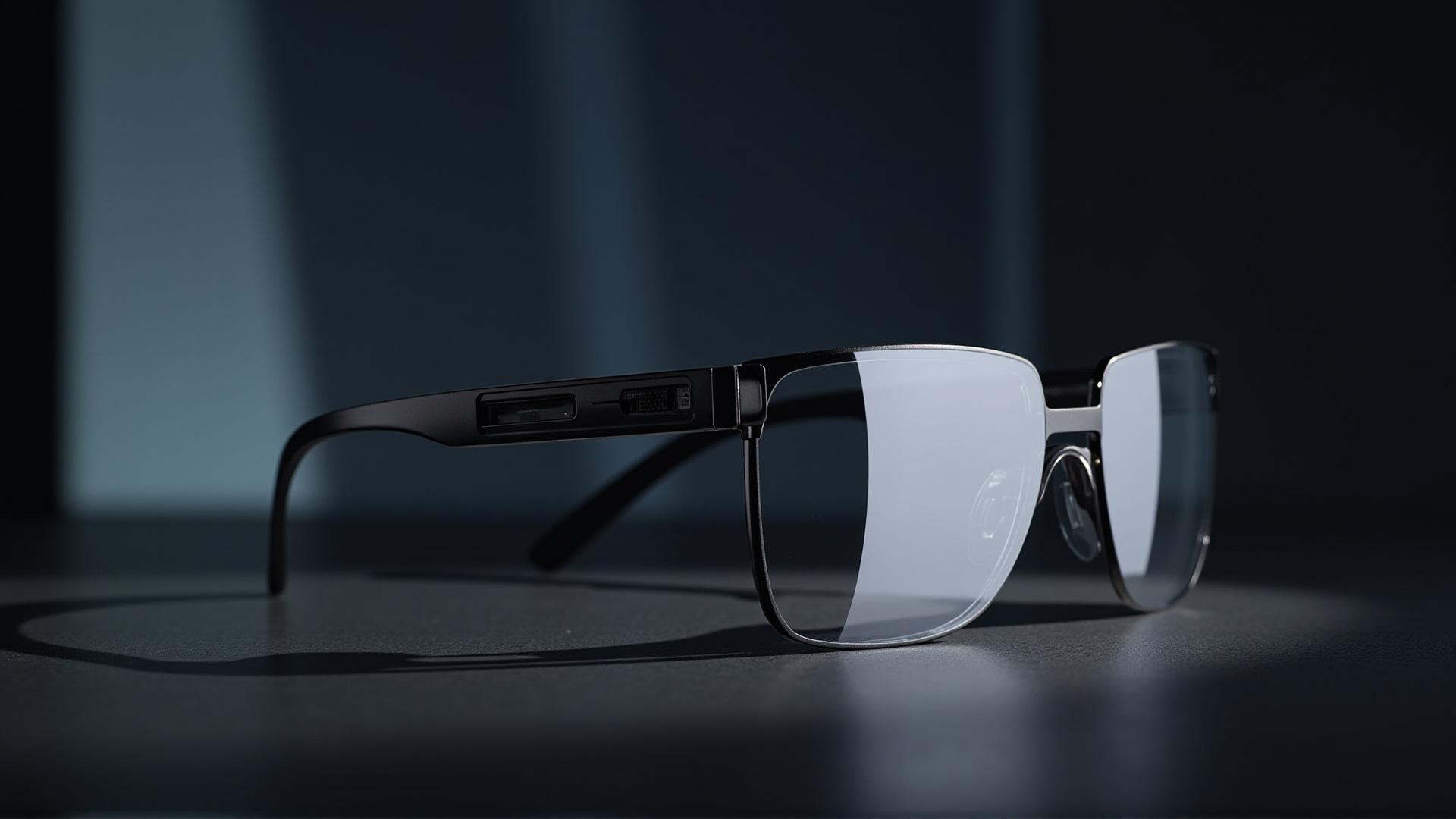
The MT5 publishes six things about itself, and the shape of those six is unusual enough to set the order of the whole customisation programme. The camera sits in the eight megapixel class. The frame cell is 220 mAh. A charge takes two hours or less. The rated use is published as a range rather than a point, six to eight hours. The charging method is magnetic, with a charging case. And the product is listed as the case-equipped version of the model, so the designation itself carries the configuration.
What is not published is the number a buyer reaches for first: the capacity of the case. On four other camera models the catalogue publishes the case capacity and leaves the charging method unstated. On this one the arrangement is reversed — the method is fixed and the accessory's energy is not. That single asymmetry drives the sequence here, because a magnetically charging frame needs a magnetic counterpart in the box, and nobody can yet say what that counterpart holds, how often it tops the frame up, or how much battery mass it adds to the parcel.
The rest of what the catalogue leaves open for this model is a familiar list: no colour list, no feature line, no frame weight, no ingress marking, no radio version and no certification row naming the model. None of that is unusual for this range, and each item becomes a written request rather than an unknown to be guessed at.
This article walks the programme in the order the decisions bind, for the buyer who owns the commercial outcome and the compliance owner who owns the file. It quotes no price, no minimum order quantity, no lead time and no certificate number, because none of those is published for this model or for any other in the range.
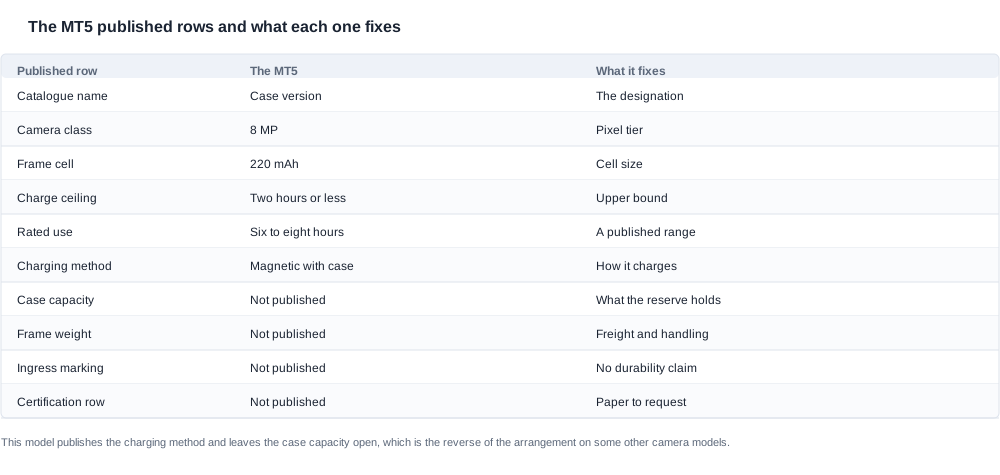
What the catalogue publishes for the MT5, and what it leaves out
Six published facts, and they are enough to write a defensible specification. The catalogue names this model as the case version of the MT5, which means the configuration is part of the name rather than an option attached to it, and every document, label and carton has to carry that same string. The camera is in the eight megapixel class. The frame cell is 220 mAh. The charge ceiling is two hours or less. The endurance figure is six to eight hours, published as a range where several neighbouring models carry a single number. The charging method is magnetic charging with a charging case.
That page carries two time figures and labels them in a way that is easy to misread, so it is worth reading carefully before either number reaches a listing. One row gives two hours or less for a charge. The other gives six to eight hours on a row headed with a charging-duration label, while the catalogue's own model table records that figure as the endurance for this model. The practical rule for a buyer is simple: the two-hour figure is the charge time, the six-to-eight-hour figure is the endurance, and neither of them should be quoted without the condition behind it, because a range published without a condition is an open invitation for a customer to supply their own.
The class position matters commercially. The eight megapixel class holds eight of the eleven camera models in the catalogue, and the thirteen megapixel class holds three. A brand building a tier at the eight megapixel level is therefore building a tier with seven peers inside it, and the differentiator has to come from something the catalogue publishes or from something the programme has measured, because the pixel count alone will not separate the model from its own class.
Two published facts make this model easier to place than most. First, the charging method is published rather than open, which is not true for every camera model in the range — four of them publish no charging method at all. That is worth having, because a magnetic charge has consequences the programme can plan around instead of discovering: the counterpart in the box has to be a magnetic one, and the accessory line has to be built on that basis. Second, the endurance is published as a range, which is more honest than a point figure and gives a page room to say what it actually means, provided the condition is stated.
The gap that carries the programme is the case capacity. Across the eleven camera models the case row comes in three states plus one explicit exception. Five models publish a case capacity, including one with two published sizes and one with a folding case. Two models publish a charging case without a capacity figure, and the MT5 is one of those two. Three models carry no case row at all on their page. One model is stated to have no case. So the MT5 sits in the narrow group where the existence of the case is confirmed and its energy is not — which is a different problem from a model whose page says nothing about a case, because the accessory is confirmed and therefore has to be costed, packed, documented and described.
The remaining gaps are the standard ones, and they should be treated as a request list rather than as a reason to wait. There is no feature line on this model's page, so no marketing descriptor can be inherited from the catalogue and every claim on a private label page has to be traceable to a specification row or a test report. There is no colour list, so the colourways that exist in this model's tooling are a question rather than a choice. There is no frame weight; the only weight published anywhere in the catalogue belongs to a different model, and a figure from another platform is not a proxy for this frame. There is no ingress marking, so no durability claim of any kind can be made. There is no radio version, and no certification row naming this model.
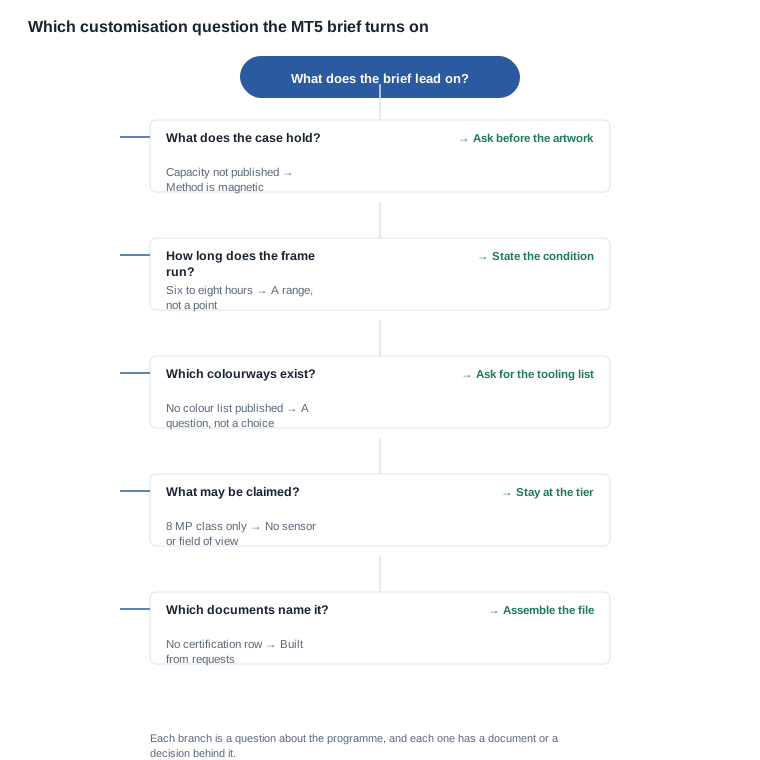
Step one: the case, because the method is fixed and the capacity is not
Magnetic charging is not a detail of the accessory; it is the way the product charges. A magnetically charging frame needs a magnetic counterpart to take power from, and the catalogue names a charging case as the counterpart for this model. That settles one question and opens another. It settles how the frame charges, and it means the case is part of the charging route rather than a convenience that ships in the box. It opens the question of what the case is, because a case can be two very different objects.
That is the first thing to put in writing: does the case store energy and then top the frame up, or is it a magnetic cradle that passes current while the frame charges? If it stores energy, the capacity figure is a commercial headline and the customer's question is how many times they can top up before they need a socket. If it passes current, the customer has to keep the case plugged in, the endurance story changes shape entirely, and the programme should not describe the case as a reserve at all. The catalogue's wording supports a case but does not settle the architecture, so a page that describes reserve hours for this model is describing something nobody has confirmed.
The missing capacity then costs four specific things. The top-up claim cannot be stated, because without the number neither the number of charges nor the additional hours are calculable. The battery content of the parcel cannot be computed, which decides the packaging cavity, the freight class and the transport paperwork, and a second lithium cell travelling in every unit is the difference between a single-cell shipment and a two-cell one. The transport file for the case cell cannot be scoped, because the documentation a forwarder asks for is tied to the cell that is actually packed. And the paper comparison against the models whose case capacity is published cannot be made, which matters when the same programme is planning more than one camera model.
What to ask is short and specific. Ask for the case capacity in mAh, the case's own input interface, the case charge time, the case weight and its dimensions, and whether it carries a battery indicator. Ask whether the frame can be charged from any source other than the case, and what happens to a customer whose case is lost or damaged. Ask whether a spare case can be bought separately and on what terms. Ask what transport documentation covers the case cell in the shipping configuration the programme intends to use. The MT5 charging options analysis sets out how the charging brief runs across this range, the battery transport compliance guide covers the file a forwarder will ask for, and the shipping weight breakdown covers the parcel arithmetic once the case is measured.
There is one more commercial consequence that only becomes visible after the architecture question is answered, and it should be settled before the artwork rather than after the first shipment. A case that ships in the box is an accessory line whether the programme intends it or not, because cases get lost. Whether a replacement is available, in what configuration, and on what terms is a decision about the accessory line, and it is easier to take while the programme is still one decision rather than four.

Step two: the brand layer, and the colour question with no published answer
The brand layer for this model is the same as for the other camera products in the range: the Bluetooth device name, the logo, the temple shape, the colour, the packaging, the system language and interface, and the firmware. What differs on the MT5 is that the catalogue can answer none of them, so the sequence of the requests is what keeps the programme to a single production cycle.
Ask for the Bluetooth device name first. It is embedded in firmware, and it then appears in the pairing instructions, on the packaging, in the conformity file and in every support ticket that will ever be raised about the product. Ask for the logo position and the temple shape next, because both are constrained by the mould and the constraint has to come back from the factory in writing before artwork is approved; a logo that does not fit the mould is discovered at pre-production, and a relabelled shipment costs more than a proof. Ask for the colourways third, because a colour has to exist in this model's tooling. Packaging comes last, because the box contents depend on the case decision taken in the previous step. The OEM ready brand guidelines note covers the step where the hardware pushes back on the identity.
The colour question on this model is a genuine open item rather than a formality, and it is worth separating it from the tooling question. The catalogue publishes colour lists for some camera models and not for others; this model's page carries none. A brand carrying a colourway across from a neighbouring model is therefore carrying an assumption about a different mould, and the answer that matters is not "is this colour nice" but "does this colour exist in this model's tooling, and if it does not, what does adding it involve". That last part is a commercial question, not a product question, and it is the point at which a tooling charge and a different order structure enter the conversation. We publish no minimum order quantity and no cost for a tooling change, so the only way to answer it is a written quotation for the specific programme.
The software layer carries the same trap in a different place. The catalogue carries an AI feature entry for twenty of its twenty-eight models, and for the entries it carries it publishes no behaviour at all: not whether the assistant runs on the device or in the cloud, not whether it needs a subscription, not whether it works without a connection, and not where anything is stored. A programme that wants to brand the software experience therefore needs those answers before the artwork is approved, not after the first production run, because the answers determine what can be claimed on the packaging and in the listing. The AI features in smart glasses guidance sets out the four questions to put to the supplier.
The last item in this step is the platform question, and it is the one most often answered wrongly because the published figures make it look answered. A shared class and a shared accessory arrangement across the range are shared specification rows, not evidence of a shared platform. Whether the tooling, the firmware branch and the accessory set underneath are common enough to amortise is a factory question, it needs a written answer, and the answer belongs in the file. The red flag to watch for in a reply is a shared specification being offered as proof of a shared programme.
Step three: the file, the marking and the sample you approve against
The conformity file for this model is assembled rather than inherited. The catalogue's export certification material is company-level, its content is images rather than text, and the images are ten patent certificates — eight appearance-design and two utility-model. A patent certificate records that a design or a mechanism was granted protection; it is not evidence that a product conforms to a requirement in a market, and no per-model certification row exists anywhere in the catalogue. So the file a programme submits is built from documents it requests, each of which has to name the model and the configuration. The certification checklist sets out the document set, and the MT5 certification status piece covers what the catalogue does and does not hold.
The marking is the part of the file that meets the physical unit, and it is the step most programmes defer. Every unit leaving the factory should carry the marking required for its destination market, and the way to test that is to verify markings on a random sample drawn from the production run rather than on the first carton. A compliant document does not guarantee that the physical marking is on every unit, and a mislabelled unit is a customs question rather than a quality question.
The re-test step is the one that catches problems created by the customisation itself. A logo change, a colour change and a firmware change each reopen something that had already been verified, and the check that mattered before the change is the check that has to be repeated after it. The order that works is to re-run the physical and documentation checks against the production build rather than against the sample that was approved before the artwork changed.
The box contents follow from the decisions already taken, and they have to be written per market because the warnings, the language and the operator details are. The sport smart glasses packaging options note covers how features land in the box, and the Bluetooth audio glasses box checklist covers the item list in general, including the charging counterpart that a magnetically charging frame needs in order to be usable at all.
The sample is where the programme either holds or loses, so it has to be approved against a written specification rather than against a good impression: the designation including the case configuration, the eight megapixel camera class, the 220 mAh cell, the charge ceiling of two hours or less, the six-to-eight-hour endurance, the magnetic charging method with its case, the colour, the box contents, the marking, the firmware version, and the logo placement with its dimensions and finish. The MT5 specification list is the honest baseline for what is known before the unit arrives, and the MT5 buyer review checklist covers the checks to run on the unit itself — including the ones a catalogue row cannot answer: the frame weight, the dimensions, the packed weight with the case, and whether the magnetic contact holds the frame securely and aligns without marking the finish.
The imaging claim has the same boundary as every other camera model in the range. The eight megapixel class is published and nothing beyond it is: no sensor model, no field of view, no video format, no frame rate, no low-light behaviour. A page can state the class. A page cannot state image quality from it, and a tender that needs something about the imaging module itself needs a document or a measurement, not a pixel count.
The six questions to settle before you commit on an MT5 customisation
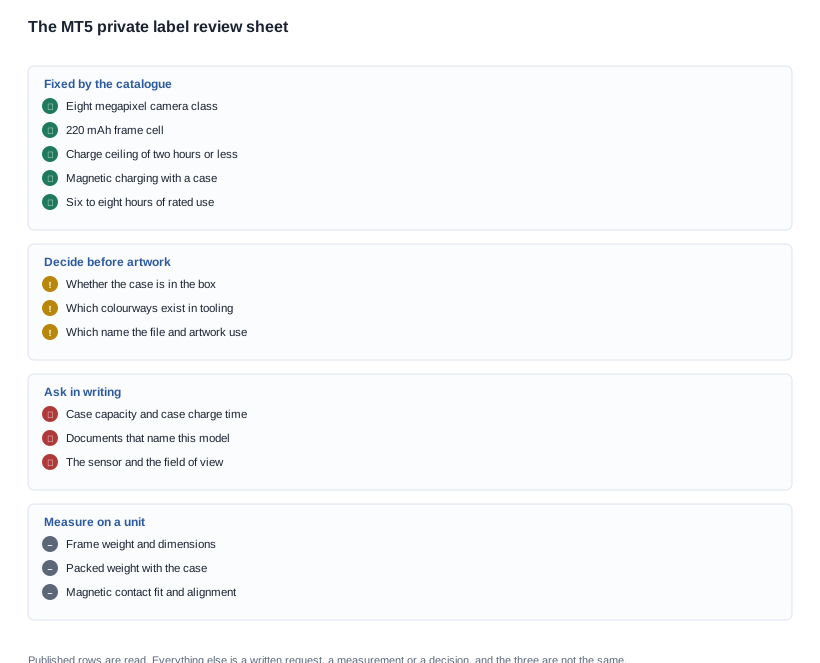
- Does the case store energy or pass current? The architecture decides whether the accessory is a reserve or a cradle, and it decides what the programme may claim about hours between charges.
- What does the case hold? The capacity is not published for this model, and without it neither the top-up claim, the parcel's battery content nor the transport file can be scoped.
- Which colourways exist in this model's tooling? No colour list is published, and a colour carried over from a neighbouring model is a colour from a different mould.
- What can be claimed about the software experience? The catalogue publishes an AI entry for twenty of its twenty-eight models and no behaviour for any of them, so on-device, subscription, offline and data-handling answers are needed before the packaging is written.
- Which documents name this model and this configuration? Test reports, the component and module list, the cell documentation for the frame cell and the case cell, the marking artwork, the instructions and the technical file index.
- What may be claimed about the camera? The class is published and the behaviour is not, so the claim stops at the class or rests on evidence the programme has actually obtained.
Those six are the decisions. Four positions stay open whatever they decide, and they belong on the same page because they are the items that are discovered late: the case capacity and the case's own interface and charge time; the frame weight, which has to come off a unit; the ingress position, which carries no marking and therefore supports no durability claim; and the certification row, which the programme builds from the documents it requests rather than reads off a catalogue line.
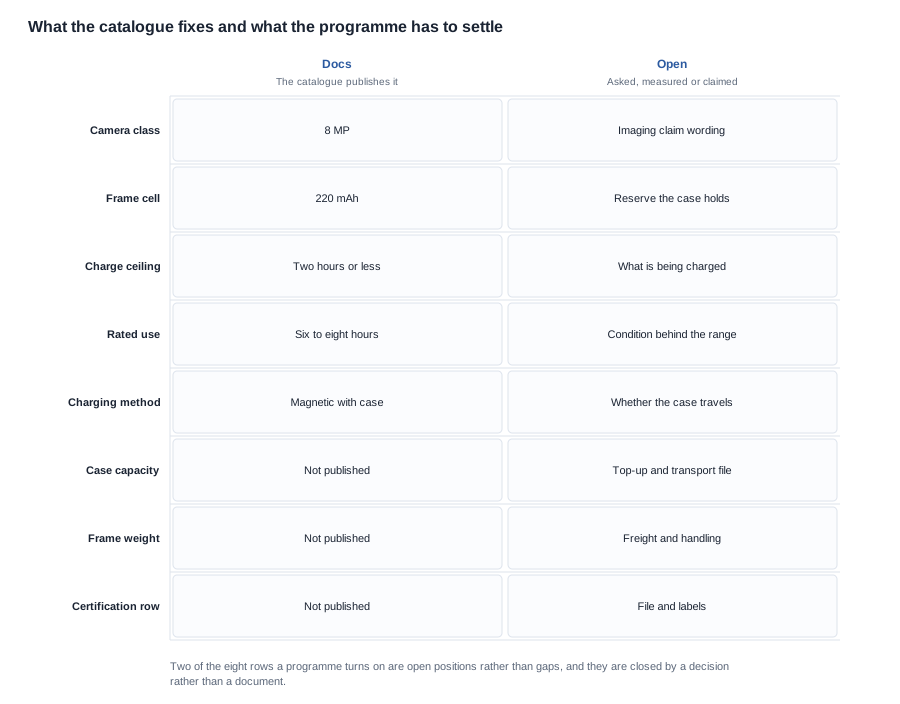
The matrix above is the summary a buyer and a compliance owner should agree on before the first order. Each row pairs what the catalogue publishes with the single item that closes the gap beside it, and the two open positions in it — what the case holds and how the frame charges — are closed by a document and a decision respectively, which is why they have to be taken before the artwork rather than after it.
On this model, our position is narrow and deliberate. We publish the eight megapixel class, the 220 mAh cell, the charge ceiling of two hours or less, the six-to-eight-hour endurance range, the magnetic charging method with its case, and the fact that the case capacity is not published. We do not publish a weight, a colour list, an ingress marking, a radio version, a certification number or a reserve-hours claim for this model, because the documentation does not contain them and because the architecture question has not been answered. We do not describe a magnetically charging frame as one that charges from a cable, and we do not carry a colourway across from a model whose tooling is not this one.
Tell us the target market, the volume and the configuration you are considering, and we will tell you which of the six items above are defined today and which have to be requested. The camera range this model belongs to is on the AI camera glasses page, and the platform options are on our OEM ready platforms page.
Related reading
- The accessory and charging brief — MT5 charging options
- The freight arithmetic — AI camera glasses shipping weight
- The document set a private label needs — certification checklist
- What the catalogue holds and does not hold — MT5 certification status


