

The K01 and the LC-105-1 publish the same three headline rows and differ on two others. Both publish a stated endurance of about 8 hours, a charge time of two hours or less, and magnetic charging. The K01 publishes 90mAh2 against the LC-105-1's 55mAh2, and the K01 publishes Bluetooth V5.3 against the LC-105-1's V5.4. That is the whole of the published difference between them.
Which makes this comparison unusual in a useful way. The row most comparison tables lead with — runtime — is the row that cannot separate these two at all, and the row that can separate them is a radio version that a customer will never see, feel or notice. Working out which use case each model fits therefore means working out what the buyer is actually buying, not what the specification sheet is wearing.
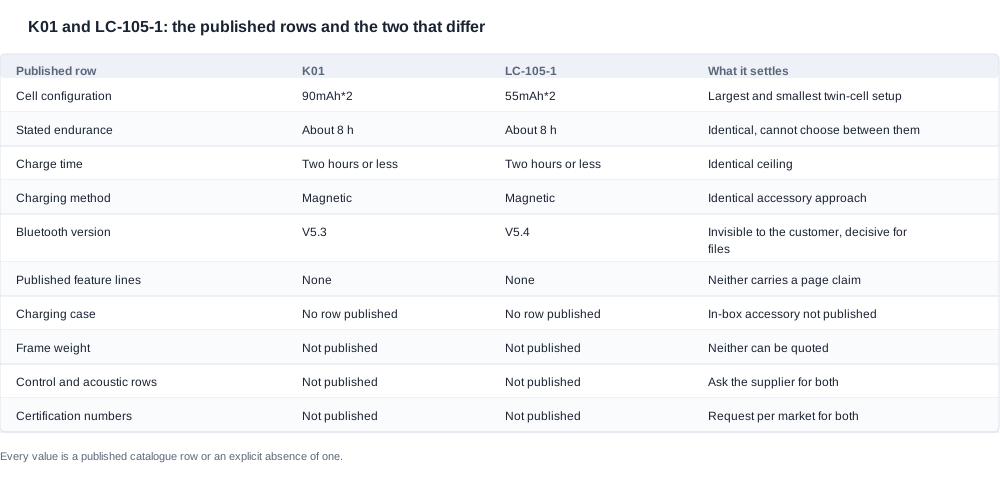
The two models and the rows that actually differ
The published rows side by side
| Published row | K01 | LC-105-1 | What it settles |
|---|---|---|---|
| Cell configuration | 90mAh*2 | 55mAh*2 | The largest published total energy in the audio range against the smallest twin-cell configuration |
| Stated endurance | About 8 h | About 8 h | Identical, so it cannot choose between them |
| Charge time | Two hours or less | Two hours or less | Identical ceiling |
| Charging method | Magnetic | Magnetic | Identical accessory approach |
| Bluetooth version | V5.3 | V5.4 | The only other published difference, and it is invisible to the customer |
| Published feature lines | None | None | Neither model carries a claim a product page can be written around |
| Charging case | No row published | No row published | The accessory in the box is not published for either |
| Frame weight and dimensions | Not published | Not published | Neither can be quoted |
| Control, acoustic and microphone rows | Not published | Not published | Neither can be listed on any of them |
| Certification numbers | Not published | Not published | Neither can be quoted |
That table has two rows that differ and eight that do not, and the two that differ pull in different directions. The cell configuration favours the K01 on any claim about energy in the frame. The radio version favours the LC-105-1 on any claim about sitting on the current generation. A buyer who wants both properties has to check whether they can actually be combined, because our catalogue does not offer a model that has both.
The 55 mAh × 2 tier, and what it does to the runtime row
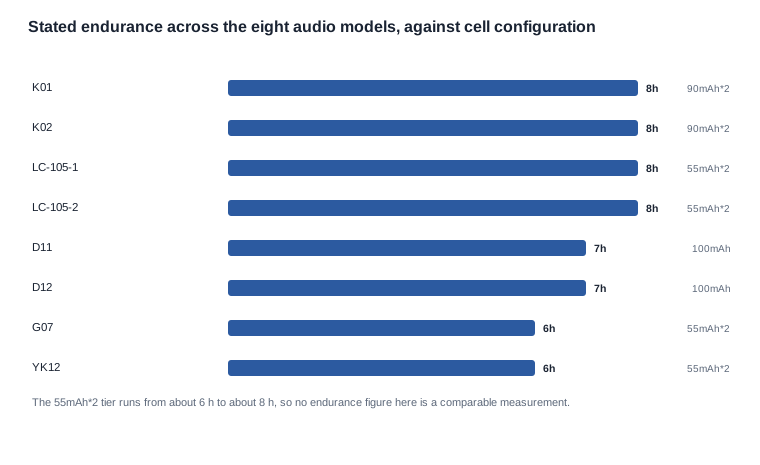
The LC-105-1 sits in a cell tier where the runtime figures are not uniform, and that matters more here than in most comparisons. The 55mAh*2 configuration appears on four audio models: the LC-105 pair publishes about 8 hours, and the G07 and the YK12 publish about 6 hours. Within that tier the published endurance therefore runs from about 6 to about 8 hours, and the LC-105-1 is at the top of it.
Two points follow, and both are worth being careful with.
The LC-105-1's own figure is about 8 hours. That is what its catalogue page publishes, and it belongs in any statement about this model.
The spread inside the tier is the diagnostic. Identical published cells producing both a six-hour and an eight-hour figure means the endurance figures were not taken under one protocol, so none of them can be treated as a comparable measurement — including against the K01. The eight hours on the K01 and the eight hours on the LC-105-1 are the same number on two different architectures, and they were not necessarily produced the same way.
That is the reasoning behind the how to compare battery life method, and the audio range battery picture lays out the full grid across the catalogue.
Neither model publishes a feature line
This is worth stating plainly because it determines what a listing can say about either of them. Of the eight audio models, five publish no feature line at all: the K01 and the D12, the LC-105-2 and the LC-105-1, and the K02. The three that do carry one are the D11, with a surround-sound descriptor and a long-endurance descriptor, the G07 with its slim detachable temple, and the YK12 with a surround-sound descriptor and a slim temple.
Both models in this comparison sit in the featureless group. Neither publishes an acoustic descriptor, a structural feature, a control method or any other claim that a product page can be written around. Their pages have to be built from the electrical rows, which is why the use-case fit question in this article is really a question about what the buyer's own proposition supplies.

Why the shared runtime row cannot pick a use case
Eight hours on both, and what that rules out
The most natural way to split these two models for a use case is to say the K01 lasts longer and the LC-105-1 is lighter. Neither half of that sentence survives the published rows.
The runtime half fails because both publish about 8 hours. There is no runtime difference to allocate to an application.
The lightness half fails because neither publishes a weight. No audio model in this catalogue publishes a frame weight, and the single published frame weight anywhere in the catalogue belongs to the MT6, a camera model's eyewear body, which cannot be carried across to an audio frame. What the cell configuration does tell you is that the K01 carries more energy in the frame than the LC-105-1, and more energy in the frame generally means more mass and a different internal balance — but that is an inference, not a figure, and it is exactly the inference a listing is most likely to make by accident.
The weight comparison across the audio range covers why the one published weight cannot be borrowed, and why the sample measurement is the cheapest item on any list.
What the cell difference actually gives a buyer to work with
What the K01's larger cell configuration does support is a claim about energy carried, written carefully. The catalogue publishes the cell value and the cell count, so the row reads 90mAh2 against 55mAh2; when the two are added for analysis the result has to be marked as a derived figure — "two cells totalling 180 mAh" — because a bare total in a specification block reads as an official number.
Beyond that, the cell difference is genuinely useful for one practical purpose: it is the only published row on which the two models can be told apart in a specification block. For a buyer who needs a document to point at, that is worth having, provided the claim stops at energy.
And there is a second-order effect that a buyer planning a programme should note. Two cells of 90 mAh across the temples and two cells of 55 mAh across the temples are the same architecture, which means the replacement procedure for a failed cell is probably the same, which means a channel's repair process does not have to be redesigned between the two models. Whether the cells are field-replaceable at all, and how a partial failure is handled, is not published for either model.
The radio version is the difference your customer never sees
Why this is the more consequential of the two differences
The cell configuration is visible in a specification sheet and can be described in a listing. The radio version is invisible — no customer looking at the product can tell V5.3 from V5.4 — and yet it decides two things that matter commercially: what your listing can claim, and what compliance files you have to hold.
On the listing side, the radio version is a weak claim and a risky one. "Bluetooth V5.4" is a version number, not a benefit, and a customer cannot evaluate it. A listing built on it is leaning on a specification rather than an experience. The radio version becomes genuinely useful only when it is attached to something the customer can act on — a known platform in a specific market, a device policy that excludes an older version, a pairing behaviour the buyer can actually rely on.
On the compliance side, it is decisive. The radio version is what determines which conformity framework the product falls under in each market. In the European Union that is the Radio Equipment Directive (EU) 2014/53/EU for radio equipment, with EMC governed separately under 2014/32/EU — and the framework is the buyer's obligation to satisfy, not something our catalogue supplies. Our catalogue carries a company-level export certification page whose content is images rather than text, the catalogue text contains no reference to CE, FCC or RoHS, and there is no per-model certification row for either model. Every document that names the K01 or the LC-105-1 is a request with a lead time.
The V5.3 pairing, and why it is not a tier
Here is the fact that makes the radio version more than a technicality. The K01 and the K02 are the only two models in the entire catalogue publishing Bluetooth V5.3. The other six audio models — the D11, the D12, the LC-105 pair, the G07 and the YK12 — all publish V5.4.
Read that as a platform fact rather than a hierarchy. These two are a pair on one radio generation, and the rest of the audio family sits one generation ahead. That is a different thing from a good-better-best ladder, and it changes what a range built on them can claim.
A buyer who positions the K01 above the LC-105-1 on a V5.3-versus-V5.4 basis is building a tier on a version number, which is a weak proposition for a customer and a strong one for a procurement file — where the version actually determines which conformity route applies and whether a customer's supported-hardware list excludes the product.
The bluetooth connectivity piece covers what to establish before a radio version is quoted as a feature, and the Bluetooth audio glasses which model to pick piece covers the range-level version of choosing between the audio models.
What has to be established before the radio version carries anything
Three questions, and none of them can be answered from our documentation.
- What platform does the customer actually run? If it is known and it is a V5.4 platform, then a V5.3 model is a deliberate choice to run an older generation, and that choice needs a reason the customer can be given. If the platform mix is mixed, the product has to be known to work across versions.
- What functionally changed between the generations for this product? Our catalogue does not record it, and it is not something we will guess at. A version difference only becomes a claim when something the customer cares about actually changed.
- Does the customer's own policy exclude a version? Some institutional and corporate buyers maintain supported-hardware lists, and a V5.3 product can be excluded by a policy nobody thought to check. This is the fastest route to a purchase order that stalls, which is why it belongs in the first round of questions.
Matching either model to an application
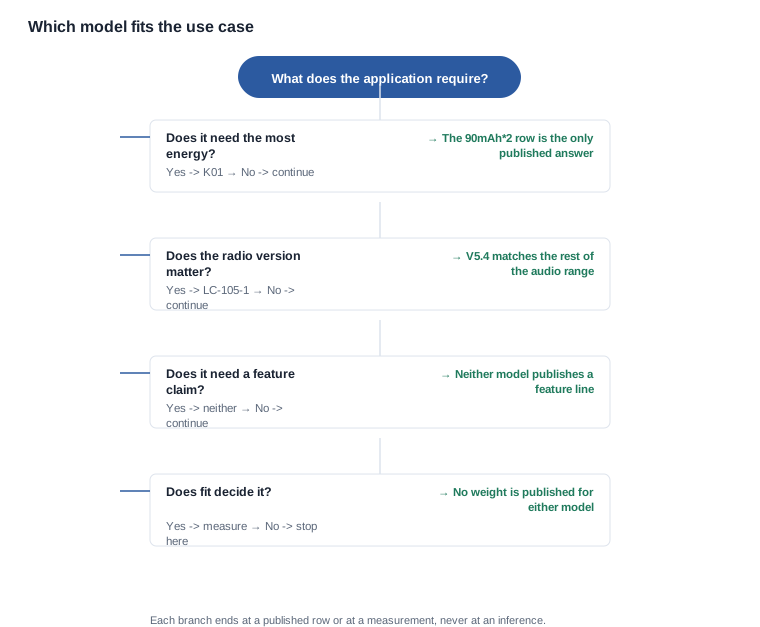
The four branches, and what each one leads to
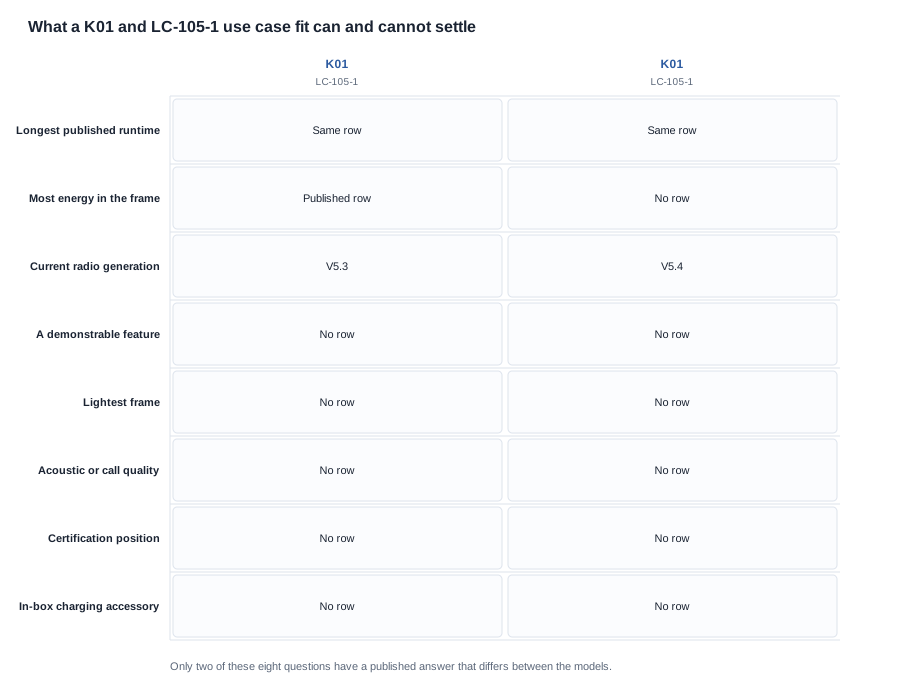
Does the application need a documented runtime, and does it need the frame to carry more energy than the minimum? Then the K01. Its 90mAh*2 is the largest published total energy in the audio range, and for an application where a customer is running long sessions on a single charge and the buyer's own proposition has to point at a row, that is the row to point at.
Is the application one where the radio version matters — a known platform, a device policy, a pairing behaviour the buyer can rely on? Then the LC-105-1, because it publishes V5.4 alongside the rest of the family. In a range where the buyer wants one consistent platform across the whole audio line, choosing the V5.4 model is the decision that avoids a compatibility question on every listing.
Does the application depend on a product claim — sound, a control method, a structural feature? Then neither model, on the published rows. Neither carries a feature line, neither publishes acoustic figures, and neither publishes a control method. A channel whose proposition needs a demonstrable feature has to obtain that evidence before it can be written, and until then the honest position is that both models are featureless.
Is the application one where fit and mass decide the outcome — a long shift, a hot environment, a wearer who is sensitive to weight? Then the published rows cannot answer it, and the answer comes from weighing samples. Neither model publishes a weight, and the cell difference suggests the K01 carries more mass, which is a reason to measure both rather than a reason to assume.
A practical order for working through the choice
- Write the buyer's own proposition in one sentence, before looking at either model. The proposition is what the listing will say, and it determines which rows matter. A sentence like "open-ear audio for long sessions in a fixed office" points at energy and runtime; a sentence like "a current-generation wearable for institutional buyers with a device policy" points at the radio version.
- Test the proposition against the published rows of both models and discard the ones that cannot support it. For both models the runtime, the charge time and the charging method are identical, so none of those can be part of the differentiator. That leaves the cell configuration and the radio version.
- Establish the radio-version position in writing — the customer's platform, and whether any policy applies to it. This is the one branch where the answer can eliminate a model outright, and it costs a single question.
- Obtain the endurance test condition for both, in identical words. Not because it will separate them, but because it is the only way the shared eight-hour figure becomes usable rather than decorative.
- Measure both samples for weight, temple length, lens width and bridge width. If the proposition came down to fit, this is the step that decides it.
- Only then fix the model and write the listing from the rows that survived step two.
The point of running the steps in that order is that a buyer who picks the model first and then writes the proposition will find that the proposition bends to fit whatever the model happens to publish. That is how a comparison table ends up with a difference in it that nobody can source.
Where the use case actually gets decided
There is a deeper point here about what this comparison can and cannot do. The published rows describe hardware, and hardware determines what a product can do. They do not determine what an application needs, and they do not determine what a buyer's customer will pay for.
A model fits a use case when the rows it publishes match what that use case requires and the rows it does not publish are not load-bearing for it. The LC-105-1 fits a use case that needs the current radio generation and does not need the largest energy configuration in the range. The K01 fits a use case that needs the most published energy and can accommodate a V5.3 product. Neither fits a use case that turns on a demonstrable feature, because neither publishes one.
And in every case the rows that are load-bearing but unpublished have to be established before the order rather than after it, which is where the evidence checklist comes in.
The questions to ask before you commit to either model
A buyer who has to defend this choice to a colleague, a channel manager or a compliance lead needs the reasoning on the record. Five questions cover it, and the answer to each one either picks a model or removes it from consideration.
Which row is your proposition actually resting on? If it is energy in the frame, the K01 and the LC-105-1 are not close and the question is settled by the published cell configuration. If it is the radio generation, the LC-105-1 matches the rest of the audio family and the K01 becomes the harder one to justify. If it is fit, mass or a demonstrable feature, then you should know at this stage that neither model's published rows can carry it, and that you are buying on evidence rather than on specification.
What platforms do your customers run, and is the answer documented? This is the only question here that can eliminate a model outright, and it is the one most often skipped because it feels like someone else's problem. It belongs in the first round of questions with everything else, because the radio version determines the conformity route and a supported-hardware policy can exclude a product outright.
Do you need the runtime figure to be usable, or merely publishable? If a page needs to say "about 8 hours" with a condition attached, the condition has to be requested for both models. If the page needs a duty cycle, a working day or a comparison against another product, the published figure is not enough and a measurement is required before the copy is written.
Can the range run both, and what would each one say? If the answer is that the second listing would say the same thing, the honest conclusion is that one model is the better buy and the second designation is a packaging cost. If the answer is that they serve genuinely different channels — say a current-generation institutional buyer and a high-energy consumer channel — then two models is defensible on merchandising grounds, and the tier gap should be described as a channel difference rather than dressed up as a specification difference.
What are the total costs beyond the unit price? For either model the accessory chain, the certification work, the artwork and the carton run are all larger than a unit price comparison suggests. And because the two models share an architecture, a channel that stocks both may find that one shared accessory chain and one shared repair process carries most of the benefit while one designation carries all of the risk.
The way to use these questions is to answer them before the samples arrive and before any artwork is commissioned. Answering them afterwards is how a buyer ends up with a range that was decided by whichever sample happened to arrive first.

Evidence to hold before either model enters a programme
What to request in writing
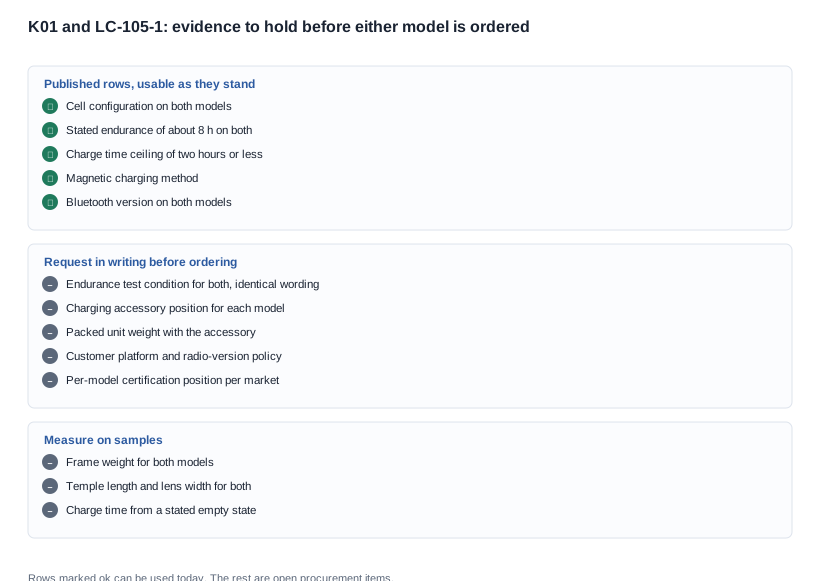
The endurance test condition for both models, in identical words. Include whether the Bluetooth link was active during the measurement, what volume was set, and whether the measured sample was the production configuration. Both models publish about 8 hours and neither publishes a condition, so this request decides whether that shared figure can appear on a page with any claim attached.
The charging accessory position for each. Magnetic charging is a method, and the catalogue does not publish whether the corresponding object is a case, a pad or a dock, nor its capacity for either model. The audio range publishes no charging-case row for any of its eight models, so nothing in the documentation tells a buyer what ships in the carton. Ask for the accessory, its capacity, its interface, its own charge time and its weight.
The certification position per model per market. Two models, two sets of documents if the files name the model, and a lead time on each. This is the request that should go out first, because it is the one that can stop a shipment at the border.
The radio-version facts. What platforms the customer runs, whether any institutional policy applies, and what the supplier can confirm about behaviour across versions.
What to measure on samples
Weigh both frames and record the temple length, lens width and bridge width. This is the row that predicts the return rate, it is missing on both sides, and it is closed in an afternoon with a scale and calipers. The cell configuration difference suggests the K01 carries more mass, and the measurement is what turns that suggestion into a fact or dismisses it.
Time a charge from a stated empty state. The published ceiling is two hours or less, and the ceiling says nothing about the starting point, the completion criterion or the time the dock itself takes. A buyer who schedules charging around the product needs the measured version.
Three failure modes this comparison produces
The runtime row was allocated to an application. Symptom: a buyer tells a customer the K01 lasts longer, and the field result does not support it, because both models publish the same figure. Root cause: a shared row was treated as a differentiator. Prevention: check which rows actually differ before assigning them to applications.
The weight difference was assumed from the cell difference. Symptom: a listing implies the LC-105-1 is the light option, and the channel corrects its own copy after the returns arrive. Root cause: a capacity figure was read as a measurement. Prevention: weigh the samples and quote the measurement, or quote no weight at all.
The radio version became a marketing claim. Symptom: a listing says "Bluetooth V5.4" as a selling point, and a customer who compares the versions finds nothing to compare. Root cause: a platform fact was promoted into a benefit. Prevention: attach the version to something the customer can act on, or leave it in the specification block where it belongs.
Where CYNRIN stands on the K01 and LC-105-1 comparison
These two models are separated by two published rows and nothing else, and a comparison built on anything outside those two rows is comparing something our documentation does not contain. The runtime, the charge time and the charging method are identical, and we will not pretend otherwise in order to make the pair easier to write about.
We will also not fill the gaps. Where the catalogue is silent — weight, dimensions, acoustics, control method, the accessory in the box, the certification position — we will say it is not published and tell you it has to be obtained, rather than supply a plausible number that becomes a commitment. And we will not describe either model as better, as higher-tier or as better value, because on the published rows there is nothing to rank.
What we can tell you is the platform picture, which is the part that actually helps a buyer decide: these are two models with no published feature line, the same stated runtime, and a radio version that separates them from each other and from the rest of the audio range. The published K01 specification list and the published LC-105-1 specification list are the honest baselines for both, and the K01 against the K02 comparison covers the pair that shares every row with the K01.
Five items to settle before the model is fixed
- The customer's platform and radio-version position, in writing.
- The endurance test condition for both models, asked in identical words.
- The charging accessory position and packed unit weight for each.
- The measured frame weight, temple length, lens width and bridge width.
- The certification position per model in each destination market.
Related reading
- The published rows for the first model — K01 smart glasses specifications and features
- The published rows for the second — LC-105-1 smart glasses specifications and features
- The runtime row across the range — how to compare smart glasses battery life
- The accessory cost picture — Bluetooth audio glasses charging options
- The measurement question — Bluetooth audio glasses weight comparison
Send us the application your buyer is actually deploying into, the platforms their customers run and the channels you sell through, and we will tell you which of the two published rows decides it.


