

The KY06 and the L1 Pro sit thirty milliamp-hours apart on the frame, they both charge within the same published ceiling, and one publishes a range for its endurance while the other publishes an approximation. That asymmetry is the most useful thing in this comparison, because it tells you the two runtime figures are not the same kind of number and a buyer who sets them side by side without asking why will be misled.
The charging rows are asymmetric in the same way, and in the opposite direction. The KY06 publishes how the device charges — magnetic charging with a charging case — while leaving the case capacity unstated. The L1 Pro publishes how much the case holds — 1400 mAh — while leaving the charging method unstated. So the comparison that looks like a spec sheet on the surface is really a comparison of what the catalogue chose to disclose. This article walks through both rows, explains what each published number can and cannot be used for, and turns the gaps into a written request you can send to the supplier before you order.
The published battery and charging rows for the KY06 and the L1 Pro
The CYNRIN camera glasses range publishes a consistent set of rows per model: a model code, a full product name, a battery cell capacity, a stated runtime, a stated charging time, a charging method line, and a Bluetooth line. Two of those rows for the KY06 and the L1 Pro carry directly comparable values, and two of them are published in complementary form.
The KY06 is published as the KY06 AI camera sport glasses. Its published cell capacity is 260 mAh. Its published runtime is the range 6~8 h. Its published charging time is ≤2 h. Its published charging method line reads magnetic charging plus a charging case, and the capacity of that case is not published in the catalogue table. The Bluetooth column for the KY06 carries no version figure.
The L1 Pro is published as the L1 Pro AI camera glasses. Its published cell capacity is 290 mAh. Its published runtime is approximately ~7 h. Its published charging time is ≤2 h. Its published charging method line states that the charging method is not published, together with a charging case whose capacity is published as 1400 mAh. The Bluetooth column for the L1 Pro also carries no version figure.
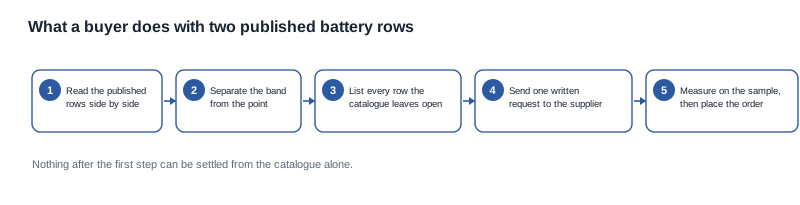
Note the word approximately in the L1 Pro runtime row. It is a different claim from the KY06's band. A band of 6~8 h is a statement that the measured result fell somewhere inside that window under whatever conditions were used, and a buyer can legitimately publish it as a range. An approximation of ~7 h is a rounded single figure, which is a statement about a central tendency and hides the spread underneath it. Two runtimes written in different forms cannot be differenced by a third-party buyer, and the catalogue does not publish the spread for either of them.
The same caution applies to the charging time row, but in the opposite direction. ≤2 h is a ceiling, not a typical figure, and it applies identically to both models. A ceiling tells a buyer the worst case that was committed to. It does not tell them the common case, so a buyer who writes "charges in 2 hours" in retail copy has quietly converted a ceiling into a specification that the catalogue does not support. If the charging experience is part of the product story, the ceiling is the number to negotiate against in writing.
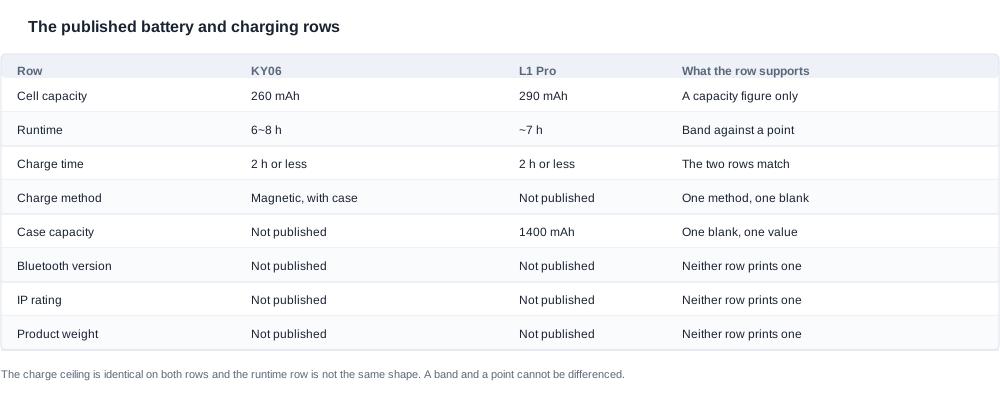
Collected into one view, the two published rows look like this, and every "not published" entry below is a genuine gap in the catalogue rather than a formatting artefact:
| Row | KY06 | L1 Pro |
|---|---|---|
| Cell capacity | 260 mAh | 290 mAh |
| Runtime | 6~8 h | ~7 h |
| Charging time | ≤2 h | ≤2 h |
| Charging method | Magnetic + case | Not published |
| Case capacity | Not published | 1400 mAh |
| Bluetooth version | Not published | Not published |
| IP rating | Not published | Not published |
| Product weight | Not published | Not published |
The pattern in that table is the finding. Four of the eight rows are published for both models, and they are the four rows that carry no product-specific detail: cell capacity, runtime, charging ceiling, and a charging statement of some kind. Everything that would distinguish the two models in a customer-facing sense — how it charges, how big the case is, how it connects, how heavy it is, how it survives weather — is either published for one model only or missing for both.

Reading a runtime range and a charging ceiling side by side
A buyer who wants to use these two rows for a real decision has to start by reading them as two different kinds of statement. It helps to think of the runtime row as a band, the charging row as a ceiling, and the two charging-method rows as complementary halves of one disclosure.
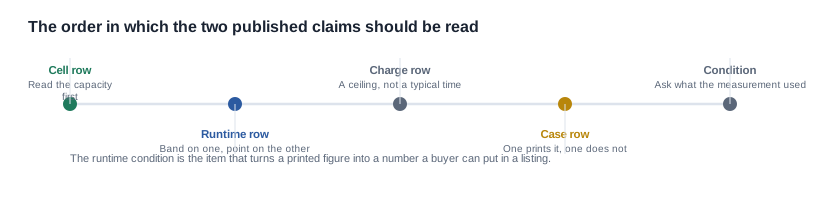
The runtime band. A 6~8 h band is the honest form of an endurance claim, and the fact that the KY06 is published this way while the L1 Pro is published as an approximation tells you something about how the two numbers were recorded. A band is normally produced by a measurement whose spread was wide enough to matter — different clip lengths, different feature states, different ambient conditions — and the manufacturer chose to disclose the spread rather than a single flattering figure. An approximation is normally a rounding of one representative measurement. That does not make either one wrong. It makes them non-comparable, and it means neither one tells a buyer what a specific customer's day will look like.
The charging ceiling. Both models publish ≤2 h. The useful reading is a contract boundary: the manufacturer committed that a full charge would not exceed two hours. If a buyer's quality control plan includes an incoming check on charge time, the ceiling is the line that lot must stay under. What it cannot be used for is retail copy, because a buyer cannot claim a typical experience from a ceiling.
The complementary charging rows. The KY06 tells you the interface — magnetic — and withholds the case size. The L1 Pro tells you the case size — 1400 mAh — and withholds the interface. A buyer can already see where this leads: the KY06 programme needs a case-capacity answer before it can write a pack-out specification, and the L1 Pro programme needs an interface answer before it can write any customer instruction about charging at all. Those are not small gaps. An interface answer changes what the buyer can put in the manual and on the retail carton; a case-capacity answer changes the accessory bill of materials and therefore the unit cost of the shipped kit.
We will not convert a published range into a fixed hour figure, so a buyer comparing the KY06 and the L1 Pro on runtime should treat both rows as ranges and confirm the test condition in writing.
There is one more honest observation to make about the cell figures. The KY06 carries a 260 mAh cell and the L1 Pro carries 290 mAh, a difference of 30 mAh or roughly a tenth of the L1 Pro's cell. It is tempting to read that as a runtime advantage, and on paper it is directionally sensible. But the published runtimes do not confirm it, because the KY06's band reaches 8 h while the L1 Pro's approximation sits at ~7 h. So the larger cell does not produce a better published endurance number, which means a buyer cannot use the cell difference as a selling point, and a supplier claiming it as a feature should be asked what measurement backs it.
The same discipline applies to the case. A 1400 mAh case for a 290 mAh cell suggests several recharges of the frame per case charge, but the catalogue does not publish the charge efficiency, the case's own charge time, the connector, or whether the case can charge the frame only or the frame and nothing else. Any cycle count derived from 1400 divided by 290 is a buyer-side estimate that should never appear in retail copy or in a contract as though it were a published figure.
The charging questions this comparison does not answer
Everything in this section is a question the published rows leave open. The point of listing them together is that they are not all equally urgent, and the order reflects how much downstream work each unanswered item creates. A question that changes what you can put on the retail carton or in the manual should be answered before you order; a question that changes your internal quality control checklist can be answered during the sample stage.
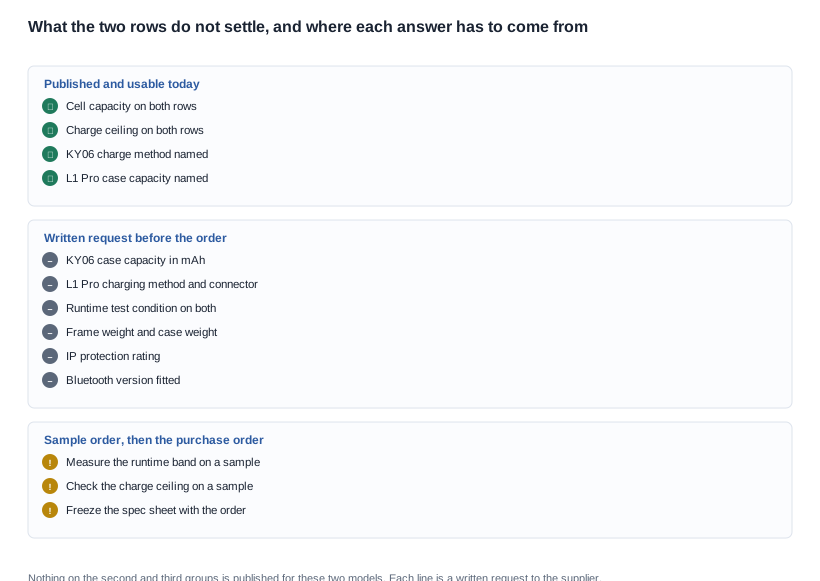
The checklist above is the technical half. A buyer working through the questions to ask before you order should hold it next to the commercial half below, because a specification that has no commercial anchor is a specification that gets renegotiated by whoever is more patient.
The questions to ask, in the order that minimises rework:
- What is the charging case capacity for the KY06, and is the case supplied in the retail box or sold separately? This is the single largest published gap between the two models and it directly sets the accessory cost per unit.
- What is the charging method for the L1 Pro — wired, wireless, or a dedicated dock — and what connector does the frame use? Without this, no customer-facing charging instruction can be written.
- What test condition produces the KY06 6~8 h band and the L1 Pro ~7 h figure? Ask specifically whether it is continuous video capture, intermittent capture, or standby, and which features were enabled during measurement.
- What is the weight of the charging case for each model, and the weight of the frame alone? The only published weight anywhere in this range belongs to a different model, so both of these arrive as unpublished.
- What is the IP protection rating for each model, or is none claimed? The published IP figures in this range cover two other models only, so neither the KY06 nor the L1 Pro can carry a water-resistance claim today.
- Which Bluetooth version is fitted to each model? The catalogue carries the column but publishes no figure for camera glasses models, so this has to come from the supplier.
- Does the supplied charging case recharge the frame from empty, and how long does the case itself take to charge?
Each of those seven items is a question with a written answer available, because they are manufacturing and configuration facts rather than performance claims. That distinction matters for how you request them. A supplier's quality control team can answer the case capacity, the connector, the weight and the Bluetooth version with a single line in a specification sheet, and those are facts that stay stable across the production run. The runtime test condition is also a fact, but it is a fact about a measurement that the supplier has to describe, which is why asking for the condition rather than for a better number is the correct move.
Knowing what to ask is only half of the job, because the second half is deciding which trade-off you are willing to accept. Every one of these seven answers will land somewhere on a spectrum, and each answer carries a cost somewhere else in the programme. A larger case capacity raises the accessory cost and the packed weight; a faster declared charging time may depend on a charger the customer has to buy separately; a wider runtime band is more honest but harder to use in retail copy, where customers read a range as uncertainty. Naming the trade-off explicitly in your own request — for example, that you would accept a tighter band in exchange for a stated measurement condition — is what makes the supplier's answer usable, because it tells them which side of the trade-off you actually care about and lets them answer the question you have rather than the one they expected.
What you should not do is ask a supplier to "improve" the published runtime. That request invites a marketing number rather than a measurable one, and it gives you a figure you cannot defend in your own quality control plan. The right request is a description of how the existing figure was measured. If the answer is that the 6~8 h band was measured with the frame recording continuously and the ~7 h figure was a single measured run, then you know exactly what to write in your listing copy for each model and you know to keep them in different forms.
Two further items belong in the same request because they are commercial rather than technical, and because they will shape the answer you get on the technical ones. The first is whether the published figures apply to the private label configuration you intend to order, or only to the catalogue configuration. A supplier can change a cell, a case, or a firmware power profile for a branded variant, and the published rows describe the catalogue variant. The second is whether the quoted figures are the ones your contract will carry, which converts an informal specification reference into an agreed item on a purchase order.

Putting the battery and charging position into the purchase order
By the time a buyer reaches the purchase order stage, the battery and charging comparison should already be settled, because it is one of the earliest decisions in a camera glasses programme and it propagates into packaging, manuals, accessories and inspection. The order in which you settle it is worth being deliberate about.
The first stage is the specification freeze. Take the published rows you can use — 260 mAh with a 6~8 h band and magnetic charging for the KY06, 290 mAh with a ~7 h approximation and a 1400 mAh case for the L1 Pro — and write the unanswered items beside them with the written answers attached. The result is a specification sheet that states, for each model, exactly which figure a customer may see and which figures are internal. That sheet then goes into the technical file that accompanies the first purchase order and stays with it for every subsequent lot.
The stage order matters more than the individual items. If the runtime condition is settled after the packaging is printed, the buyer has to reprint. If the case capacity is settled after the accessory order is placed, the buyer has to re-order. If the charging interface is settled after the manual is written, the buyer has to re-issue the manual and the support team has to correct the instructions it has already given to customers. Running the seven technical questions and the commercial rows as one batch, before the packaging design is finalised, is what turns a comparison article into a decision that actually holds.
The sample order is where the runtime condition gets validated rather than assumed. A sample order for each model lets you measure the actual figure under the condition the supplier described and compare it against the published band. If the sample measures inside the published 6~8 h band for the KY06, you have evidence for your retail copy. If it lands outside, you have a specific and fair conversation to have before the bulk order, rather than a general complaint later. The same exercise validates the ≤2 h charging ceiling on both models and confirms the charging interface that the catalogue did not publish for the L1 Pro.
The bulk order is where the commercial terms catch up with the technical ones. The catalogue publishes no minimum order quantity, no lead time, no sample order cost, no warranty period, no deposit structure, no payment terms, and no incoterms for any model in this range, so every one of these is something you obtain from a quotation and record on the purchase order rather than something you read off a spec table. For a programme that ships with a charging case, the MOQ on the case configuration is often the binding number rather than the MOQ on the frame, so ask for the MOQ of each accessory line separately. The lead time for a bulk order should be quoted for the branded configuration, and the deposit and payment terms should be tied to inspection points rather than to dates.
The risk in this particular comparison is one that is easy to underprice. If the KY06 case capacity comes back at a level that makes the accessory heavy or expensive, or if the L1 Pro turns out to use a proprietary dock rather than a standard connector, the programme economics change after the packaging artwork is already approved and the tooling is already committed. That is why the battery and charging answers need to sit in front of the packaging and tooling decisions rather than behind them, and it is the reason a written request sent early costs far less than a correction applied late.
There is a factory-level dimension to this too, and it is worth planning for rather than discovering. A due diligence check on the plant that builds these models does not normally cover battery characterisation as a discrete line item, so it is worth asking for the test report that produced the runtime figure, and for a factory audit that observes the charging fixture and the runtime measurement bench rather than only the assembly line. Buyers often want to evaluate the programme through one of two lenses: a per-unit criteria sheet that says what a conforming lot looks like, or a process criteria sheet that says what the factory must be able to demonstrate at inspection. The battery and charging rows are the natural place to specify both, because they are the rows a customer will notice first when they go wrong.
A shipment-side question belongs in the same batch as well. Buyers who ship these models with a charging case in the retail box need to know the packed dimensions and the packed weight per unit, because those figures drive the container plan and the freight quote, and because a packed weight that cannot be reconciled with the published accessory list is usually a sign that the case configuration differs from what was discussed. A sample order is the cheapest way to test the packed configuration: weigh the packed retail unit, measure the carton, and compare it against the accessory bill of materials before committing to a bulk order. That single exercise answers the packing question, the accessory question and, in many cases, the case capacity question at the same time.
For the same reason, treat the compliance work as part of the same request rather than as a separate track. The catalogue carries no per-model certification text for this range, so the declaration of conformity, the applicable certification documents and the supporting test reports have to be requested from the supplier for each model code you are ordering. A buyer who asks for those documents alongside the case capacity and the runtime condition gets one considered response; a buyer who asks for them six weeks later, after the packaging is finished, gets a scramble. The compliance documents, the quality control plan and the warranty terms are all part of the same written request, and the contract should carry the specification freeze so that a change to the cell, the case or the charging interface after approval is a documented change with a cost attached rather than a silent substitution.
One closing practical note on how to evaluate the answers that come back. Every commercial and technical figure discussed here — the runtime bands, the charging ceilings, the case capacities, the weights, the certification status — should reach you as a written line attached to the purchase order, not as a verbal answer or a catalogue impression. The published rows in this article are the ones you can rely on today. Everything else is an open item that a supplier can close quickly if the question is specific, and cannot be closed at all if it is asked as "tell me about the battery".
The KY06 smart glasses battery life article covers how the KY06's runtime band should be phrased in customer-facing copy, and the KY06 smart glasses specifications and features page sets out the rest of the published KY06 configuration. For the L1 Pro, the L1 Pro smart glasses specifications and features page carries the corresponding detail. The AI camera glasses battery comparison article sets the runtime rows for the wider range against each other, the how to compare smart glasses battery life guide covers the method for reading runtime claims in general, and AI camera glasses shipping weight and AI camera glasses which model to pick cover the logistics and selection sides of the same decision. For weather resistance, the sport smart glasses water resistance options article identifies which models in the range carry a published IP figure.
Between the KY06 and the L1 Pro, the published data supports a programme decision but not a performance verdict. The two rows are close enough on cell capacity and charging ceiling that neither model wins on the published numbers, and the meaningful difference is that one model publishes its charging interface while the other publishes its case capacity. Decide which of those two disclosures your programme needs, request the other in writing before you order, and keep both runtime figures in the form the catalogue published them.


