
These two models differ on one row that matters commercially — the charging format, and therefore the box — and on three rows that matter to the customer but are documented only as feature names. Working out ky06 smart glasses vs v03 pro is therefore a question about which of those two things your channel is paid to sell.
The published rows are short enough to read in a minute. The KY06 carries an eight megapixel camera class, a 260 mAh cell, a charge time of two hours or less, a rated endurance of six to eight hours, magnetic charging and a charging case. The V03 Pro carries the same eight megapixel tier, a 220 mAh cell, the same charge ceiling, a rated endurance of five to eight hours, and Type-C charging — plus photochromic lenses, flexible temples and three colour options.
Everything that would settle the choice beyond that is unpublished for both. That is not an obstacle to the decision; it is the decision's real content, and this article is organised around it.
KY06 smart glasses vs V03 Pro: what each model is actually selling
Put the two rows next to each other and the differences fall into three groups: one difference a buyer can verify today, three a buyer can only take on trust, and a long tail where neither model publishes anything and the choice has to be made on channel logic rather than on data.
The verifiable difference is the charging format. Magnetic charging with a case is an interface decision with consequences that reach the carton, the spare-parts plan, the accessory revenue line and the freight weight. Type-C charging is a cable, a socket and a much lighter parcel. This is the one axis on which you can build a defensible commercial story today, because both halves of it are printed.
The unverifiable differences are the V03 Pro's photochromic lenses, its flexible temples and its three colours. Each is a named feature. None of them carries a performance figure anywhere in the catalogue — not the switching time, not the tint depth, not the light transmittance, not the operating temperature range, and not for any other photochromic product in the range. A named feature can carry a listing; an unquantified one cannot carry a claim, a tender response or a customer conversation that will be repeated back at you.
The long tail is where most buyers actually lose time. Neither model publishes frame weight, temple dimensions, an ingress protection rating, a sensor model, a field of view, a frame rate, a video format, a storage arrangement, or per-model certificate numbers with issuing bodies and validity periods. Certification is claimed at company level only.
The practical consequence is that this comparison cannot be settled by a scoring sheet, because there is nothing to score on most axes. It has to be settled by deciding which product your customer is actually buying, and then checking that the one field you depend on can be obtained in writing before you commit.
The published rows, side by side, and where they stop
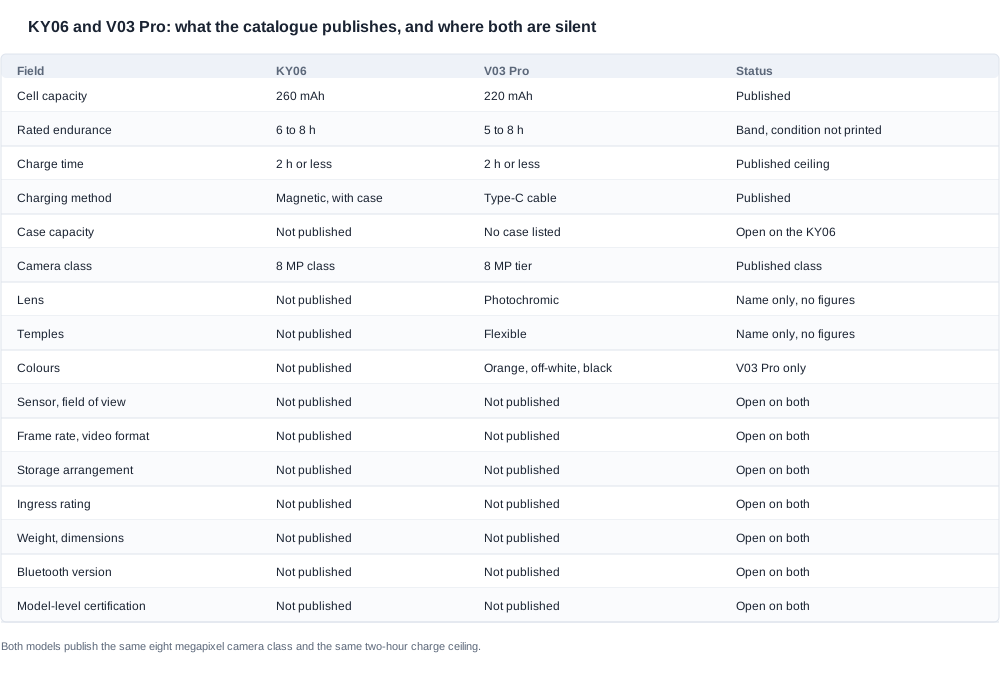
A comparison that leaves out the shared blanks produces a false impression of difference. The table below states what is published for each model and marks the fields where both are silent, because the silent fields are where the commercial exposure sits.
Both models share the same eight megapixel camera resolution class and the same charge ceiling of two hours or less. Their cells sit on two different tiers within the range: the KY06 on 260 mAh, the V03 Pro on 220 mAh. Their endurance figures are different shapes — six to eight hours against five to eight hours — and neither shape publishes the test condition that produced it. Their charging formats are opposite: magnetic with a case, against a Type-C cable.
Read the endurance row carefully before you build any operating promise on it. A bracket is a disclosure, and it is a better disclosure than a single number, because it tells you more than one condition was measured. It is still not a specification, because the condition is not printed. Plan on the lower bound of each bracket, write the lower bound into anything a customer or a channel partner will read, and treat the upper bound as the good case. The method for comparing endurance figures across the range sets out the comparison rules, and the KY06 endurance note covers the behaviour behind its particular band.
The two runtime brackets are also the reason a spare-unit policy differs between the models. A channel that staffs a shift on continuous recording plans differently against a five-to-eight-hour bracket than against a six-to-eight-hour one, and neither bracket is long enough to carry a full double shift on one charge. That is a channel design question, not a specification question, and it is worth settling before the purchase order rather than after the first field report.
The V03 Pro's Bluetooth entry is published as not published, and the same is true of the KY06. Neither the section nor the range carries a radio version row for any of its models. This is a narrower gap than it sounds, because a buyer who never claims a radio version is not exposed to it — but it becomes a live issue in a specification annex that promises a device link profile, and in any certification scope, where the applicable radio rules are determined by the version and the destination market. Both are closed by the same written request.
The KY06 dock: an accessory decision that becomes a packaging line
The KY06's magnetic charging method is published, and a charging case is published as existing. Those are two different facts, and the distance between them is where the commercial work is.
A magnetic dock fixes the accessory list. It determines what a spare-parts programme contains, what a channel partner stocks, and what a returned unit is replaced with. It also means the case is part of the product rather than an accessory in a box, so it enters the freight calculation, the carton design and the unboxing that a retail shelf sells. That is the strongest commercial argument the KY06 has, and it is a real one.
The case capacity is not published. That single omission changes what you can promise. Elsewhere in this same camera range, published case capacities include 1400 mAh on the CY05 and the L1 Pro, and the CY03, two published options at 900 mAh and 1400 mAh on the L2 Utral, and a 1200 mAh folding case on the MT6. So the KY06 is not being compared against an abstract box — it is being compared against a documented range of between roughly 900 and 1400 mAh of possible case capacity, and you do not know where in that range it sits.
The failure case here is specific and common. A buyer takes the model name, assumes a case in the standard configuration, builds a retail price that depends on the dock, places the order, and then learns from the factory that the case is a separately quoted line item at that quantity, or that it ships with a reduced capacity, or that it is available only above a minimum order quantity. By that point the artwork is locked, the shelf plan is fixed and the price band has already been promised to a channel partner. The recovery is slow, because the cheapest fix is a packaging redesign and a reprint.
So the question is not whether to ask. It is what to ask, and in what order. Ask three things in writing before any artwork is approved: the rated capacity of the case, whether the case is included in the standard configuration at your quantity or quoted as a line item, and the packed unit weight with the case inside. Then ask what happens to the case line at each order tier. A supplier who answers all four in one message is giving you a usable configuration; a supplier who answers with "standard case" and no number is telling you the specification will arrive later, and that later date is your schedule risk.
Two further questions close the accessory economics. Ask which spare parts the factory supplies for the dock and the case separately, and ask whether the private label work extends to the case or only to the glasses. A private label that covers the glasses but not the dock produces a retail box where the customer's own brand appears on one object and the factory's appears on the other, and that is visible the moment the customer opens it.
The charging case options analysis covers the accessory economics across the range, and the shipping weight breakdown covers how the parcel changes once the dock is in it.
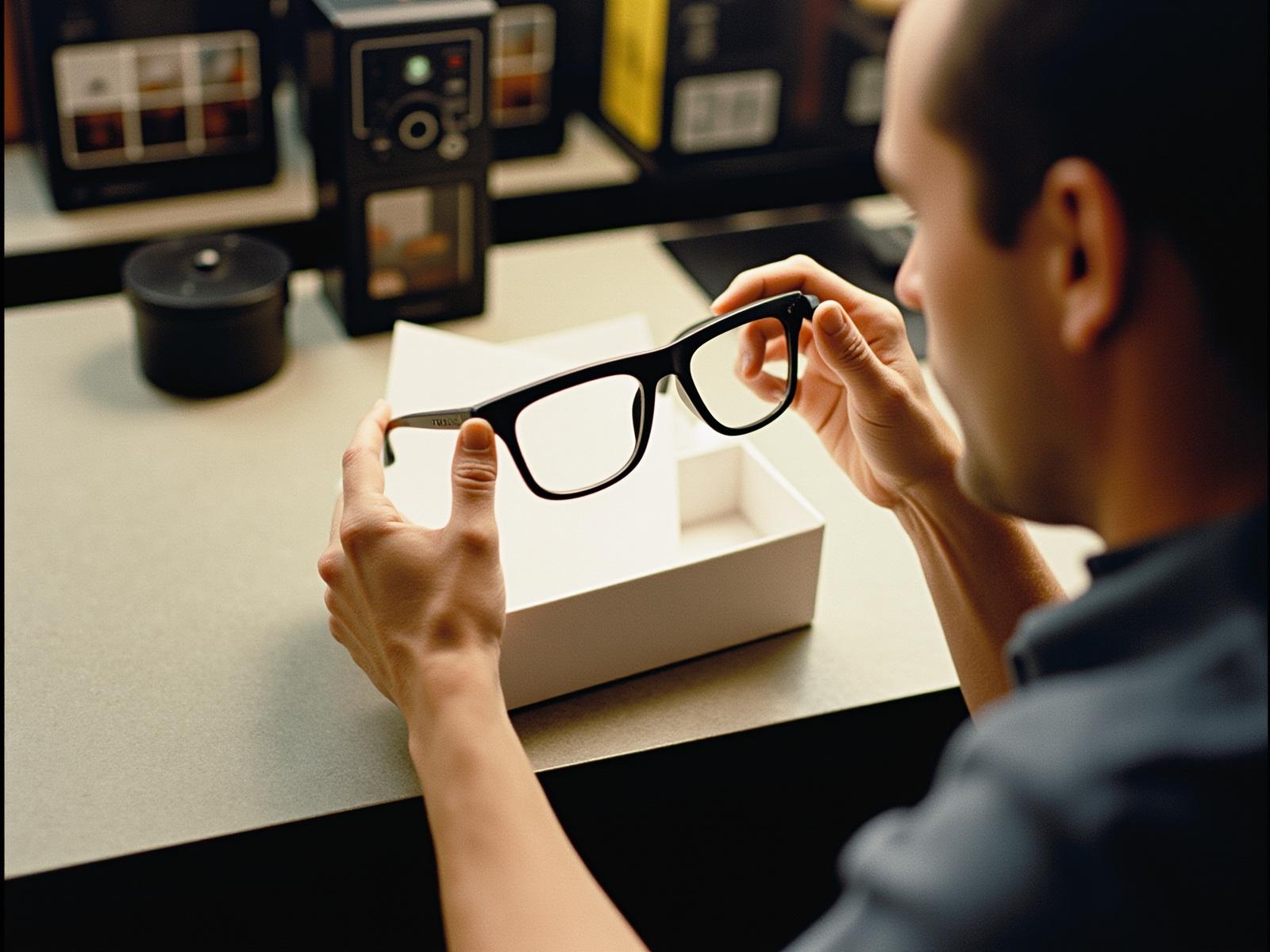
The V03 Pro lens: a feature you can advertise and cannot yet substantiate
The V03 Pro's photochromic lens is the commercially interesting feature in this comparison, because it solves a friction point that customers who wear prescription lenses recognise immediately. A lens that adapts between indoor and outdoor conditions removes the changeover between two pairs of glasses, and that is a benefit a customer will understand without a demonstration.
That is precisely why the missing numbers matter. Four figures would turn this feature into a claim: switching time, tint depth, light transmittance, and operating temperature range. None of them is published for this model, and none is published for any other photochromic product in the range, so there is no neighbouring model whose figures you could reasonably carry across. A lens is an optical component with real variation between suppliers, and a specification sheet that omits all four is a specification sheet that has not yet been written.
The boundary condition matters as much as the numbers. Photochromic behaviour is temperature-dependent, and it is activation-dependent. A lens that darkens quickly in direct sun may take considerably longer to clear indoors, and both behaviours slow at low ambient temperatures. So a customer in a warm retail demonstration environment and a customer on a cold street are experiencing two different products, and the risk lands on whichever market you ship into first.
Three ways this goes wrong in practice, in order of how often it happens. First, a listing claims an adaptive lens without qualification, and a customer in a cold climate reports that the lens barely darkens; the claim was the seller's, so the return is difficult to refuse. Second, a channel partner uses the lens as the primary reason for the purchase and a customer discovers the tint is not strong enough for driving, because no tint depth figure was ever established. Third, a buyer builds a retail price band around the feature, discovers the lens position is not differentiator in their market, and is left holding a differentiated-cost product at a differentiated price with nothing to promote.
The mitigation is procedural and cheap. Ask for the four figures in writing, attach them to the technical file, and set an acceptance criterion before the sample is made — for example, that the supplier confirms switching behaviour at a stated temperature, and that a sample unit is tested against it. A supplier with real lens data sends it in one message. A supplier without it will answer in a different way, and the shape of that answer is itself the due diligence result.
Get the four figures, then build the page. Until you have them, the honest construction is to describe the lens as an adaptive photochromic lens with the capability to adjust between indoor and outdoor conditions, and to make no performance promise beyond that. That sentence is defensible, it is useful, and it does not create a claim you cannot support. Where the photochromic specification gap sits is covered in the photochromic smart glasses section.
The temples and the colours are on the same footing. Flexible temples are published as a feature for this model and no comfort figure accompanies them. Three colour options are published — orange, off-white and black — which is enough for a listing and not enough to plan a seasonal range against, because no per-colour minimum order quantity is published either. Ask what the minimum order quantity is per colour, because a three-colour option with a single-colour minimum order quantity is a supply chain decision disguised as a marketing one.
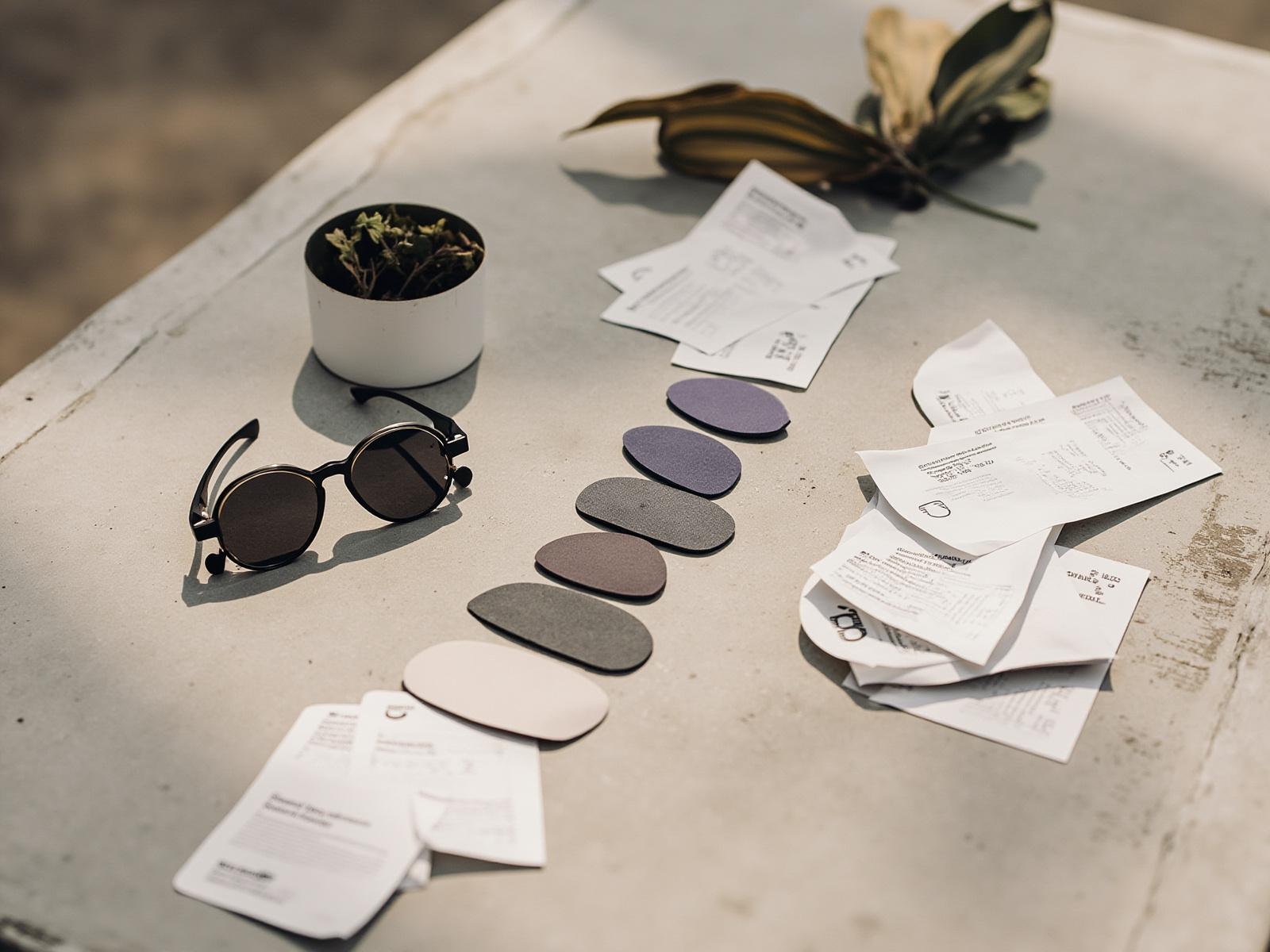
Matching a model to a channel, a customer and a sample order
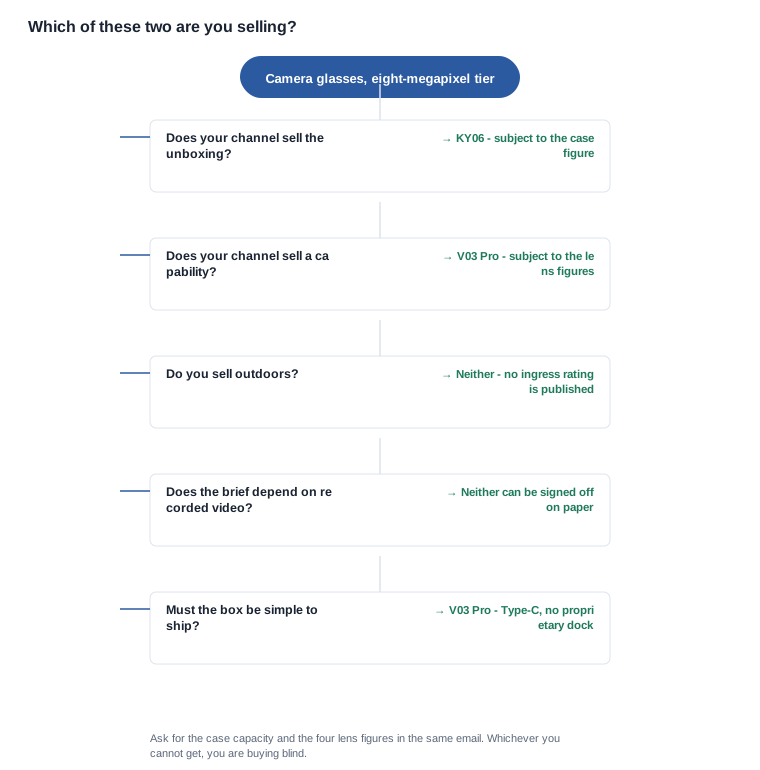
The comparison becomes tractable once it stops being a specification comparison and becomes a channel-design one. The decision tree below is written for the buyer who has to place one order and live with it, rather than for a reader comparing numbers for interest.
The first question is what your customer is buying. If the purchase is an impulse or gift-driven retail decision, the unboxing is doing the selling, and the KY06's dock is the model whose evidence supports that story. If the purchase is a considered decision by someone who already knows they want an adaptive lens, the V03 Pro's photochromic feature is the model that gives them a reason, provided the four lens figures arrive.
The second question is which single field your whole proposition depends on, and whether you can get it. For the KY06 that field is the case capacity. For the V03 Pro it is the lens performance set. Whichever field you cannot obtain, you are buying blind on the part of the product your customer will notice. Ask both in the first message, to both suppliers, and treat a partial answer as a finding rather than as a delay.
The third question is whether recorded video is load-bearing in your delivery. If it is, neither model can be signed off. No sensor model, field of view, frame rate, video format, storage capacity or overwrite behaviour is published for either. The camera section publishes no video specification for any of its models, so this is not a weakness of these two in particular — but it does mean a brief that depends on video resolution, framing or capture duration requires a sample order and an acceptance test before the order, not after it.
The fourth question is operational rather than product-facing: can your channel absorb the accessory model? A dock-based product implies a spare-parts line, a heavier parcel and a returns process that handles a case as well as a frame. A cable product implies a much simpler logistics profile and a lower accessory cost per unit. Neither is better in the abstract. One of them is better for your channel, and the honest assessment is that this question often decides the comparison before the feature set is discussed at all.
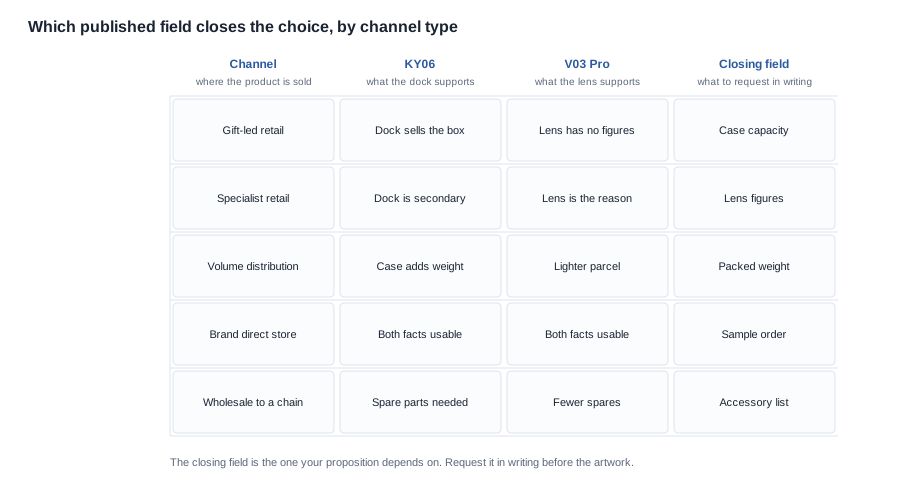
If your channel is a gift-led retail shelf, weight and packaging drive the economics and the dock wins the argument. If your channel is a considered-purchase specialist retailer or a brand's own store, the lens feature is what differentiates, and the V03 Pro becomes the better fit — provided the lens figures are obtained. If your channel is a volume distributor with a narrow margin and a freight-sensitive delivery model, the lighter parcel is a real cost advantage and it belongs in the comparison arithmetic as a number, not as a footnote.
Two further comparisons help complete the picture before you shortlist. The row-by-row comparison against the V03 Pro sets these two models out field by field, and the KY06 use-case comparison against the CY05 shows how a mid-range dock model sits against one that shares the same case capacity tier. Where each model sits in the wider range is covered in the KY06 range comparison.
Before you commit: the shortlist, the sample order and the questions to ask
The sequence below is written to be used, not to be admired. Each step exists because a specific published field is missing, and each step has a completion condition you can check without asking anyone else.
Freeze both published rows as the baseline. Copy the entries exactly as printed, one column per model, and mark every absent field as not published rather than as zero or as unknown-because-secret. That baseline is what makes two quotations comparable, and it is what you check every later document against.
Turn each absence into a named question with acceptance criteria. A general request for specifications returns a general reply. A named question with a stated acceptance criterion returns something you can evaluate. The list below is written to be pasted into a request.
Ask the supplier to quote against a configuration, not a model name. A quotation written against a model carries no scope; a quotation written against a configuration carries one. Ask for the unit price against the configuration you intend to ship, with the accessory set, the packaging and the private label work itemised, and with the exclusions listed explicitly. A quotation that lists its exclusions is easier to evaluate than a lower quotation with a silent list.
Run a sample order against a written scenario. For the KY06, the scenario is a full charge cycle from the case plus a dock cycle, measured and timed. For the V03 Pro, it is a lens transition from indoor to outdoor light and back, at a stated ambient temperature, with the timing recorded. State the scenario before the sample is made, keep the record in the technical file, and treat a sample that cannot meet the stated criterion as a finding about the product rather than as a defective sample.
Put the commercial set in writing. Minimum order quantity, production lead time, the unit price and the tier it belongs to, bulk order pricing, tooling and non-recurring engineering, sample order terms, warranty period and its remedy, quality control and defect terms, production capacity, shipment terms, incoterms, payment terms, deposit structure, and the contract that governs all of it. None of this is published, so a number that arrives without a source is an invention rather than an estimate. Where the accessory weight and parcel assumptions belong in the comparison is covered in the battery and charging economics.
Close the compliance position per destination market. Ask for the technical file, the test report and the declaration that applies to each model in each market you intend to ship to, and record the result in the due diligence file. If a factory audit is part of your supplier qualification process, run it before the artwork is locked rather than after the first shipment.
Sign the technical file and the purchase order together. The annex and the order should carry the same numbers in the same wording, with published figures in one column and supplier-provided figures in another. That is what makes a configuration real: two documents that agree, rather than a catalogue page and an order that do not.
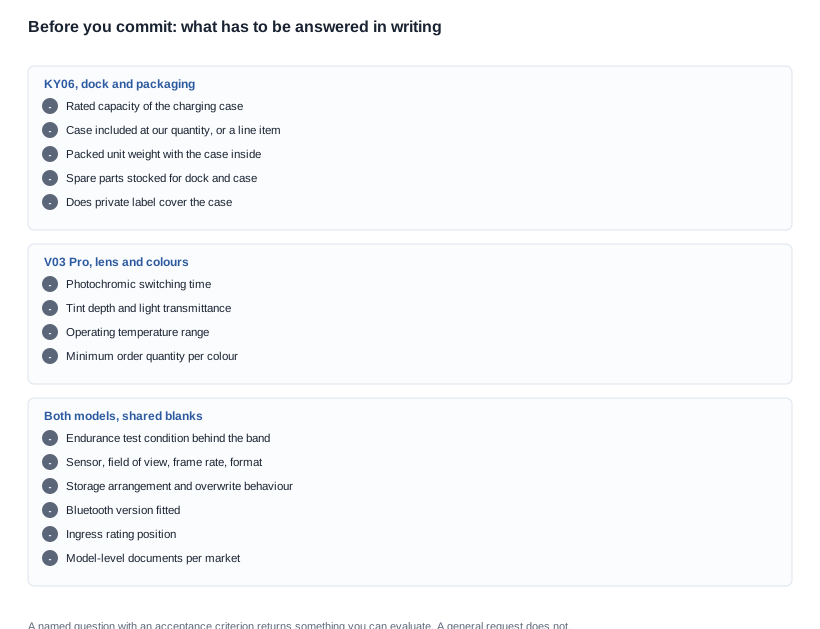
The questions below are ordered by how fast each one closes risk. Ask them before you commit, not after the first shipment.
- What is the rated capacity of the charging case, and is the case included in the standard configuration at our quantity or quoted as a line item?
- What is the packed unit weight for each model, with the case included for the KY06?
- What endurance test condition produces the published brackets for each model, and at what temperature and camera setting?
- What is the photochromic switching time, tint depth, light transmittance and operating temperature range for the V03 Pro lens?
- What sensor, field of view, frame rate, video format and storage arrangement does each camera deliver?
- Which Bluetooth version is fitted on each model, and is it the same version on every unit?
- Does either model carry an ingress protection rating, and if so which one, documented how?
- What model-level compliance documents and declarations exist for each destination market?
- What is the minimum order quantity per colour for the V03 Pro, and the minimum order quantity and tier structure for the KY06?
- What are the production lead time, the bulk order tier structure, and the tooling and non-recurring engineering costs?
- What are the warranty period, its remedy, and the quality control and defect terms?
- Which incoterms, payment terms and deposit structure apply to the first order?
On our side of the table, we can lay out every published row for both models and tell you that one sells a box and one sells a feature, and that the feature is the one you cannot yet verify. We will not quote a case capacity or a lens performance figure, we will not present photochromic capability as though its behaviour were documented, and we will not claim a video specification for either model. Send us the channel, the target retail price, the quantity, the markets and which of the two things your customer is actually buying, and we will tell you which model fits and which fields have to be closed before you promote it.
Related reading
- The range both models belong to — AI camera glasses
- Where the photochromic specification gap sits — photochromic smart glasses
- How case capacity changes the product — smart glasses battery life
- Field by field against the same pair — KY06 vs V03 Pro specification comparison
- Where the KY06 sits in the range — KY06 smart glasses how it compares
Send the channel, the price, the quantity and what your customer is buying, and we will tell you which model fits.


