

AI camera glasses private label options divide into two very unequal halves. One half is presentation: the brand name on the box, the printed insert, the language, the colour scheme, the artwork. That half is genuinely open, and it is where most private label conversations start and, in our experience, where a useful programme is decided. The other half is identity: the model designation that appears on the conformity documents, the camera that is fitted, the cell, the runtime band and the charging-case capacity. That half is not open, because none of it belongs to the brand in the first place. This article sets out the boundary, the questions to put to a supplier, and what has to appear on a quotation before a private label programme is worth committing to. We do not promise that private label is available, we do not quote a customisation charge, a minimum order quantity or a lead time, and the section on what our catalogue publishes explains the reasoning behind that restraint.
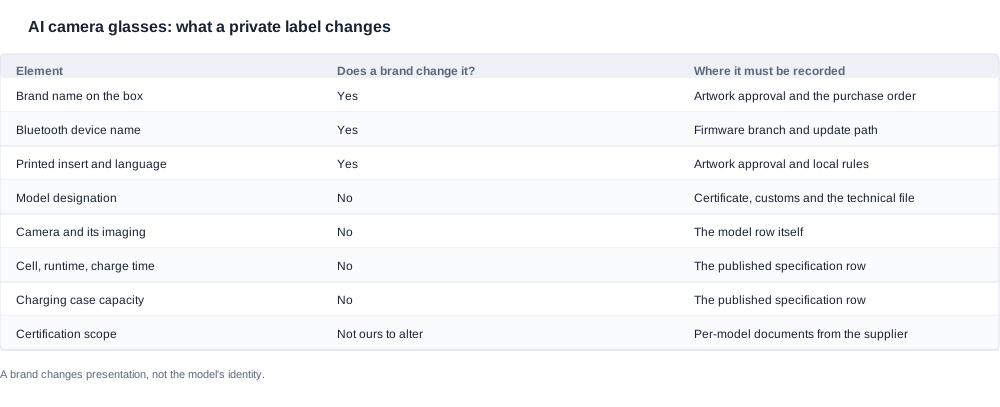
AI camera glasses private label options: what a brand can and cannot change
The single most useful thing a buyer can do at the start of a private label discussion is to sort the elements into the two halves explicitly, because the failure mode in this category is a buyer who assumes the camera is a configurable item and discovers the opposite at the artwork stage.
Presentation is open. The brand name printed on the retail box, the printed insert and its language, the artwork, the colour identity and the arrangement of the accessories inside the box are all commercial and design decisions. They sit with the brand, they are negotiated per programme, and the questions to ask about them — minimum quantity per configuration, artwork charges, plate costs, proof rounds, who owns the artwork — belong on the quotation.
Identity is fixed. The model designation does not move when a brand is added to the box. The camera and its imaging behaviour do not move. The cell capacity, the rated runtime band and the charge time do not move. The charging-case capacity does not move. The published specification rows describe the technical object, and a brand changes how that object is presented and marketed, not what it is. The AI camera glasses customisation options piece covers the axes in full, and the camera imaging notes cover why the camera in particular is not a programme variable.
Between the two sits a third group that is genuinely a negotiation rather than a fact: the firmware. The device name a customer sees in their phone's Bluetooth list, the behaviour of the companion application and the update path behind it are variables that a brand can influence, and a brand that takes on the firmware takes on a maintenance commitment that does not end when the programme ships. That commitment is a cost that does not appear on the quotation as a line item, which is why it needs to be stated rather than implied.
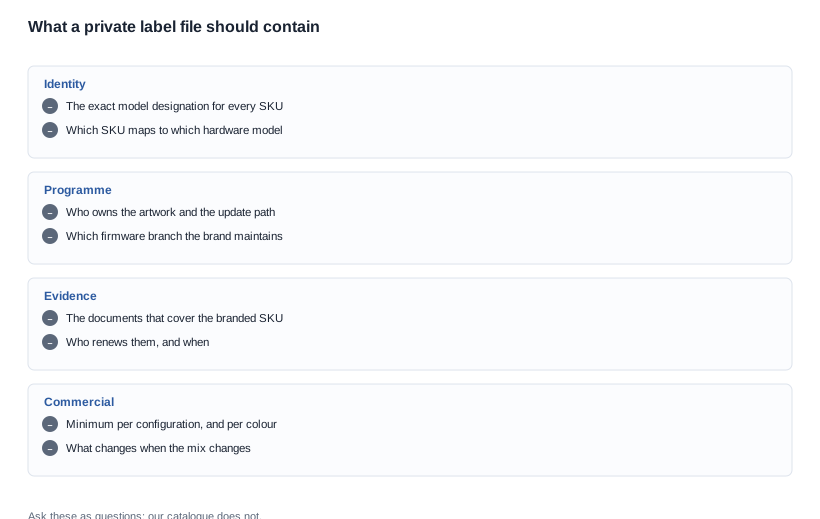
There is a fourth group, and it is the one with the most legal weight: the documentation. A private label programme does not create documents, and it does not extend them. A certificate names a model designation; a conformity file names a model designation; a customs declaration names a model designation. The catalogue carries a company-level export certification page whose content is images rather than text, with ten patent certificates shown as images — eight appearance-design patents and two utility-model patents — and the catalogue text contains no reference to CE, FCC or RoHS. There is no per-model certification row anywhere in it. So every question about which certifications cover a branded unit is a question for the supplier, and the answer has to arrive as a number with an issuing body and validity dates, not as a statement of capability.

The four layers of a private label programme and who owns each
Sorting the programme into layers makes the ownership question answerable, and ownership is what determines who pays for a change three years later.
Layer one, the physical presentation. The retail box, the insert, the printed material and the language. Ownership is usually the brand's, because the brand has commissioned the artwork and will want to change it. The questions to ask: who supplies the artwork and in what format, how many proof rounds are included before the plate is cut, what the artwork charges are, and whether those charges are per configuration or per programme.
Layer two, the accessory set. The charging case, the charging cable or dock, and whether they ship in the box. Ownership here is a commercial decision as much as a design one, and the AI camera glasses packaging options piece covers how the contents drive the packed weight and the freight class, while the AI camera glasses charging case options piece covers the accessory economics model by model. The question to ask is whether the accessory set is per configuration or fixed across the range, and what happens to the minimum when it changes.
Layer three, the firmware and the application. The device name, the companion application and the update path. Ownership here is the expensive one. A brand that owns the update path will eventually make changes to it, and each change is a validation cycle against hardware it did not design. The OEM ready platforms customisation depth piece covers the four depth levels and what each one commits the buyer to, and the question to ask is who is responsible for a firmware update when a customer reports that something has stopped working.
Layer four, the technical object and its documentation. The model designation, the camera, the electrical rows and the conformity file. Ownership here sits with the supplier and cannot be transferred, because these are the properties the documents describe. The question to ask is which documents exist for the exact designation, and whether any of them name a brand, because a document that names a brand can only be used by that brand.
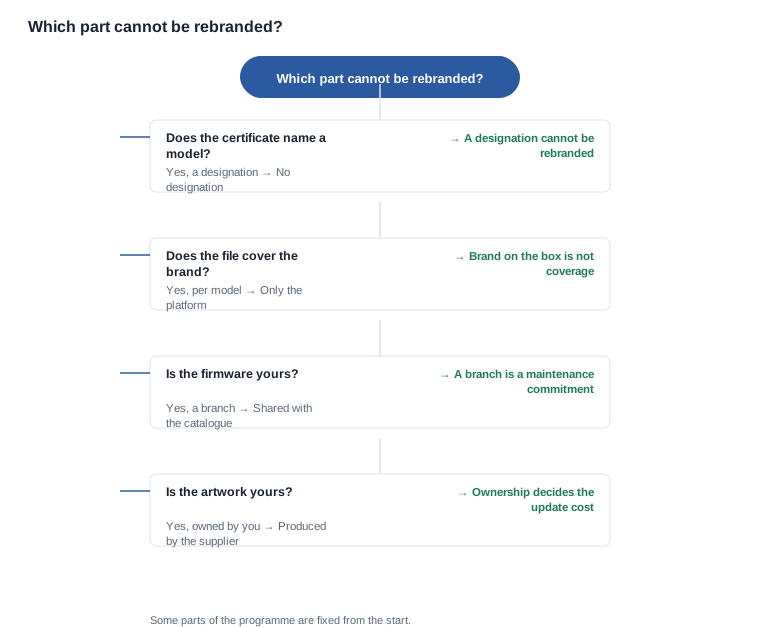
The four layers also have four different renegotiation dynamics. Presentation is renegotiated at every order. The accessory set is renegotiated when the mix changes. The firmware is renegotiated rarely and expensively. The technical object and its documentation are not renegotiable at all. A private label programme that is priced as though all four behave like the first one is a programme whose cost will rise after launch, and the question to ask a supplier about that is simple: which of these four layers will you renegotiate, and at what cost.
Questions to ask a supplier before the first artwork proof
These are the questions to ask, in this order, and the ordering matters because each answer determines how the next one is framed.
On identity, first. Ask which model designation sits behind each SKU the brand intends to sell, and ask the supplier to name the documentation that covers it. The answer should be a designation and a document reference. A supplier that answers with a product name, a family name or a capability statement has not answered, and the brand should not produce artwork against an unanswered question.
On the firmware, second. Ask what the device appears as in the Bluetooth list, whether the brand may change it, whether the companion application is brandable, and what the update path is once the programme is live. Then ask who carries the cost of a firmware change requested after launch, and what the notice period looks like.
On the artwork, third. Ask for the artwork charges, the number of proof rounds, the minimum per configuration and per colour, and whether the artwork is reusable across models or redrawn for each one. A range built on one platform with a shared box architecture typically amortises the artwork across the range; a range of unrelated boxes does not, and the difference shows up in the minimum rather than in the artwork line.
On the documentation, fourth. Ask for the certificate numbers covering the exact designations, with the issuing body and the validity dates, and ask what happens to those documents if a variant changes its case, its interface or its artwork. The O-series compliance analysis piece covers what that evidence needs to contain, and the export documentation checklist covers the markings that cannot change.
On the commercial terms, last. Ask for the minimum per configuration, the minimum per colour or size, whether the two are the same number, the artwork and tooling charges, the payment terms, the delivery schedule per configuration, the warranty position and the validity period of the quotation. Every one of these is a line the buyer can negotiate, which is why they belong on the list before the artwork is approved rather than after the first shipment. The OEM ready platforms pricing tiers piece covers the commercial structure around a range.

One more question is worth putting in writing early, because it is the one that determines whether the programme is a range or a single product: ask whether the brand's SKUs can share a platform. If several models share the app, the firmware branch, the accessory family, the conformity file and the artwork, each additional SKU costs a fraction of the first. If they do not, the programme is three programmes with one brand on them, and it should be costed that way from the start. The OEM ready platforms scaling up piece covers the sequence, and the OEM ready platforms channel strategy piece covers why the channel decision should precede the product decision.

What changes when a private label programme spans more than one model
A single-model private label programme is a specification exercise. A multi-model one is a range exercise, and the two behave differently enough that the questions change.
The difference is what the models share. A range built on one platform shares the companion application, the firmware branch, the accessory family, the conformity file and the artwork, and each additional model in that range therefore reuses work that has already been done. A range assembled from models that do not share a platform does not: each model arrives with its own accessory set, its own file and its own artwork, and the programme is priced as several programmes sharing a brand name. The test is simple to state and worth asking early, because it determines whether a range is affordable: do these SKUs run the same application, the same firmware branch and the same accessory family?
Where a range does share a platform, the second question is how many configurations it creates, because each configuration can carry its own minimum. A range with three models, two of which publish a charging-case capacity and one of which does not, is not three configurations. It is a case configuration and a no-case configuration, each with its own accessory set and its own minimum, and a colour ladder on top of that multiplies the count again. Buyers routinely underestimate this because they count models rather than configurations, and the minimum per configuration is a number that appears on the quotation.
The third question is how the range is protected from drift. Between the first order and the third, something usually changes — an artwork update, a colour addition, an accessory substitution, a supplier change on one model. Each of those can move a variant away from the document that covers it. The clauses that prevent this are simple and are worth having in the purchase order: notice before any change to the charging case, the charge interface, the artwork or the printed material; a re-issue of the documentation pack for any configuration change; and the model designation written on the order so that a substitution is visible at goods-in rather than at the customer.
There is a fourth question that a buyer usually asks too late. If the range includes models from different published tiers — a 13 MP model and an 8 MP model, or a model with a case and a model without — then the listing copy has to describe them differently, and the copy is owned by the brand. Writing that copy is a marketing task, but deciding which models sit in which tier is a specification task, and it is better made against the published rows than against the supplier's summary sheet. The OEM ready platforms which models are ready piece covers how that view changes when a range is opened properly, and the OEM ready platforms warranty setup piece covers why the failure list has to exist before the first order rather than after it.
A private label walkthrough for a first-time programme
The following is a hypothetical walkthrough, written to show the decision sequence rather than to report a result from a client project.
Assume a regional retailer that wants to put a camera-glasses line under its own brand for the first time. The retailer has two stores, a small online channel and no product team. Its constraint is not money but risk: it has no one who can read a conformity file, and it has already learned once that a documentation gap discovered at customs is expensive.
The retailer's first step is to stop thinking in terms of a programme and start in terms of a designation. It writes down the two hardware models it wants, with their catalogue designations, and asks each candidate supplier for the documentation covering those exact designations. One supplier answers with designations and document references. The other answers with a description of what the company is capable of. The retailer drops the second from the shortlist on the strength of a single question, which is exactly the efficiency this approach is meant to produce.
The second step is to sort the elements. The retailer walks the four layers and marks what it wants to own: the artwork and the insert, certainly; the accessory set, yes but only if the case capacity is published for the model it picks; the firmware, no, because it has no one to maintain an update path; the technical object, no, because it could not own it if it wanted to. That decision — explicitly declining the firmware — is the one that saves the programme money, because a firmware branch carries a maintenance obligation that the retailer would have absorbed without knowing what it was.
The third step is to fix the accessory question against the published rows. It wants a case in the box, so it restricts its choice to the models that publish a charging-case capacity, and it asks for the case weight on a packed sample, because the case changes the freight class and the parcel. The AI camera glasses shipping weight piece covers why that figure cannot come from a catalogue.
The fourth step is to put the artwork behind the documentation rather than in front of it. The retailer refuses to approve a proof until the certificate numbers arrive, on the reasoning that a mark printed on a box that the file does not support creates a liability the retailer carries and the supplier does not.
The fifth step is to write the programme into a quotation with the lines the brand actually needs: the minimum per configuration and per colour, the artwork charge and the proof rounds, the accessory set, the payment terms, the delivery schedule, the warranty position and the validity period. The retailer adds a change-control clause so that a change to the case, the interface or the artwork reopens the documentation question rather than proceeding silently.
The result is a programme that is narrower than the retailer first imagined, with no firmware ownership, and with a single hardware platform behind it. That is a defensible outcome, and it was reached without any number being invented along the way.
What our catalogue publishes about private label, and what it does not
On AI camera glasses private label options, our position is that the boundary between what a private label programme changes and what it does not is the first thing to agree, and that the most common failure in this category is a buyer who assumed the camera was a programme variable. We publish the specification rows that any private label programme has to sit on top of: the twenty-eight model designations and their electrical rows, the eleven camera models among them, the resolution tiers, the charge interfaces and the charging-case capacities. We do not publish a customisation charge, a tooling charge, a minimum order quantity, a lead time or a delivery schedule, and we will not state that a private label programme is available in a particular configuration, because neither our catalogue nor our quotation process establishes that on its own.
That restraint is not a refusal to help; it is the most useful thing we can offer in this category. A private label programme has more moving parts than a standard purchase, and each one that is agreed on a verbal assurance rather than a written line becomes a dispute at the point where it is most expensive. The AI camera glasses which model to pick piece covers the model decision behind the designation, the OEM ready platforms export documentation piece covers the markings that cannot change, and the AI camera glasses bulk ordering piece covers where a branded programme sits in a production sequence.
If you are planning a private label programme in this category, send us the SKUs, the hardware models you have in mind, the destination markets and the artwork status. We will tell you which published rows apply, which elements of the programme are fixed by the model rather than by the brand, and which questions belong on your supplier list.
Related reading
- The axes in full — AI camera glasses customization options
- The model choice behind it — AI camera glasses which model to pick
- How deep the programme goes — OEM ready platforms customization depth
- The compliance evidence — OEM ready platforms certification coverage
- The markings that cannot change — OEM ready platforms export documentation
- The accessory that decides the cost — AI camera glasses charging case options
- The box that carries it — AI camera glasses packaging options
- The parcel arithmetic — AI camera glasses shipping weight
- The channel decision first — OEM ready platforms channel strategy
- The commercial structure — OEM ready platforms pricing tiers
- Adding models later — OEM ready platforms scaling up


