

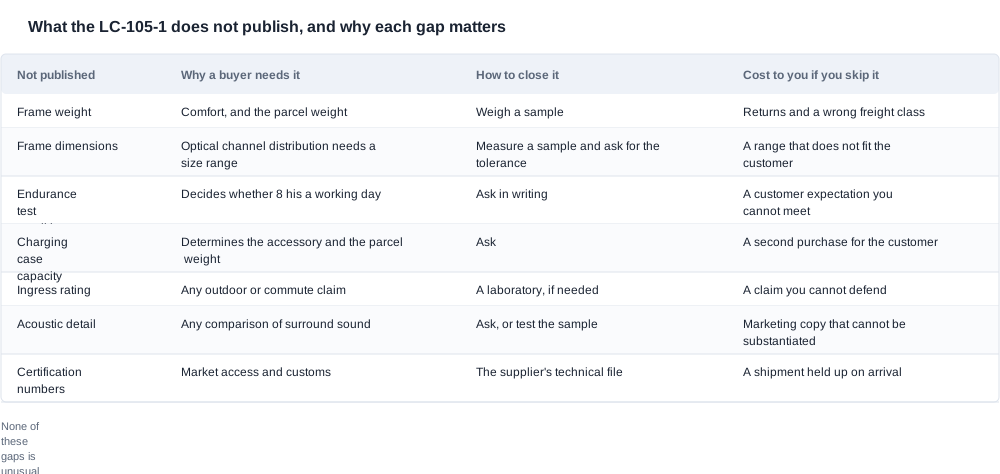
The LC-105-1's limitations are not performance limitations, and a buyer who reads them that way will spend their time on the wrong question. This model publishes five standard specification rows — Bluetooth version 5.4, a battery capacity of 55mAh*2, a two-hour charge ceiling, roughly eight hours of rated use, and magnetic charging — and its catalogue page carries no feature row of any kind. So there is no published weakness to argue about: the published position is that a very small number of things are stated and a large number are not. What that costs is not performance, it is promise capacity. Almost every line a channel buyer would want to write on a product page for this model has no published row behind it, and each of those missing lines is a decision that has to be made somewhere other than the catalogue. This page sets out the blanks, sorts them into the ones that can be closed with a document, the ones that can be closed but must stay internal, and the ones that will never become a published specification at all — and then puts a price on each in terms of time, money and risk. Price, order quantity and lead time are not published for this model, and we would rather show you the short list of what is published than a long list of what we could have said.
Lc-105-1 smart glasses limitations: a thin published sheet, not a weak product
There is a useful way to think about a catalogue like this one, and it reframes the whole question. Every published row is a licence, and every absent row is a licence that has not been granted. For most buyers the interesting question about a model is what it does; for a buyer in this category the more useful question is what it may be said to do, because that is what a listing, a compliance file and a customer-service script all depend on. Judged that way, the LC-105-1 is not a weak model. It is a model with five licences and an unusually long list of absences, and the absences are the same absences the rest of the range has, because the catalogue is uniform in what it does not publish.
Sort the absences and they fall into three groups, and the sort matters more than the list. Some blanks can be closed by asking: the supplier can weigh a frame, measure it, name its colours, state what ships in the box, produce the documents that the destination market requires, and describe the workload behind the rated-use figure. Some blanks can be closed but must never reach a product page even once they are closed: a measured microphone figure is evidence for a quality file, not a catalogue row, and a laboratory acoustic report is not a sound descriptor a customer can be shown. And some blanks will never become a published specification for this model at all, because no model in the catalogue publishes that kind of row — an ingress rating belongs to the V06 and the S7, a frame weight belongs nowhere in the audio range, and a control method on the temple is published for no model in this catalogue at all.
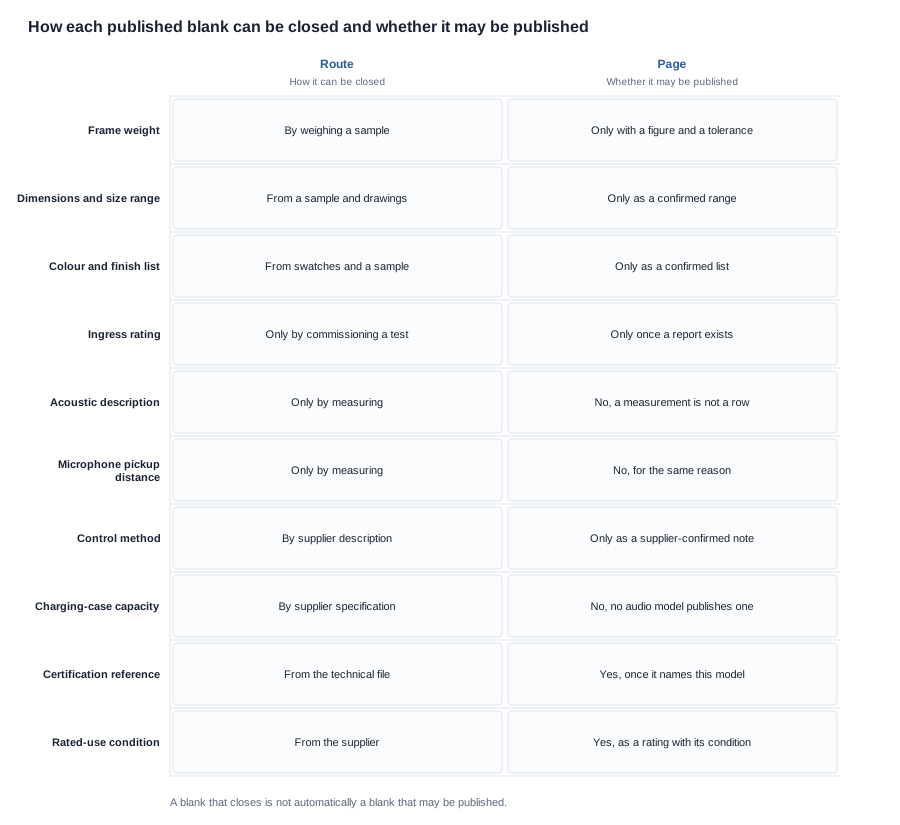
The table below is the working inventory. It is deliberately operational: for each thing the catalogue does not publish for the LC-105-1, it says whether the gap can be closed, whether the closed item may then appear on a listing, and where the answer has to come from. A buyer who uses this table as a request list rather than a complaint list converts a set of unknowns into a set of documents with owners and dates, which is the only way a thin catalogue sheet becomes a purchase that can be defended at review.
| What the catalogue does not publish for the LC-105-1 | Can it be closed | Can it reach a product page | Where the answer comes from |
|---|---|---|---|
| Frame weight in grams | Yes, by weighing a sample | Only with a figure and a tolerance | A packed sample on a scale |
| Frame and temple dimensions | Yes, from a sample | Only as a size range the supplier confirms | A sample and the drawings |
| Colour or finish options | Yes, from a sample | Only as a confirmed list | Swatches and a sample |
| Ingress rating | Only by testing | Only once a report exists | A laboratory, at cost and time |
| Acoustic description | Only by measuring | No, a measurement is not a row | A test report, kept internal |
| Microphone pickup distance | Only by measuring | No, for the same reason | A test report, kept internal |
| Control method on the temple | By description | Only as a supplier-confirmed specification | A written supplier statement |
| Charging-case capacity | By specification | No, no audio model publishes a case row | A supplier specification |
| Per-model certification reference | Yes, from the supplier | Yes, once it names this model | The technical file and declaration |
| Warranty term and defect allowance | Yes, as commercial terms | Yes, as published terms | The quotation and the contract |
| Rated-use test condition | Yes, from the supplier | Yes, as a rating with its condition | A written test description |
Two traps sit inside that table and both have caught buyers before. The first is the weight: a single mass figure is printed in the whole catalogue, 158 g on the MT6's frame body, and that is a camera model. A buyer who treats a published number as a general one will put a weight on an audio listing, and a buyer who quotes the 158 g will have quoted a camera product. Our catalogue prints a frame weight for no audio model at all, so for the LC-105-1 the answer is that the figure has to be weighed and stated as a supplier figure. The second is the ingress rating: IP54 appears on the V06 and the S7 and on no other model, so "IP54" on an audio listing is a claim imported from a different category, and the correct wording for this model is that no ingress rating is published.
The blanks that will never become catalogue rows
Start with the group that cannot be closed by any amount of requesting, because the obstacle is not the supplier's unwillingness but the shape of the catalogue.
The first is the ingress rating. A rating of this kind exists only after a test has been performed on a specific product, and it attaches to that product permanently. Nothing the catalogue publishes for the LC-105-1 can be assembled into one, and the two models that do carry IP54 are camera models whose construction has nothing to do with this frame. A buyer who wants an ingress rating on this model is commissioning a test, and the cost and the lead time of that test sit on the buyer's own project plan, not on the supplier's quotation. Until it is done, the honest line on the product page is that no ingress rating is published for this model.
The second is any acoustic or microphone figure. The catalogue publishes a sound descriptor for the D11 and for the YK12 and for none of the others, and it publishes a microphone pickup distance for no model at all. A laboratory measurement does not repair this: a measured figure is evidence in a quality file, and a page that prints it is making a specification claim the catalogue has never made for this model. This is why the weight comparison across the range and the microphone testing notes belong on the buyer's own evaluation plan rather than on the listing — they tell you how to obtain a number for yourself, and they say nothing about what this model publishes.
The third is the control method. Not one model in this catalogue publishes a control row of any kind, so there is no catalogue precedent for this model to inherit, and a product page for the LC-105-1 cannot describe a control surface on the strength of what other models do. If the supplier documents one for this model, it becomes a supplier-confirmed specification that a buyer may state; what a buyer may not do is borrow one from elsewhere in the range.
The fourth group is the commercial terms: price, minimum order quantity, lead time, warranty, defect allowance, packaging specification. These are not published for any model in the catalogue, and they are not product rows — they are quote items that a buyer obtains and then decides how to use. A buyer's own cost model, its cash conversion and its service promise are all built on these, and all of them are negotiated rather than read. The certification position has the same character from a different direction: our catalogue text contains no reference to CE, FCC or RoHS for any model, no per-model certification row appears, and the company-level export-certification page consists of pictures carrying patent certificates rather than conformity assessments. What a buyer can state is therefore nothing on the page, and what a buyer must obtain is the conformity file, the signed declaration and the test reports that name this model — against the Radio Equipment Directive (EU) 2014/53/EU for the radio, with the separate EMC Directive 2014/32/EU governing electromagnetic compatibility.

The blanks a request closes, and the ones that stay internal
The second group is the one a procurement team can actually work on, and it is worth treating as a request list rather than a list of complaints. Eight documents, each with a named owner and a use, close most of what a buyer needs in order to price this model, publish it and service it. The order below is roughly the order in which they should be requested, because the first two gate the rest.
- The frame weight, and the weight of a packed unit. The frame weight belongs on the technical sheet; the packed weight belongs on the freight sheet. Both come from weighing a sample, and neither is published for any audio model, so this request has to include the sample rather than just a question.
- The dimensions and the size range. Frame, temple and lens geometry, and the adjustments a customer is offered. A size range is publishable; a single dimension is not, because a buyer cannot describe a product range with one number.
- The colour and finish list. Publishable as a list, and only as a list the supplier confirms, because a swatch photograph is not a specification and a channel that orders on the photograph alone will eventually order the wrong finish.
- The box contents and the packed dimensions. This is the accessory decision for a magnetic-charging model: whether a cradle, a pad or a cable is in the box, and what the carton measures. No audio model publishes a charging-case row, and the models that publish a case capacity are camera models, so the case question is answered here by the supplier rather than read from the catalogue.
- The technical file, the declaration of conformity and the test reports, each naming this model rather than a platform or a family, with the issuing body and the expiry dates stated. The Bluetooth SIG listing identifiers are worth requesting separately, because they are the one item a buyer can resolve independently in the member database.
- The cell test summary for the paired 55 mAh cells, which the forwarder will ask for at the point of booking freight and which usually supports the battery and shipping paperwork as well.
- The endurance test description. The workload, the start state, the end criterion and the build of the measured sample, which is the condition that turns the rated-use row into something enforceable.
- The commercial quotation itself — quantity bands, unit price, minimum order quantity, lead time, payment nodes, warranty term, defect allowance, packaging specification — because these are the blanks that a buyer's own margin, cash cycle and service promise are built on, and none of them are published.

Each blank on that list needs a name against it, because a request without an owner is a request that returns an answer nobody can use. The owner for the weight, the dimensions and the colours is the supplier's engineering or quality function, because those come from the physical unit. The owner for the conformity file, the signed declaration, the underlying test reports, the Bluetooth SIG identifiers and the cell summary is the supplier's compliance function, because those are documents that either already exist or have to be commissioned. The owner for the workload behind the rated-use figure is whoever ran the measurement, and the owner for the packed weight and the carton dimensions is the packaging function, because those numbers are set by what is in the box and how it is nested. Naming the owner for each blank turns a list of questions into a set of instructions, and that is the difference between a request that is answered and a request that is acknowledged.
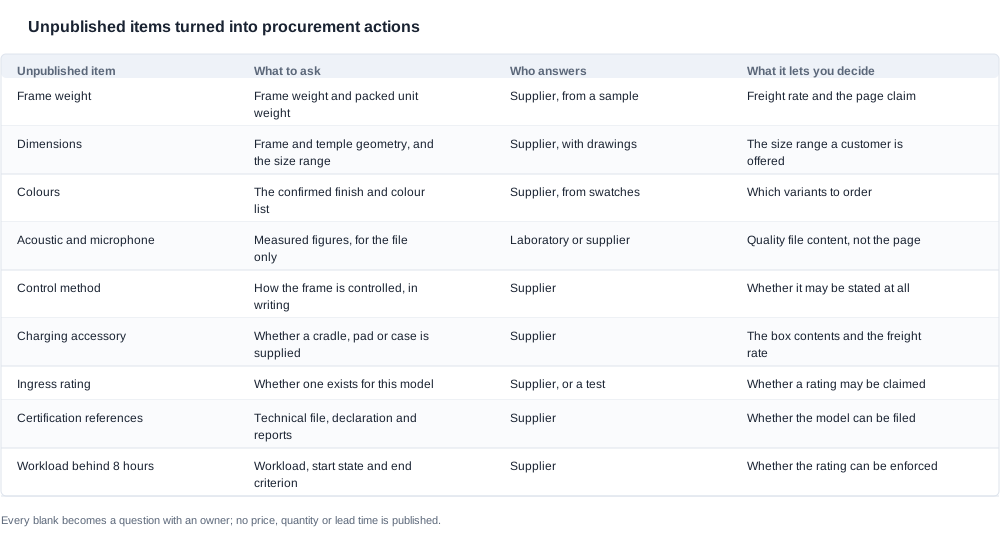
The same discipline applies to dates. A request without a date returns a document that arrives after the ship date it was needed for, and the forwarder, the laboratory and the channel's own review process each have lead times the buyer's project plan does not control. Putting a date against every blank — the date the document is needed, not the date it would be convenient — is what turns a schedule into a schedule rather than a hope. That is the whole conversion: a blank in a catalogue becomes a request with an owner and a date, a request with an owner and a date becomes a document, and a document becomes a decision the buyer can take on their own timetable.
Not everything that arrives belongs on a product page, and separating the two is where buyers lose the most. A packed weight is an internal number: it drives the freight rate, the carton design and the pallet quantity, and printing it on a retail page tells a customer nothing they can act on. A measured microphone figure or a laboratory acoustic report is internal evidence for a quality file, not a specification the catalogue has made. A cell test summary is a logistics document. The frame weight, the size range and the colour list, by contrast, are the three items in this set that genuinely belong on a product page once the supplier has stated them, and they are also the three that a customer most often asks about and most often cannot find. That is the practical shape of this model's limitations: a short list of things that would materially improve the page, and a longer list of things that belong in a file, a carton or a spreadsheet.
Closing the blanks in order: which question unlocks which decision
A request list is not a plan, and the order in which the blanks are closed decides how long the whole exercise takes. The sequence below is the one that works when the answers have to come from more than one department inside the supplier, and when each answer is needed before the next question can properly be asked.
Start with the two rows a product page cannot be written without. They are the frame weight and the packed dimensions, because the listing copy, the freight calculation and the packaging artwork all depend on them. The questions to ask are short: what does the finished unit weigh, and what does a packed carton weigh. If the reply comes back as a range, ask for the figure that will be printed on the box and the tolerance behind it, because a range printed on a carton is a claim nobody can verify later.
Then the documents that decide whether the goods can move at all. The cell test summary comes before the packing instruction, because the instruction is derived from the cell, and a supplier who sends the instruction without the summary has sent the answer without the reasoning behind it. On the radio side, the order that works is the identifiers naming this model first, then the reference carrying an expiry date, because a document with no expiry has no owner and will not be re-checked when it lapses.
Then the endurance question, which is the one that may never be answered. A rated-use figure that cannot be reproduced is a marketing number, and the only substitute is an acceptance condition. Write it before you order rather than after a complaint: the state the cell is in when the timer starts, how long the run lasts, what the device does during it, and what counts as the end of the run. A supplier who accepts a written acceptance condition has agreed to something measurable. A supplier who will not has told you the figure is a marketing figure, which is useful to know before it reaches a customer.
The red flags live in the answers rather than in the documents. Signs that a file has never been assembled include a supplier who cannot name the laboratory, cannot state an expiry, cannot say which cell the report covers, or answers the cell question with the packing instruction. A supplier who quotes a compliance claim without a scope is offering paperwork rather than evidence, and the criteria to hold it to are short: does the document name this model, does it carry a reference and a date, and does the configuration inside it match the rows published here.
The total cost of an open blank. An unanswered request is not free, because it propagates: an unconfirmed weight delays the artwork, an unresolved certification question delays the lane, and an acceptance condition written after the goods have shipped is a claim nobody can enforce. That is why due diligence on a thin published sheet is not extra rigour — it is the shortest route to a specification you can defend. The trade-offs run between time spent now and time lost later, the predictable pitfalls are the ones where a range was accepted as a figure and a platform was accepted as a model, and the checklist above tells you when to spend that time.
Where our position sits. On this model, our position is that a blank is not a weakness in the product but a gap in the published record, and it gets closed by a document or by a measured sample rather than by an argument. We will not print a figure that only the supplier holds, and we do not publish a weight, a dimension or a certification reference for this model, because the catalogue contains none of them. A shortlist a buyer can defend is what we can stand behind; a claim a customer will one day ask us to prove is not.
The eight hours: a rating that cannot be reproduced, ranked or converted
One blank on this model deserves separate treatment because it is the row a buyer is most likely to build something on, and it is the row that supports the least.
Six models in this catalogue publish a rated use of about eight hours, and they publish it across four different cell configurations: the K01 and the K02 on 90mAh2, the LC-105-1 and the LC-105-2 on 55mAh2, the YKC02 on 70mAh2, and the ZH12 on 100mAh. Not one of those six publishes a test condition — no workload, no start state, no end criterion, no volume level, no ambient temperature. And within a single cell configuration the figure is not even consistent: the 55mAh2 group contains the LC-105-1 and the LC-105-2 at about eight hours and the G07 and the YK12 at about six hours.
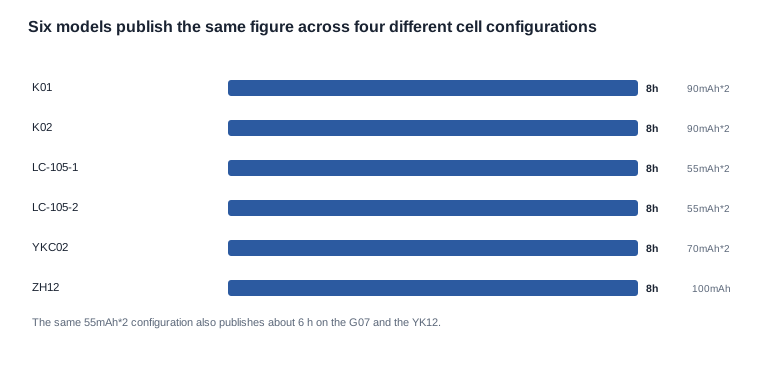
Inside a single cell configuration the picture is stranger still. The 55mAh*2 group contains four models: the LC-105-1 and the LC-105-2 publish about eight hours, while the G07 and the YK12 publish about six. Those four models share a published cell configuration and a magnetic charging method, and the catalogue publishes no feature row for the LC-105 pair that would account for the difference, so the only visible gap between a model at eight hours and a model at six is the model name and the figure itself. Three practical consequences follow for anyone buying on this row. This model's endurance cannot be inferred from its cell configuration, because the same configuration carries a lower published figure elsewhere in the range. A competitor's endurance cannot be inferred from its cell configuration either, because the same logic runs in reverse. And the tier cannot be used as a shorthand for a duration class, which is the assumption a catalogue reader is most likely to make when a cell configuration looks shared. The published figure belongs to the model rather than to the tier, and the only way to make it operational is to attach a workload to it.
Three consequences follow, and each of them costs a buyer something specific. The figure cannot be reproduced, because reproducing it requires the method, and the method is not published; a buyer who wants to verify it on a sample has nothing to reproduce against. It cannot be ranked, because the six models publishing eight hours span four cell configurations and no common measurement, so a table that sorts the range by endurance is sorting by an unstated protocol rather than by performance. And it cannot be converted into working hours, because a shift plan needs a workload and a tolerance, and a rating without a workload is a number that cannot be scheduled against.
What the row can still do is narrower and still worth having. It can serve as a manufacturer rating on a listing, worded as a rating and accompanied by the workload once the supplier has confirmed it — which is the treatment set out in the how to compare battery life method piece and, for this model specifically, in the LC-105-1 smart glasses battery life analysis. It can also be compared against another model from the same supplier, where a common method is more likely, which is what makes it usable inside a single range and unusable across a competitor set. What it cannot do is carry a specification claim on its own, and a listing that presents eight hours as a fact rather than as a rating has quietly assumed the method it was never given.
There is a second limitation attached to the figure that is not about measurement at all. The LC-105-2 publishes the same rows as this model, including the same rated use, and the catalogue publishes no difference between the two. So a range built on the endurance figure cannot differentiate the two models either, and a buyer who writes "longest-running model in the range" on an LC-105-1 listing is making a claim that the catalogue cannot support in either direction — the LC-105-1 and LC-105-2 comparison works through that pair in detail, and the published LC-105-1 specification list is the baseline to read it against.


