

The LC-105-1 smart glasses cannot be judged with a value ratio, because the catalogue record for this model carries no unit price, no price tier, no order minimum, no lead time and no warranty term. What it carries is five standard specification rows and a product page with no feature line on it: a cell configuration of 55mAh*2, a rated endurance close to eight hours, a charge ceiling of two hours, magnetic charging and Bluetooth V5.4. For a brand buyer, a distributor or an e-commerce seller, that is not a gap waiting to be patched. It is a division of labour between what a product record settles and what only a transaction settles.
This assessment therefore works backwards from the missing amount. Instead of asking what the LC-105-1 costs against the alternatives, it asks three narrower questions: what a value argument can legitimately be built on when cost is absent from the record, which published rows carry that argument, and which blanks have to be closed before the argument survives contact with a procurement file. The final section places the model inside the eight audio models, grouped by published class rather than by tier, because a shortlist built on published rows is the only comparison the catalogue can support on its own.
Nothing here recommends the model or rules it out. No amount appears in this assessment, and no model is put forward as the right pick for a scenario. What follows is a method, the rows that feed it, and the questions that turn each blank into a named field on a document.
What the catalogue lets you put in the value argument
The catalogue is a product record. It carries the fields that describe what a product is — cell class, endurance rating, charge ceiling, charging method, radio version, and on some pages a short list of structural features. It does not carry the fields that describe what the product costs to buy, and it does not carry the fields describing the commercial programme wrapped around it. For the LC-105-1 the published content is five rows: 55mAh*2, about eight hours, two hours or less, magnetic, and V5.4.
That gives a buyer exactly three legitimate moves, and each one is a way of using the record rather than a way of going around it.
- Use the published rows as filters, not as values. The five rows on the model page can tell a buyer whether the model belongs in a shortlist for a stated duty cycle. They cannot tell a buyer whether the model is worth what it costs, because no row on the page is a commercial row.
- Convert every blank into a written request. A gap in the record only becomes a problem when it stays a gap. Each unpublished item becomes a question with a named answer, and that is what turns an unknown into a deliverable a sourcing team can chase.
- Keep the commercial terms out of the catalogue record entirely. Unit price, order minimum, lead time, warranty term and certificate numbers belong to a quotation and a compliance file. They are not product attributes, and importing them into a specification argument is exactly how a value claim gets written that nobody can defend in a review.
Two absences on the audio pages shape the first move more than most buyers expect. The eight audio models publish no charging-case row as a group, and they publish no ingress-protection row as a group; the IP54 marking appears elsewhere in the catalogue, on the V06 and the S7, and it is not a row any audio model carries. Neither of those is a statement that the products have no case or no sealing. Both are statements that the audio pages do not answer the question, which puts each one on the request list rather than in the assumption column. The distinction matters commercially: an unanswered question is a supplier task with a deadline, while a confirmed absence is a design fact that changes the programme.
There is a second structural point that belongs in the same place. The catalogue publishes no camera row for the audio models and no touch-control row for any model in the range. A brand planning a listing therefore cannot inherit an imaging claim or a control claim from the record — not for this model and not for its neighbours — and any such claim has to arrive from the supplier as a written statement, attached to the model string it applies to.
For a brand base, this shapes what the value argument is actually for. A brand is not buying a device; it is buying a configuration it can hold a claim on, restock, and defend when a customer asks. The published rows tell a buyer whether the device can serve the configuration. The evidence layers tell a buyer whether the configuration can be defended. The commercial terms tell a buyer whether it can be sustained. Only the first of those is available from the catalogue, so a value argument that pretends to cover all three is quoting a capability it does not have.
The published rows that carry the argument
Each of the five rows does a different job, and it is worth taking them one at a time, because a value argument built on a cell class is a different argument from one built on an endurance rating. Mixing them is where a procurement file starts to drift away from what the evidence supports.
The cell configuration, 55mAh*2. The row publishes two cells of 55 mAh each. What it can carry is a capacity class: the model sits in the smaller cell class of the audio range. What it cannot carry is any figure for total energy, any statement about cell chemistry or format, and any cycle-life expectation. The number also has to be written the way the catalogue writes it, as a cell value and a cell count, because a bare total would read as a published figure when it is an inference of ours.
That class is not a differentiator on its own, because four audio models publish it: the G07 and the YK12, and the LC-105-2 and the LC-105-1. A capacity class that four models share is a grouping, and a value argument resting on it says something about the range rather than about this model. Buyers who want the class to do more work than that should ask for the cell specification itself — format, chemistry, and what the supplier will stand behind — because the class label on its own carries no purchasing leverage.
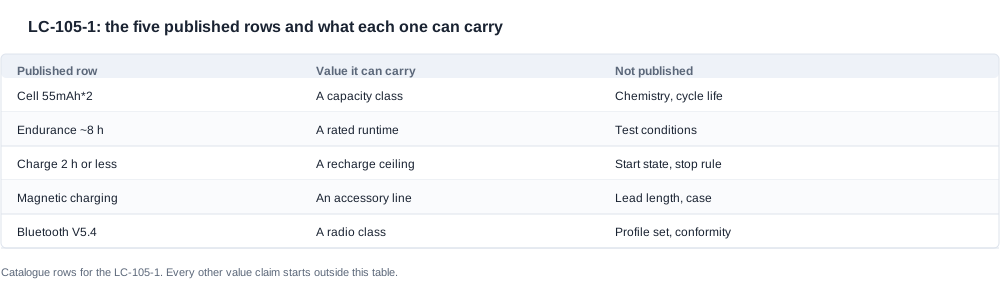
The endurance rating, about eight hours. The row carries a rating, and a rating can be quoted as a rating. It cannot be extended into a shift length, a working day, or a claim about performance under load, because the catalogue publishes no test conditions for it anywhere in the range. The evidence for how far the figure can be pushed sits in the structure of the range itself: within the same 55mAh*2 class, the LC-105-1 and the LC-105-2 are published at about eight hours, while the G07 and the YK12 are published at about six. A cell class spanning both figures means the class does not determine the endurance, and every endurance statement has to be made per model rather than per family. A buyer who quotes the class figure as though it applied to all four models will be contradicted by the catalogue two pages later.
The rating is not specific to the audio range either. Six models across the catalogue are published at about eight hours — the K01 and the LC-105-1, the K02 and the LC-105-2, and the ZH12 and the YKC02 — and they sit on four different cell configurations, with no test conditions published for any of them. A number that appears against four different capacity classes and two different charging methods is partly a catalogue convention, and that is exactly why it can be cited and exactly why it cannot be stretched into a comparison.
The charge ceiling, two hours or less. This is an upper bound and it has to be written as one: a charge time of two hours or less, at or under two hours. It is not the same statement as a charge that completes inside two hours, and the distinction is not pedantic in a procurement file, because an upper bound tells a buyer the worst case rather than the typical case and cannot be used to plan a turnaround. The row publishes neither the state the product starts from, nor the condition that ends the charge, nor what the charging draw does once the ceiling is reached. No audio model publishes a charge ceiling shorter than two hours, so there is no shorter figure inside the group to argue about; the whole group shares the same ceiling, and the question is therefore about the start state and the termination criterion rather than about the number.
The charging method, magnetic. The row supports the fact of magnetic contact charging and, with it, one commercial consequence: the contact lead is a specific item that has to be stocked and replaced rather than a generic cable, so it belongs in the accessory scope of a programme instead of inside a one-line comparison. That is also why the charging method has to be read as a programme fact rather than a preference. Across the audio range, magnetic covers six models and Type-C appears only on the D11 and the D12, so a buyer moving volume on a contact lead is buying a consumable stream, and a buyer who has standardised on Type-C is making a different programme choice even though both rows read as a single word on a specification page. The row does not publish the lead length, the connector at the other end, the retention of the contact, or whether a case is in the box — and the absence of a case row remains an unanswered question rather than a confirmed absence.
The radio version, V5.4. The row publishes the Bluetooth version, which is a technical class statement. It does not publish the profile set, the behaviour in a multi-device environment, the codec behaviour, or anything about the radio that could be carried into a conformity claim. On compliance the position is narrow and worth stating precisely, because radio version is the row buyers most often try to promote into a certification statement. The catalogue text contains no CE, FCC or RoHS reference anywhere, and it publishes no per-model certification row, so a radio version is a technical row and not a conformity claim. The frameworks a per-model file would eventually be built on are the Radio Equipment Directive (EU) 2014/53/EU, and the EMC directive 2014/32/EU is the companion instrument, and the radio version determines which of those two a file has to address. At company level the catalogue carries an export-certification section reproduced entirely as pictures, showing ten certificates — eight appearance-design filings and two utility-model filings. That page is a company-level record and cannot be used to attach a conformity statement to one model string.
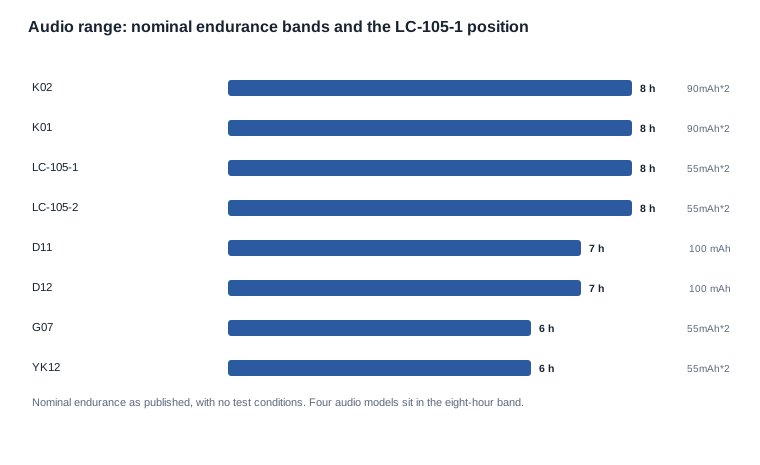
The absence of a feature line. The product page carries no structural feature line at all. Across the eight audio models, five publish no feature line — the D12 and the LC-105-2, the K01 and the LC-105-1, and the K02 — while three do: the D11 with surround sound and a long-battery line, the G07 with an ultra-slim and detachable temple, and the YK12 with Surround Sound and a Slim Temple. A feature-led claim cannot be written from the LC-105-1 page, so the value argument has to rest on the standard rows and on the evidence the buyer collects for itself. The D11 and the D12 show how much weight a single line can carry: their only published specification difference is the surround-sound line, and that one line is the only thing that separates two models with the same cell, the same charge ceiling, the same charging method and the same radio version.

The rows that have to be bought before the argument works
The published rows are the first layer of the value evidence and the only layer a reader can obtain without asking anyone anything. Three more sit above them, and an assessment is complete only when every row a claim depends on has a named home in one of the four.
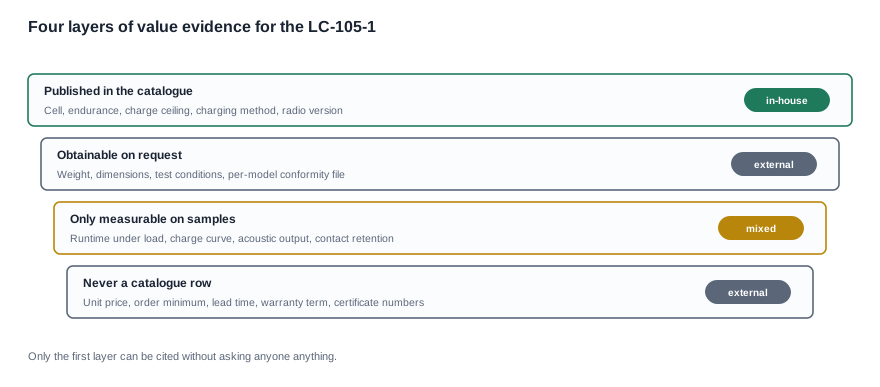
The second layer is what a supplier can hand over on request, in writing, without inventing anything. For this model the list is long and specific: the frame weight in grams, the frame dimensions, the test conditions behind the endurance rating, the acoustic specification, the microphone specification, the charging lead details, the charging-case status and capacity if a case exists, the packed unit weight and the carton dimensions, and the per-model conformity file with the numbers it cites. A supplier who answers these in writing has converted an unknown into an input. A supplier who answers them in a call has not, because a claim that cannot be filed against a document cannot survive a channel review.
The third layer is what no document can supply and only a sample can produce: endurance under a defined duty cycle, the charge curve from a stated start state to a stated termination, measured acoustic output rather than a specification, the behaviour of the magnetic contact over repeated cycles, and connection stability when other devices are active in the same environment. A sample order is not a formality here. It is the only mechanism that closes the third layer, and it should be scheduled against the questions that matter rather than against whatever sample list happens to sit in the catalogue, because a sample that answers a question nobody was going to ask is a cost with no return.
The fourth layer never appears as a catalogue row, and that is not an omission to be corrected. Unit price, price tier, order minimum, lead time, warranty term and certificate numbers are attributes of a transaction rather than of a product, and they exist in a quotation and a compliance file. Keeping them in that layer is what allows the first three layers to be cited honestly, and it is also what keeps a value assessment from turning into a claim the supplier never made.
Each item on the request list should be written as a question with a named answer, so that the reply files against a specific row instead of dissolving into a general assurance. For this model, a request set that can be sent as it stands looks like this.
- What is the frame weight in grams, measured without any case, insert or packaging?
- What are the frame dimensions, and are they the outer dimensions or the lens-box dimensions?
- Under what conditions was the published endurance rating measured — volume level, codec, ambient temperature, and the state the test started from?
- What ends the charge, and what start state does the two-hour-or-less ceiling assume?
- Which document carries the conformity record for this model string, and which numbers does it cite?
- Is a charging case part of the delivered configuration, and if so what does it add to the packed unit weight?
- What is the packed unit weight and the carton dimensions for the configuration being quoted?
- What are the order minimum, the lead time measured from which point, and the warranty term with its defect allowance?
Two of those questions decide the freight line and therefore a large part of the delivered cost, and both are measurement rather than opinion. A frame weight without packaging gives the device weight; a packed unit weight and a carton dimension give the volumetric class that a long route charges on. A brand that has not measured those two figures is quoting a delivered cost it has not calculated, and the error usually surfaces in the second year of selling rather than in the first order.
Where the value sits among the eight audio models
Once the catalogue is grouped by published class instead of by tier, the LC-105-1's position is easy to state and worth stating precisely, because a shortlist built on a class can be defended and a shortlist built on an impression cannot.
The published rows of the audio group, gathered in one place, read as follows.
| Audio model | Cell | Endurance | Charge ceiling | Charging | Radio | Feature line |
|---|---|---|---|---|---|---|
| K02 | 90mAh*2 | ~8 h | 2 h or less | Magnetic | V5.3 | No feature line published |
| K01 | 90mAh*2 | ~8 h | 2 h or less | Magnetic | V5.3 | No feature line published |
| D11 | 100 mAh | ~7 h | 2 h or less | Type-C | V5.4 | Surround sound, long battery |
| D12 | 100 mAh | ~7 h | 2 h or less | Type-C | V5.4 | No feature line published |
| LC-105-1 | 55mAh*2 | ~8 h | 2 h or less | Magnetic | V5.4 | No feature line published |
| LC-105-2 | 55mAh*2 | ~8 h | 2 h or less | Magnetic | V5.4 | No feature line published |
| G07 | 55mAh*2 | ~6 h | 2 h or less | Magnetic | V5.4 | Ultra-slim, detachable temple |
| YK12 | 55mAh*2 | ~6 h | 2 h or less | Magnetic | V5.4 | Surround sound, slim temple |
The eight audio models split into three endurance bands: about eight hours for the K01 and the LC-105-1, and the LC-105-2 and the K02; about seven hours for the D11 and the D12; about six hours for the G07 and the YK12. They split into three cell configurations as well — 90mAh2 for the K02 and the K01, 55mAh2 for the LC-105-2 and the G07, and the LC-105-1 and the YK12, and a single 100 mAh cell for each of the D11 and the D12. Magnetic charging covers six of the eight, with Type-C appearing only on the D11 and the D12. Bluetooth V5.3 appears on the K01 and the K02, and V5.4 on the other six.
On that structure, the LC-105-1 is one of four audio models published in the eight-hour band, one of four in the 55mAh2 cell class, one of six on magnetic charging, one of six on V5.4, and one of five whose page carries no feature line. It shares the eight-hour band with the K01 and the K02, which sit on a larger cell class, and it shares the cell class with the G07 and the YK12, which sit in the six-hour band and do publish feature lines. Neither comparison is a ranking, and neither is a price position. They are two statements about where the model sits and about which published row a buyer would use to justify it — and both of them point back to the same structural fact, that the 55mAh2 class does not determine the endurance and the eight-hour band does not determine the cell.
The more important structural point for a brand buyer is duplication. The LC-105-1 and the LC-105-2 publish identical rows, word for word, on two different pages. So do the K01 and the K02, whose five rows also match each other. A catalogue containing two pairs of indistinguishable records cannot answer a question a buyer is certain to ask — why these two rather than those two — and the honest answer is that the distinction has to come from the supplier or from a sample, not from the record. That is a procurement risk rather than a curiosity, because a channel that stocks two records it cannot separate will eventually be asked which one it is quoting, and the answer has to exist before then. The twin comparison for the LC-105-1 and the LC-105-2 works through what that means for a range selection, and the LC-105-1 limitations analysis sets out the documentation gaps the duplicate rows leave behind.
Three further boundaries belong in the same file, because all three are things a brand base cannot be planned on. Weight is unpublished for this model; the catalogue publishes a frame weight in exactly one place in the whole range, on the MT6 eyeglasses body, and that figure belongs to a different product entirely. No touch-control row is published for any model in the catalogue, so a control claim has no anchor in the record. And the weight comparison across the audio range is where the freight consequence of a missing weight figure becomes concrete for a brand that has to draw a carton.
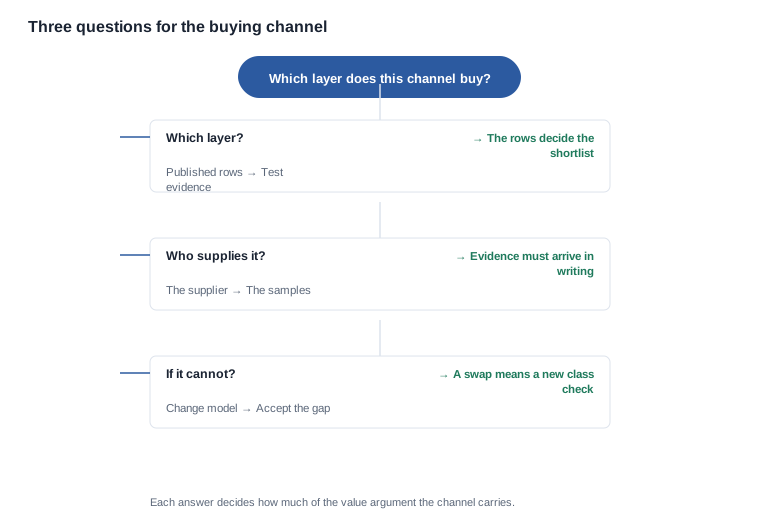
The three questions in the diagram are the ones a channel buyer should carry into a supplier conversation, because they decide how much of the argument the channel can carry on its own.
- Which layer does this channel actually buy? A channel that sells on published specification can work from the catalogue rows alone. A channel that sells on tested endurance or on acoustic performance needs the third layer, and a channel that resells on a documented compliance file needs the second.
- Which layer must the brand supply itself? If the answer is the second or the third, the cost of closing it belongs in the programme as a task with a named owner, not as an assumption that the supplier covers it.
- If a layer cannot be supplied at all, what happens then? The options are to change the model and re-run the class check, or to accept the gap in writing and narrow the claim set accordingly. The second option is legitimate, but it has to be a decision on the record rather than a discovery at the review stage.
The LC-105-1 smart glasses value for money assessment
Pulling the layers together gives an assessment that fits on one page, and it is worth writing down what it says as clearly as what it does not.
What the published rows support is a class-level claim: a two-cell 55 mAh configuration, a rated endurance of about eight hours with no test conditions attached, a charge time of two hours or less, magnetic charging, Bluetooth V5.4, and no feature line on the product page. That is enough to place the model in a shortlist against a stated duty cycle, and enough to explain to a buyer why the model is being considered at all. It is not enough to distinguish the model from the LC-105-2, and it is not enough to support any statement about what the model costs relative to anything else.
What the assessment therefore amounts to, in one line: the LC-105-1 can carry a class argument and a documentation argument, while a distinguishing argument has to be bought from the supplier or measured on samples. A brand buyer who needs a distinguishing argument — a temple geometry, an acoustic signature, a measurement the listing can cite — should treat the request set above as the cost of that argument rather than as a formality before the first order, and should expect the same request set to be unavoidable for the sibling model that publishes identical rows.
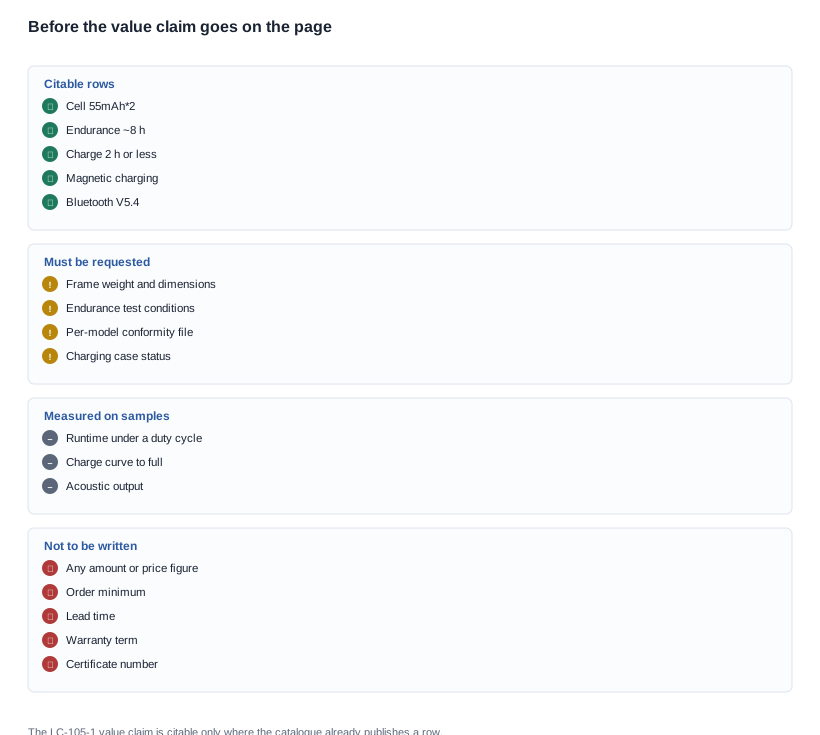
The boundaries of the assessment matter as much as its contents, because a value page is the place where an unsupported claim is most likely to be made and least likely to be caught.
- It is not a price judgement. The catalogue publishes no amount for this model, none appears here, and no comparison against any other model on cost has been made.
- It is not a model recommendation. The eight audio models have been grouped by published class, and a grouping is not a verdict on which of them a channel should carry.
- It is not a conformity statement. The catalogue carries no per-model certification row and no CE, FCC or RoHS reference, so nothing here states which conformity file the model comes with.
- It is not a performance claim. The endurance figure is quoted as a rating with no test conditions, and no claim has been derived from it beyond the rating itself.
Everything above rests on the division of labour described at the start, and for this model it applies in a specific way. Our position is that a value argument for this model has to be assembled from published rows and from evidence the buyer collects, because the catalogue does not publish prices and we will not present an estimate as though it were a published figure. We will publish the cell configuration, the endurance rating, the charge ceiling, the charging method and the radio version exactly as the catalogue writes them, and we will not attach a comparison, a ranking or an amount to them. A brand base has to be judged on the programme it produces, so the OEM ready model readiness overview is the right place to test whether the configuration holds together, and the customisation path for the sibling platform is the place to work through what a brand is choosing between two pages that publish identical rows.
For a first conversation with a supplier, the shortest version of this assessment is the checklist above: which rows may be cited, which items have to be requested, which items have to be measured, and which statements may not be written. The specification sheet in our catalogue is the baseline every one of those lines is checked against, and the who should buy the LC-105-2 analysis sets the same questions against the other page.
Related reading
- Published figures for this model — LC-105-1 smart glasses specifications and features
- What the catalogue leaves out — LC-105-1 smart glasses limitations
- The identical-rows question — LC-105-1 versus LC-105-2
- Runtime in context — LC-105-1 smart glasses battery life
- The range overview — Bluetooth audio glasses


