

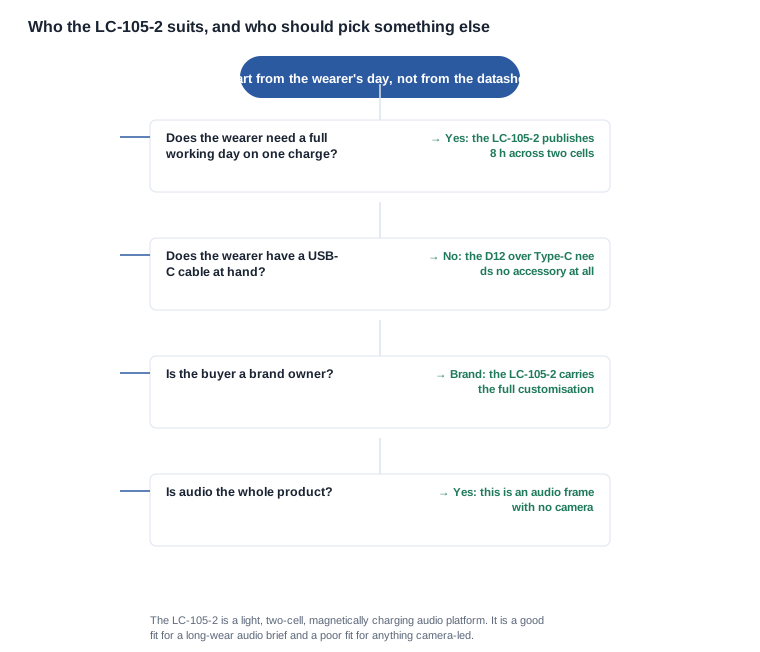
The LC-105-2 smart glasses suit a buyer whose customer wears an open-ear frame for a full working day and wants a light, plain, brandable audio platform. They do not suit a buyer whose customer will not have a USB-C cable to hand, nor one whose proposition depends on a camera, nor one who needs a published weight. The model is Bluetooth 5.4, two 55 mAh cells, magnetic charging, a charge time of 2 hours or less and about 8 hours of endurance — and that is where the decision starts.
Lc-105-2 smart glasses: a platform for a long-wear audio brief
Five published rows. Bluetooth 5.4, two 55 mAh cells, charge time of two hours or less, magnetic charging, about eight hours of rated endurance.
Read together rather than one at a time, they describe a specific product: a dual-cell frame, charged by contact, intended to be put on in the morning and left on through the day. The two-cell arrangement is the point — 110 mAh distributed across both temples — and it is why the source describes this platform as an ultra-light configuration. That description is not accompanied by a figure, and that is the first thing to deal with.
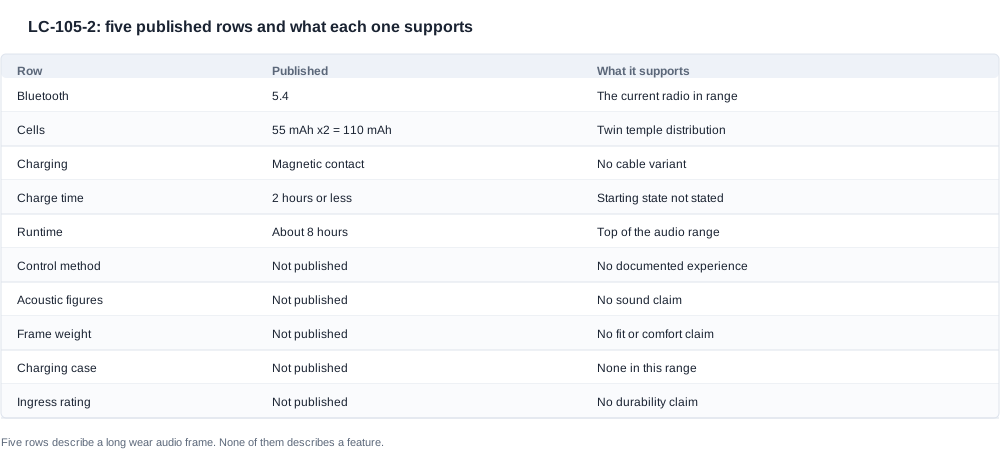
What those five rows do not settle is nearly everything a listing normally needs. No control method is published, so there is no documented user experience. No acoustic figures exist, so there is no sound claim to make. No frame weight, temple length or lens dimension is published, so there is no fit claim. No charging case is published, and none is published for any model in this range. No ingress rating, no certificate numbers, no colour list.
That combination makes the LC-105-2 a platform choice rather than a feature choice. A buyer who needs a feature should not be reading this article, because this model does not have one to find. A buyer who needs a reliable long-wear audio frame with a large customisation surface should be, because that is exactly what this is.
The four branches that decide it
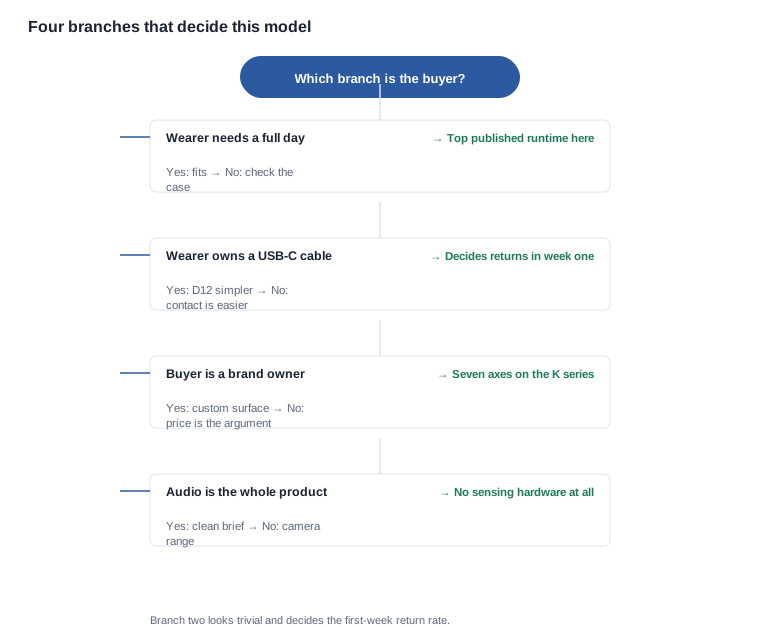
Branch one: does the wearer need a full day on one charge? The LC-105-2 publishes about 8 hours across two 55 mAh cells, which is the longest published figure in this range and the top of the audio family's figures. If the customer works a long shift, this platform fits. If they need a day and a half, the case has to carry the difference, and no model in the audio range publishes a case, so that is a category limitation rather than a model one.
Branch two: does the wearer have a USB-C cable at hand? If yes, the D12 is the simpler product for them, because it charges over Type-C with the cable they already own. If no, or if the customer simply will not think about which cable goes where, the magnetic approach with a case is more forgiving. This is a small decision with a large effect on first-week returns, and it is worth more attention than its simplicity suggests.
Branch three: is the buyer a brand owner? If yes, the LC-105-2 is a good starting platform, because the K-series audio models carry the widest documented customisation axis set in the range: logo, colour, packaging, temple shape, system and UI, Bluetooth name and firmware. That set is what lets a brand build a product that is not a repackaged stock unit, and the customisation path for this platform walks through the seven axes in the order they should be decided. If the buyer is a reseller, the specification is simpler to buy and the price is the argument.
Branch four: is audio the whole product? The LC-105-2 has no camera and no sensing hardware. If the brief is an audio wearable, that is a clean product with a clean proposition. If the brief involves capture, the AI camera glasses range is where the decision actually lives, and none of the camera reasoning in this article transfers.
A fifth branch, applied last, decides whether any of the first four matter: can your channel run a platform with no feature? Some channels cannot. A retailer that requires a differentiating claim per listing, a marketplace whose ranking rewards feature density, or a brand whose marketing function needs something to say will all find this model difficult. That is not a defect in the product; it is a mismatch with the channel's operating model, and it is cheaper to identify in the shortlist stage than after the listing is live.
The way to run all five is in order rather than together. Branches one to four are product facts and cost nothing to establish. Branch five is a question for your own commercial team. Eliminators first, preferences second: a brand that builds its shortlist from what it can sell rather than from what it can sell around tends to end up defending a model it should have ruled out.
And the criteria to apply to whichever branch you land on are all answerable by the supplier in one message. Endurance condition, weight, dimensions, control method, case availability, certification position. A supplier who answers all six is a different relationship from one who answers none, and that difference is worth more to a buyer than any single specification row.
The two features that are named but not specified
The LC-105-1 and the LC-105-2 publish identical specifications, and the source does not state what separates them. That is the first thing to resolve, and it is a range-structure question rather than a product one: two SKUs that are identical on paper have to be justified by something, and if the answer is a colourway or a packaging tier, that is a legitimate reason to run both.
If the answer turns out to be that they are the same product under two designations, the right response is to say so in your own catalogue and on your product pages, because two identical listings compete with each other and the buyer who discovers it concludes that one of them is a lesser product. Collapsing them halves the documentation load for that rung of a range and removes a question from every future customer conversation.
The second gap is weight. The source describes this platform as ultra-light, and the description is not accompanied by a figure. For a category where weight decides whether a product is worn all day, that is a claim to be substantiated rather than repeated. A weight is one of the easiest numbers in this industry to obtain and one of the easiest to omit by accident, so its absence here is worth chasing.
The weight comparison across the audio range covers what happens to a shipping calculation and a comfort claim when the number is missing. Both are affected: the comfort claim because the customer cannot feel the number you are not quoting, and the shipping calculation because your freight model is working from an assumption rather than a measurement.
There is a third named-but-unspecified item that gets less attention than it deserves. The charge time is stated as two hours or less without a starting state. Charging from flat and charging from a partly used frame are different measurements, and the difference between them is exactly the difference between a customer who charges at a desk and one who charges overnight. Ask for the starting state before writing the row into a listing.
Where it sits against its neighbours
Against the G07 and the YK12, it shares the 55 mAh × 2 configuration but not the design features: the G07 publishes a detachable, ultra-slim temple and the YK12 a slim temple, while the LC pair publishes neither. Against the K01 and the K02, it has 110 mAh instead of 180 mAh and the same published eight hours, and it gives up the translation claim, while neither side publishes a touch control row to describe. Against the D11 and the D12, it trades two cells for one and magnetic charging for Type-C.
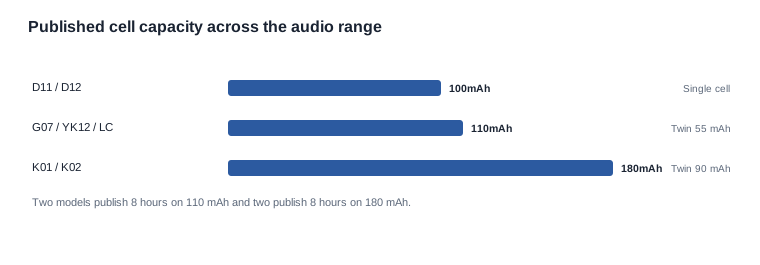
That last comparison is the one buyers get wrong most often, because it looks like a downgrade when it is a different design. The D12's single larger cell and Type-C charging is simpler for the customer, and the LC-105-2's twin smaller cells and contact charging is simpler for the brand, because a contact-charging frame with no case to specify, no cable variant to manage and no charger to certify across territories is one fewer thing to get right in several markets at once.
The K01 and K02 comparison is different again, and it is the one that decides whether this model is right. 180 mAh against 110 mAh is a real difference in energy, published on both sides. Eight hours on 110 mAh and eight hours on 180 mAh cannot both be right under one protocol, and no test condition is published for either, so the honest position is that these two figures came from different methods rather than that one model is twice as efficient. That is not disqualifying, but it does mean a channel that leads on battery claims should be careful about putting the two side by side.
The LC-105-2 and D12 use case comparison works through the Type-C question in detail, and the published LC-105-2 specification list is the honest baseline for the model.
A word on the trade-off that buyers usually under-price. Moving from this model to the D12 does not make the product worse; it moves a decision from the brand to the customer. Contact charging asks the customer for nothing, which reduces first-week returns, and it asks the brand for cable and charger decisions across territories, which increases launch work. Neither is better in the abstract, and the right answer depends on how much support resource the brand has in the destination markets rather than on anything about the product itself. Channels selling into several markets with thin local support usually prefer contact charging; channels selling into one market with strong support usually prefer Type-C.
And a word on the trade-off buyers usually over-price. Moving from this model to the K01 or K02 does not add capacity that the customer will notice, because both publish the same eight hours. It adds documented features and a larger published cell, which is a listing difference rather than a usage difference. If your channel sells on specification rows, that is worth paying for. If your channel sells on how the product feels after a full day, the twin-cell configuration is the more relevant argument and the larger cell is not.

How to evaluate an ultra-light claim with no number
The description exists and the figure does not, so the sample has to produce the figure. This is a short test and it settles more than it appears to.

Weigh the frame, in grams, on a production sample rather than a showroom unit. Write the figure down and treat it as the official weight for all customer-facing material from that point on, because a weight that changes between the listing and the review is worse than no weight at all.
Then test the thing the description is actually about. Ultra-light frames fail in one specific way: they are comfortable in the hand and uncomfortable on a face by hour four, usually because the temple pressure is high relative to the mass. Wear it for a full working day and note when it comes off, and why. That single observation is worth more than the gram figure for deciding whether the customer will still be wearing it next month.
Measure the temple contact point specifically, and check whether it moves over a day. A lightweight frame that slides is a different product from a lightweight frame that stays put, and the difference is visible to a customer within a week.
Then check the cell arrangement against the claim. Two 55 mAh cells distributed across the temples is a design choice with a consequence: if one temple is heavier than the other, the frame will sit unevenly, and the customer will correct it constantly. Weigh both temples separately.
And check what happens when one cell fails, because a dual-cell design creates a partial-failure state that a single-cell design does not have. The LC-105-2 limitations list covers what is not published on this model, and the partial-failure behaviour is on it.
Then run the receiving check. Open three cartons from the same delivery and compare the contents against the packing list, weighing one unit from each. Variance between units on a lightweight frame is normal, and variance between units is what your freight model has to survive — a model that ships a gram heavier than the sample is a small cost, and a model that ships two grams lighter per unit is a measurable margin across a bulk order.
Finally, decide the acceptance criteria in writing before the bulk order. State which measurements must match the sample, what must be present in every carton, and what the remedy is if they are not. On a model with two identical sibling SKUs this is doubly important, because the one thing the receiving team must never confuse is which model arrived.
What to confirm before the first order
Five things, in the order they block work.
- What physically differs between the LC-105-1 and the LC-105-2. One line, in writing, before packaging artwork is designed.
- The frame weight in grams, and the frame dimensions, measured on a production sample rather than quoted from a datasheet.
- The endurance test condition behind the eight-hour figure, asked in the same words you would use on any model in this range so the answers are comparable.
- Whether a charging case exists for this model, and its capacity. If the answer is that none exists in this range, that is a category position and you can plan around it; if a case exists but is unpublished, get the figure.
- The certification position for this model in each destination market, and whether the declaration names the model or only the company.
Then the commercial set, which is unpublished on every model here: minimum order quantity, lead time, price, incoterms, payment terms, deposit structure and warranty. Ask specifically what the warranty covers on the charging contacts, because contact charging is a wear interface, and a frame whose contacts corrode or whose charging becomes intermittent is a warranty claim that arrives as a battery complaint.
Where we can narrow this faster: the LC-105-2 limitations list sets out the full gap set, and the Bluetooth audio glasses buying guide covers the range-level decision across every model rather than this one alone.
On how to use those questions, the order matters more than usual here. The weight and the sibling difference come first, because both are cheap to answer and both change what you can print. The endurance condition comes second, because it decides whether a number can go on a page without a note beside it. The case question comes third, because the answer is probably no and planning around no is easier than discovering it after the artwork. The certification question comes last, because it is necessary in every market and rarely the reason two models are being compared. Checking them in that order stops a compliance question from displacing a product question, which is the most reliable way a shortlist goes wrong.
On negotiation, put the configuration in the purchase order rather than in the email thread. The configuration here is unusually load-bearing: two models on this platform publish identical rows, so the only thing distinguishing the SKUs at receiving is what was agreed. Write down which model, which batch, which accessory set and which colourway each line covers, and write down what happens if the delivery does not match. A quality control record that lists quantity and appearance will not settle any of that, and a purchase order that does not specify it leaves the buyer holding whatever arrived.
And on due diligence, do the supplier work once and reuse it. Every gap on this model is shared with its siblings and with most of the family, so a request that asks for weight, dimensions, endurance condition, case availability and certification position for the whole platform will answer this model's questions and the next three models' questions at the same time. That is the practical efficiency of a shared platform, and it is worth more to a brand building a range than the individual row on any single model.
What we will and will not confirm
The LC-105-2 is a good platform for a long-wear audio brief and a poor one for a specification-led brief, because almost every published row it has is shared with another model. The case for it is the two-cell light configuration and the customisation surface, not any number that distinguishes it on a datasheet.
We will not quote a weight for it, we will not present the eight-hour figure as a guaranteed working day, and we will not invent a charging case for a model whose documentation does not mention one. We will not describe the difference between this model and its sibling, because our documentation does not state one and we would rather leave the question open than answer it wrongly. The LC-105-2 battery life analysis covers the endurance question in the depth it deserves, and the range selection guide is the right place to compare across the whole family.
Send us the customer, the expected daily use and the volume, and we will tell you whether the LC-105-2 fits the brief — and if the answer is that the D12 is simpler or the K01 is more distinctive, we will say that too rather than sell you this one.
Related reading
- The specifications this model publishes — LC-105-2 smart glasses specifications and features
- The endurance question in detail — LC-105-2 smart glasses battery life
- Choosing across the range — Bluetooth audio glasses which model to pick
Send us the customer, the expected daily use and the volume, and we will tell you whether the LC-105-2 fits the brief.


