

Medical device boundary and claims is the most consequential question a smart glasses brand can get wrong, and the reason it is consequential is that the answer changes the whole commercial model rather than adding a file to the end of one. A document you forgot is an inconvenience. A product that has been classified as a medical device is a different product, on a different timetable, with a different cost base, a different insurance position and a different set of things that have to be true before a single unit ships.
The boundary itself is drawn in one place and only one: the claims. Not the sensors, not the circuit design, not the form factor, not the price. A device is placed inside the medical regime by the purpose it is presented as having, and that purpose is set by what the manufacturer states — on the label, in the documentation, in the promotional material and in the sales material. That last category is where most glasses programmes trip, because the listing copy and the trade brochure are written by people who are not thinking about classification.
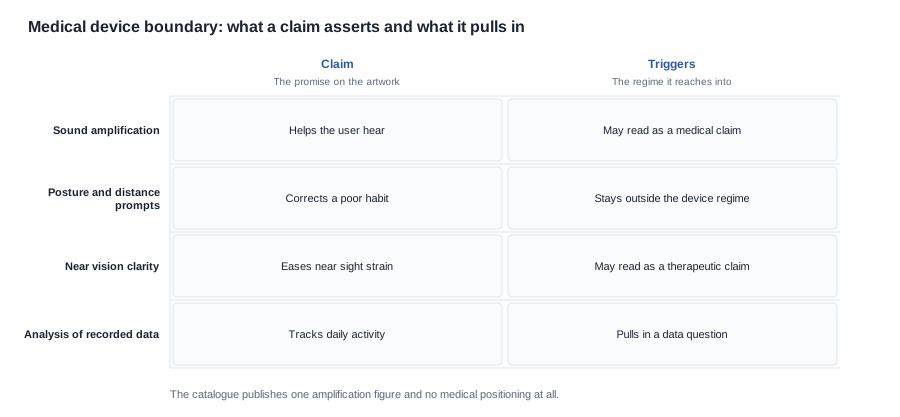
Medical device boundary: the claim decides the regime, not the hardware
What has to be ruled on before the artwork is locked
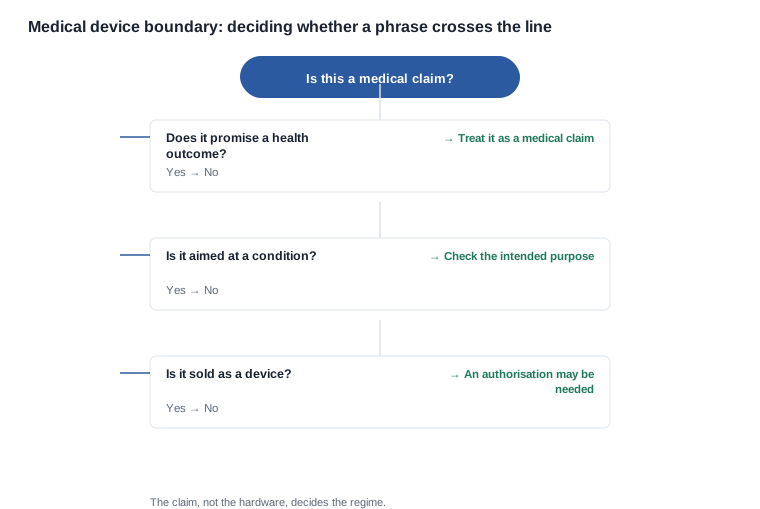
Three conclusions will keep a buyer out of trouble in this category. First, the regulatory question is answered by the intended purpose, and the intended purpose includes the promotional and sales material, which means your own listing copy is regulatory evidence and has to be drafted accordingly. Second, the trigger for crossing the boundary is a claim about a health outcome, not a technical capability; a device that measures something is not a medical device, and a device that says it improves something may be. Third, the practical consequence of getting it wrong is not a fine but a schedule, because the conformity route for a medical device is a different programme with its own evidence, its own review and its own queue.
Before you order anything, the red flags worth naming are a marketing page that promises a health outcome and a distributor copy that nobody reviews. The instruction that follows is simple and it is cheap: write down every benefit phrase that appears anywhere in the material — artwork, manual, listing, brochure, trade show stand — and rule on each one before the artwork is locked. The ruling is a decision about wording, not about testing, and it can be taken in an afternoon.
The buyer who rules on claims, and the exposure they take
The reader is a brand-side compliance lead, a procurement manager or a channel buyer who is about to put a product into a market where health-related wording is common and where the boundary is watched closely. Some of them are launching a product that has an adjacent feature — a camera, a posture sensor, an audio path — and want to know how close to the line they can position it without a change of commercial model. Others have inherited a product whose marketing was written by a partner and are trying to establish, late, whether the claims can be sustained.
What such a reader is managing is not a regulatory fine. It is the risk that a claim in the artwork creates an obligation the organisation cannot discharge, at a point in the programme where the schedule can no longer absorb it. That risk is asymmetric: the cost of removing a phrase is a reprint of the artwork, and the cost of keeping a phrase that has been read as a medical claim is a conformity programme, a notified body schedule, a clinical evidence file and a launch date that moves by quarters.
There is also a reputational dimension that a B2B buyer should price even though it does not appear in the compliance file. A product marketed with a therapeutic claim that then behaves like a consumer product is a complaint generator, and the channel in which the complaint arrives is usually the channel that supplied the marketing copy. A claim review is therefore also a supplier review.
Why crossing the line changes the commercial model
The reason this is worth the attention it gets is that the difference between the two models is not a file. In the ordinary case, a product is placed on a market by a manufacturer that assembles a technical file, issues a declaration, affixes a mark, and keeps the evidence for a defined period. That is a proportionate piece of work, and a competent factory does it routinely.
In the medical case, the product requires a determination of classification, a documented intended purpose, a conformity assessment that may involve a notified body depending on the class, technical documentation that is substantially larger, a clinical evaluation, a representative in the market, registration, post-market surveillance and a vigilance process. Every one of those is a programme with a duration and a cost, and none of them can be compressed by buying more units.
The commercial consequence is the part buyers underestimate. A product that is reclassified cannot simply be held back while the file is assembled; it cannot be sold at all until the route is complete, and a channel that was planned around a launch date has to be re-planned. The unit economics are also different, because the evidence cost is spread over a volume that is now set by the cost rather than by the market.
This is why the claim question belongs at the specification stage rather than at the artwork stage. At the specification stage, removing a claim costs a paragraph. At the artwork stage it costs a reprint. At the launch stage it costs the launch.

The rules that draw the line, and where our own catalogue sits
What the two regimes actually turn on
Two regulatory systems matter to a buyer placing a connected eyewear product on a European or United States market, and both turn on the same pivot. In the European Union, a product is a medical device when its intended purpose, as stated by the manufacturer on the label, in the documentation, in promotional material or in sales material, is the diagnosis, prevention, monitoring, prediction, prognosis, treatment or alleviation of disease. The definition is deliberately broad, and the mechanism by which it captures a consumer device is the marketing sentence rather than the bill of materials. The United States regime works on a similar logic, and it treats the presentation of a product as a device without the required authorisation as misbranding, which is the provision at 21 CFR 800.30.
Two practical consequences follow for a procurement team, and both concern documents rather than hardware. First, the promotional material is part of the classification record, so it cannot be written by a separate function without a review step. Second, the classification is a determination that has to be documented, not an assumption that can be left implicit because the hardware looks like consumer electronics.
A buyer should also know what is not in scope of this question. Electrical safety, ingress protection, chemical content, radio conformity and transport documentation are all real obligations on a connected eyewear product and none of them is affected by whether the marketing says the product improves your posture. Keeping the two apart is what allows a buyer to run both workstreams in parallel rather than folding them together.
The 35 dB row, and why it is a claim risk rather than a feature
Our catalogue contains a concrete illustration, and it is worth handling precisely rather than nervously. One entry in the range is a bone conduction glasses model. Its published rows are a 200 mAh cell, a charging time of two hours or less, a rated runtime of about seven hours, a Type-C charging method, and a single figure labelled as an amplification gain of 35 dB. That is the complete published specification for that entry.
What the catalogue does not contain, verified across all thirty-three pages of its text, is any medical, hearing, therapeutic, wellness, near-vision or treatment wording at all. The words for medical devices, for hearing aids, for hearing, for near vision, for treatment and for health protection do not appear in the catalogue text at all. There is no regulatory classification, no clinical evidence, no intended-purpose statement and no claim of any therapeutic effect attached to that entry or to any other model in the range.
So the catalogue position is defensible, and the risk is entirely in what happens next to it. A 35 dB amplification figure on a bone conduction product is exactly the kind of number that a listing writer, a distributor or a marketplace template will turn into a sentence about hearing. "Amplifies sound by 35 dB" is a specification. "Helps you hear better" is a benefit claim, and a benefit claim about hearing is the fastest route from a consumer product into the medical regime. The line between the two is not drawn by the number; it is drawn by the sentence that contains it.
That distinction is the single most useful thing a buyer can carry out of this subject, and it applies to every model in the range, not only to the bone conduction entry. A specification figure is a fact about the hardware. A benefit sentence is a claim about what the hardware does for the user, and it is the sentence that is regulated.
The criteria a buyer applies to a claim before it reaches artwork
The review form, and what a skimmed answer looks like
A claim is ruled on rather than negotiated, and the table below is the form a buyer uses to do it. Each line states how the phrase is measured, what it has to meet and the shape a weak answer takes, so that the same wording can be applied to artwork, to listings, to brochures and to store descriptions. A claim that cannot be ruled on against these lines has not been reviewed at all, it has been skimmed, and the difference shows up later in a customer questionnaire.
| Line to test | How it is measured | The line it has to meet | How a weak answer shows up |
|---|---|---|---|
| Outcome wording | Read every benefit sentence and classify it as descriptive or outcome. | Outcome wording is absent unless it is supported and permitted. | A sentence promising an improvement with no evidence attached. |
| Condition reference | Look for any reference to a condition, symptom or diagnosis. | No condition is referenced in any material. | A sentence describing a named condition. |
| Audience specificity | Check whether the copy addresses a defined group with a need. | The audience is described by activity, not by condition. | Copy written for people with a specific complaint. |
| Intended purpose record | Ask whether a written intended purpose exists for the model. | A document states what the product is for. | An intended purpose implied by the marketing. |
| Specification to claim link | Trace each benefit sentence back to a published figure. | Every sentence sits one step from a published number. | A sentence with no published figure behind it. |
| Supplier material | Review the brochure, the listing template and the trade display. | Each is checked and the risky phrases are flagged. | A partner's copy shipped without review. |
| Distributor copy | Review the copy used by channel partners. | The channel copy is approved centrally and cannot be edited freely. | Channel copy written independently by each partner. |
| Developer and store copy | Review the description used in the application store. | The store description matches the approved wording. | A store description richer than the packaging. |
| Claim approval record | Check that a claim was approved and by whom. | Each approved claim has a name and a date against it. | Approval in a message that cannot be found later. |
| Change control | Ask what happens when a new feature is added. | A new feature triggers a claim review before launch. | Features added without a marketing review. |
| Classification determination | Ask whether a classification has been recorded for the model. | A determination exists and covers the configuration shipped. | An assumption that the product is a consumer device. |
| Withdrawal trigger | Ask what would make a claim be withdrawn. | A trigger is defined and a process exists to act on it. | No process, so a claim stays until somebody objects. |
Two rows in that list are routinely confused, and the confusion produces a false answer. A specification figure and a benefit sentence are not the same kind of claim, and a document that links a benefit sentence to a specification does not thereby support the benefit. Separately, the approval record and the copy are different things: a claim can be approved and then reintroduced by a distributor writing its own listing, which is why the channel copy has to be controlled rather than merely encouraged.

Sweeping the claims out of the material
The sweep, step by step
The sweep is a short, repeatable piece of work and it is much cheaper than a classification dispute. The order below is the order that works, because each step depends on the previous one being done.
-
Collect every piece of material that carries a phrase about what the product does for the user — artwork, manual, listing, brochure, trade display, application store description and partner copy.
-
Split each phrase into a descriptive half and an outcome half. "Amplifies sound by 35 dB" is descriptive. "Helps you hear better" is an outcome.
-
Rule on every outcome phrase. Should it be removed, softened to a descriptive form, or retained with evidence and a classification check behind it. Record the decision against the phrase, not against the document.
-
Check whether any phrase refers to a condition, a symptom or a defined group with a medical need, and remove it if so.
-
Establish whether the phrases survive in the channel copy as well as in the packaging, and put the approved wording somewhere the channel cannot quietly replace it.
-
Record the intended purpose in a document, so that the classification question has an answer that is written down rather than inferred.
-
Agree what happens when a new feature or a new claim appears, and put it on the change register so that it is triggered rather than remembered.
A buyer who wants to know how to evaluate a claim quickly should start at step two, because the descriptive-versus-outcome split does most of the work and takes the least time.
What to rule on, phrase by phrase
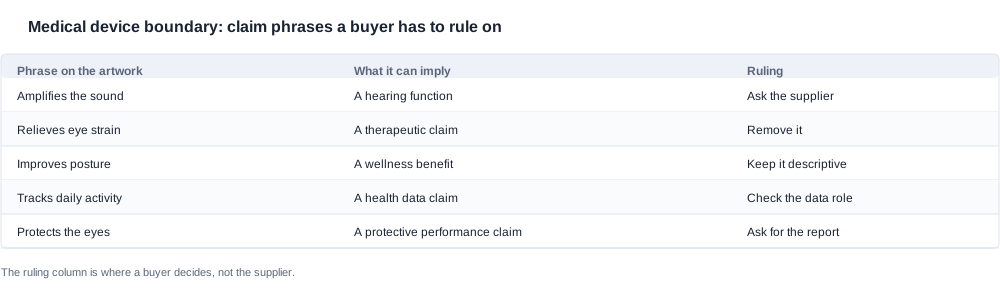
The table above is not a list of banned phrases. It is a list of the shapes a buyer will actually meet, with the ruling that usually applies. The judgement is always the buyer's, because the party that writes the marketing is the party that decides the intended purpose, and a factory cannot make that decision on a brand's behalf.
The three tests worth applying to each phrase are worth stating separately. The first is whether the phrase could be read as a statement about a health outcome by somebody who is not hunting for one. The second is whether the phrase describes what the hardware does or what the user gets. The third is whether the phrase would survive being read aloud next to the product by a person who has no context. A phrase that fails the third test is a phrase that will be quoted back at you by a marketplace, and it is worth removing before that happens rather than after.
The record that has to survive the artwork stage
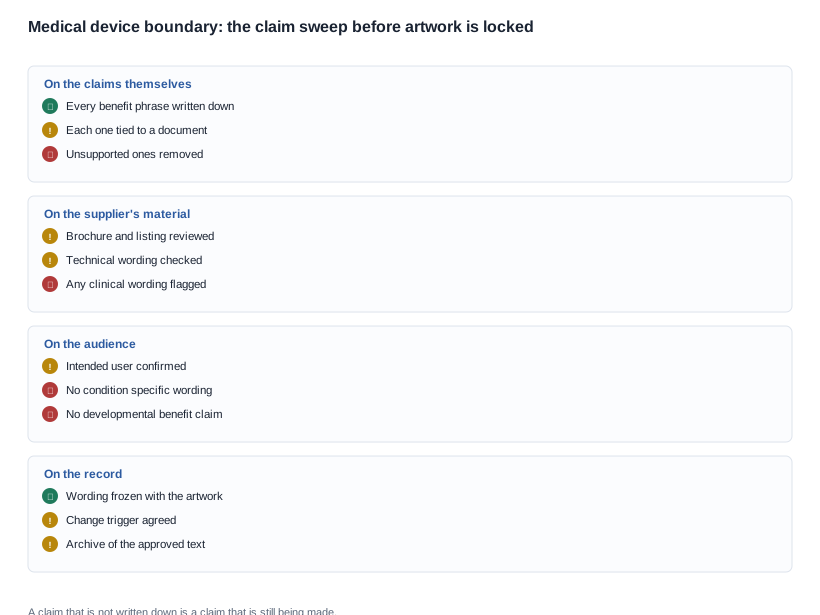
The checklist is arranged by phase because the phases fail differently. The claims themselves fail when a benefit sentence survives without a ruling attached. The supplier's material fails because it was written for a different market. The audience fails when copy is written for a defined group with a medical need. The record fails when nobody can show what was approved and why.
The item that matters most in practice is the archive of approved wording. A claim review that produces a document nobody can find six months later has not happened, because the next person to write copy will not know what was already ruled on. The archive is a folder, a version and a date, and it costs nothing.

The cost of crossing, and the negotiating position
Four ways a medical claim comes back after the sweep
The signs that a claim has come back are visible in the channel copy rather than in the packaging, and the buyer who watches the channel copy will find it first.
The distributor's own listing. The brand approves restrained copy, and a channel partner writes a listing that promises a benefit. The symptom is a marketplace page making a claim the packaging does not. The cause is that the brand supplied a product and no approved wording. The prevention is a single approved text file that the channel is required to use, and a channel agreement that says the wording is fixed.
The application store description. The store listing is written to be persuasive, because that is what store copy is for, and it drifts further than the packaging. The symptom is a claim that appears in a store review. The cause is a separate marketing surface with its own approval route. The prevention is to put the store description on the same change register as the artwork.
The feature that arrived late. A new function is added to the firmware and a feature description is written with it. The symptom is a claim that nobody reviewed, attached to a function that was never assessed. The cause is a feature pipeline that does not touch marketing. The prevention is a rule that no feature ships without a claim check.
The comparison the customer makes. The packaging is restrained, and the product is compared with a competitor whose packaging is not. The symptom is a support enquiry framed as a health question, which is where these programmes usually surface. The cause is that the restrained copy was written for compliance rather than for the customer. The prevention is to write restrained copy that still explains the feature, so that the restraint does not read as evasiveness.
Wordings written for compliance and never revisited read as evasiveness to a customer. They are reasons to control the wording centrally and to treat the approved text as a controlled item.
What a supplier can and cannot do about it
The commercial conversation here divides into what the factory controls and what it does not, and the division is worth stating precisely because it determines who owns the risk. The factory controls the hardware, the published specification rows, the brochure and the technical wording in its own material. It cannot decide the intended purpose of a private-label product, because the purpose belongs to whoever markets it, and it cannot approve a claim on a brand's behalf.
What the factory can do is refuse to supply material containing a claim the brand has not approved, supply a neutral specification sheet, and flag a claim in the brand's own copy that crosses the line. What it cannot do is guarantee that a downstream distributor will not write one.
The questions to ask a supplier are therefore short, and they are about material rather than about hardware. The commercially sensible arrangement is to put the approved wording into the purchase agreement, give the factory the right to withhold material that contradicts it, and keep the classification determination on the buyer's side of the line where it belongs. A supplier who offers to write the claim for the brand is offering to take on a determination that is not the supplier's to make.
The total cost of managing this is small and it is front-loaded. A day of review and a controlled text file cost nothing, and they sit against a risk whose size is set by a timetable rather than by a penalty.
A claim review worked through, and the limit of what we publish
A hypothetical claim review, step by step
What follows is an illustration rather than a case history. No client is described and no figures are claimed, and the model, the materials and the channels are assumed for the purpose of showing how a claim review is sequenced.
The scenario. A buyer is launching a bone conduction model from the range into two markets, through a distributor who writes its own listing and into an application store where the product description is written separately.
Step one, the catalogue position. The buyer first decides which model in the range carries the highest claim risk, and reads the published row for it: a 200 mAh cell, a charging time of two hours or less, a runtime of about seven hours, Type-C charging and a published amplification gain of 35 dB. The buyer confirms that the catalogue carries no medical, hearing or therapeutic positioning at all, so the review is not a dispute about what the supplier said; it is a review of what the buyer's own channel will say.
Step two, the material. The buyer collects the packaging artwork, the manual, the distributor's draft listing and the store description, and splits each phrase into descriptive and outcome halves. The distributor's draft turns the 35 dB figure into a sentence about hearing, and the store description turns the posture and distance prompts into a statement about correcting a habit.
Step three, the rulings. The descriptive phrases stay. The hearing sentence is removed, because the descriptive form is available and the outcome form would change the classification. The posture sentence is softened to what the published rows support. The distributor and store copy are replaced with the approved text, and the approved text is issued as a single controlled file.
Step four, the record. The buyer writes the intended purpose down, records a classification determination for the model as configured, and puts the store description and the distributor listing on the change register. The next feature to be added goes through the same check.
Step five, the trade-off. The distributor objects that the restrained copy will not sell. The buyer holds the position and offers the alternative of approved wording the distributor may use without editing. The distributor accepts, and the lesson from this programme is that the approved text has to be given to the channel rather than merely restricted.
The specifications we publish, and the claims we will not make
There is a line we will not help a buyer cross, and it is worth naming before the catalogue is read as if it said something it does not. We publish no medical, hearing, therapeutic or developmental positioning for any model, we make no medical claims, we hold no medical device authorisations, and we will not help position a product in a way that implies a medical benefit or a health outcome. The 35 dB figure on the bone conduction entry is published as a hardware specification and it stays that way. What we do publish is the ordinary specification — the cell capacity, the charging time, the runtime, the charging method, the Bluetooth version where a row exists, the pixel class, the IP54 marking on the V06 and the S7 — and the phrase on the artwork is the buyer's to rule on.
We will also tell a buyer plainly where the risk in this category actually sits. It is not in the catalogue and it is not in the factory's own material. It is in the copy between the factory and the customer — the listing, the store description and the distributor's page — which is written for persuasion and reviewed by nobody.
The consequence of our position is that we will not approve a claim for you and we will not produce a piece of clinical language. What we will do is publish the specification, flag a phrase in your material that we think crosses a line, and make sure the wording on the units matches the wording in the documentation.
The phrase sweep to run this week
If you are working on this now, the next step is short and specific. Send the models, the draft artwork, the listing copy and the channel arrangement, and ask for a phrase-by-phrase review of the material. We will tell you which published figures exist, which claims sit one step away from a published figure and which do not, and where a phrase in your copy reads as a health outcome.
The medical device boundary and claims applicability check article works through the scoping question, medical device boundary and claims documentation sets out the evidence a classification determination rests on, and medical device boundary and claims common myths covers the beliefs that most often leave a claim unreviewed. The medical device boundary pillar holds the requirement set.
Send us the material, and we will tell you which phrases are defensible and which ones change the commercial model.


