

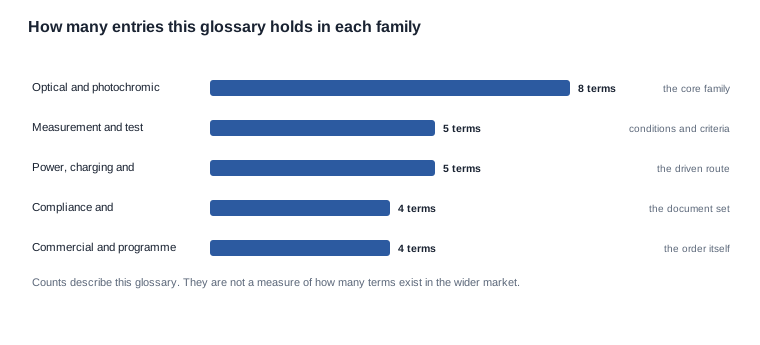
Every entry below is written the way a glossary is useful to a buyer: what the term denotes, why the distinction changes the order, and what to ask to close it. The terms are grouped into five families, and the families are not decorative — each one lands in a different document, which is the fastest way to find out whether a word belongs in your specification or in your sales copy. We publish the rows we hold for our own products and mark the rest as unpublished, so this glossary also records which terms have no answer in the catalogue today and therefore have to be settled by the buyer. Twenty-six terms are covered; the counts in the chart below describe this glossary rather than the wider market.
Photochromic: using this glossary in a specification
The useful way to use a glossary is not to read it once but to use it as a checklist against a document you have already received. Take the supplier's specification or their product sheet and go through it term by term. Every term that appears without a condition, a method, a unit or an identifier is a term that has been used as a marketing word rather than as a specification, and every one of those is a place where the final programme cost can appear.
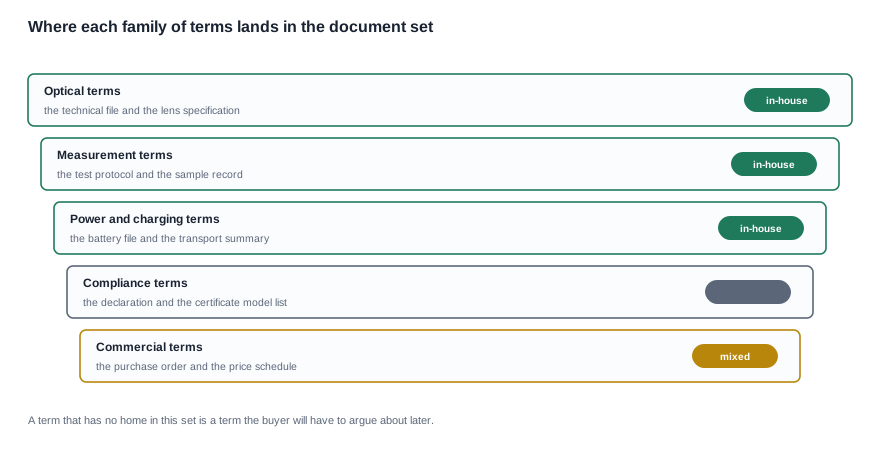
There are five families here, and each one ends up in a different part of the file:
- Optical and photochromic terms land in the technical file and in the lens specification.
- Measurement and test terms land in the test protocol and in the sample record.
- Power, charging and enclosure terms land in the battery file and in the transport summary.
- Compliance and documentation terms land in the declaration of conformity and in the certificate model list.
- Commercial and programme terms land in the purchase order and in the price schedule.
A specification that uses the right word in the wrong place is a common and expensive error. A transmission figure written into the sales copy instead of into the acceptance criteria is a claim rather than a criterion, and a claim is settled by a customer's objection rather than by your own process.
Two further uses are worth naming, because they turn the glossary from a reference into a working instrument. The first is as a cross-check on a document you have not written yourself: take any specification in this category, find the terms it uses, and check whether each one appears in the family where it belongs. A term that has migrated from the measurement family into the commercial family — a switching time quoted as a price justification, a configuration treated as a colour — is a term that has lost its condition, and that is where commercial disputes start.
The second is as a way to split a supplier conversation. Each entry ends with a question, and the questions are ordered so that the mechanism question comes before the evidence question and the evidence question comes before the programme question. Asking them out of order produces answers that sound complete and settle nothing, because the programme question has no meaning until the evidence question has been answered.

Optical and photochromic entries
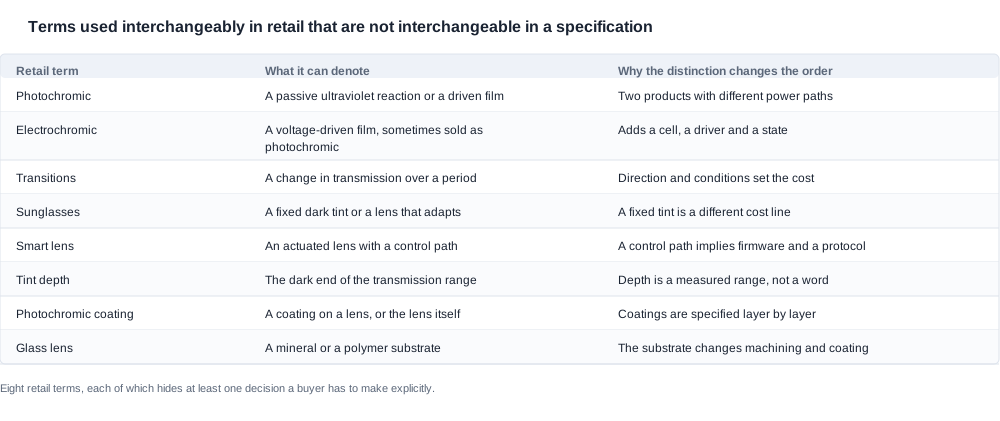
Photochromic
A lens that changes its light transmission in response to ultraviolet in the incoming light, without an applied voltage. In retail the term is used loosely for any reactive or any driven lens. For a buyer: it decides whether the product has a power path at all, and therefore whether a cell, a driver, a firmware function and a battery transport file are in scope. Ask: is the change driven by ultraviolet in the light, or by an applied voltage, and what is the power path in the second case?
Electrochromic
A lens whose transmission is changed by an applied voltage, and which can therefore be set to a chosen state and hold it. Our catalogue describes the dedicated colour-change entry as electrochromic. For a buyer: it is a different product from a passive lens, not a variant of it, and it introduces a commanded-state specification that a reactive lens does not have. Ask: what states are reachable, what tolerance applies to each, and how long does the lens take to reach a commanded state?
Reactive element
The part of the lens that actually changes state — the chemistry that responds, whether a dopant in a substrate or a film between layers. For a buyer: it is the item that carries the performance figures, and it is usually supplied rather than manufactured in-house, which is why the performance evidence comes from someone else. Ask: who supplies the element, and on what published specification does the quoted performance rest?
Substrate
The body the reactive element is carried on, either a mineral glass or a polymer. For a buyer: the substrate determines how the lens is worked, which coating systems can be applied to it, what tooling a shape change triggers and what tolerance is available on the seating face. Ask: mineral or polymer, and which coating system is specified for it?
Coating stack
The set of surface layers applied to the lens — typically an anti-reflective layer, a scratch-resistant layer and, in some designs, the tint layer itself. For a buyer: the stack is a specification and a cost line, and two quotations for the same platform differ here more often than anywhere else. Ask: which layers, at what durability grade, and what changes in price and in lead time if the grade changes?
Clear state and dark state
The two endpoints of the transmission range a lens covers: the highest light transmission it reaches in low light, and the lowest it reaches at full reaction. For a buyer: the pair is the product; a figure for one end alone is half the range, and the half that is usually quoted is the one that looks best in a demonstration. Ask: the transmission at both ends, with the measurement method stated for each.
Transmission and transmittance
The proportion of light passing through the lens, expressed as a percentage. For a buyer: it is a measured quantity with a method attached, and two percentages from different methods are not the same quantity. Ask: which method and which instrument, and is the figure measured on the finished product or on a sample element?
Tint depth and uniformity
Tint depth is how far the lens travels towards its dark end; uniformity is how evenly that darkness is distributed across the lens area. For a buyer: depth decides whether the product can be described as adapting to light at all, and uniformity decides whether a good unit is rejected at first article. Ask: the depth as a range, and the uniformity as a maximum difference between zones on a stated grid.
Measurement and test entries
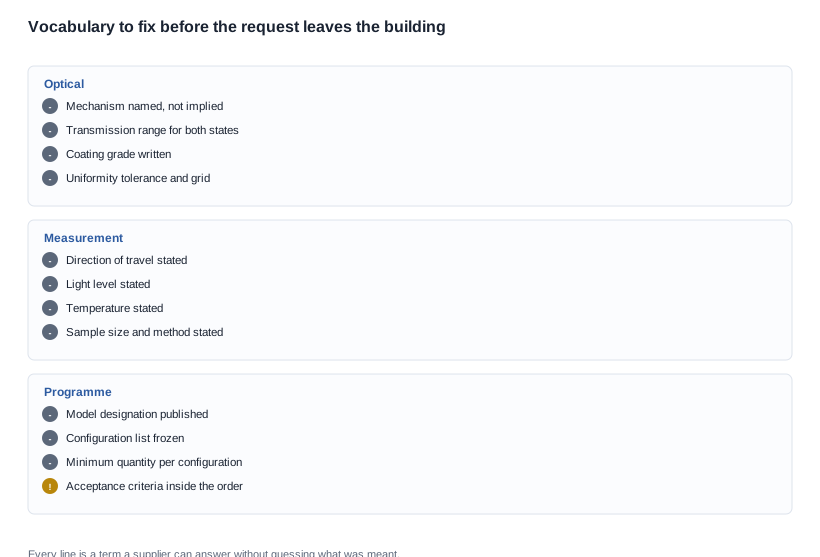
The measurement family is where most specifications fail, and it fails in a specific way: the number is quoted and the condition is not. Every entry in this family describes a quantity that only exists alongside at least one condition — a direction, a level, a temperature, a grid or an end point. A figure that arrives without its condition is not a smaller piece of information; it is a different measurement from the one you would get from another supplier, and comparing the two is meaningless. This family also contains the criteria a warranty is written against, which is why the failure criterion sits here rather than in the commercial section.
Switching time
The time a lens takes to move between two states. For a buyer: it is only meaningful with its conditions, and the two directions are different measurements that are routinely quoted as one number. Ask: two figures, one per direction, each with a light level and a temperature, and whether each is a typical value or a best case.
Direction of travel
Which way the measurement was taken: towards darker, or towards clearer. For a buyer: a product that darkens quickly and clears slowly is a different product from one that does the reverse, and the direction is what tells you which it is. Ask: which direction does each published figure describe, and is there a figure for the other direction?
Light level
The illuminance at which a measurement was taken. For a buyer: a switching time measured under an artificial source is not comparable with one measured under open sky, and the two are frequently mixed in the same document. Ask: the level in the same units across every figure you are comparing.
Uniformity tolerance
The maximum permitted difference in transmission between zones of the lens, measured on a stated grid. For a buyer: without a grid, two people can measure the same unit two ways and argue indefinitely; a tolerance agreed after the first complaint is a tolerance that has already been missed. Ask: the tolerance, the grid, and the number of reading points per zone.
Cycle life and failure criterion
The number of state transitions a lens survives, together with the condition that defines failure — normally a transmission floor. For a buyer: a cycle count without an end point is a quantity, and it converts a warranty from a period of time into a state of the product. Ask: the cycle count, the transmission floor that defines failure, and the test conditions in between.
Power, charging and enclosure entries
The power family exists because of the two routes in this category. A passive lens has no power path at all, and every term in this family is irrelevant to it. A driven lens has a complete one: a cell, a charging interface, an enclosure, and the state that the electronics hold. The terms in this family are where the difference between the two routes becomes visible in the bill of materials, in the transport file and in the aftersales process. They also carry the failure modes that generate field reports — a contact fault reported as a battery fault, a unit that has been stored empty, a state that survives a power cycle when the specification assumed it would not.
State
A specific condition a driven lens is holding, such as a clear state or a set tint. For a buyer: the state is what a channel actually operates — set it, work in it, change it — and it is the unit in which a driven lens specification is written rather than a reaction time. Ask: how many states are reachable, how they are commanded, and whether the state survives a power cycle.
Flat battery behaviour
What the lens does when the cell is empty: holds its last state, returns to clear, or becomes opaque. For a buyer: on a driven route this is a product behaviour and a support script line, and it has to be specified rather than discovered by a customer in a vehicle. Ask: the behaviour at a flat battery, written down and applied to every unit in the lot.
Magnetic charging
A charging interface in which the unit attaches to a cradle by magnetic alignment rather than a plug. The dedicated colour-change entry in our catalogue charges magnetically, with a 100 mAh cell, charging in two hours or less and a rated runtime of about seven hours. For a buyer: the interface determines the accessory line, the spare pool and the contact faults that will be reported as battery faults. Ask: which cradle, which cell, and what the contact arrangement is.
Charging case
A powered case that charges units away from a mains supply. For a buyer: it adds a cell, a packaging requirement and a transport obligation, and it creates a second item that needs stocking, spares and end-of-life handling. Ask: the case capacity, whether the case is supplied, and how the case is treated for transport.
Ingress rating
The declared resistance of the product's enclosure to dust and water, written as a two-digit code such as IP54. In our catalogue the IP54 marking appears on two models only, V06 and S7. For a buyer: the rating belongs to a specific model and a specific configuration, and a rating cannot be transferred between products or inherited by a variant. Ask: the rating for the exact model designation you are ordering, and which test it came from.

Compliance and documentation entries
The compliance family describes the position a product occupies in a market, and it is the family that most often surprises a first-time buyer. The rules that apply to a product do not attach to a category; they attach to a specific product in a specific configuration, described in a specific document set. A colour-change lens is precisely the kind of change that reopens that set, because it changes the optical description of the product, and where the product also carries a camera it changes the imaging description as well. The terms below are the vocabulary for asking whether the documents you have been shown actually cover the product you are buying.
Model designation
The formal identifier for a product, used on certificates, packaging, customs descriptions and technical files. For a buyer: a product without one cannot be correctly documented, and the dedicated colour-change entry in our catalogue publishes no model designation at all. Ask: the designation written on the quotation, character by character, before the deposit.
Certificate model list
The set of models named on a certificate. For a buyer: a family-level document does not cover a branded configuration, and the check that catches a substitution is comparing the model string on the units against the list. Ask: the model list per certificate, per configuration, with the issuing body and the validity dates.
Declaration of conformity
The document in which a manufacturer states how a product meets the applicable requirements of a market's rules. For a buyer: it describes the product as it was assessed, so a configuration change means the declaration has to be revisited rather than carried over. Ask: which declaration covers the exact configuration, and what the supplier's position is on re-issue after a change.
Technical file
The retained body of evidence behind a product's conformity position: design records, test results, risk assessment and the specification the product was built to. For a buyer: it is what an authority or a distributor asks for, and its value to a buyer is that it shows what the product actually is. Ask: where the file is kept, in what language, and for how long it will be retained.
Commercial and programme entries
The commercial family is the vocabulary for the part of the purchase that is decided after the product is chosen. Two figures matter more than the unit price: the configuration count, because it multiplies everything that is priced per configuration rather than per unit, and the minimum order quantity attached to each configuration, because it decides whether each of them is viable. The remaining terms describe how a supplier's own commercial structure is read — the tier structure, which shows how much of the programme depends on reaching a volume, and the landed cost, which is the only figure that lets two quotations be compared at all.
Configuration
A specific combination of a platform with its options, each of which is treated as a distinct product for documentation, artwork, labelling and minimum quantity purposes. For a buyer: a colour-change lens on a platform with three published colour options is three configurations, not one product with a swatch. Ask: the full configuration list, and the minimum order quantity attached to each one.
Minimum order quantity per configuration
The smallest quantity the supplier will build for one configuration. For a buyer: this is the figure that decides whether a configuration is viable, and it moves when a committed configuration count is offered instead of a committed unit count. Ask: the minimum per configuration, and whether it differs for a configuration carrying a lens.
Price tier
A volume band at which a supplier's unit price changes. For a buyer: the tier structure tells you how much of the programme economics depend on you reaching a volume, and a steep structure is a warning about under-ordering rather than a discount to be won. Ask: the unit price at each tier, with the volume boundary stated.
Landed cost
The unit price plus freight, duty, packaging, the per-configuration documentation charge amortised across units and any test or sample costs. For a buyer: it is the only figure that compares two quotations, because the lens distorts the non-unit components more than it distorts the unit price itself. Ask: the quotation broken into unit, configuration, setup and logistics lines.
It is worth being precise: we publish the rows we hold and mark the rest as open. For the camera platform with the colour-change lens configuration we publish the sensor class, the rated runtime, the charging interface, the cell capacity, the charging time, the temple design and the published colour options. For the dedicated colour-change entry we publish the lens technology, the Bluetooth version, the cell capacity, the charging time, the rated runtime, the charging interface, and the absence of a model designation. We do not publish switching times, transmission ranges, uniformity tolerances, cycle life figures, coating specifications or lens model designations for any model, because those are the rows a buyer has to write and a supplier has to confirm, and a plausible figure in a catalogue becomes a claim somebody else will have to defend.
Two places to take the terms in this glossary once you have fixed them: the photochromic smart glasses product entry, where the terms appear in the form the channel will see them, and the photochromic lens technology background page, where the mechanism behind the optical family is set out.
If you are building a specification from this glossary, send us the terms you have already fixed and the ones still open, and we will tell you which of them we can answer from published rows and which have to be written into your acceptance criteria.


