

CE marking on a product is the end of a process, not the process itself — and understanding what the mark is attesting to changes how you read the documentation behind it. The Radio Equipment Directive governs radio equipment; the CE mark on a Bluetooth device says that the manufacturer declares conformity with that directive's essential requirements, supported by a technical file, and has completed the applicable conformity procedure. It does not say the product is safe, good, or tested to any particular standard beyond the essential requirements, and it says nothing at all about product safety, chemical content or traceability.
The two things that most often go wrong in this category are both about scope rather than about paperwork. The first is the directive number: the Radio Equipment Directive is (EU) 2014/53/EU, and the electromagnetic compatibility directive is (EU) 2014/32/EU, and a file that quotes the second when it means the first has been written against a different instrument. The second is the assumption that a mark on a unit means somebody checked it. In the common case, nobody did: the mark is the manufacturer's own declaration, and the proof is a document the buyer has to ask for.
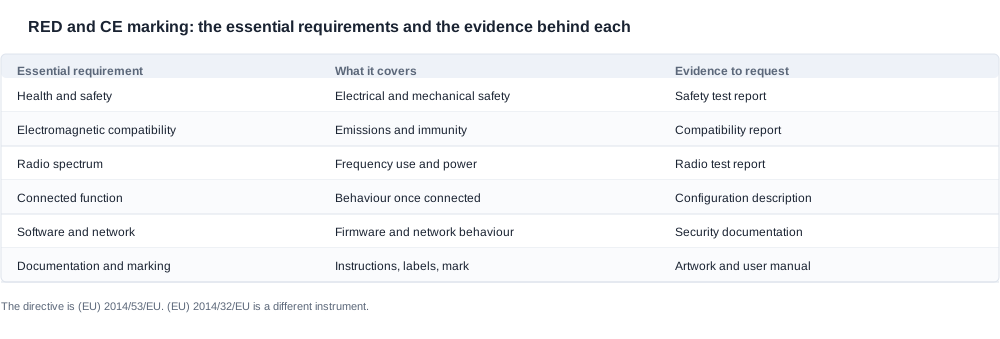
RED directive and CE marking: what the mark actually attests
Three conclusions for a European radio launch
Three conclusions will make the rest of this subject straightforward. First, the mark attests to the radio directive's essential requirements and nothing else, so a file that covers the radio, the chemicals and the product safety does not become redundant because the unit carries a mark. Second, in the common case the mark is a self-declaration, so the evidence exists because a manufacturer wrote it, not because a third party verified it, and the buyer's job is to establish whether the document describes the unit in the carton. Third, the declaration and the technical file are the mark's real content, and the question to ask a supplier is always the same one: does this document name the model and the configuration you are ordering.
The practical instruction follows: before comparing two quotations on a European radio product, establish whether each file is a self-declaration or involves a notified body, and establish which configuration each file covers. A self-declaration for a different antenna is not a comparable offer, and a notified body file is not a comparable offer either, because it carries a review cost and a timetable that the self-declaration does not.
The reader of a declaration, and the schedule behind it
The reader is a brand-side compliance lead, a procurement manager or an importer who is placing a radio product on a European market and has to assemble a file that a customer, a marketplace or a market surveillance authority may ask to see. Some of them are opening a new programme and need to know what to put into the specification, because the answer changes whether the quotation includes an assessment cost. Others already have product in the channel and need to reconstruct the file for a model that was bought from a factory which has since changed.
What such a reader is managing is not a fine. It is the gap between a file that exists and a file that describes the goods. In radio equipment that gap is unusually easy to create, because the antenna, the firmware and the transmit power are all engineering decisions that are routinely changed after the file is written and are rarely treated as changes to a compliance document.
The second thing being managed is the schedule. A notified body route has a review queue in it, and the queue does not move because a launch is approaching. A buyer who discovers the notified body requirement in week twelve of a programme has made a structural error, not a paperwork one.
The directive number, and the one it is confused with
The Radio Equipment Directive is (EU) 2014/53/EU. It is a separate instrument from the electromagnetic compatibility directive (EU) 2014/32/EU, and the two are routinely quoted in each other's place. The distinction is not pedantic, because the two instruments carry different essential requirements and different procedures: the radio directive adds the spectrum requirement to the health and safety and electromagnetic compatibility requirements, and it is the radio directive that carries the additional connected-device requirements.
There is a second source of confusion in this family, which is the relationship between the directive and the standards used against it. The essential requirements are written in the directive; the harmonised standards are the means of demonstrating conformity with them, and the standards are versioned and change. A file that lists a standard without its version is not usable, because a reader cannot tell whether the demonstration was made against the current text of that standard or a superseded one.
The third confusion is between the directive and the mark. The directive is what is being attested to; the mark is how the attestation is communicated. They are related, but a buyer who asks "is it CE marked" has asked a question about the communication rather than about the attestation, and the useful question is always about the declaration and the technical file.
The evidence lines, and what an unverified answer looks like
The evidence behind a mark is what a buyer actually holds, and the table below sets that evidence out line by line. Each row states how it is measured, the line it has to meet and the shape a weak answer takes, in a form that can be sent to a supplier unchanged. The last column is where a radio file usually fails, because the difference between a declaration that names the model and one that names a family is invisible until a customer asks which unit they received.
| Line to test | How it is measured | The line it has to meet | How a weak answer shows up |
|---|---|---|---|
| Directive cited on the declaration | Read the instrument quoted on the declaration. | It is (EU) 2014/53/EU for radio equipment. | The electromagnetic compatibility directive quoted in its place. |
| Declaration names the model | Compare the model on the declaration with the model in the order. | The designation matches, including the variant. | A family name covering several hardware variants. |
| Configuration described | Read the antenna, the chipset and the firmware branch in the file. | The description matches the shipped configuration. | A file describing a reference design. |
| Standards and versions | Read each standard and the version used in the demonstration. | Each standard is named with its version. | A list of standards without versions. |
| Conformity route | Establish whether the route is internal control or third-party examination. | The route is stated and the evidence matches it. | A file with no route stated at all. |
| Notified body involvement | Look for the body identifier on the marked unit. | Any body involved is identifiable and named in the file. | A body identifier on the unit that the file does not mention. |
| Essential requirements covered | Map the file against each essential requirement in turn. | Every requirement has evidence against it. | A radio report treated as a complete file. |
| Connected function evidence | Ask whether a connected or body-worn function is covered. | The additional connected-device requirement is addressed. | An older file in which the requirement is absent. |
| Declaration accompanies the unit | Ask for the declaration to ship with the product. | A copy is supplied with the first delivery. | A declaration that exists only in the factory's archive. |
| Technical file retention | Ask how long the documentation is kept and by whom. | The retention period is stated and the owner named. | A file held on one person's machine. |
| Instructions and warnings | Read the instructions for the market they ship into. | The required statements are present and in the right language. | A single instruction set for several markets. |
| Change control | Ask what change forces the file to be revisited. | A written trigger covers the radio, the firmware and the antenna. | An assurance that changes are immaterial. |
Two rows in that list are routinely compared as though they were the same thing, and the comparison produces a false result. A declaration that names the model is not comparable with a technical file that describes the configuration, because the first is a statement and the second is the evidence. And a file built on harmonised standards is not comparable with a file built on other methods, because the two take different routes to the same declaration and carry different review effort.


The assessment route behind the mark, and who actually signs it
The route from specification to a marked unit
The sequence below is the order in which the work genuinely happens, and it is worth writing into the programme because it shows where a buyer can influence the cost and where they cannot.
-
Fix the configuration, so that the file has a subject.
-
Establish the standards applied and the route that follows from them.
-
Decide the assessment route and whether a notified body is involved.
-
Assemble the technical documentation for that configuration.
-
Issue the declaration of conformity naming the model and the standards used.
-
Affix the mark, supply the declaration, and check the instructions for the market.
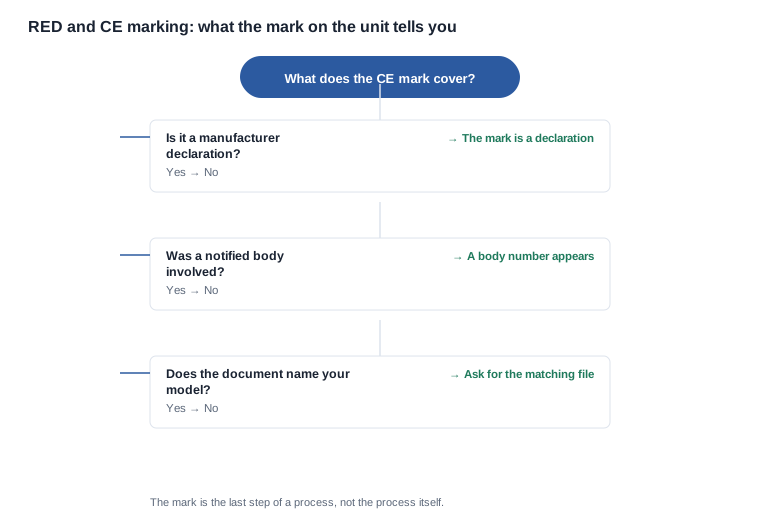
The two routes are worth distinguishing in commercial terms. The internal production control route is the default for radio equipment where harmonised standards are applied in full, and it places the whole burden on the manufacturer. The third-party route exists for cases where harmonised standards are not applied or not applied in full, and it adds a review, a queue and a document from the body. A buyer who knows which route the product will take can price it and schedule it; a buyer who discovers it later can do neither.
What the mark itself adds is communication rather than assurance. In the internal control route there is no body identifier on the unit. In the third-party route there is one, and it is the fastest way to tell the two apart from the packaging alone.

The file that sits underneath the mark, and how to request it
What to request under the mark
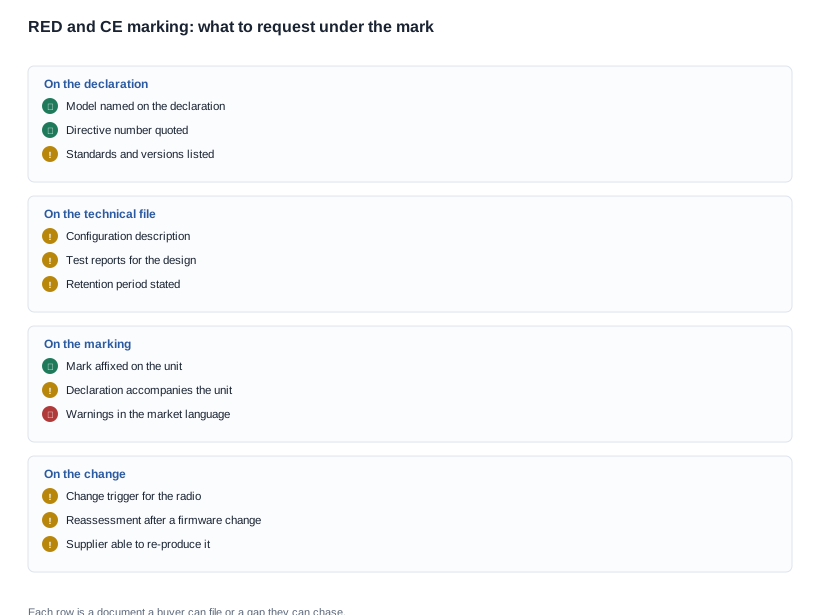
The request list is deliberately short and deliberately ordered by how quickly each item fails. The declaration is fast and it fails often, because a declaration for the wrong model is common. The technical file is slower and it is the document that settles the question. The marking and the instructions are checked on a physical unit, which is where a mismatch between the file and the goods finally shows itself.
The item that is most often skipped is the retention question. A radio file is normally retained for a defined period — ten years after the product was placed on the market is the expectation the directive sets — and the period matters commercially because it is the period during which a buyer, a customer or an authority may ask for it. A factory that has not kept the file for that period cannot produce it later, and the buyer who discovers that afterwards has no remedy.

What the mark leaves out, and what it does not replace
Four ways the mark and the file come apart
The mark on the unit, the file for another variant. The product family shares a housing, and the file covers the first variant while the second ships. The symptom is a customer asking why their units do not match the declaration. The cause is a model designation written at family level. The prevention is to name the variant on the declaration and to check the identifier on a production unit against it.
The firmware that changed after the file was written. A radio product's firmware is revised, and the revision touches behaviour rather than the radio, so nobody treats it as a compliance change. The symptom is a question about whether the shipped software is the assessed software. The cause is a release process that does not know a compliance boundary exists. The prevention is a release-note line and a written trigger.
The connected function that the file predates. Additional requirements for connected and body-worn radio equipment came into the directive after a long period of practical application, and an older file may simply not address them. The symptom is a gap in the file that nobody noticed because the older file passed every check it was given. The prevention is to ask when the file was assembled and whether the requirement set has moved since.
The market that took the file. The declaration and the instructions are written for one market and shipped into several. The symptom is a finding about the language of the safety information rather than about the radio. The cause is a file treated as global. The prevention is to keep the market on the document and the document on the market.
Files written for one market and shipped into several are not global files. They are reasons to read the file against the unit rather than against the brochure.
The movable parts of a radio file, and the parts that are fixed
The commercial conversation in this category divides into two clean groups. What can be negotiated is everything upstream of the assessment: the chipset, the antenna, the transmit power configuration, the firmware branch that will be frozen, the model designation, the colour and variant range, and the market set the file covers. Each of those is a design or commercial decision with a regulatory consequence, and each is worth deciding early.
What cannot be negotiated is the assessment itself, the review where a notified body is involved, and the time both take against a directive that moves underneath them. A supplier who offers to compress the assessment by reducing the configuration is offering something that does not exist.
The scope question is where the buyer has leverage, and it is the part of the negotiating position worth preparing before the quotation arrives. A supplier who has already assessed a chipset and an antenna will quote the incremental cost of a regional or a connected variant far more cheaply than a first assessment, because the expensive part is the characterisation. The trade-offs are worth writing down, because a buyer who has not named the variant list will find that each one is priced as a first assessment. A buyer who fixes the variant list before the quotation gets that price; a buyer who decides variants one at a time pays the characterisation repeatedly.
The total cost of this category is driven by the number of radio configurations a buyer creates and the number of markets the file has to cover, and by how often the file is reopened after a change. That is a planning decision, and it belongs at the specification stage.
A European radio launch worked through, and the limit of our catalogue
A European radio launch, step by step
The scenario set out below is an invented one, used to show the reasoning rather than to describe a programme that took place. No client is described and no figures are claimed; the model, the quantity and the markets are assumed.
The scenario. A buyer is placing a camera-equipped smart glasses product on two European markets, with a further market planned, and the channel customer requires the file before listing.
Step one, the configuration. The buyer freezes the configuration that will ship: the radio module, the antenna and the firmware branch. The catalogue publishes a Bluetooth version for fourteen models and none for the eleven camera models, so for a camera model the radio position is established through a request rather than read off the specification sheet, and it is written into the order as a controlled item.
Step two, the route. The buyer establishes whether the product will be assessed with harmonised standards applied in full, which determines whether a notified body is involved. That answer is obtained before the quotation is signed, because it changes both the cost and the timetable.
Step three, the request. The request goes out asking for the declaration and the technical documentation for that configuration. A supplier who returns a declaration naming a different variant does not move forward, and is asked again in a form that requires the configuration to be named.
Step four, the comparison. The two quotations are compared on scope rather than on unit price: which configuration each covers, how many markets, whether the additional connected-device requirement is addressed, and what happens to the file if the firmware branch moves.
Step five, the unit. On the first delivered units, the buyer checks the mark and any body identifier against the file, and confirms that the declaration naming the model is supplied with the delivery.
The electrical rows we publish, and the conformity we do not
A CE mark on a unit is not a document, and we would rather explain what stands behind it than claim it. The catalogue publishes the electrical rows: cell capacity, charging time, rated runtime, charging method, the Bluetooth version for the fourteen models that carry one, the pixel class, the IP54 marking on the V06 and the S7, and the 158 g weight of the MT6 glasses body with its 1200 mAh folding charging case. It publishes no declaration of conformity, no technical file, no test report and no certification status, because the catalogue text carries no reference to CE or to the Radio Equipment Directive and the export certification page it does carry is a company-level page of images. What we can confirm for a specific model is the radio configuration and the protocol features the product uses, which is what tells you what a file would have to cover.
We publish no CE mark statement, no declaration of conformity, no technical file and no test report, because the catalogue text contains no reference to CE, to the Radio Equipment Directive, to FCC, to RoHS or to REACH, and the export certification page it carries is a company-level page the page holding images rather than text — ten patent certificates, eight appearance-design patents and two utility-model patents. A company-level page cannot be read across to a per-model conclusion about conformity.
What we can do for a specific model is confirm the radio configuration and the protocol features the product uses, so that a buyer can establish what a file would have to cover, and tell them plainly which published rows exist and which do not. On the eleven camera models, where no Bluetooth version is published at all, even the protocol position is a request rather than a reference. We would rather say that than produce a plausible paragraph.
The request to send this week
If you are working on this now, the next step is short and specific. Send the model, the configuration, the antenna, the firmware branch and the target markets, and ask for the declaration and the technical documentation for that configuration rather than for the range. We will tell you which published rows exist for the model and where the file has to come from.
The RED directive and CE marking pillar holds the requirement set, the certification checklist page holds the wider set, the FCC compliance page covers the parallel route in the United States, and smart glasses GPSR and the other rules covers what this regime does not reach.
Send the model and the configuration, and we will tell you what our catalogue settles and what the declaration has to cover.


