

A selection question has a mechanical shape, whatever the product is. It names a use, it names the candidates, and it needs one value on that use for each candidate — comparable values, from the same source, under the same conditions. Only then can a buyer say that one model is the right one for a particular job.
The S7 publishes a charge time of two hours or less, magnetic charging, a 260 mAh cell, an endurance figure of five to eight hours and a 13-megapixel camera, and its feature line reads ergonomic design, 13-megapixel imaging, a detachable inner frame and an IP54 marking. It does not publish a colour row, a charging-case row, a weight, a dimension, a Bluetooth version or a camera specification. There is no independent product page for it either — one product image on the model page, no demonstration video, and no detection report supplied with the record.
Those rows are enough to describe the model and not enough to rank it. That is the honest shape of a best-for question, and this page does something more useful than pretend otherwise: it separates the part of the answer that the catalogue can support from the part that only a measurement, a document and a decision can supply.
Why a best-for answer needs a comparable quantity, and this catalogue publishes none
Start with the mechanics, because a selection answer usually fails at the first step rather than the last. A buyer who asks which model is best for a use has, in effect, nominated a dimension — endurance, ingress, image quality, size range, channel alignment — and asked for a value on that dimension for every candidate. Three conditions have to hold at once: the values must be on the same dimension, they must be measured the same way, and they must come from a source the buyer can check. A value that fails any one of them cannot be ranked, however good it appears.
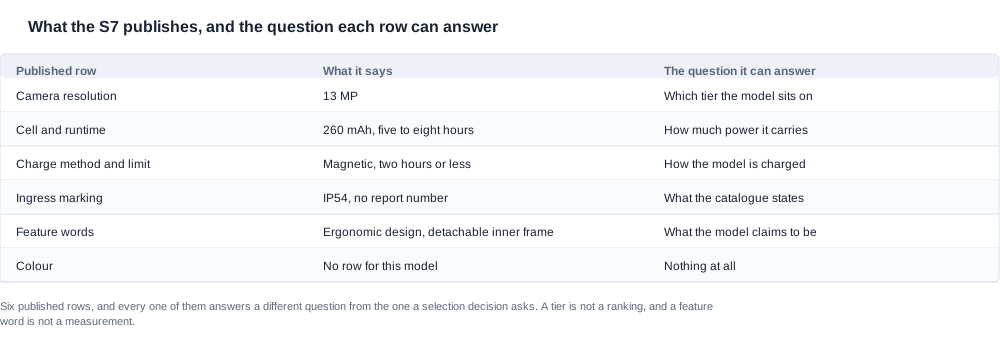
What the catalogue publishes for this model answers different questions from the one a ranking asks. The figure above lays out the six published rows against the question each of them can actually answer. A resolution figure tells you which tier the model sits on; it does not tell you whether the image is good, because no sensor model, field of view, video mode, frame rate or storage arrangement is published for it. A capacity and a runtime bracket tell you how much power the model carries; they do not tell you how long it runs in your customer's use, because no endurance condition accompanies them. A charge method and a ceiling tell you how the model is charged; they do not tell you how long a charge takes, because the starting point of the measurement is not published. An ingress marking tells you what the catalogue states; it does not tell you what has been tested. A feature line tells you what the model claims to be; it is not a measurement, and four-character phrases cannot be ordered against a number. And a missing row tells you nothing at all.
Two of those rows are worth pulling out, because a buyer will otherwise treat them as separators.
The 13-megapixel figure is a tier with three members, not a position. Three models in this catalogue publish 13 MP, and the number says nothing about how any of them performs — it is a still-image resolution with no sensor, no pixel size and no light-gathering information behind it. A tier label separates a product from other tiers, not from its own peers, and the interesting comparison for a buyer is almost always between peers.
The IP54 marking appears on two pages of the whole catalogue. Those two are this model and its sibling in the same sport family, which means the marking is not a separator between them: it is a gap the two of them share. A shared gap is a good reason to ask for a report, and a bad reason to choose one model over the other.
What a buyer can legitimately conclude today is narrower than it looks. The tier this model sits on, the positioning the company states for it, the fact that it shares its ingress gap with one other model in the family, and the list of rows that do not exist for it — that is a complete and useful description of where the product stands in the documentation. What it is not is a reason to prefer this model to another. Those are two different statements, and a listing that runs them together is making an argument the paperwork does not support.
So the answer to a best-for question cannot be assembled from published values, because the published values are either identical across the candidates, or attached to no condition, or not measurements at all. That is not a criticism of the catalogue. It is a statement of what a catalogue is, and it is the reason the question has to be answered somewhere else: on a sheet, with documents behind it, before the artwork is printed.
What the record says about who this model is for, and why it cannot rank two models
The product record does answer a version of the question, and a buyer should know exactly which version it answers.
For this model, the record lists the intended uses as outdoor riding, running and hiking, hands-free capture and calls in motion, and sport livestreaming. It lists the intended customers as sport brands, sellers in the riding and running categories, outdoor-equipment channels and marketplace sellers, with sport and outdoor, riding and outdoor equipment as the intended industries. It names the problem the model is meant to solve: holding a device while moving is unsafe, ordinary glasses do not block sweat or rain, and a shot cannot be taken quickly with a phone in your hand.
That is a genuine answer to who would ask about this model, and it belongs in a listing as positioning rather than as a specification. It is also, on its own, not a selection answer — and the reason is visible one row over in the record.
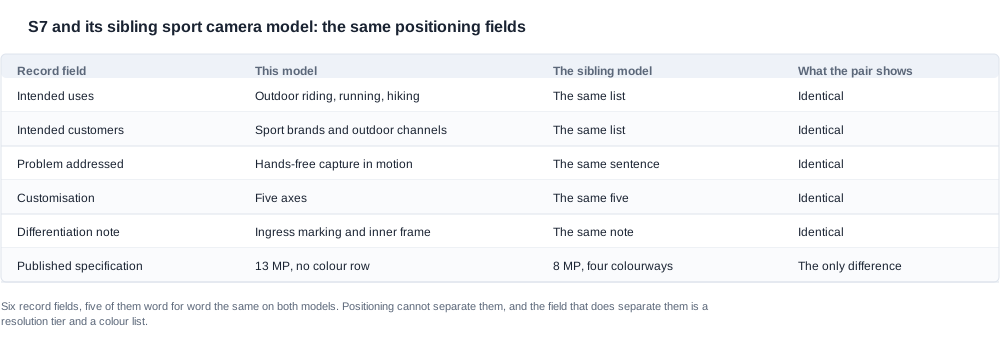
The sibling model in the same sport family carries the same positioning, word for word. The intended uses, the intended customers, the intended industries, the problem it is meant to solve, the customisation position and the differentiation note are the same text in both rows. A buyer comparing these two models is therefore comparing a positioning sentence with itself, and any conclusion drawn from those fields is a conclusion about the family, not about either model.
The fields that do separate them are two, and neither is one a customer would choose on. The published specification differs — 13 MP against 8 MP, and a colour row on one page where the other page has none. The optional-configuration field differs for the same reason, because the catalogue lists four colourways for the sibling and no colour row at all for this model. A resolution tier and a colour list are what is left when the positioning has been removed, and a selection decision cannot be built on them.
Two details in that comparison are worth a buyer's attention before they reach for either field.
The record's own note about the differentiation of this model names the sibling's four colours. The S7 page in the catalogue has no colour row, so a colour cannot be promised for it; the note belongs to a different model. It is an easy error to make when several rows of one record are read together, and the rule that avoids it is simple: the model page is the source, and a parameter that is not on the page is a question rather than a specification.
The sibling's feature line carries a four-character phrase about endurance that this model's does not. Underneath that phrase, the two models publish the same cell, the same runtime bracket, the same charge method and the same charge ceiling. A marketing phrase sitting above an identical published number is not a comparison either, and asking what the phrase is measured against is a better question than repeating it.
The dimension itself usually comes from the customer, not from the catalogue. A buyer who arrives with a use in mind — a particular kind of outdoor session, a channel that has to sell a finished product in a particular market — already holds the dimension that matters, and the catalogue is the place to check whether the model publishes anything on it. If the catalogue publishes nothing on that dimension, then the dimension is not a comparison against another model; it is a specification to be written. A shortlist built on the customer's own dimension, with the published rows checked against it, is the version of this exercise that survives a question from a channel partner.
The the charging and battery rows of both models sets the two published sides by side, and the S7 published specification list is the baseline for this model's own rows.

The three proofs a selection answer has to stand on
If the catalogue cannot rank, three quantities can — and each one has to be evidenced before it can carry a sentence on a listing. They are the picture, the ingress and the sizing, and they are the three things this model has to prove.
One: the picture, measured rather than asserted. A 13-megapixel figure is the tier; the picture is a configuration, and the catalogue publishes nothing about the sensor, the field of view, the video resolution, the frame rate, low-light behaviour or where the footage is stored. On a model whose visible difference from its sibling is a resolution number, that is the central gap, and it is closed by a sample and a stated configuration rather than by a table. The question to send is exact: which sensor, which field of view, which video resolution and frame rate, and where the footage is stored. The camera imaging notes cover why the sensor and the field of view settle the picture, and the sample evaluation page covers what a physical unit can and cannot demonstrate. The S7 buyer review checklist turns the same set of rows into a review sheet with owners and tolerances.
Two: the ingress, evidenced rather than printed. The model page carries an IP54 marking and the record states that there is no third-party test report number behind it, and that an IP rating needs a detection report before it can be claimed externally. Read the two digits in order and they carry two meanings: the first one is about solid foreign objects, where 5 allows a limited amount of dust ingress and does not mean dust-tight, and the second one is about water, where 4 covers splashing from any direction and stops short of immersion, of a shower and of a water jet. Because the marking appears on only two pages of the catalogue, it cannot separate this model from its sibling; it can only be closed, for both of them, with the same four items: the standard, the laboratory, the sample batch, and the model string the report actually names. The IP rating testing notes set out what to ask a laboratory, the IP rating guidance page carries the standard, and the sport water resistance notes cover what a marking means where it does apply.
Three: the sizing, specified rather than implied. The detachable inner frame is four characters on a feature line, and the catalogue publishes no size range, no composition and no purpose for it. That is enough to put the phrase on a page and not enough to call it a sizing system, because a sizing system has to answer a question a customer will ask at the point of sale: which sizes exist, and how is the right one chosen. The questions to send are short — which sizes are available, whether inner frames can be ordered separately as spares, and what the measured weight of a production unit is, since the model page publishes no weight at all. The sport sizing analysis covers how a size matrix for this category gets built from samples.
None of these three proofs asks a supplier to invent a number. Each asks them to state which number they are quoting, under what conditions, in which document, and each ends in something a buyer can keep: a configuration, a report reference, a size range.

How to record a selection answer so it survives a channel question
The three proofs are worth nothing if they are not recorded in a form that still reads three months later, after the supplier contact has changed and the packaging is already printed. The record is a sheet with one row per model per dimension, and it needs six columns.
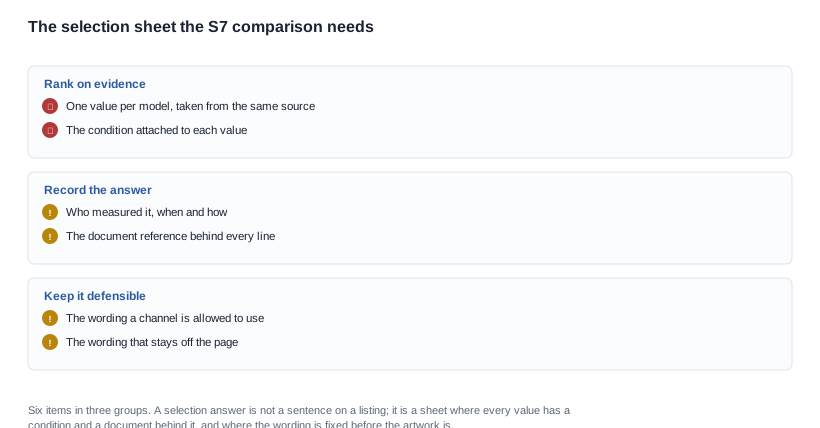
The dimension, named as the customer would state it rather than as a feature name. The published value, so that a later reader can see what the catalogue said at the time. The measured value, with the unit. The condition, which is the column that decides whether the sheet is usable at all: a runtime without a workload, a charge time without a starting point and a resolution without a frame rate are not values, they are gaps with a number attached. The document reference, not a summary of the document — a reference can be checked, a summary cannot. And who measured it, and when, because a measurement without an owner is a rumour with a unit.
Five rules keep the sheet honest, and they are worth writing into the request rather than remembering them afterwards.
One: take both values from the same source, or the comparison is void, however plausible the two numbers appear together. Two: a value without a condition cannot be ranked — publish it as a range with its limits attached, or do not publish it. Three: a feature word cannot be ordered against a number, so a phrase about endurance and a runtime figure are two different things and belong in two different columns. Four: record the reference, not the summary, and put the summary in the wording column where it belongs. Five: fix the wording before the artwork, in two columns: what a channel is permitted to say, and what stays off the page.
One case deserves its own line, because it is the most common outcome and the least discussed. Often the two candidates turn out to be identical on the dimension that actually matters — the same cell, the same charge method, the same ingress marking, the same runtime bracket — and the only difference sits on a row the customer never asked about. In that situation there is no selection to record, and the honest output is an undifferentiated note rather than a preference: the two models are the same product for this customer, and the decision to carry one or both is a range and stocking decision that has nothing to do with the specification. Writing that down is more useful than manufacturing a difference, and it stops a product line from carrying two model numbers that a customer cannot tell apart.
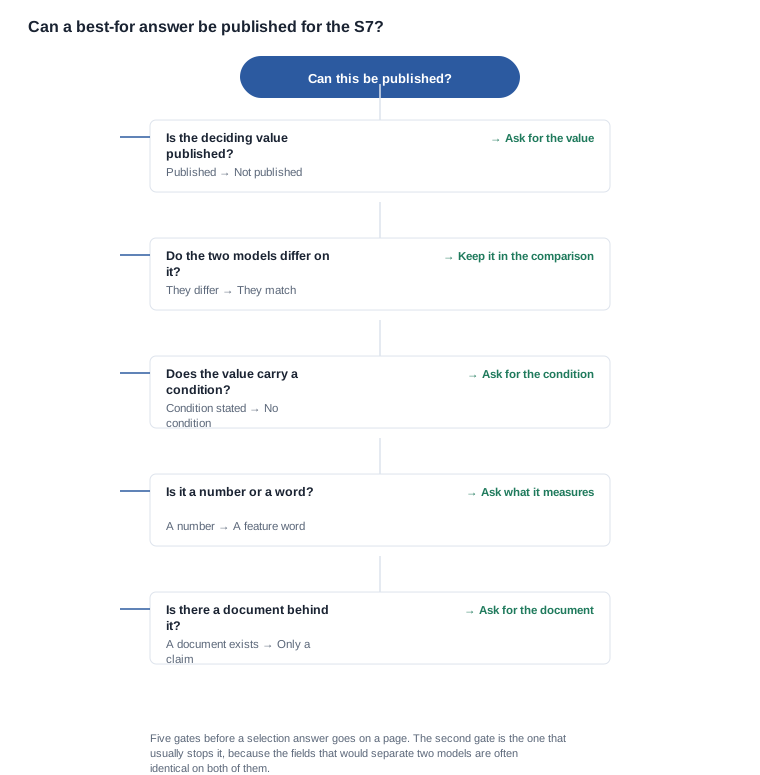
What to ask, as a single message, so that the answers arrive in one place: the camera configuration each model was measured at; the workload behind the endurance figure for each model; the ingress report for the model string that will be printed; the size range and the measured weight; and the document that will be used to check the first delivery against. Questions to ask before the order is placed rather than at the sample stage are worth a great deal more, because at the sample stage the evidence has usually already been spent.
Red flags in the answers are easy to name. A summary where a reference was asked for. A figure that arrives as typical, or as an industry average, or with no unit. A promise to confirm something later, with no date attached. A document that names a family, a platform or a sample batch rather than the model string on the artwork. And a value that is technically different but practically identical, which is the most common way a selection answer ends up meaning nothing.
Before you commit, put the sheet and the three proofs into the agreement, along with the rule that a change of cell, of configuration, of model string or of test laboratory requires notification. Without that clause the sheet describes the goods as they were when it was written, and the first production run is where the difference shows up.
There is a trade-off here, and it belongs to the buyer rather than to the factory. A narrow, fully evidenced answer covers fewer channels and takes longer to produce; a broad one covers more and rests on values nobody can check. The commercial side of the same models is covered in the S7 value analysis and in the V06 value analysis, and the S7 common questions piece works through the same rows from the buyer's side.
What the S7 record supports, and what it will not claim
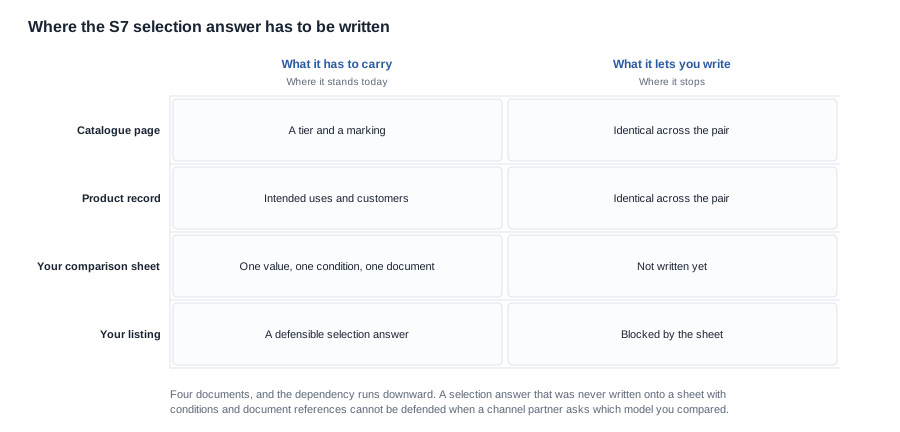
The catalogue page carries a tier and a marking. The product record carries intended uses and intended customers, identical to the sibling model's. Neither of them carries the values a ranking needs, so the dependency runs downward: the comparison sheet holds the measured values, their conditions and their document references, and the listing can only repeat what the sheet supports.
What the documentation supports. The published rows for this model, the positioning the company states for it, the three proofs above, the sheet structure, and the fact that a defensible best-for answer can be built once those three are evidenced — and only then.
What it does not support. There is no published camera configuration, no ingress report, no size range and no measured weight. The record also warns that the printed page numbering for this section disagrees with the printed index, so establish which page your supplier is citing and name that page in the agreement. And a caution about the record's own columns: several of them carry entries that belong to neighbouring models, which is why the model page remains the source for any parameter you intend to publish.
What we will and will not write. We will give you the published rows for this model, the positioning the company states, and the three proofs with the exact questions that close them. We will not name this model as the right one for a use case, because no published value supports a ranking and we will not manufacture one. We will not call the detachable inner frame a sizing system while its sizes are unpublished. We will not print the ingress marking as a tested result, we will not turn an endurance bracket into a working day, and we will not quote a weight, a colour or a certificate number that the documentation does not contain. This model sits in the family covered by sport smart glasses, and the rows above are what its own model page carries.
Give us the two or three models you are actually choosing between, the use each of them has to serve, and the date your packaging has to be ready, and we will tell you which published rows can carry the comparison, which of the three values has to come from a measurement first, and which of the two models is undifferentiated on the record rather than different from it.
Worth reading next
- The rows this model publishes — the S7 specification list
- The two sport camera models side by side — the two-model battery and charging comparison
- Building a size matrix from samples — the sport sizing notes
- What to put to a testing body for the ingress evidence — the IP rating test notes
- Turning the same rows into a review sheet — the S7 buyer review checklist
Give us the models you are choosing between and the use each has to serve, and we will tell you which published rows can carry the comparison and which values have to be measured first.


