

A case study on an AI feature is nearly always unpublishable, because it reports a result without the conditions that produced it. Smart glasses ai features smart glasses case study template is therefore not really a publishing template — it is a way to produce evidence about a capability that cannot be specified in advance. If you have read the rest of our AI coverage, you will already know that our documentation publishes no accuracy figure, no language coverage, no latency and no architecture detail for any of our 28 models, which means no such study exists on our side for you to reproduce.
That absence is the reason this template matters. In most categories, a buyer can write a specification and check the supplier against it. In the AI category, the capability questions — accuracy, language coverage, offline behaviour, latency — cannot be resolved from documentation at all, because in this range there is nothing to read, and the same is broadly true of most suppliers. The sample is therefore the measurement instrument. It is the only device you have that can produce a number specific to your product.

Smart glasses AI features: why studies go unpublishable
The structural problem
A case study is a report of something that happened, and a report is only useful if the reader can tell what happened because of what conditions. Most AI feature studies fail that test in one of three ways.
The conditions are missing. The study reports "92% accuracy on customer queries" with no content set, no language pair, no network condition and no date. That number is not a measurement — it is a number with the referent removed, and it cannot be reproduced by you or by anyone else.
The failures are missing. The study reports what worked. A report of successes is a demonstration, and the failure list is the part with engineering value in it. It is also the part that tells a buyer whether the feature can carry the weight of a marketing claim.
The requirement is missing. The study was run without a written statement of what the feature had to do, so it produces data and no decision. This is the most common failure and the most expensive one, because the buyer ends up comparing the data against an expectation that was never written down and therefore cannot be checked.
Why documentation cannot replace the study
The capability questions in this category are not published. Not by us, and — from what buyers tell us — not by most suppliers either. There is no standard test method for AI accuracy on a wearable, no standard latency measurement condition, and no standard definition of what "offline support" means.
What that means practically is that the sample is the measurement instrument, and it takes about a day of work to produce something defensible. A day is a real cost against a launch schedule, and it is a very small cost against the alternative of discovering the behaviour after the listing is live.
What a template is for
A template in this category is not a document format. It is a protocol, and it exists to make two things true at once: that the result is specific enough to act on, and that somebody else could repeat it.
The six fields below are the minimum for that. Each one closes a specific failure, and a study missing any one of them should not be circulated as evidence — not because it is dishonest, but because it cannot carry a decision.
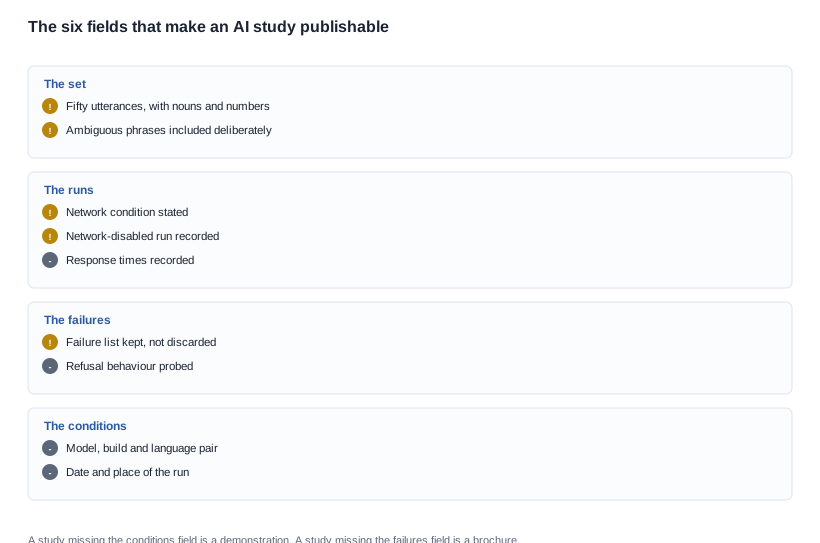

The six fields that make a study reproducible
Field one: the requirement set
A written statement of what the feature must do, written before the first prompt and dated. Not a list of desirable behaviours — a threshold per function, in the terms the channel actually cares about.
For a translation feature in a retail channel, the requirement set might be: the pair must be handled for the languages listed; a spoken request must be transcribed accurately enough to act on; the response must arrive within a stated time on a stated connection; and where the system is unsure it must say so rather than produce a fluent answer.
The requirement set is what turns the study from a description into a decision, and it is the field most often skipped because it feels like paperwork until the day you have to decide whether a result passes.
Field two: the content set
Fifty sentences resembling what your customer will actually say. Include proper nouns, numbers, units, product codes, names that could be two different things, and deliberately ambiguous phrases.
A generic test set produces a generic result that tells you nothing about your product. Thirty easy sentences and twenty hard ones, with the hard ones written to be hard, is a better set than fifty that a demonstration script would also pass.
The set should be written by someone who knows the channel, not by whoever has the most time. A support lead who has read a thousand tickets for your category will write a better content set than an engineer working from a feature list, because they know which phrases actually occur and which ones get misheard.
Field three: the network condition
What the connection was while each run was made. Which is more useful stated as: the condition that is normal for your worst market, not the condition in the supplier's demonstration room.
If your channel includes markets with inconsistent connectivity, then "normal" for the study is a poor connection, and the result will tell you whether the feature is usable there or merely present. This field is the one most often left implicit, and it is the one that most changes the conclusion.
Field four: the network-off run
The field most often omitted, and the one that decides where the product can be used. Turn the network off and enumerate what still works: capture, calls, playback, the assistant, the settings.
If your customer will use this in a warehouse, a basement or abroad on a poor connection, that is the operating condition rather than an edge case. The network-off run is what tells you whether the AI feature can be a dependency or only an enhancement — and therefore whether you can put it on the packaging as the reason to buy the product.
Field five: the failure list
Record the failures specifically, with the input, the output, and why it failed. Not a count — a list.
A count tells you a rate, and a rate without the inputs behind it cannot be acted on. The list tells you which inputs to expect trouble with, and that is what a support script, a training brief and a listing caveat are all written from.
Field six: the conditions, build and place
The model, the firmware build, the date, the place, the language pair, the unit identifier, and the tool used for timing. This is the field that most often gets left off, and it is the one that makes the difference between a study and an anecdote.
Without it, a result cannot be reproduced by you — which means it cannot be reproduced at all, because the units you tested are gone and the firmware has been updated since.
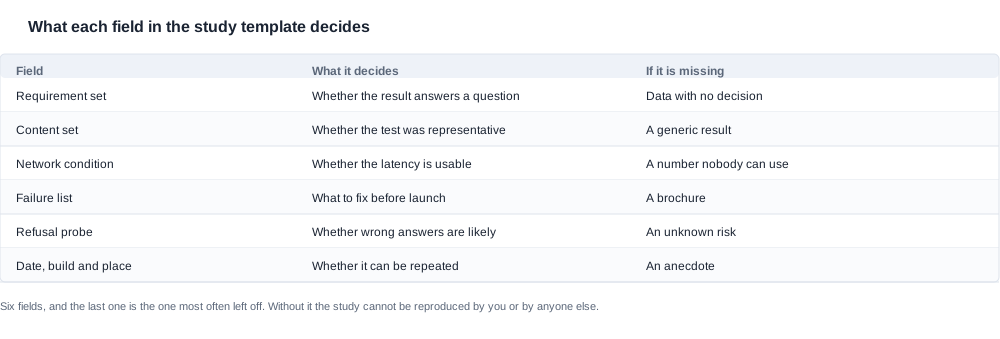

Building the content set that actually tests the feature
A method that produces comparable results
The content set is the part of the template where most of the judgement sits, and it is worth being precise about how to build one that another engineer could use.
Start from real inputs, not plausible ones. The best source is the support tickets, the call transcripts, the query logs or the voice notes your channel already receives. Sample from them, then normalise the personal information out. If the channel is new, the second-best source is the ten questions a salesperson is asked most often, written in the customer's phrasing rather than the product's.
Layer the difficulty deliberately. Divide the fifty into three tiers and keep the count of each in your notes: the requests that a demonstration would pass, the requests with a proper noun, a number or a unit in them, and the requests that are genuinely ambiguous — a name that could be two people, a number with no context, a phrase with two readings. The third tier is where the engineering value is, and it is where a fluent-wrong-answer risk shows up.
Include the negatives deliberately. Every set needs prompts that should be refused or that have no correct answer. A system that returns a confident, fluent nonsense is more damaging than one that returns nothing, and this is invisible in a demonstration because demonstrations are made of prompts that work.
Write the set before the sample arrives, or at least before you have seen it work. A set written after the results describes the product rather than testing it, and the difference is not detectable from the output — it is only detectable by knowing what you intended to include.
Running it and recording what happens
Run each prompt on a sample, in a stated network condition, and record four things per prompt: what was said, what came back, how long it took, and whether the answer was correct, incomplete, wrong or correctly refused.
Time every response against a fixed threshold rather than recording the raw number alone. A raw latency figure with no threshold attached tells you nothing about whether the feature is usable; a threshold makes it a pass or a fail, and a pass or a fail can go into a specification.
Repeat the network-off run against the same set, and record what still answers. Where a prompt in the first set now fails with the network off, that prompt is in your listing's limitation set.
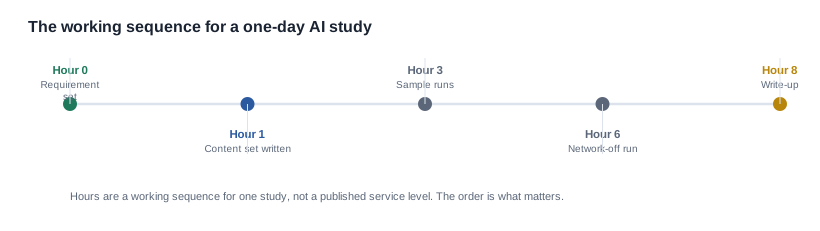
The working sequence below fits comfortably into a day for one product and one feature, and it is deliberately ordered so that the hardest runs happen while the team still has attention.
Three audiences, three versions of the same study
A study usually has to serve three readers, and the mistake is to write one document that tries to serve all three. They need different things, and they need different levels of detail.
The internal team — product, support and marketing — needs the failure list and the limitation set. It needs to know which inputs fail and what the feature does with no connection, because that is what a support script and a training brief are written from. It does not need the raw timings for every prompt; it needs the threshold and whether it was met.
The supplier needs the requirement set, the content set and the failure list, in a form they can act on. It is worth sending the content set itself, because a supplier who can see the exact prompts can reproduce the run and explain the failures, which is faster than trying to describe fifty utterances in an email.
The customer-facing team — the channel, the retail staff, the reseller — needs one page. What the feature does well, what it cannot do, and what to say when a customer asks for something outside it. That page is the last one to write, because it is the one that has to be true, and it becomes true only once the failures are known.
Writing them in that order also stops the study being shaped by the marketing audience. If the listing is written first, the content set tends to be built from the sentences the copy already promises, and the study then confirms the copy rather than testing the product. That is the failure mode this whole template exists to prevent.
Keeping the study useful after the launch
A study is usually most valuable in the months after launch, when the first wave of real queries arrives and the gaps between the test set and reality become visible.
Two habits make that work. Retain the content set and the conditions with the study, rather than only the results, so that a later run is comparable with the first. And schedule a re-run at a defined interval and a defined trigger — after a firmware update, after a change of provider, and before any major campaign that will drive unusual traffic. An AI feature that has changed underneath you since the last study is a feature whose listing may no longer be true, and the cost of noticing that through a study is far lower than the cost of noticing it through a complaint.

Turning a study into a decision rather than a document
Compare against your requirement set, not against another product
If you defined what the feature must do before testing, you now have an answer you can act on. If you did not, you have data and no question. That is the whole reason field one exists, and it is worth restating because it is the point at which most studies go wrong.
Comparing your result against another supplier's result is almost always a mistake in this category, because the two results were produced under different conditions, on different content sets, with different thresholds. You will end up choosing on the number and not on the evidence.
The comparison that works is three-way: your result against your requirement set, your result against the same requirement set for the other suppliers, and the gap between them against what the gap would cost you. The third step is the one buyers skip, and it is the one that turns a test result into a purchasing decision.
Write it up so somebody else could repeat it
That means the content set, the conditions and the method — not the conclusion. A result another engineer cannot reproduce is a claim with a table attached.
The write-up should be short enough that a colleague reads it, and complete enough that a colleague could run it. In practice that means: the requirement set, the content set as the actual fifty prompts, the conditions table, the results table with the failures listed, and a one-paragraph conclusion that states which requirements passed and which did not.
Decide the degradation case from the result
The network-off run is the one that determines whether the feature can be a dependency or only an enhancement. If the degradation is acceptable, the feature carries marketing weight safely. If the degradation means the product stops doing what it was bought for, then either the copy changes or the product changes, and both are cheaper to decide here than after launch.
A second decision falls out of the failure list: whether the failure mode is visible. A system that says "I did not catch that" is a support-script line. A system that answers confidently and wrongly is a different category of problem entirely, and it is the one that will not appear in your own test set if your test set is too polite.
The commercial consequence of the study
A completed study changes three commercial positions, and it is worth using it deliberately rather than letting it sit in a folder.
The acceptance criteria for the order. The thresholds you measured become the criteria in the purchase order, and a lot that fails them is a lot you can refuse. Without the study, there is nothing to refuse against.
The warranty. A warranty written against the failure criterion from field six is measurable at the point of a claim. A warranty written against a description is a negotiation.
The listing. The failure list and the network-off run write your copy. A narrow description built from a measured result is defensible; a broad one built from a demonstration is not.
What our own position leaves open
Our documentation references an AI voice assistant capability across the camera platforms and describes AI translation support on the independent site. It publishes no accuracy figure, no supported language list, no latency, no offline behaviour, no processing location, no subscription terms and no data jurisdiction.
That means we cannot supply a completed version of this template for our own products, and we would rather say that than publish a study whose conditions we cannot describe. It also means that if you run this study against one of our samples, you will be producing evidence that nobody else in the chain has — which is a strange position for a manufacturer to be in, and a useful one for a buyer.
What we can offer is the other half. Send us a study you have run against one of our samples and we will tell you which results are consistent with our published rows and which are not. A result that conflicts with something in our documentation is worth knowing about, for either of us.
For context on what our catalogue does and does not carry: twenty of our 28 model entries are designated as AI products — eleven camera models, eight audio models, and one electrochromic entry with no camera — and that count is a naming convention of the range rather than a statement that twenty products share one implementation. Across the camera group we publish the cell capacity, the charging interface, the resolution class, the rated runtime and the charge time; the eight audio models additionally publish a Bluetooth version, while the camera series publishes none. One weight appears in the whole catalogue, 158 g for the MT6 camera platform excluding its foldable charging case, and no model publishes a weight for an AI-equipped configuration.
The gap is consistent and it is explainable: we publish the rows of the product we assemble, and not the implementation characteristics of a feature somebody else provides. The same rule applies to the lens in a photochromic programme, and to the radio qualification position, where our catalogue carries an export certification statement at company level but no per-model certification row. It is a rule about what we can honestly evidence, and it applies to every product we list.
That is also why we cannot publish a completed version of this template for our own products. There is no completed version to publish, and writing one would mean either inventing conditions or borrowing a supplier's, and neither would survive the first customer who asks how the number was reached.
The feature background is under AI features in smart glasses. The limitations this test surfaces are in the AI feature limitations we know about, the claims method is in AI features manufacturer claims, the rows to establish before you start testing are in the AI features procurement checklist, and the sample protocol itself is under sample evaluation.
Related reading
- What this test is designed to find — AI features limitations and drawbacks
- The rows to establish before testing — AI features procurement checklist
- The sample protocol itself — sample evaluation
Send us a study you have run, and we will tell you which findings are consistent with our published rows.


