

A distributor's smart glasses programme comes down to three decisions and one constraint. The three decisions are which family the range is built on, how the range is ordered and replenished, and what the pages are allowed to claim. The constraint is that the published catalogue supports all three decisions only partially, and a programme that plans around the published rows rather than around the published gaps will discover the gaps at the worst point.
This overview sets out the three decisions, the published position that constrains them, what each of the four families is actually for, and the commercial frame around them. It is written to be read before the deeper articles rather than instead of them.
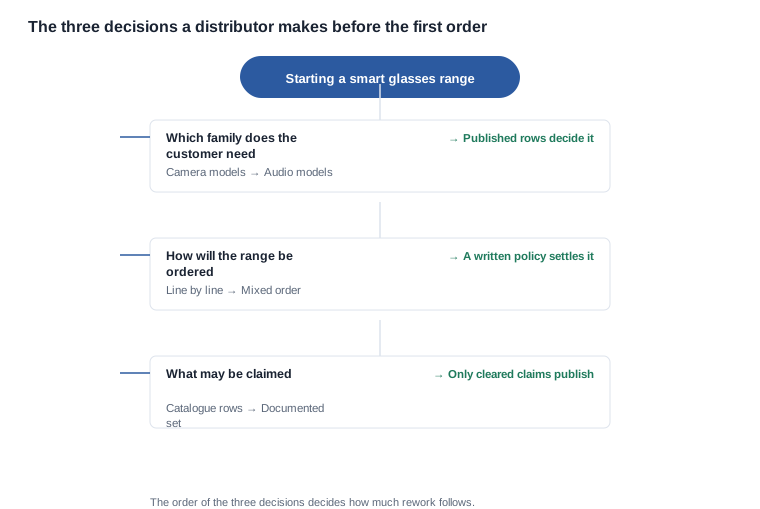
Smart glasses for distributors and retailers: the three decisions
Decision one — which family the range is built on
The catalogue divides into families that behave differently, and choosing between them is a customer decision rather than a catalogue decision. Eleven camera models publish a resolution class and a charging case position but no Bluetooth version. Eight audio models publish a Bluetooth version, a cell configuration and a runtime, and no camera row at all. Three sport models publish a Bluetooth version and no camera row. Three children's models publish a runtime of about twenty hours and, on two of them, a set of feature lines around posture, distance and lens fogging.
The selection tests worth applying are in the range category comparison note. The entry-level options and the budget categories are the two notes worth reading when a programme also has to cover a price-sensitive customer. The model selection guidance covers how a single family is narrowed down. The point for this overview is that a range usually serves more than one customer type, so the decision is normally a small number of families rather than one.
How the three decisions interact
The three decisions are usually taken in sequence, and that sequence is the source of most rework in a channel programme. Choosing the family first is right, because the family determines which documents the programme needs and how much of the range is describable from published rows. Choosing the order structure second is right, because the configuration count it produces determines the artwork work and the warehouse set-ups. Choosing the claims third is right, because a claim that cannot be supported by a document or by the distributor's own judgement will not survive the first review.
The interaction worth watching is between the second and the third. A configuration that exists only because of a claim — a colour created to match a brand palette, a bundle assembled to carry a particular accessory, a configuration built to satisfy a market-specific requirement — adds work to every stage downstream of it: a new artwork file, a new packing specification, a new line in the document set and a new row in the returns process. Claims that can be made from the published rows cost nothing to carry.
The other interaction is between the first and the second. A range built on one family is cheap to order and simple to replenish; a range spanning four families is a different programme, with the case states, the cell configurations and the feature lines all varying. The catalogue does not decide which of those two a distributor should run, and it is not written to. It is written to let the decision be made on published facts.
Decision two — how the range is ordered and replenished
A mixed order policy decides what may travel in one shipment, what the minimum applies to, and how a single line is re-ordered later. It is worth writing before the first order because the answers determine the artwork freeze, the documentation scope and the warehouse set-ups, and all three are expensive to change afterwards. The mixed order policy discussion sets out the six rules in detail.
The trigger for this decision is usually the first promotional reorder rather than the first order, which is why it is worth making early.
Decision three — what is claimed, and against what
Every claim on a page needs a source, and the sources are of different kinds: a published catalogue row, a supplier document, or the distributor's own judgement about what the product does for the customer. The first kind can be published today. The second kind has to be requested and arrives with a model list on it. The third kind is the distributor's own to defend, and it moves the liability onto the distributor.
Two rows in this catalogue shape that decision more than any other. The catalogue body names no standard at all and states no per-model conformity row anywhere, although our own product record notes that these are claimed for the camera, audio and sport categories, with the model list and the certificate numbers still open. And no camera model publishes any camera detail beyond the resolution class — nothing about the sensor model, the field of view, the frame rate, the video format or the storage capacity. A page that describes capture quality therefore has to be built from a specification sheet, not from the catalogue.
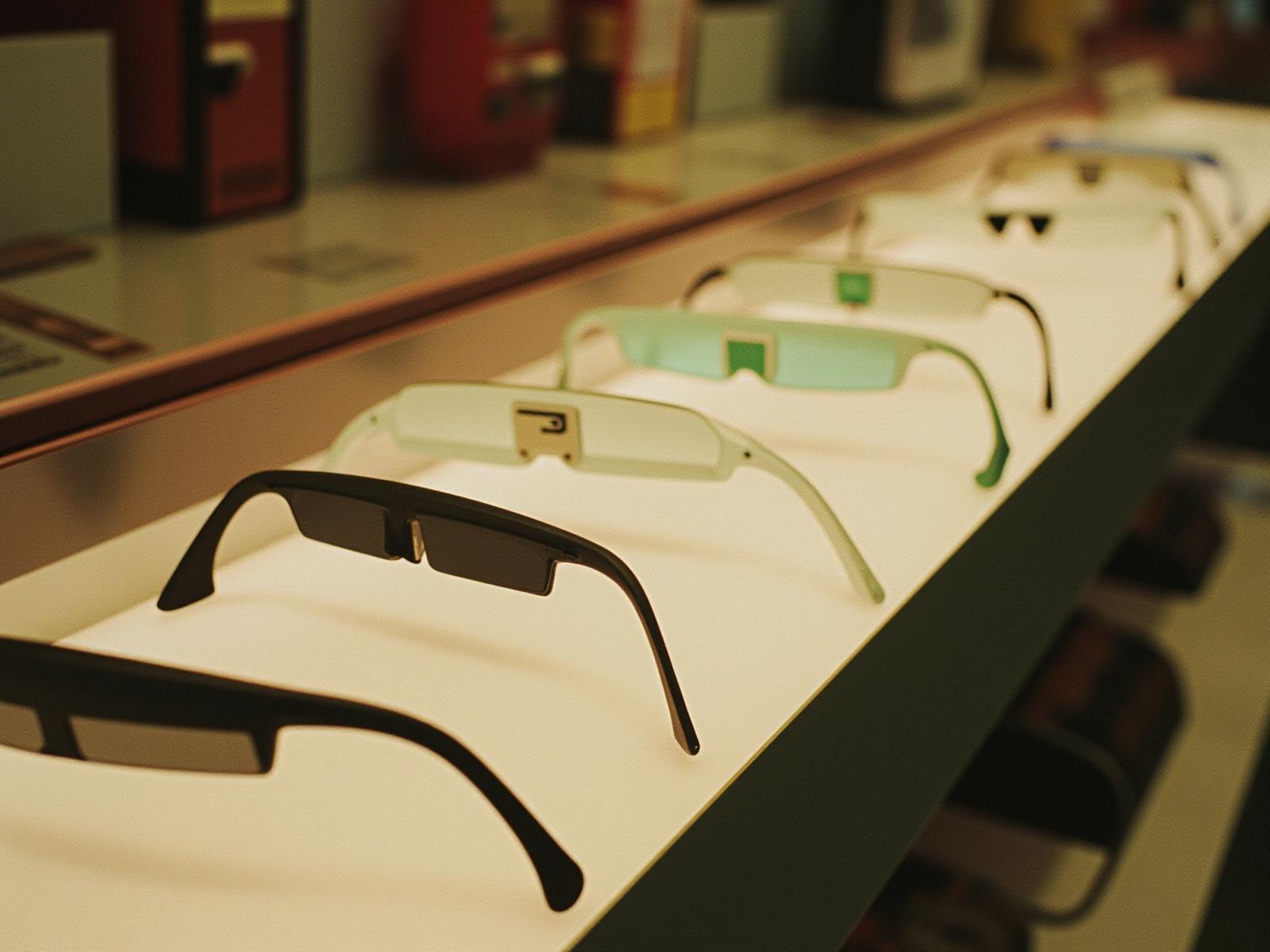
Smart glasses for distributors and retailers: the published position in one view
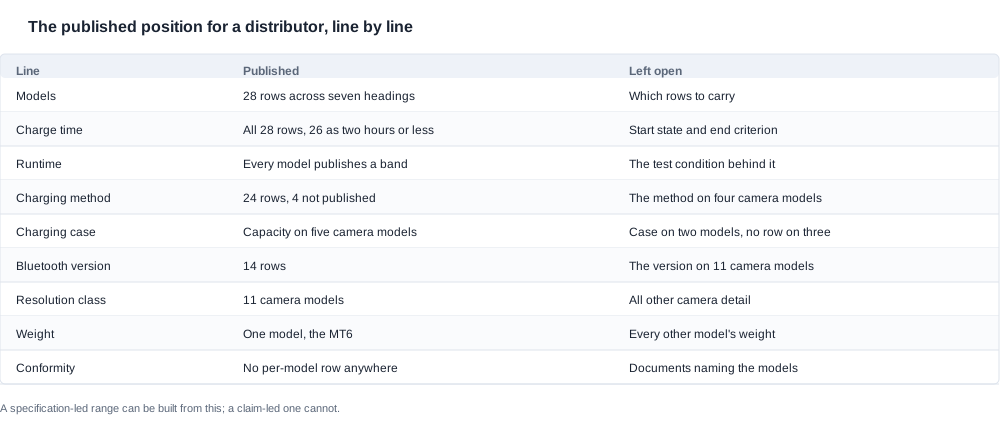
What the catalogue gives you
Twenty-eight rows, published consistently and versioned, which is the one thing a channel programme can rely on completely. Every row publishes a charge time, with twenty-six of them stating two hours or less — a ceiling rather than a duration — with only the D17 and the ZH12 publishing approximately one hour. Every model publishes a rated runtime. Twenty-four publish a charging method. Fourteen publish a Bluetooth version. Eleven publish a resolution class. Five publish a charging case capacity. Two publish colour options. Two publish an ingress marking. One publishes a weight.
What it leaves open
Field of view, frame rate, video format, stabilisation, storage capacity and sensor model for the camera models. Every model's weight except the MT6's 158 g, which excludes its foldable case. Frame geometry, temple profile and nose bridge. Acoustic performance, for which no third-party measurement report exists. The charging method on the MT6 and the L1 Pro, and the CY03 and the CY05. The case capacity on the KY06 and the MT5. Any per-model conformity statement. Carton specifications, packaging weights, freight terms, unit price, production lead time and minimum order quantity.
The practical reading of the two tables is that a distributor can build a specification-led range from this catalogue and cannot build a claim-led one from it. The AI features section is where the feature-level position is set out, and the ingress rating guide and the rating verification discussion cover the two models that publish a marking — the V06 and the S7 — against the rule that a rating needs a report behind it before it goes on a page.

Smart glasses for distributors and retailers: the four families and what each is for
Camera models
Eleven rows, and the largest family in the catalogue. Eight publish 8 MP — the CY03 and the V03, and the KY06 and the CY05, and the V03 Pro, then the V06 and the MT6, and the MT5 — and three publish 13 MP: the S7, the L1 Pro and the L2 Utral. Cells run from 220 mAh to 290 mAh, with the 290 mAh figure shared by the CY03 and the L2 Utral, and the CY05 and the L1 Pro. Runtimes sit in three bands: five to eight hours, six to eight hours, and about seven hours.
The structural features are sparse and worth knowing by name. The V03 Pro publishes a flexible temple, photochromic lenses, a Type-C charging port and three colours. The V06 publishes an ergonomic frame, a long-runtime line, a removable inner frame, IP54 and four colours. The S7 publishes an ergonomic frame, a 13 MP line, a removable inner frame and IP54. The MT6 publishes portability, 158 g and a foldable case. The MT6 against the V03 Pro comparison shows how two models in one family differ on published rows.
For a distributor, the camera family is where the documentation request is heaviest and where the range differentiation is weakest, because the only published discriminator is the resolution class and the case state.
Audio models
Eight rows, the best-documented family in the catalogue. The K01 and the K02 publish Bluetooth V5.3, two 90 mAh cells and about eight hours. The D11 and the D12 publish V5.4, a 100 mAh cell, about seven hours and Type-C charging, with the D11 publishing a surround sound line and the D12 publishing no feature line at all. The LC-105-2 and the YK12, and the G07 and the LC-105-1 publish V5.4, two 55 mAh cells and magnetic charging, with the G07 and the YK12 publishing about six hours and the other two about eight. Those two — the G07 and the YK12 — are the only models in the family where the cell configuration and the runtime coincide, and they are distinguished by their feature lines: an ultra-slim detachable temple on the G07, and a surround sound line with a slim temple on the YK12.
Two conditions are worth stating precisely, because they are easy to get wrong. The D12 publishes no surround sound line, so a family described as having surround sound across the board is misstating one of its members. And the 55 mAh pair with the shorter runtime is the G07 and the YK12 together, not the G07 alone.
How to describe a family in a range plan without over-claiming
A range plan is a document that gets read by people who will not open the catalogue, and that creates a specific risk: a row that is correct in isolation becomes wrong when it is compressed. The compression usually happens in three places.
A resolution class becomes a video quality. "8 MP" is a published figure for eight camera models; it is not a frame rate, not a field of view, and not a statement about what a customer can capture. A published runtime becomes a working day. The bands are about five to eight hours, six to eight hours and about seven hours, and none of them carries the test condition, so a plan that says "a full shift" has gone past the published row.
And an ingress marking becomes a waterproof claim. IP54 appears on two models and is a catalogue annotation without any third-party report number behind it, which means a page may state the marking and may not state a tested performance.
The rule that avoids all three is simple: a compressed description may only use the figure and the qualifier the catalogue gives. Where the catalogue writes a band, the compressed version keeps the band. Where the catalogue writes a ceiling, the compressed version keeps the ceiling. Where the catalogue writes nothing, the compressed version has to ask.
Sport models and the children's models
The three sport models publish a Bluetooth version and no camera row. The YKC02 publishes two 70 mAh cells, about eight hours and magnetic charging, with a surround sound line and a long battery life line. The D17 publishes a 115 mAh cell, about seven hours, a charge time of approximately one hour, Type-C charging, a remote control photo line and a surround sound line. The ZH12 publishes a 100 mAh cell, about eight hours, approximately one hour to charge, Type-C charging, a remote photo line and a stereo surround sound line.
The three children's models publish the longest runtimes in the catalogue, about twenty hours, with 40 mAh cells on the A05 and the A06 and a 70 mAh cell on the A07, all magnetic. The A07 publishes Bluetooth V5.4; the A05 and the A06 publish none. The A05 and the A06 publish the same six feature lines, which the catalogue lists as a lens-side electronic fogging unit, correct and incorrect posture-and-distance prompts, and lens clarity and lens fogging. The record also notes that the A05 and the A06 carry identical parameters with the difference to be confirmed, and that the certification position for this family is not provided at all — which is the point at which the highest-risk claims in the category become possible, and the point at which a channel partner should stop and check.
The three entries without a model string
The AR, the electrochromic and the bone conduction rows publish specifications but carry no model number, which means they cannot be ordered against a SKU and should be presented as information rather than as stock. The AR entry publishes figures identical to a standard Bluetooth audio pair, with an indicator light and button control, and the record marks its customer, market and differentiator as unknown. The electrochromic entry publishes no performance figure for its lens at all. The bone conduction entry publishes a 35 dB amplification gain, which our own record identifies as the most aggressive figure in the catalogue and, at the same time, the one that carries the highest compliance risk, because a hearing-assistance claim would bring the product inside medical device regulation. No such claim is ours to make, and a channel partner ought not to make one either.
The order in which questions should be asked
The order in which questions are asked is worth as much as the list itself, because the early answers change the shape of the later questions.
- Which models do you intend to carry, and which published rows apply to each of them? This establishes the specification base and shows which rows are missing before any commercial discussion.
- Which configurations does each of those models need? Colours, packaging versions and destination labelling, because the minimum and the artwork both count configurations rather than models.
- What may the pages claim, and where does each claim come from? Catalogue row, supplier document, or your own judgement — naming the third one is what stops it becoming an accident.
- What is the minimum per configuration, and what is the lead time for the configurations on the order? Both are confirmed per enquiry, and both are needed before a launch date can be set.
- Which documents will you release, and against which model list? A document set is useful only if it names the models it covers.
- How does a single line get re-ordered, and who receives a return? Both answers determine the stocking model and the cost of the programme's second year.
The criteria behind the sequence: establish the specification base before the commercial terms, and settle the commercial terms before a launch date is fixed in a customer's plan.
Smart glasses for distributors and retailers: the commercial frame
The three decisions sit inside a commercial frame that has four parts, and each part has its own timetable.

The range is fixed first, because it determines the configuration count, and the configuration count determines everything downstream. The configurations are enumerated next — model, colour or option set, packaging version and destination labelling — because the minimum, the artwork and the documentation scope are all measured against them. The mixed order policy is then written, so that the reorder path is settled before the first promotion rather than during it. The documents are requested per model list, which is the only way a conformity file can be closed. The artwork freeze follows, and after it, changes are chargeable events rather than design decisions. The sample is the point at which the published rows and the delivered unit are finally compared, and it is worth treating a sample as evidence rather than as a courtesy. The review closes the loop: a policy examined once a year against the models actually reordered is worth more than one written once and left.
Commercially, none of the numbers a distributor needs most are published. Price, minimum order quantities, production lead times, development items, packaging minimums and warranty terms are each confirmed per enquiry, because each is decided by configuration, quantity, mix and the schedule at the time. The wholesale programme sets out the framework, and the distributor and retailer solution sets out how the enquiry is normally handled.
The after-sales discipline that decides the second year
The second year of a channel programme is decided by the returns path, and the returns path is decided by the configuration record. A unit that comes back from a customer has to be identified as a model and a configuration before it can be inspected, credited or resold, and the identification comes from a record created at order time. Programmes that skipped the configuration record discover the gap on their first mixed return, and the manual work of identifying stock at that point is usually what turns a modest returns rate into an operational problem.
Three questions settle it before the first order. Who receives a returned unit — the distributor or the manufacturer. What the window is during which a unit can be returned, and what happens to a unit outside it. And what evidence is required: the configuration record, photographs of the fault, the packaging, the accessories, the batch reference if there is one. Each answer belongs in the same document as the after-sales route, and none of them is published.
Smart glasses for distributors and retailers: where we stand and what happens next
Where this leaves us
We publish the rows we hold and mark the rest as not published. We hand over the specification sheets and conformity documents a distributor's programme needs, with the model list on them. We make our own data graphics, because they are built from rows we hold and can be audited against them. We do not manufacture product images for a product we cannot photograph, we do not write claims that no document supports, and we do not publish prices, minimum order quantities or lead times that we have not quoted.
The checklist
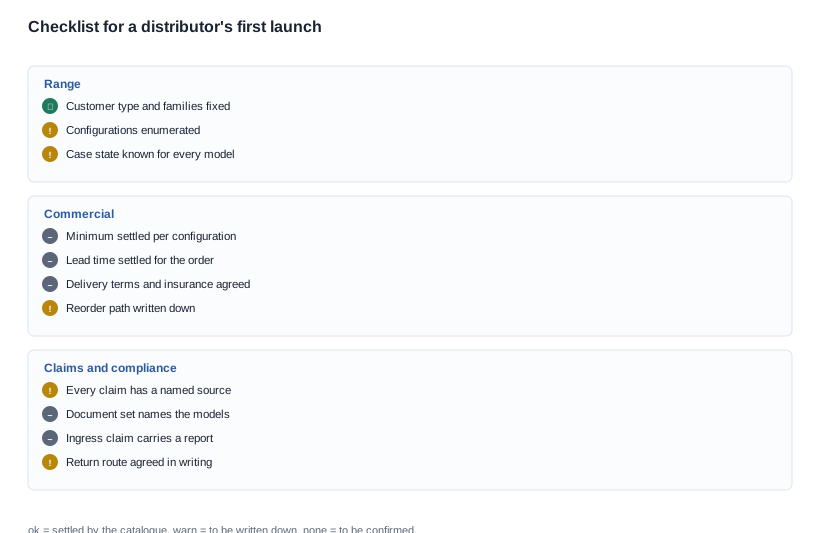
The immediate next step is short: send the customer, the families under consideration, the destination markets and the claims the pages intend to make. In return you get the published rows for those models, the documents we can release against them, and the list of what the published catalogue does not answer. For the sport-positioned models and the family-specific questions, the sport smart glasses discussion and the range note on frame geometry and clearance are the two that tend to save a round of questions.


