

The V03 and the V03 Pro publish the same camera, the same cell, the same charge time and the same endurance range. Everything that differs is a configuration option — the interface, the lens, the temples and the colourways. That makes this a poor comparison on a specification table and an excellent one for understanding how a platform pair should be built.
Most comparison pages treat two models as competitors, and this one is deliberately different: the V03 and the V03 Pro are closer to two trim levels of one product than to two products, and a buyer who reads them as rivals will spend the budget comparing things that were never going to differ. This one treats them as tiers, and that difference in framing is the whole useful content of the page. A buyer who wants to know which model is better will not find an answer here, because the published rows do not contain one. A buyer who wants to know how to structure a two-SKU range will find that the structure has already been solved once, and can be copied.
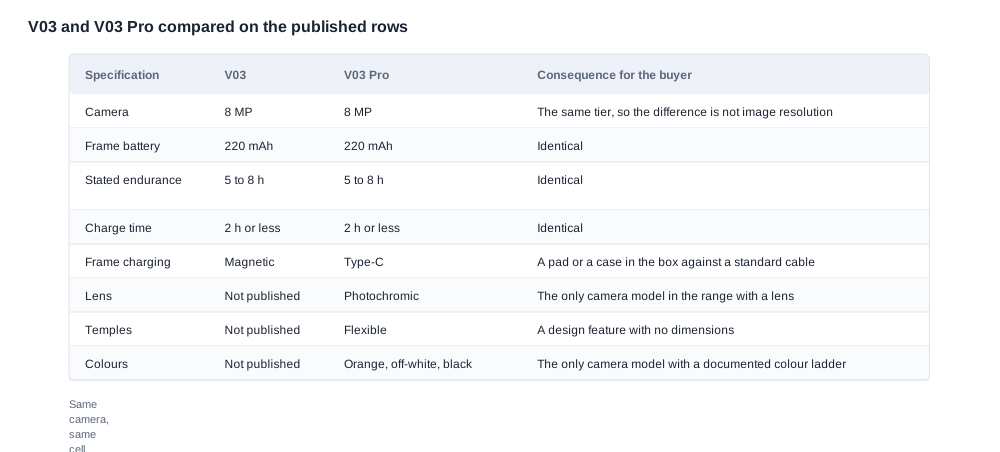
The V03 and V03 Pro published rows, field by field
| Specification | V03 | V03 Pro | Consequence for the buyer |
|---|---|---|---|
| Camera | 8 MP | 8 MP | The same tier, so the difference is not image resolution |
| Frame battery | 220 mAh | 220 mAh | Identical |
| Stated endurance | 5 to 8 h | 5 to 8 h | Identical |
| Charge time | 2 h or less | 2 h or less | Identical |
| Frame charging | Magnetic | Type-C | A pad or a case in the box against a standard cable |
| Lens | Not published | Photochromic | The only camera model in the range with a lens |
| Temples | Not published | Flexible | A design feature with no dimensions |
| Colours | Not published | Orange, off-white, black | The only camera model with a documented colour ladder |
There is one more row a buyer should add to this table before using it, and it is the row neither model publishes: the charging case. The V03 row carries no case field and the V03 Pro row also carries none, so on this pair the case question is identical to the question it is on any other model in the range — which is to say, it is open. What the interface split does change is the shape of the answer, because a Type-C frame and a magnetic frame are likely to receive different case recommendations from the same factory.
That matters for a range built on this pair, because it is the one place where the platform's cheapness stops helping. Shared hardware means shared qualification, but a differing accessory means a differing accessory supply chain, and the two together can produce a range that has saved money on engineering and spent it on packaging. The saving is still real; it is simply not in the place a buyer expects to find it.
Read the table as a buyer rather than as a specifier and a pattern emerges. The four identical rows are the ones that cost money to establish — the camera tier, the cell, the endurance behaviour and the charge time are the expensive parts of a product, and they are already paid for. The four differing rows are the ones that cost almost nothing to change: an interface, a lens, a temple profile and a colour set are configuration decisions, not engineering programmes.
It also tells the buyer where the risk sits. The four identical rows are the four claims that will appear on two product pages simultaneously, so a mistake in any of them is a mistake published twice, and the two pages will contradict each other the first time one of them is edited. The four differing rows are lower risk in that respect and higher risk in a different one: each is a claim made once, and a claim made once is a claim nobody has cross-checked.
That division is the entire commercial case for this pair, and it is also the reason the pair is harder to compare than it looks. A comparison table rewards differences, and every difference here is cheap; a buyer optimising for maximum visible difference between two SKUs would choose a different pair entirely, and would pay a second qualification cost to do it.
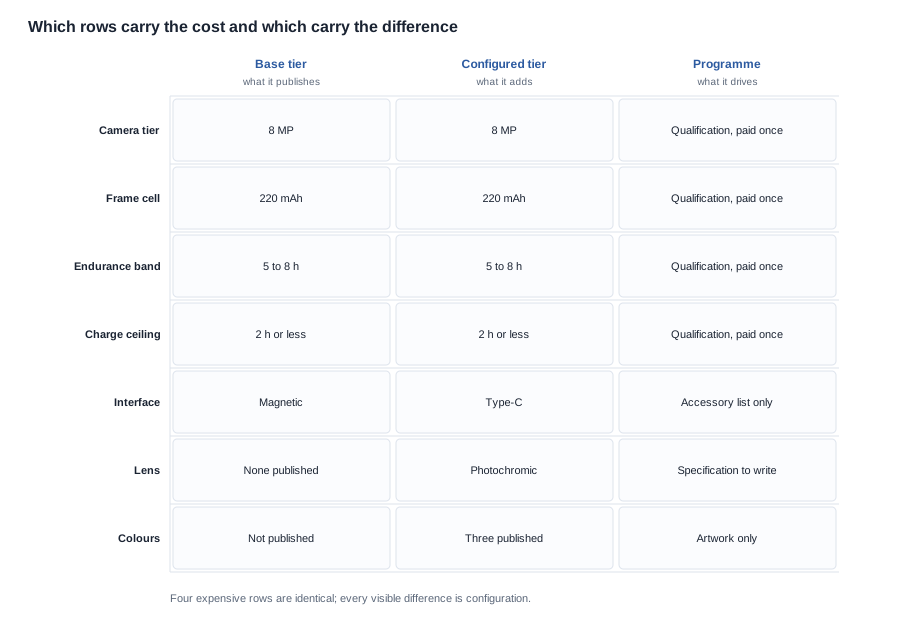

Why this pair is a good platform structure
There is a discipline point here that is easy to miss. A two-tier range on one platform invites the buyer to think of the tiers as interchangeable, and they are not interchangeable in the one respect that matters most to a customer: what arrives in the box. The entry model needs a magnetic pad and the configured model does not, so a customer who buys the wrong SKU has an unusable accessory rather than a missing feature. Any listing that presents the two tiers as a simple upgrade path has to make the accessory difference visible, and that is a copy decision that belongs before the launch rather than after the first support ticket.
The hardware is identical, so the range is cheap. One cell, one camera tier, one endurance behaviour, one firmware branch, one app. A brand running both models pays the qualification cost once and then adds a second SKU that costs a colourway, a lens, an interface and a cable.
That saving is the number most often missed in a two-model range business case, because it does not appear in either quotation. Qualification cost is the engineering time, the compliance spend, the documentation work and the sample rounds needed to establish that a product can be sold in a market. Paid twice, it is often the second-largest line in the programme. Paid once across a platform, it is amortised, and the second SKU's real cost is tooling plus artwork plus a cable.
The differentiators are all customer-facing. A photochromic lens, three published colourways, flexible temples and a Type-C interface are four things a customer can see or feel, and none of them requires a new engineering programme. That is the definition of a good tier.
There is a practical test for whether a proposed tier difference is a good one, and this pair passes it without qualification: the customer should be able to describe the difference in one sentence without using a specification word. "It changes with the light" is a sentence a customer can repeat. "It has a higher battery capacity" is not, unless the capacity difference is large enough to change the day. Applying that test to the four differentiators here returns four usable sentences, which is the best result this range offers. A proposed tier difference that fails the test is not automatically wrong; it is simply a difference the customer will not be able to repeat, which means it will not do the work a tier is supposed to do.
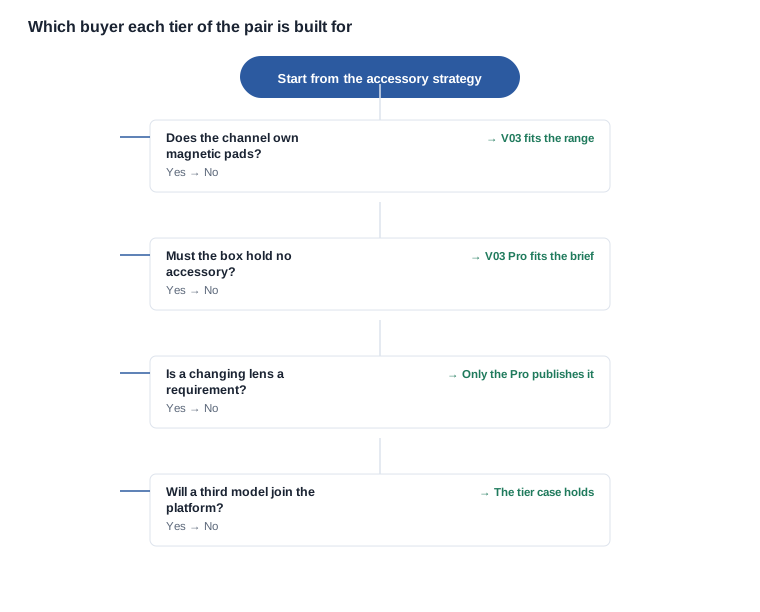
The interface change is a deliberate split, not an accident. The V03 keeps the magnetic convention that the rest of the camera range uses, and the V03 Pro moves to Type-C. That means the V03 Pro can be sold to a customer who wants no accessory in the box and a lighter parcel, and the V03 can be sold to a distributor whose range already runs magnetic. The charging case options analysis covers the parcel arithmetic, and the shipping weight breakdown covers the freight.
There is a second-order effect on the quality control plan as well. Two models sharing a camera tier and a cell are inspected against one set of criteria for the powered unit, and the differing rows are inspected as configuration checks rather than as quality checks. That is efficient, and it is also where a defect can hide: a lens fitted to the wrong variant, or a colour shipped against the wrong artwork, passes every powered-unit inspection and fails only at the packing station. The variant list is therefore a document the quality control plan needs, not just a document the ordering team needs.
The strategic consequence is worth stating, because it is unusual. This pair lets a range serve two accessory strategies at once — one SKU that needs a proprietary pad, one that needs nothing — from a single engineering base. A buyer who has previously run two separate platforms to achieve that is paying twice for a result this pair reaches once. The cost of that saving is the interface split itself, which means the range now carries both a pad and a cable in its accessory inventory. Whether that is worth it depends on whether the two SKUs are sold into the same channel, and it is a question worth answering before the split rather than after.
What the pair does not solve
The camera specification is absent on both. No sensor, no field of view, no video format, no frame rate, no storage arrangement. Since the two models publish the same camera tier, this is one qualification for the platform rather than two, and it should be closed once.
The colour ladder deserves a similar caution, and for the opposite reason. Three published colours are a genuine commercial asset — they let a buyer build a range ladder without re-tooling — but they also create an expectation of a complete colour set. A customer who sees three colours on a listing and finds only two available at the point of purchase has been told something the catalogue did not. The fix is unglamorous: state the available colours and their lead times, and treat a colour minimum from the factory as a commercial term to be negotiated before the artwork names them.
The photochromic lens is a named feature, not a characterised one. The lens on the V03 Pro belongs to a category in this catalogue that publishes no performance data and no model designation. Before the lens goes on a product page, the mechanism, the switching time with its test condition, and the tint depth as a transmittance range have to be established. The photochromic buying guide sets out the five checks, and the photochromic response time analysis covers the switching behaviour.
A second consequence follows from the same asymmetry, and it affects how the pair is launched. A tier whose differentiator is a visible option can be launched with the entry model first and the configured model once the lens specification is closed, because the entry model's claims do not depend on the lens data. A tier whose differentiator is a performance claim cannot be launched in that order, because the claim has to be true on day one. Knowing which of the two a buyer is building decides whether the launch can be staged.
The lens is the riskiest of the four differentiators for a specific reason: it is the only one that describes a dynamic behaviour rather than a static attribute. A colour is either on the carton or it is not, and a customer can verify it in a second. A lens that changes with light is judged on how quickly it changes and how dark it gets, and neither figure is published. A buyer who puts "photochromic" on a product page without the switching time has published a claim that will be tested by every customer who walks indoors on a sunny day.
The flexible temples and the three colours are names. The V03 Pro publishes flexible temples and a colour list; it does not publish a temple profile, a frame dimension or a weight. The colour list is commercially useful because it is a documented starting point, but it is not a sizing specification. The sport fit and sizing analysis covers how to turn a colour list into a size matrix when a frame is involved.
The endurance range deserves the same treatment. Both models publish five to eight hours with no test condition, and because both share the cell, both figures describe the same hardware under conditions nobody has stated. A buyer who writes the band on one page should write it identically on the other, and should ask once for the method rather than twice for the number. Two suppliers answering the same question separately will sometimes return two different figures, and the correct response is to treat the disagreement as a finding about the method rather than as a better number.
Two further gaps apply to both models and neither is solved by owning them as a pair. Neither row publishes a frame weight or any dimension, and neither publishes an ingress protection rating. Both are cheap to close and expensive to discover late, because one of them ends up on the carton and the other ends up in the compliance file.


The judgement behind this structure, and the five questions to close
This pair is the best platform structure in the camera range and a poor product comparison, and a buyer should run them as two tiers of one product rather than as two products. We will not present the 13-megapixel tier as relevant here — neither model is in it — and we will not present the photochromic lens as a characterised lens, the 8 MP as an image quality claim, or the 5-to-8-hour range as a working day. The published V03 specification list and the published V03 Pro specification list are the honest baselines, and the model readiness overview sets out where this structure holds across the range.
The negotiation follows the same structure. The specification, the certification evidence and the quality thresholds for the shared hardware are close to fixed, because a change there affects both SKUs and both listings. The configuration terms — lens supply, colour minimums, the interface split, accessory inclusion — are negotiable, because they are decisions rather than facts, and a supplier who has been asked for a variation list is a supplier who is already pricing those decisions. A buyer who negotiates the shared specification and the configuration terms as one conversation usually obtains more, because the configuration decisions are worth more to the factory than the unit price is.
How to evaluate a supplier on this pair is different from evaluating one on a single model, and the difference is worth stating. A single-model supplier is judged on whether it can deliver one thing well. A platform supplier is judged on whether it can hold two configurations consistent with one specification, which is a harder discipline and a rarer one. The evidence to ask for is therefore comparative: ask for the platform specification once, and ask which fields vary between the two configurations and which do not. A supplier who answers with two separate specification sheets has described two products; a supplier who answers with one sheet and a variation list has described a platform.
Five questions to close for the platform
- Sensor model, field of view, video format, frame rate and the storage arrangement.
- The photochromic lens specification: mechanism, switching time with its test condition, and tint depth.
- The endurance test conditions behind both ends of the range.
- Frame weight, dimensions and the temple profile.
- The certification position for both models, and whether the reports name them both.
The first of those is the highest-leverage of the five, and it is worth doing once properly rather than twice partially. A single platform specification covering both model designations, with the camera fields completed, answers the imaging question for the entire range and removes the largest unanswerable objection to selling either model. It is also the one field where two suppliers are most likely to agree, because the hardware is shared — which makes it the cheapest place in the whole programme to build trust before the harder commercial conversation starts.
The fifth of those deserves a note, because it is the one most often answered optimistically. A report that covers the platform without naming both model designations may cover neither of the models a buyer has ordered, and the practical test is the same one used elsewhere in this range: the designation on the document must match the designation on the purchase order. Where the two are different, the question is not whether the report is valid but whether it covers the variant that will actually ship.
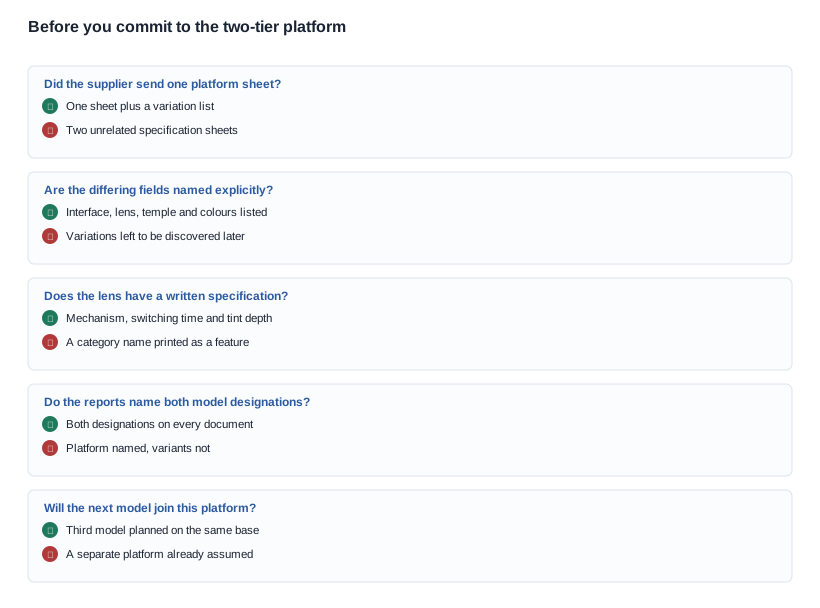
Before you commit to that structure, it is worth writing down what would have to be true for it to fail. The pair fails if the two SKUs are sold into genuinely different channels with different accessory conventions, because the shared platform then saves qualification cost that the channel split would have made irrelevant anyway. It also fails if the photochromic lens specification never arrives, because the V03 Pro's only differentiator is then a category name with no characterisation behind it. Neither failure is likely, and both are cheap to exclude by asking the right two questions early.
The value of running these two models as tiers rather than as rivals shows up at the moment a third model is added. If the third model shares the platform, its incremental cost is a configuration and its qualification cost is a review. If it does not, the platform argument was decorative and the range has been paying a second set of fixed costs from the start. That question — does the next model join this platform — is the one a buyer should be asking before committing to either of these two.
Related reading
- The published rows for the entry model — V03 smart glasses specifications and features
- The published rows for the configured model — V03 Pro smart glasses specifications and features
- Choosing across the camera range — AI camera glasses which model to pick
Send us the channel, the price bands and the markets, and we will tell you whether this pair is the right tier structure for your range.


