
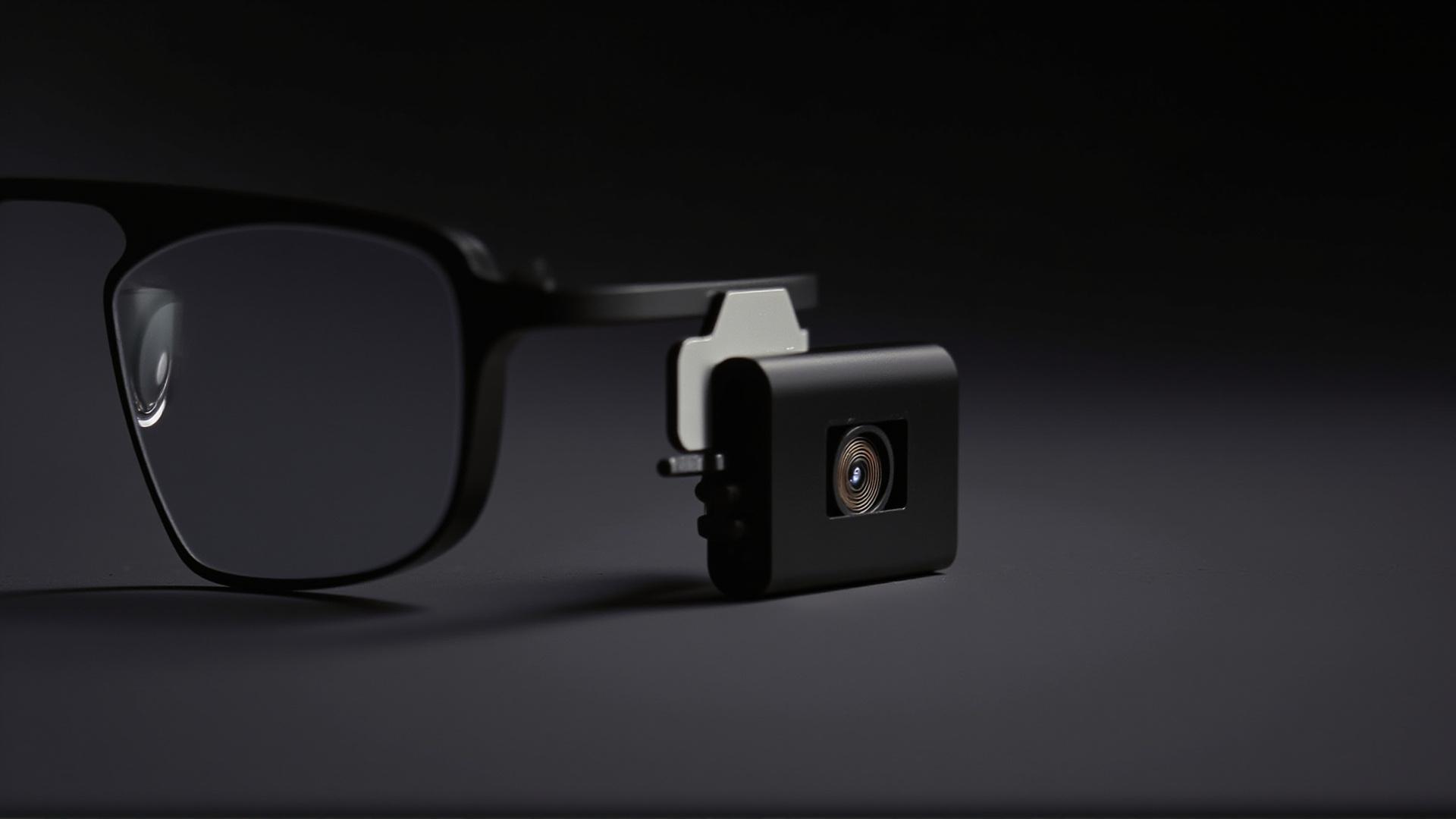
The V03 Pro publishes three things that matter to a brand programme and one thing that decides how much work the programme is. The three are a colour list of three published colourways, a variable-tint lens configuration, and a Type-C charging interface. The fourth is the absence of a charging case, which the catalogue states explicitly for this model — an explicit statement, not a gap in the table, and the distinction matters because a gap and an absence lead to different programme decisions.
Those four published rows make this one of the more documented camera models in the range, and they shape the customisation sequence in a specific way: the identity work sits on the colour ladder and the lens line, while the packaging work sits on a frame for which the catalogue prints no charging-case row. Everything else — the camera claim, the weight, the conformity file — has to be established rather than assumed, and two of those three can only be closed by a request and a measurement.
This article walks the programme in the order the decisions have to be taken. It is written for the person who has to answer for it: what is fixed before anybody opens a design tool, what has to be decided, what has to be characterised before a claim is printed, and what has to be measured on a unit. No commercial terms appear in it, because the route list, the artwork rules, the minimum quantities, the lead times and the unit costs of a brand programme are quoted per programme rather than published as product facts.
V03 Pro customisation: what the catalogue already fixes
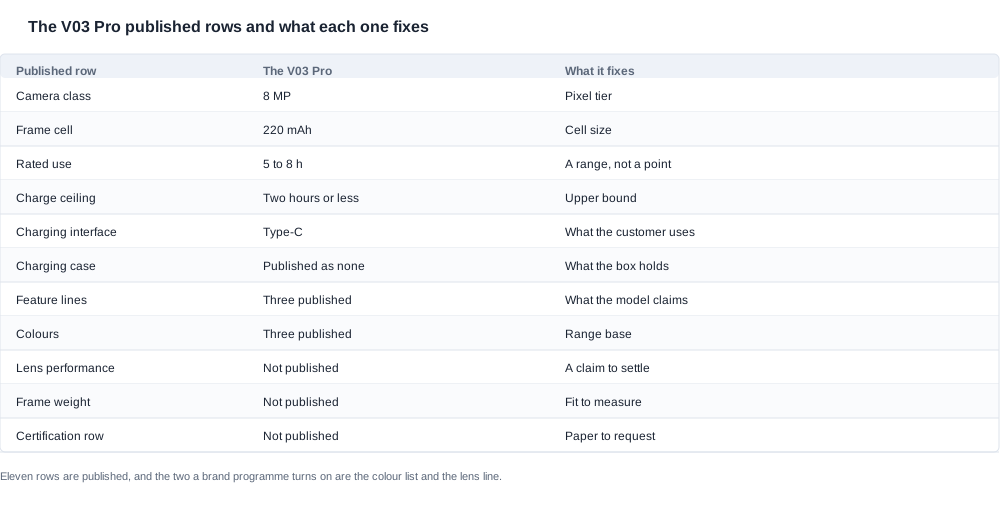
Eleven rows are published for the V03 Pro, and a programme can be planned on them before a single request is made. The camera sits in the eight megapixel class with seven other models. The frame cell is 220 mAh, which is the smallest published frame cell in the camera range, and the rated use is published as five to eight hours — a range rather than a point, so there are two planning anchors instead of one. The charge ceiling is two hours or less, and the charging interface is Type-C, which is one of seven Type-C frames in the catalogue.
Two of the published feature lines carry the brand work. The catalogue lists a flexible temple and a variable-tint lens configuration for this model, and neither appears on any other camera model in the range. The flexible temple is a shape to work with and a constraint to design against, because a moulding that flexes has a defined envelope for anything applied to it. The variable-tint lens is a different kind of row: it is the only camera model in the catalogue with a lens configuration at all, and it is also the row where the catalogue publishes the mechanism and nothing else about the behaviour.
The colour list is the third row that carries brand work: orange, off-white and black. It is worth being precise about where this model sits among the models with published colours, because the shorthand gets used too freely. This model publishes three colourways, the V06 publishes four, and the rest of the catalogue publishes none. So the choice in front of a brand is not between a documented range and an undocumented one — it is between a ladder of three, a ladder of four on a different model, and no ladder at all.
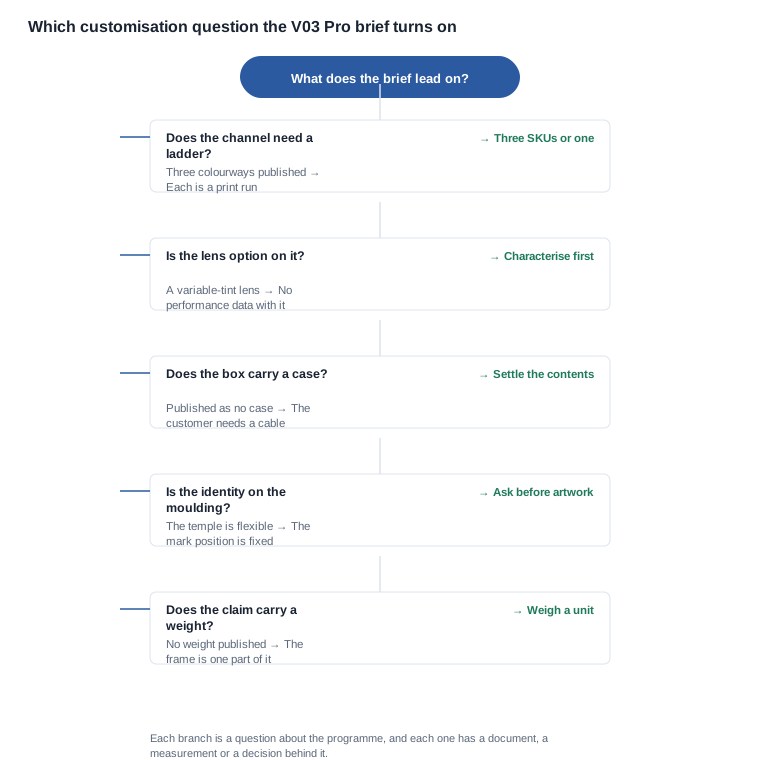
The absent rows are as published as the present ones. The catalogue publishes no sensor model, no field of view and no video specification for this model, so the camera claim stays at the eight megapixel class and cannot be widened by any configuration. It publishes no lens performance data at all, which is the subject of the second step. It publishes no frame weight, and the only published weight anywhere in the catalogue belongs to the MT6, so the weight of this frame has to come off a unit. And it publishes no per-model certification row, so the programme's file has to be built from documents it requests rather than from a published position.

Step one: the colour ladder, and what it does to the print plan
Three colourways are published for this model. The commercial consequence of that list is straightforward and it is worth setting out before the brand side, because the print plan follows from the colour count and not from the artwork. Three colourways means three packaging stock keeping units, three artwork versions and three print setups, in exchange for a merchandising ladder on a single product. One colourway on a single product is a smaller operation. Three colourways across a channel that sells on choice is a different proposition, and which of the two a programme is depends on how the channel actually buys rather than on how the range looks on paper.
The criteria for deciding are therefore about distribution rather than about design. A channel with one buyer and one order is usually better served by a single colourway, because the second and third SKUs add setup work without adding reach. A channel where the colour choice drives the click, or a marketplace where the variant list is part of the proposition, is where a ladder earns its setup cost. The AI camera glasses packaging options piece covers where that setup cost lands, and the AI camera glasses entry level options piece sets out the parcel positions model by model, which is the frame in which this decision sits.
Two further questions belong in the same request. The first is allocation: whether the three colourways can be produced within one order or are allocated per colourway, and on what commercial terms, because that determines whether the programme has one purchasing unit or three. The second is whether the range extends past the published list, which is a different project with a different tooling path rather than a variation on this one. Both are commercial terms, both are quoted per programme, and neither appears in any published material.
How to choose between one colourway and three
The question is not aesthetic and it does not have a general answer, which is why it is worth writing the criteria down before anyone falls in love with a variant list. Three criteria decide it, and they are checked in order. The first is whether the channel buys by variant: a channel that orders one colour per style carries the cost of three print runs without the reach of three listings. The second is whether the product page in that channel converts on a colour choice, which is a channel fact and not a product fact. The third is what happens to the second and third colourways when the season turns, because a ladder that has to be cleared is a ladder that constrains the next order.
When the answer on the first criterion is no, the ladder is a cost with no matching return and the honest decision is a single colourway, with the flexibility of adding a second later if the channel's behaviour changes. When it is yes, the ladder is usually worth doing, because a colour ladder on a product with a published list does not need new tooling — it needs a print plan and an allocation rule. The trade-off to keep in view is that the ladder also multiplies the number of stock keeping units a distributor has to hold and the number of listings a retailer has to maintain, and those two costs sit with the channel rather than with the factory.
The third point is the one most programmes forget. A ladder is a commitment across more than one order cycle, and the criterion for it is not the first order but the second: whether the second colourway will still be in the range when the first one is reordered. If the answer is uncertain, a programme that starts with one colourway and adds a second on evidence has lost nothing except the setup it has not yet paid for.
Step two: the lens option, which is the hardest item
This model publishes a variable-tint lens configuration, and it is the only camera model in the range that does, which makes it the platform for a product whose proposition is an adaptive lens rather than a camera. The difficulty is not the novelty of the feature. It is that the catalogue publishes the configuration and none of the behaviour that a customer would judge it by.
What a lens claim needs in order to survive a customer is a switching behaviour, a tint depth in each state, an operating range, and a statement of the conditions under which the figures were taken. None of those is published for this configuration. The photochromic buying guide sets out the five checks that a lens has to pass, and the photochromic how it works piece sets out the two different technologies that both get called a photochromic lens. A lens behaviour that a customer can verify by standing in a window is exactly the kind of claim that has to be characterised before it is printed on a box.
The practical instruction is to treat characterisation as part of the programme rather than as a follow-up. Ask what evidence exists for the configuration, in what condition it was taken, and what may be said about it in marketing and on packaging. A programme that intends to describe the lens generically can do so from the published row alone. A programme that intends to describe what the lens does — how fast it changes, how dark it gets, what happens at the ends of the temperature range — needs the characterisation first, and that request belongs in the same document as the conformity questions rather than in a later conversation.

Step three: the brand layer, in the order the moulding allows
The order matters more here than on a fixed frame, because two of the three brand items on this model are attached to a moulding that flexes. The device name comes first, because it is embedded in the firmware and then appears in the pairing instructions, on the packaging and in every support ticket afterwards; a name changed late is a name that has to be changed in three more places. The mark comes second, constrained by the moulding, with the constraints confirmed in writing rather than discovered at proof. The flexible temple comes third, and it is both an opportunity and a constraint, because it gives a brand a shape to work with and a surface that will not accept anything the moulding cannot carry.
Where a factory pushes back on the identity — a mark that will not sit on the moulding, a colour that does not exist in the tooling — is exactly what the brand guideline process is built to catch, and it catches it before artwork rather than after. The trigger for that conversation should be a drawing and a written constraint, not a mood board, because the constraint is what makes the artwork possible.
A fourth item belongs in this step and is specific to a camera product: the first-person framing. The field of view is not published for this model, which means the way the camera sees is a sample observation rather than a specification, and it is the thing a customer judges first. It goes on the sample sheet rather than in the artwork, because a framing that disappoints is a product decision rather than a brand one, and discovering it after artwork approval is the most expensive way to find out. The V03 Pro buyer review checklist works through the same ground from the specification side.
The moulding constraints, and the red flags in a brand brief
Three red flags show up in a brand brief on a model like this, and each of them is cheaper to catch in the guideline conversation than in the artwork review. The first is a mark specified as a shape rather than a position. A moulding carries a defined set of surfaces, and a shape drawn for a flat area will land somewhere else on a curved or flexible temple. The second is a colour specified by appearance rather than by reference, which on a model that publishes a named list of three colourways is avoidable: the published list is the reference, and a brand that wants something outside it is making a tooling request rather than a selection. The third is a claim about the lens written into the brief, which is the lens characterisation step again, arriving early and in the wrong document.
The way to catch all three is the same: the brief goes to the guideline process as a drawing and a list, and the answer comes back as a written constraint on what the moulding can carry and which published option the request maps to. What to ask in that conversation is what the mark position options are, whether the flexible temple accepts a mark at all, and which parts of the brief cannot be met on this configuration. A programme that receives that answer has a workable brief; a programme that receives a verbal reassurance does not, because the constraint always reappears at proof.
The order of the three brand items in this step also matters, and it is not an aesthetic order. The device name is embedded in the firmware, so it is the item with the longest lead time inside the product; the mark is constrained by the moulding, so it is the item with the fewest available positions; and the temple is a published feature, so it is the item where the brand has room to work. Deciding the slowest item first is what keeps the artwork step from becoming the place where the programme discovers that it has already missed a date.

Step four: define the box, and note what is not in it
The box contents are the frame, the charging cable, the printed quick start in the market's language, the warranty card, the market leaflet and the compliance markings. The absence is the case, and for this model the catalogue states it explicitly rather than leaving the row unlisted, so a programme can plan the parcel without an assumption. A Type-C frame needs no dock, which means the box carries no second cell, and that changes the parcel arithmetic in a way that is worth modelling before the artwork rather than after.
The trade-off is the familiar one and it has to be weighed rather than assumed. A box with no case is lighter and simpler, and the customer has to keep a cable. A box with a case gives the customer a one-cable routine and adds a lithium cell to every unit, along with the transport documentation that a second cell implies. For a direct-to-consumer channel the first arrangement is often the easier first order, because the accessory in the box is the thing that creates friction; for a retail channel where the customer already owns a USB-C cable, the same logic points the other way. What to ask is which convention the channel's buyers already follow, and the shipping weight breakdown covers the arithmetic on both sides.
There is a related question about the printed quick start and the leaflet. Their content is market-dependent, and they are also the documents that carry the marking requirements, so they cannot be finalised before the compliance questions are answered. In practice they are drafted last and proofed against the frozen artwork, which is why the freeze step below exists.
Step five and six: prove the sample, then freeze the file
A sample is approved against a written specification rather than against an impression. The specification for this model names the model designation, the camera class, the battery capacity, the rated use, the charging interface, the colour, the lens option, the packaging contents, the marking, the firmware version, and the logo placement with its dimensions and finish. Approving against a list means the approval can be recorded, which matters later when the production file is compared with the proofed sample.
Two things need the sample rather than a signature. The lens, if the programme offers that option, because its behaviour has to be observed rather than read. And the first-person framing, because it is what a customer judges and it is not published. Everything else on the list is a comparison, and a comparison can be done against a document.
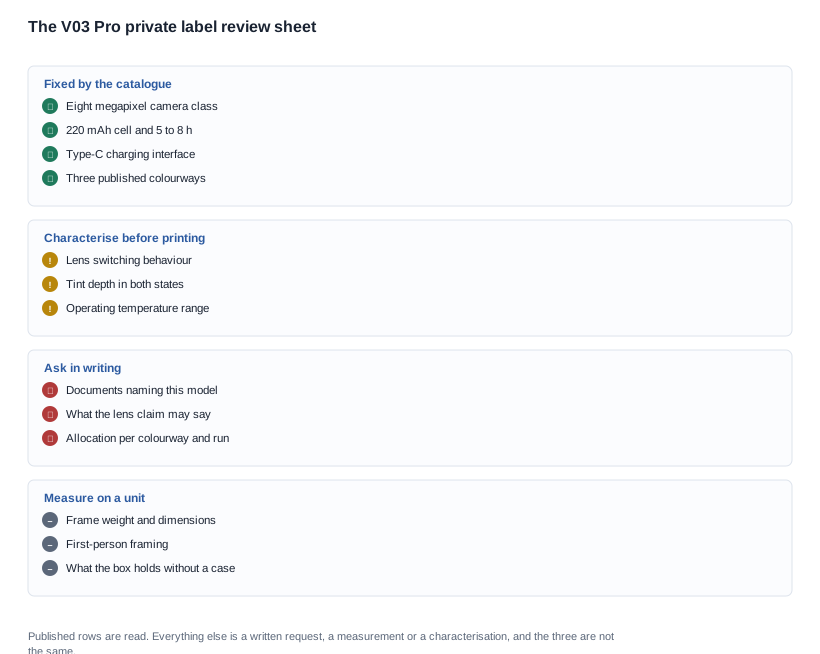
Freezing the file is the step that stops the programme from re-opening. The packaging artwork, the production file, the marking, the model designation and the certificate application are frozen together, and the locked artwork, the proofed sample, the production file and the conformity file are stored as one package rather than as four documents in four places. The export documentation checklist covers the paper that travels with the goods, and the OEM ready scaling up piece covers how the platform is shared when a second model is added to the range — which is the point at which a loose file becomes expensive.
What the freeze protects against
A freeze is not admin. It is the mechanism that turns a set of decisions into a repeatable order, and it protects against three specific failures that are expensive precisely because they are invisible while they happen. The first is a late change to the artwork that no longer matches the marking on the frozen production file, which turns a reprint into a new artwork approval. The second is a change to the configuration that leaves the conformity file describing a product that is no longer the one being shipped, which is the failure mode the whole scope document was written to prevent and which the freeze is the last defence of. The third is the ordinary one: a second order placed from a file that has drifted, where the new units differ from the first ones in ways nobody wrote down.
The practical form of the freeze is a package that a person other than the author can read. If the locked artwork, the proofed sample, the production file and the conformity file are stored together with the model designation on the outside, then the next order is placed against the same thing the first one was. If they are stored separately, the next order is placed against a memory of the first one, and the differences accumulate without anyone noticing. The criteria for deciding whether a package is complete are simple: a reader should be able to identify the exact product, the exact packaging and the exact paperwork from the package alone, without asking anyone.
That is also the moment to write down what was deliberately left open. The lens behaviour, the field of view, the frame weight, the charging method for the configuration — each of these is an open position, and each of them is a question the next programme will ask. Recording them in the freeze is what turns a set of open questions into a documented position rather than an omission.
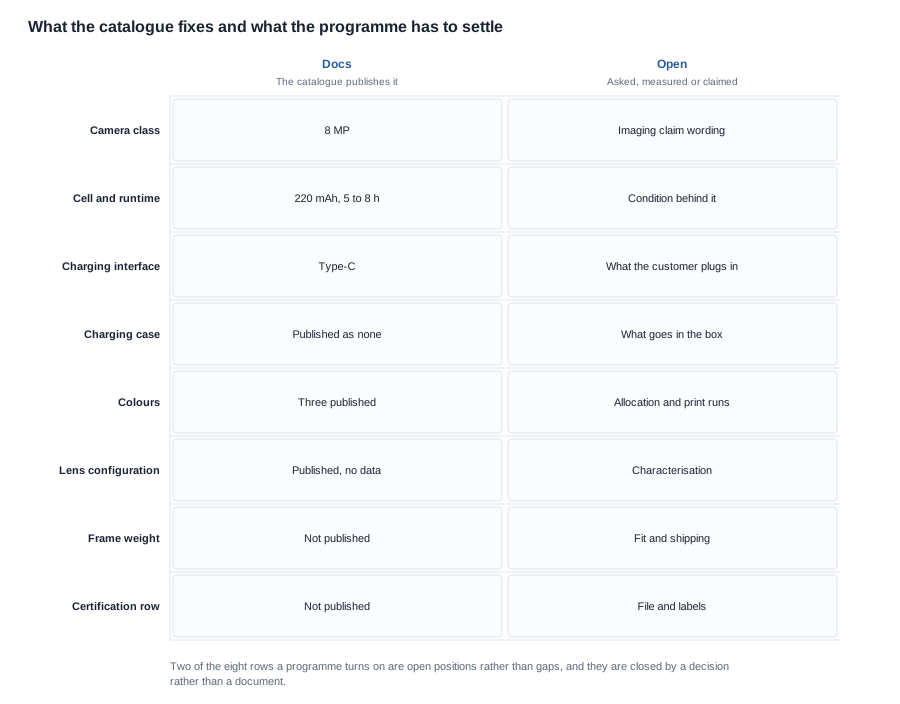
Six items have to be settled before the first order, and each one has an owner and a piece of evidence behind it:
- The colourways and the packaging unit count they create, with allocation per artwork run confirmed in writing.
- The lens specification, if the option is on the brief, characterised before anything about it is printed.
- The brand layer, in the order above, with the moulding constraints written down before artwork.
- The box contents, per market, with the compliance markings and the printed insert.
- The camera claim, closed once at the eight megapixel class and not widened afterwards.
- The frozen package: artwork, production file, marking, designation and certificate application, stored together.
On this model, our position is that it is a well-documented camera platform with two documented brand levers — a three-colour ladder and a variable-tint lens configuration — and that the lens lever is the one that carries the most work, because a published configuration is not a characterised behaviour. We will not present the lens as a characterised lens when no switching time, tint depth or temperature range is published, and we will not present eight megapixels as an image quality claim. We will not quote a weight, a case capacity or a certificate number that the documentation does not contain, and we will not rank this model against the others in the range or turn a specification into a choice of model, because neither is a fact about the product.
Send us the market, the channel and the expected volume, and we will tell you which of the six items are defined today and which need a laboratory or a factory conversation.
Related reading
- The lens qualification — photochromic smart glasses buying guide
- This model's published figures — V03 Pro smart glasses specifications and features
- The packaging consequences — AI camera glasses packaging options


