
This is the cleanest decision in the sport range, and it comes down to one question with a measurable cost. The YKC02 publishes a rated runtime of approximately eight hours. The V06 publishes five to eight hours, from a larger 260 mAh cell. The V06 has a camera in it; the YKC02 does not. That is the whole difference, and the runtime gap is the camera's cost.
A v06 smart glasses vs ykc02 which one to choose decision should therefore be made on the requirement, not on the specification table. If the end user records first-person video, the YKC02 is not in the shortlist at all and the comparison ends. If the end user does not record, the camera is dead weight, the YKC02 publishes the more useful figure, and the V06's larger cell buys nothing the customer can see.
What follows from that is not a winner but a cost. The camera costs you runtime headroom, a technical file you have to assemble rather than copy, a wider compliance surface and a quality control route written for a feature. The YKC02's advantage is not that it is better; it is that it is smaller, and smaller is cheaper to document, ship and support.
Before going further, it is worth being precise about what "choose" means here, because it does not mean the same thing for every reader of this page. A buyer choosing a model for a single retailer is choosing one product. A brand building a range is choosing a platform, and a platform brings obligations that a single product does not. If you are the second kind of buyer, the questions below are the right ones; if you are the first kind, the first question is the only one that matters.
V06 smart glasses vs YKC02: which one to choose, and the question that decides it
Put the two models into the order a buyer actually works in, and the sequence collapses to four gates.
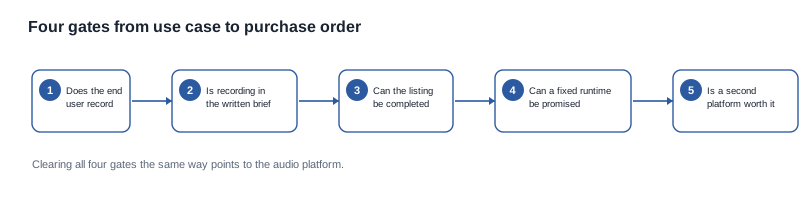
- Does the end user record? If yes, only the V06 qualifies. Nothing later in the sequence can overturn this.
- Will a fixed endurance figure be published on the listing? If yes, the YKC02 is easier to write about, because a single approximate figure is simpler than a band.
- Can your team assemble the missing camera parameters before launch? If no, the camera platform carries a documentation risk the audio platform does not.
- Is the second platform worth a second purchase order, a second technical file and a second compliance chain? If no, run one model and serve one market well.
If you clear all four gates in the same direction, the answer is the YKC02. If gate one fails, the answer is the V06. Everything else in this comparison is commentary on those two outcomes.
A useful way to state it to a channel team. The YKC02 is a product you can describe completely from our published documentation. The V06 is a product whose published documentation is a starting point. Both are legitimate products; they impose different amounts of work before they can be listed truthfully.
What is not published for either model, and should be asked about, in one list. Frame weight, temple length and lens dimensions. Sensor model, field of view, video resolution, frame rate, aperture and pixel size on the V06. The ingress test report behind the V06's IP54 marking, and every certificate number, issuing body and validity period in the family. Also absent from both rows: MOQ, lead time, unit price, packaging specification, warranty terms and the defect categories treated as returns.
That list is not a criticism of either product. It is a work instruction. A buyer who collects those answers once, in one document, before the first purchase order, has a file that supports every claim they will ever need to make about these two models. A buyer who collects them one at a time, in reply to a customer question, will collect them eventually and will pay more for them. Our certification checklist sets out the structure of that document, and the IP rating page explains why a marking without a report is not a test result.
And one thing to settle before either: whether your brief even includes recording. We ask this first in every enquiry about this pair, because the majority of smart glasses enquiries we receive describe a use case that does not require a camera at all, and the buyer had not noticed. A requirement written down before the shortlist is a requirement; a requirement discovered at the sample stage is a delay.
It helps to write the requirement down in the customer's words rather than in feature language. "Customers need to record a walkthrough and send it to their team" is a brief. "We want a camera" is not. The first version tells you what the technical file has to contain; the second only tells you which category to shop in, and it will pull you towards the higher megapixel number rather than towards the product that meets the requirement.
A related question that settles the comparison faster than any specification question: is the recording shared, stored or streamed? If a clip is stored on the device and downloaded later, the storage behaviour, the file format and the transfer route all become part of the brief. If the buyer cannot answer that, they do not yet have a use case, and choosing between these two models on the strength of a general enthusiasm for a camera is the most expensive way to make this decision.
The camera tax, priced honestly
The camera tax has four components, and only one of them is visible in the runtime row.
The visible component is the runtime. The V06 publishes five to eight hours against the YKC02's approximately eight hours. That band is the measurement of a load that spikes when the camera records, and it is the honest way to describe a product whose consumption is not constant. A buyer who needs a guaranteed eight hours of use has a real problem with the V06 and no problem with the YKC02, and that is worth more than the megapixel figure.
The second component is the technical file. The V06 publishes a camera resolution and nothing behind it. Sensor model, field of view, video resolution, frame rate, aperture and pixel size are not published. Each of those is a question to the supplier, and each answer either lands in your product page or stays in your file.
The third component is the compliance surface. A device that records introduces questions about data handling and about the environments it will be used in that an audio-only device does not. That is not a reason to avoid the camera — it is a reason to budget for the review.
The fourth component is quality control. A camera assembly has failure modes that a two-cell audio assembly does not: focus, colour cast, motion artefacts, file corruption, storage behaviour. An incoming inspection route written for audio will pass a camera unit that a customer will reject, and finding that out at the customer's end rather than yours is the expensive version.
There is a fifth component that only appears once the first order ships. A camera platform generates a return reason code that almost no buyer has set up before the first return arrives. What to ask the customer when a unit comes back, whether it is a fault, a misunderstanding or a defect, and who pays the freight either way — those answers are needed before the first return, not after the third. The quality consistency page covers how acceptance criteria and defect categories are normally structured, and writing them at the sample stage costs nothing.
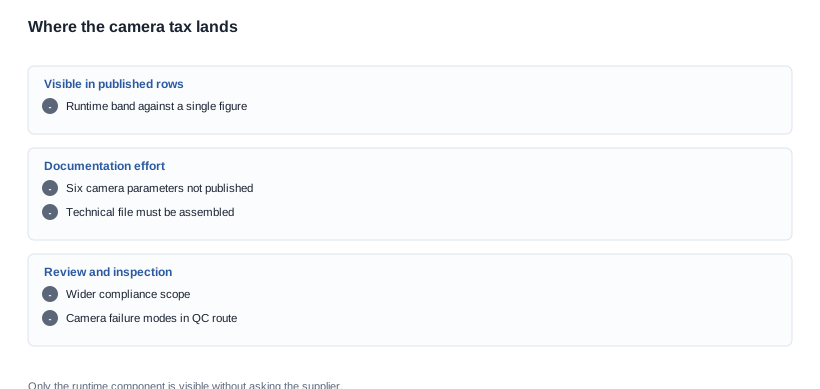
The trade-off stated plainly, because most comparisons in this category bury it. The V06 buys capture with runtime headroom, documentation effort and review scope. The YKC02 buys endurance and simplicity with the loss of the feature. Neither is the better product; they serve different briefs and they cost differently.
One caution about how this tax is usually quoted. Buyers who price the camera tax as "some battery life" consistently underprice it, because the documentation and inspection components do not appear in a quotation at all. If you are comparing two models on total cost, price the sample stage, the technical file and the inspection route into both sides, or the cheaper-looking option will move the difference into a later quarter where it is harder to see.

Three buyer profiles and the model each should shortlist
It helps to describe the buyers we actually see enquiries from, because the right answer is almost never the same twice.
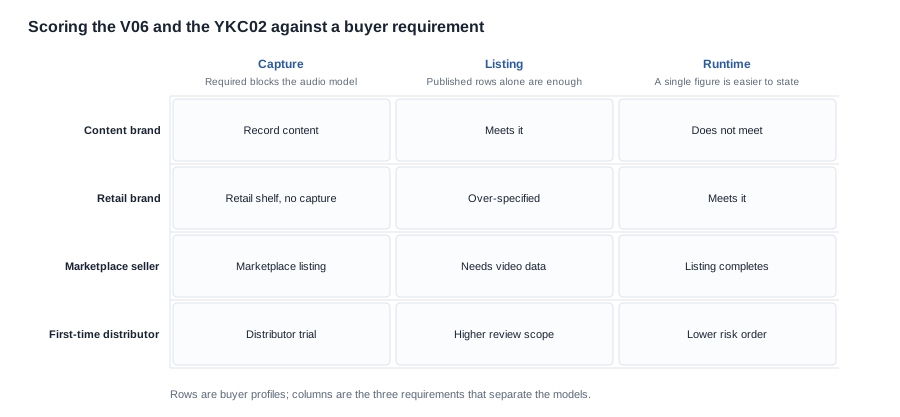
The channel brand listing in a marketplace. This buyer competes on specification tables, expects the higher-resolution camera to be the deciding factor in search, and will be judged by a return rate they cannot see until it is too late. The YKC02 is the safer shortlist here — not because it is a better product, but because its listing can be completed from the published row and its claims can be honoured. If the buyer insists on the camera, the V06 is the model, and the missing video parameters have to be closed before launch.
The brand with its own retail channel and predictable sell-through. This buyer controls its own shelf, its own photography and its own price architecture, and values a product that survives the specification conversation with a customer. Either model works; the decision turns on whether recording is in the customer brief. The V06's four published colourways are a real advantage in this channel that the YKC02 does not currently match in our documentation.
The distributor placing a first trial order. This buyer is optimising for risk, not for margin. The YKC02 is the lower-risk order because the documentation burden is smaller, the compliance surface is narrower and the platform is simpler to describe to a sub-distributor. The YKC02 pre-ordering checks are structured for exactly this buyer.
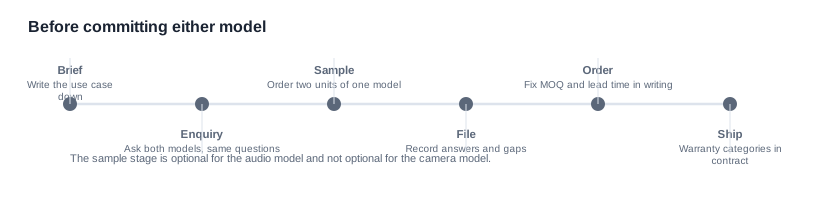
What all three profiles share is the same first question, which is why we ask it before anything else: does the end user record? A buyer who answers that question honestly has already made most of this decision.
Two further observations from the enquiries we handle. The marketplace seller consistently overestimates how much the specification table decides a purchase — in practice the shelf position and the return rate decide it, and the return rate is the specification table's fault. And the retail brand consistently underestimates how much the published row matters, because in a store the customer reads it and remembers it, so an unpublishable claim is worse there than online.
A shortlist of three questions, in the order we would send them. What does the customer do with the recording, if there is one? What has to be written on the listing that you cannot currently evidence? And what is your acceptance route when the first return comes back? A supplier's answers to those three are a better predictor of whether the order will go well than any row on either specification sheet.
What the runtime gap does not tell you
Three cautions about reading the runtime rows as a performance comparison.
First, a band is not a weakness, it is a description of a different load. Five to eight hours describes a product that does not consume power at a constant rate. Approximately eight hours describes a product that does. Neither figure is better; they answer different questions, and a listing that presents them on one scale is presenting a category error.
Second, neither test condition is published. Our documentation does not state the volume, the audio level, the camera state, the ambient temperature or the connection state behind either figure. So the runtime comparison cannot be closed from documentation at all — it can only be closed with a sample order, which is why the sample stage is not optional on this pair.
Third, the two models do not share the platform, so the comparison does not generalise. Two other models in the audio family would give a different figure against the same V06, because they run on different cell configurations. Any conclusion of the form "camera models cost X hours" is not supported by this comparison and we will not draw it. Our battery life guidance explains why a rated figure without a stated test condition is a marketing number rather than a specification.
The correct conclusion is narrow and it is enough. If you need guaranteed endurance and do not need capture, choose the audio platform. If you need capture, you accept a band rather than a figure, and you verify the band yourself before you promise it. Those are the two sentences this comparison supports, and no more.
What to write down after the sample stage, whichever model you chose. The test condition behind the runtime figure you observed. The camera parameters the supplier supplied in writing, if you took the V06. The failure modes you actually found in the sample, and which of them you have added to the incoming inspection criteria. That last line is the one that protects you at the second order, and it is the one most buyers skip.
And a boundary worth stating. The sample stage tells you about one unit, not about a production run. A sample that passes tells you the product can work; it does not tell you the factory will deliver that result at volume. That gap is closed by acceptance criteria in the contract, by a production capacity question in the audit, and by a shipment inspection route — not by ordering a second sample and hoping.
Negotiation points that decide the total cost
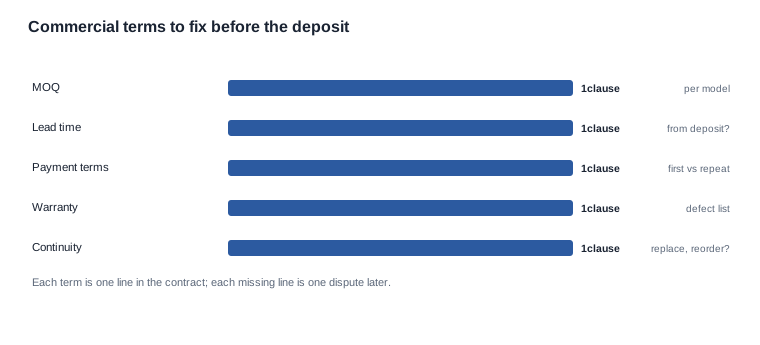
Once the model is chosen, the total cost is decided by four commercial terms, and all four are easier to fix on a first order.
- MOQ. Not published for either model. Ask for the MOQ per model and per configuration, and ask whether it is a stock MOQ or a production MOQ — they behave very differently when demand moves.
- Lead time. Ask what the lead time is measured from: deposit, artwork approval, sample confirmation or order entry. A supplier quoting 25 days from artwork approval and one quoting 25 days from deposit are quoting different products. The lead time page sets out the distinction.
- Payment terms. Ask what the deposit is, when the balance falls due, and what the terms look like on the second order. A first order and a repeat order should not carry the same terms.
- Warranty and defect categories. Ask which failures count as warranty returns and what the remedy is. A supplier who will not name a remedy has declined the claim in advance.
And two questions specific to choosing between these two. Ask whether the supplier will quote both models in one purchase order, because that decides whether your second platform costs a second transaction or not. Ask what the total cost is at your actual volume including packaging and freight, because the packaging is where a low-MOQ order quietly becomes expensive.
One more, because it is the question that decides whether you should have ordered either. Ask what the lead time to replace a discontinued platform is, not just the lead time to reorder it. A one-off platform inside a range deserves a firmer answer on continuity than a shared one, and the risk and contract terms pages cover how to record it.
And a fifth term that is easy to forget because it is not a term at all: who does the technical file. If a third party assembles it — an agent, a consultant, your own engineer — that party's scope, fee and liability have to be agreed before the work starts. Our documentation publishes specification rows, not the camera parameters behind them, so any file describing those parameters is work done with the supplier or with your sample, and it should be budgeted as a cost with a name attached.
A boundary worth stating on the audio side too. The YKC02 publishes surround sound and a long endurance figure, and neither tells you how the audio behaves in wind, in traffic or at volume. Those are sample-stage questions, and they are the questions a buyer who chose the "simpler" model is most likely to skip — because a shorter documentation list feels like a shorter risk list. It is not. The YKC02 limitations page records where the audio family's claims stop.
Our position is that this comparison has an obvious answer that buyers often talk themselves out of. If recording is not in the brief, the camera tax is pure cost and the YKC02 is the model to shortlist. We will not present the camera's runtime cost as a small detail, and we will not present the YKC02's endurance as a reason to buy it when what the customer actually wants is a recording. Tell us the channel, the volume and whether recording is in the brief, and we will tell you which one to shortlist. Both models sit on the sport smart glasses range page, with the form factor comparison in V06 and YKC02 form factor and the audio family in Bluetooth audio glasses.
Related reading
- The row-by-row form factor comparison — V06 and YKC02 form factor
- The specification rows side by side — V06 and YKC02 spec comparison
- Pre-ordering checks — V06 checks and YKC02 checks
- Where each model fits — V06 best for and YKC02 best for


