
Both of these models sit in the sport group, both charge magnetically, and they share almost nothing else that our documentation records. The V06 is a camera platform: an 8-megapixel sensor, a 260 mAh cell, up to two hours of magnetic charging, a rated runtime of five to eight hours, an IP54 marking, an ergonomic frame, a detachable inner frame and four published colourways. The YKC02 is a sport platform: Bluetooth V5.4, two 70 mAh cells, up to two hours of magnetic charging, a rated runtime of approximately eight hours and surround sound.
That is the v06 smart glasses vs ykc02 form factor question in full, and the answer is that these are not two versions of one product. They are the two halves of the sport group, and a buyer choosing between them is choosing what the product does rather than which one is better.
The warning that matters commercially is more specific than that. The IP54 marking, the detachable inner frame and the ergonomic frame are published on the V06 and the S7. They are not published on the YKC02. Treating the sport family's feature list as applying to every model in the group is the single most common listing error in this range, and it produces a customer complaint that the supplier cannot resolve.
So the useful way to use this comparison is not as a scoreboard. It is as a form factor decision: what shape of product is this range for, and which of these two shapes it already has. The V06 answers a recording brief. The YKC02 answers an endurance brief. A brand that has not decided which brief it is serving has not finished the sourcing question, and no amount of specification detail will settle it for you.
V06 smart glasses vs YKC02: two platforms, and only one shared row
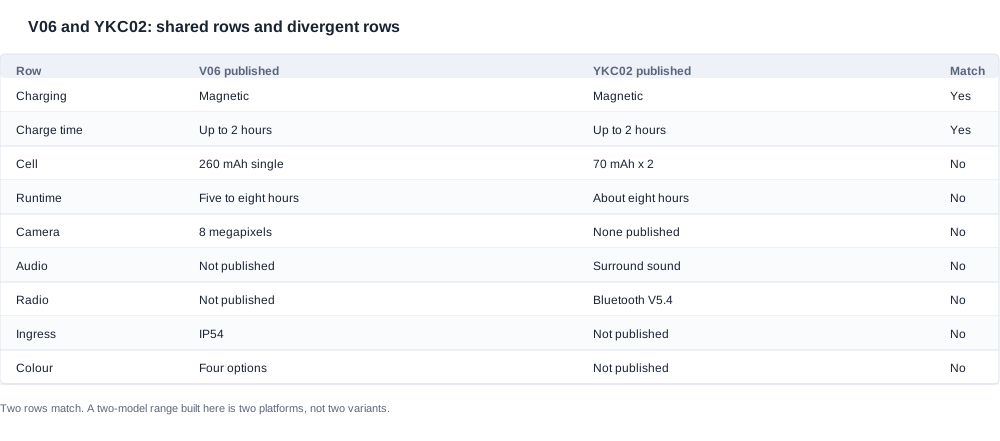
Read the two rows as columns and the comparison becomes mechanical. One row is shared: charging method. Everything else differs, and the differences are structural rather than incremental.
| Row | V06 published | YKC02 published | Same? |
|---|---|---|---|
| Charging method | Magnetic | Magnetic | Yes |
| Charge time | Up to two hours | Up to two hours | Yes |
| Cell | 260 mAh single | 70 mAh × 2 | No |
| Rated runtime | Five to eight hours | Approximately eight hours | Different |
| Camera | 8 megapixels | None published | No |
| Audio feature | Not published | Surround sound | No |
| Radio version | Not published | Bluetooth V5.4 | No |
| Ingress marking | IP54 | Not published | No |
| Inner frame | Detachable | Not published | No |
| Colour list | Four options | Not published | No |
The honest reading is that the two rows have different shapes. The V06 row is dominated by imaging and physical construction; the YKC02 row is dominated by radio, audio and endurance. A comparison chart that puts them in the same columns with blanks is showing the buyer that there is no comparison to make.
What that means for range structure. If you run both, you are running two platforms, not two colourways of one platform. That has real consequences for a brand: two technical files, two firmware branches, two incoming inspection routes and, if the platforms are as distinct as these rows suggest, two sets of tooling on the supplier's side. Our production capacity guidance is worth reading before you assume a supplier can run both concurrently at the volumes you have in mind.
And it means the amortisation argument that works between the V06 and the S7 does not work here. Those two share six rows. These two share two. A buyer who assumed the sport group was one platform with interchangeable models will be disappointed, and the disappointment shows up at the second reorder rather than at the first order.
The operational consequences are worth naming before you commit, because they are the part a specification comparison never mentions. Two platforms means two sets of incoming inspection criteria, because the failure modes of a camera assembly and a two-cell audio assembly are not the same and a single inspection route will catch one and pass the other. It means two firmware branches to maintain, and therefore two chances per year to ship a regression into a channel that has already received the first version. It means two sets of spare part planning, because a fault on one platform will not always be covered by a part held for the other.
There is a third consequence that buyers frequently discover late: the supplier relationship. A one-platform supplier has an incentive to keep you on that platform, because every reorder is the same work. A two-platform supplier has an incentive to keep you buying the platform that is hardest for you to move off. That is not a criticism of any supplier — it is ordinary commercial behaviour — but it means the second platform is worth pricing more carefully than the first, and it is worth asking directly what the second-order terms look like on each.
If the volume is not large enough to justify two platforms, the honest answer is to pick one and serve that market well. A brand with one strong listing and one colour schedule beats a brand with two listings that ship at different lead times and share a customer support route.
The camera is the fork in the road, not the frame
The single question that separates the two models is whether the end user records. The V06 has a camera. The YKC02 publishes no camera, no remote shutter and no imaging feature of any kind. Everything downstream of that — the cell size, the runtime band, the shape of the use case, the accuracy of any comparison you write — follows from it.
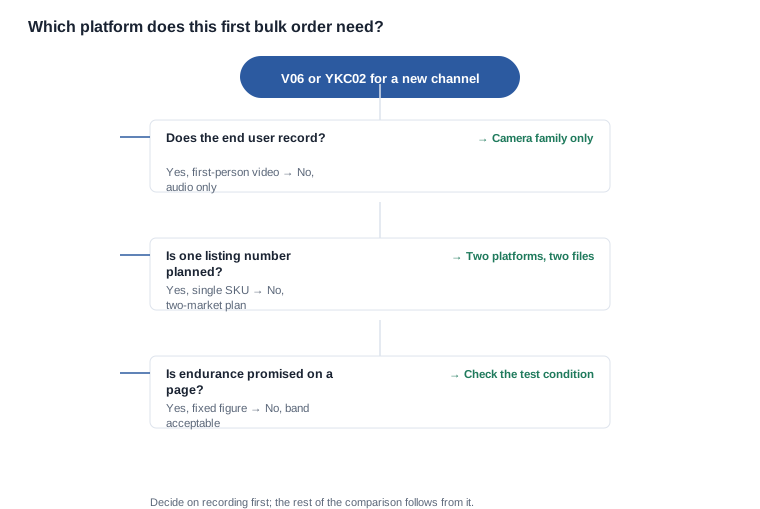
If recording is in the brief, the YKC02 is not a candidate. There is no configuration option in our documentation that adds a camera to it, and there is no published evidence that a camera-equipped variant exists. A buyer who needs both audio and capture needs one model from the camera family and one from the audio family, and that is a different sourcing decision from the one this comparison is about.
If recording is not in the brief, the camera becomes a liability rather than a differentiator. Three things follow. The cell goes up, because the V06 carries 260 mAh against the YKC02's 140 mAh total. The runtime band goes from a single published figure of approximately eight hours to a band of five to eight hours, which is harder to write on a listing and harder to promise in a contract. And the regulatory and compliance surface widens, because a device with a camera attracts a different set of questions about where the data goes than a device that only plays sound.
The honest way to describe the trade to your channel. The YKC02 publishes a longer and more consistent endurance figure because it does less. That is not a defect and it is not a marketing weakness — it is the direct consequence of removing the component that draws power. Our battery life guidance sets out why a single figure and a band are not interchangeable in a listing, and the charging solutions page covers the magnetic charging both models publish.
The mistake to avoid is presenting the YKC02's eight hours as a better battery. It is a different product doing a different job, measured on a row that does not exist for the V06. Comparing a published figure against a published band is the kind of comparison that falls apart the first time a customer tests it.
Before the camera decision is final, there is a form factor question that follows from it and gets asked later. A camera platform in this category is heavier to specify, because the sensor, the field of view, the video resolution and the frame rate all have to be described, and none of them are published for the V06. An audio platform's listing can be completed from the published row; a camera platform's listing cannot, and the gap has to be closed with the supplier's answers or with your own sample-stage findings.
That gap is the real cost of the camera, and it should be weighed before the brief is set. It is not a hardware cost — it is documentation, sample and quality control cost. A buyer who takes the camera platform is taking on a technical file that has to be assembled rather than copied, and the quality control route has to be written for the feature the customer actually pays for. The V06 pre-ordering checks are structured around exactly that.

Battery architecture, and what the two cells are actually for
The YKC02 publishes 70 mAh × 2 cells, and the pair is the reason its runtime figure holds. Two smaller cells distributed across a frame give the audio platform a steadier supply than one cell of the same total capacity would, because the load is continuous and low rather than intermittent and high.
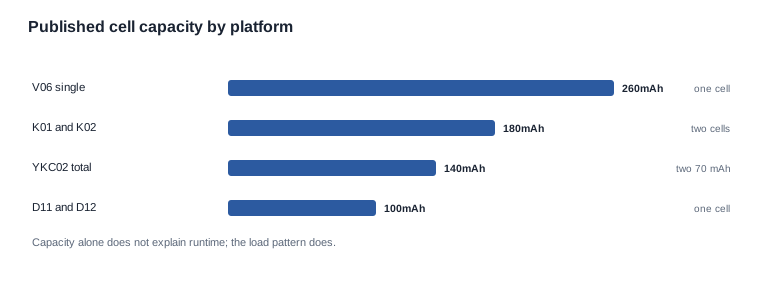
The V06 publishes a single 260 mAh cell, and the capacity is doing a different job. A camera platform has a load that spikes when it records and drops when it does not, so the cell is sized for the spike rather than for the average. This is the mechanical explanation for why the V06's published figure is a band of five to eight hours and the YKC02's is a single approximate figure of eight hours: two different loading patterns, two different ways of expressing the result.
For a buyer, the useful question is not which number is larger. It is what the number was measured under, and our documentation does not publish the test condition for either model. So the correct action is the same for both: ask for the test condition in writing, and record the answer in your technical file. The YKC02 battery rows and the V06 battery rows break both platforms down separately.
Two more things the battery row tells you about sourcing. The dual-cell platform on the YKC02 is a platform that appears once in our catalogue — 70 mAh × 2 is published on the YKC02 and on nothing else. The audio family otherwise runs on 90 mAh × 2, 55 mAh × 2 and a single 100 mAh. A brand stocking the YKC02 is therefore stocking a one-off platform, with its own qualification and its own sourcing risk, and that is a legitimate reason to negotiate harder on supply continuity than it would be for a platform shared with four other models.
And it is worth noting what neither model publishes: the shipping and transport position for the battery, and the cycle life of the cells. Both belong in the compliance conversation rather than the specification conversation, and the battery transport page sets out the frame.
A sourcing question that follows from the architecture. If you are running two platforms, ask whether both can be packed into the same carton dimension for the same freight rate, because two platforms with different case dimensions can cost more in freight than the second platform saves in margin. The logistics page covers the incoterms and packing questions that decide this, and it is worth running the numbers before you decide the second platform is affordable.
And one question about supply continuity. The dual-cell platform on the YKC02 exists once in our catalogue, which means there is no second approved source inside the range if that platform is discontinued. A single-source platform deserves a firmer answer on production continuity than a shared one, and that answer belongs in the contract rather than in a sales conversation.

Where documentation ends and a claim begins
This is the section that protects you from a listing error, so it is worth being blunt about the boundaries.
Published on the V06: the camera figure, the cell capacity, the charge time, the runtime band, the ingress marking, the frame description, the detachable inner frame and the four colour options.
Published on the YKC02: Bluetooth V5.4, the dual cell figures, the charge time, the approximate runtime, magnetic charging and surround sound.
Not published on either model, and therefore a question rather than a specification: frame weight, temple length, lens dimensions, sensor model, video resolution, frame rate, the ingress test report behind the IP54 marking on the V06, and every certificate number, issuing body and validity date in the family.
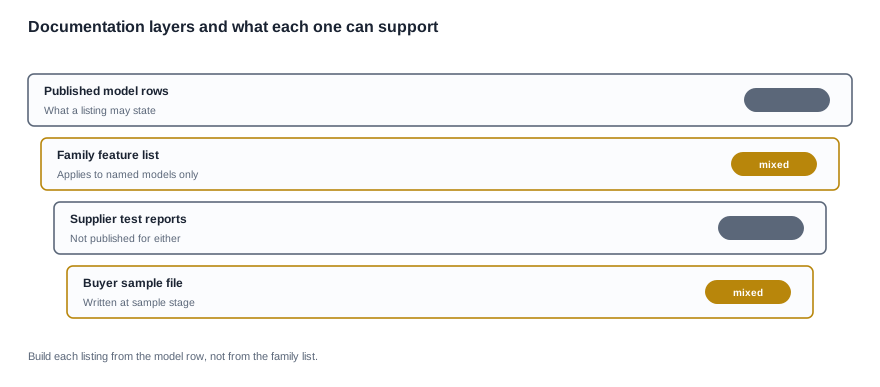
The practical rule we ask buyers to apply: build each listing from that model's own row, and treat the sport family feature list as a family statement. A listing that gives the YKC02 an IP54 marking because the family list mentions one will be wrong, and so will a listing that gives it a detachable inner frame. Our V06 certification status and YKC02 certification status pages separate what each model actually holds from what the family shares.
There is a second-order habit worth building in while you are writing the listings. Record which row each published claim came from, in the same file where you record the supplier's answers to your missing-parameter questions. When a customer disputes a claim six months after the first shipment, the difference between a defensible answer and an expensive one is usually one line in a document nobody kept.
Three claims to keep off the page entirely, for both models. The ingress marking, unless you can attach the test report that supports it — the IP rating page explains why a marking and a report are different things. The battery endurance, unless you can state the test condition behind the figure. And any comparison against a named competitor, unless you have verified it against that competitor's unit rather than against their published table.
None of those three restrictions is a marketing limitation. They are a cost limitation, and they are cheaper than the alternative. A published claim that a customer can disprove in one evening costs more in returns, in channel reputation and in the second order than the claim was ever worth. Our certification checklist covers how to assemble the evidence file so that this restriction becomes a checklist item rather than a worry.
Ordering sequence for a first bulk order
If you have never ordered either of these models, the order of operations matters more than the model. Here is the sequence we would run, and the reason for each step.
- Fix the use case in writing before you contact anyone. "Audio for outdoor and driving use, no recording" and "audio plus first-person capture" produce two entirely different shortlists, and only one of them contains the YKC02.
- Ask both questions at once. Weight, dimensions, lens material and the ingress test report are absent from both rows. A supplier who answers two of them is more useful than one who answers none, and the difference is visible in the first exchange.
- Order samples of the shortlisted model only. Two samples, not one — a single unit tells you about manufacturing variance rather than about the product.
- Test against your own acceptance criteria, written before the samples arrive, not after you have decided what you think of them.
- Fix the commercial terms while the order is small. MOQ, lead time, payment terms, deposit structure and the warranty defect categories are all easier to obtain on a first order than on the fourth. The MOQ, lead time and payment terms pages cover how each of these is normally structured.
- Negotiate a second-order price before you place the first, because the first order is where your volume argument is weakest and the supplier knows it.
Two questions to ask that most buyers skip. Ask whether the supplier will quote both models on the same production window, because running two platforms concurrently on one window changes the lead time arithmetic. And ask what happens to the lead time if one of your colours or configurations has to be re-tooled mid-order, which is the most common cause of a slipped shipment in this category.
A third question worth asking, because it changes the answer to everything above. Ask whether the two models can be sourced under one purchase order with one payment term, or whether they are contractually separate. If they are separate, your total cost calculation has to include the second transaction, the second documentation chain and the second compliance review — which is a real number, not a rounding error, and it is the number that decides whether the two-platform range is worth running.
And a fourth, which is uncomfortable and necessary. Ask what the supplier would do if the market for one platform disappeared. A one-off platform inside a two-platform range is the one most likely to be dropped, and the lead time to replace it is not the same as the lead time to reorder it. Our lead time and risk pages cover how to record that exposure so it is a number in your plan rather than a surprise.
The shortlist test: if the end user records, the V06 is the model in the sport group and the comparison ends there. If the end user does not record, the YKC02 publishes the cleaner endurance figure and carries the less complicated compliance surface. Either way, the audio family offers more models to choose from, which is set out in how the YKC02 compares across the range and in Bluetooth audio glasses.
Our position on this pair is that it is a category mistake to compare them on a single score. They are two halves of one range, and a range that carries both serves two different markets with two different products. We will not present the YKC02's eight hours as a better battery than the V06's band, and we will not present the family feature list as applying to a model it does not name. If you tell us the channel, the volume and whether recording is in the brief, we will tell you which of the two to shortlist — and the sport smart glasses range page carries both.
Related reading
- The runtime question in full — V06 and YKC02, which one to choose
- The specification row side by side — V06 and YKC02 spec comparison
- The pre-ordering checks — YKC02 checks and V06 checks
- The audio family — Bluetooth audio glasses


