
The K01 smart glasses suit a buyer whose proposition needs a documented feature — capacitive touch controls and an AI translation capability — and whose customer will actually use them. They are the only model in this range that lists a translation feature, and the only one that documents a control method, which makes them the feature model of the audio range. They are the wrong choice for a buyer selling on hardware rows, because those rows are shared with the K02.
That distinction is the whole article. A feature model and a specification model fail and succeed in opposite ways, and picking the wrong one wastes a production cycle rather than a meeting.
K01 smart glasses: a feature model on the range's most generous power configuration
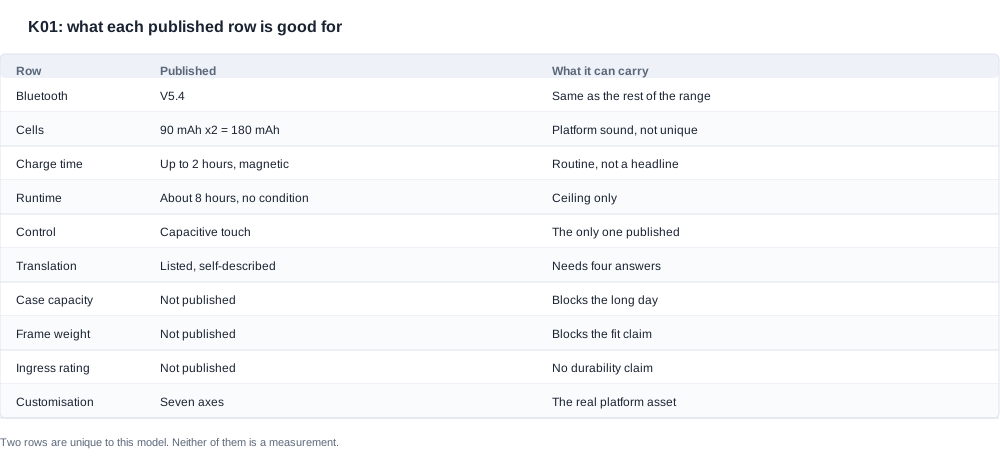
Read the published rows before the feature. Bluetooth V5.4, two 90 mAh cells, magnetic charging in up to two hours, approximately eight hours of rated runtime. Then capacitive touch control, and an AI translation capability.
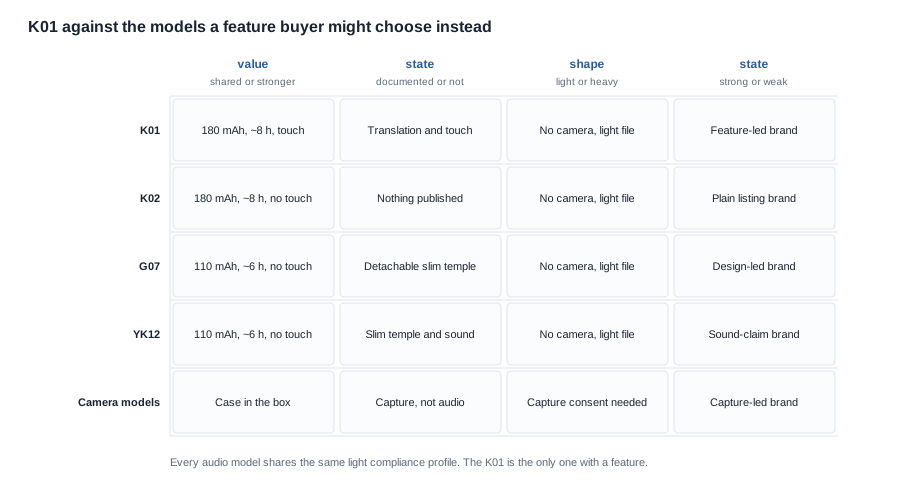
The hardware is the strongest published power configuration in the audio range: 180 mAh in total, which is more than the 110 mAh of the 55 mAh × 2 models and more than the 100 mAh of the single-cell Type-C pair. The eight-hour figure sits at the top of the published range too. Neither of those is a reason to choose the K01 over its sibling, because the K02 publishes the same configuration. They are reasons the platform is sound, and that is a different and less interesting claim.
What actually separates this model is the feature pair. Capacitive touch is the only documented control method anywhere in the range, and translation is the only documented capability. Everything that makes the K01 worth its price is a feature, and almost none of it is a measurement. That is why this article spends most of its length on how to evaluate a feature rather than how to compare a number.
One distinction has to be made early, because it governs everything downstream. The translation capability comes from our own website copy rather than from the product catalogue, which is a lower evidence level than the parameters on the same page. A buyer can describe the capability in their own listing, and a buyer who copies our wording is restating our claim and carrying it. That is not a prohibition; it is an allocation of risk, and the allocation is worth making consciously.

The four branches that decide it for the K01
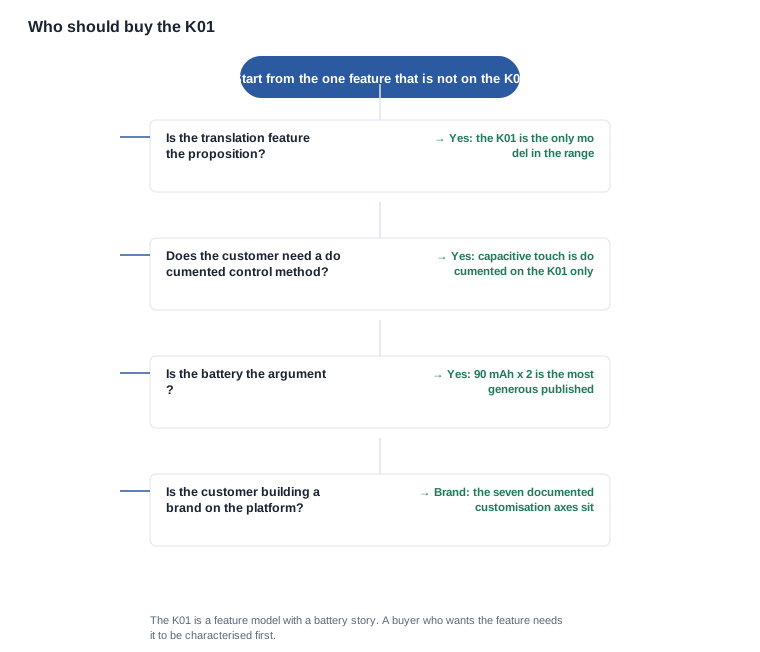
Branch one: is the translation capability the proposition? If yes, the K01 and only the K01. Four questions have to be answered before it is sold: whether translation runs on the device or in the cloud, whether it works offline, which languages are covered, and whether there is a subscription and where the data is processed. The AI feature notes set them out, and the K01 pre-order checklist covers the rest of the model.
Branch two: does the customer need a documented control method? Capacitive touch is published on the K01 and the K02 publishes none, so the K01 is the model to buy if the control method matters. It also has a known failure mode: a capacitive temple resting against a face, or a frame left on a chair, can register an unintended input. Ask how false activation is handled and whether it can be disabled, because a customer will ask.
Branch three: is the battery the argument? Two 90 mAh cells, 180 mAh in total, the most generous published energy configuration in the audio range, with about eight hours of endurance. That figure is the top of the published range and the K01 is one of four model groups reaching it, so it is a usable specification for this model rather than a differentiator. The K01 battery life analysis covers the details, including why capacity and runtime cannot be compared across this range.
Branch four: is the customer building a brand on the platform? Then the K-series is the strongest starting point in the range, because it carries the widest documented customisation axis set — logo, colour, packaging, temple shape, system and UI, Bluetooth name and firmware — with no camera and no sensing, which keeps the compliance surface manageable. The customisation path for this platform walks through the seven axes in the order they should be decided.
A fifth consideration sits underneath all four. The compliance surface of a camera product is materially larger than that of an audio product, and for a brand entering a market it does not already know, that difference is frequently the deciding factor. No camera means no image data, no storage position, no capture consent story and a materially simpler declaration of conformity. The model readiness overview maps where the sharing is documented across the range.
How to evaluate the translation capability and the touch controls
A feature claim is only worth what the evaluation was worth, and the evaluation for both features here has to happen on a sample with a written result. Neither can be judged by wearing the product for an afternoon.

For translation, test the offline case first. If the feature is cloud-dependent, airplane mode produces a failure, and the question becomes whether the product degrades gracefully or simply stops working with an error the customer cannot interpret. Test with no network and record what happens. Then test with a network, because the second failure mode is latency: a customer who presses once and gets a response after several seconds will press again, and the double activation is a different complaint entirely.
For translation, test the round trip rather than the display. Take a spoken sentence in one language, have the frame translate it, and check that the translation is of the whole sentence rather than a fragment. Then take a written sentence, because a lot of hardware translates text far better than speech, and a feature that only handles text is a different product from one that handles conversation. Record which of the two works.
For translation, test the failure case deliberately. Speak at a normal volume, speak at a quiet volume, speak with background noise, and speak with another language speaker present. Record the failure rate for each condition rather than an overall impression, because the overall impression is always better than the individual condition and it is the individual condition that generates a support contact.
For touch, test the false activation cases before the working ones. Wear the frame against the cheek for a full hour and count unwanted inputs. Put the frame face-down on a table for ten minutes and count them. Try it with a beanie, a collar and a scarf if the channel is in a cold market. A capacitive control that fires on contact is a control your customer will disable in week one, and a disabled control is a control you did not sell.
For touch, test the working cases at speed. Every documented action, in the order they appear in the instruction leaflet, performed without reading it, at least ten times each. Record which actions were unambiguous and which required a second attempt. The second-attempt figure is the number that predicts your support volume, and it is very different from the first-attempt figure.
For both, record the state that a customer can reset from. A feature that requires an app, an account or a factory reset to recover from a mistake is a feature your customer will not recover from, because they will have returned it already. Ask whether recovery is available on the device.
The buyer profiles that fit the K01
A brand whose differentiation is a feature. The translation capability and the touch controls are the two things the customer can be told about, and they are the reason the K01 costs more than the K02. In a category where most models differ only by a number, a documented feature is a rarer asset than it appears, and it is the only asset in this range that a competitor cannot match by changing a colour.
A distributor running a feature tier. The K01 sits above the K02 on a published feature, which gives a price ladder that is not built on a hidden specification difference. That matters more than it sounds: a ladder built on a real feature can be explained to a retailer, whereas a ladder built on an unstated difference has to be defended with a discount, and a ladder defended with a discount is a ladder that collapses at the first price review.
A brand that wants the widest customisation surface. The seven documented axes are on this platform family, and the absence of a camera keeps the surface manageable while the customisation depth is high. That combination — deep branding, shallow compliance — is rare and it is genuinely valuable, particularly for a brand entering a market where the product content is simple but the brand presentation has to be local.
A brand whose customer is a multilingual traveller or a language learner. This is the profile for which the translation capability is genuinely load-bearing rather than decorative. It is a narrow customer, but it is a customer who will pay for exactly this feature and will not compare the model on battery cells.
A brand whose support team is the bottleneck. The K01 has more questions than the K02 and fewer than a camera model. For a small team, that middle position is often the best available: enough documented behaviour to write a support script from, without the sensor and capture questions that a camera product generates.
And a brand that has already decided it cannot carry a photograph. There is a version of this category where the whole product decision is about avoiding capture. Distribution agreements with venue operators, employer schemes in some jurisdictions, and any channel where the customer is a minor or in a place with privacy expectations all push in that direction, and an audio frame with no sensor is the cleanest answer available. The K01 is the feature-richest audio frame in the range, which means a brand that has chosen the no-capture route does not have to settle for a plain product to get a differentiated one.
One caution applies to every profile on this list. The feature is the reason to buy and the reason to return. A customer who was sold translation and finds it accurate keeps the product and tells nobody; a customer who was sold translation and finds it does not work returns it and tells everybody. So the decision to buy this model is really a decision about your confidence in the answer to the offline question, and any buyer whose diligence process cannot obtain that answer in writing should place the order on the K02 instead, where the feature argument is not on the table.

The buyer profiles that do not fit the K01
A reseller selling on hardware rows. The hardware rows are identical to the K02, and the K01's advantages are features rather than specifications, which a customer comparing two datasheets will not see. This is the single most common way this model gets bought for the wrong reason, and it ends with a stock problem rather than a product problem.
A channel that cannot support an app. If the translation capability needs an application, the brand inherits the application, the data position and the support load, and that has to be a decision rather than a surprise. Ask for the answer in writing before the first order, because discovering it after launch means withdrawing a listing. The K01 charging options analysis covers the commercial side of the platform, and the K01 value analysis covers the commercial case.
A customer with a very long working day. About eight hours on a single figure with no stated condition, and the charging case capacity is not published for this model, so the routine a customer actually gets is not yet documented. If your customer's day is ten hours, the case is the answer, and the case capacity is the number you do not have.
A brand that needs a durability claim. No ingress rating is published for this model or any other in the audio range. A channel selling into a sport or outdoor context has to disqualify the whole family on that basis.
And a brand that cannot carry an inherited claim. The translation capability is our description. If your legal position is that you will only repeat what you can evidence independently, then a feature sourced from a supplier's marketing page is not something you can repeat, however good it is.
A buyer that will not be able to write a customer instruction leaflet is also out. This one is worth stating separately because it is not a marketing problem, it is a regulatory and a usability one. In most destination markets a consumer electronic product arrives with instructions, and those instructions have to name what the controls do. This model publishes one control method and one capability, which is enough to write instructions from — but only if you are given the specifics. If the answer is that the leaflet can be adapted from a generic template, the specific question you are avoiding is whether any behaviour can be reached accidentally, and that is the question that produces the returns.
And a buyer whose channel is entirely price-led. The K01 carries a feature premium over its own sibling, and a price-led channel will strip that premium rather than pass it on. The result is a lower margin on a higher-support product, which is the worst combination available in this range. If your channel cannot differentiate, buy the K02, which is the same hardware without the feature questions.
The pattern across all five excluded profiles is the same, and it is worth naming because it is easy to misread: none of them is excluded because the product is bad. They are excluded because the decision rests on information the product cannot supply. The K01 charging options analysis is the one to read if your concern is the long day, because it covers the accessory question that most often decides this particular choice.
What to ask before you commit on the K01
The translation questions first, because they are the ones that can disqualify the model outright rather than merely qualify it.
- Is translation on-device or in the cloud, and does it work with no network at all?
- Which languages are covered, in which directions, and is the list fixed for the life of the product?
- Is there a subscription, and what happens to the feature if the brand stops paying?
- Where is audio processed and where is it stored, and how long is it retained?
- What does the capacitive touch do on contact with skin or fabric, and can false activation be disabled?
- The endurance test condition, asked in identical words to every other model in the range, so the answers are comparable rather than individually flattering.
- The charging case capacity, and a measured packed unit weight.
- Frame weight, dimensions and the certification position for each destination market.
Then the commercial set, which applies to every model here and is equally unpublished: minimum order quantity, lead time, price, incoterms, payment terms, deposit structure and the warranty position. Ask specifically what the warranty covers on the electronics against what it covers on the frame, because a translation feature that depends on a server will be a warranty conversation eventually, and it is cheaper to define the boundary now than to argue it later.
On the customisation programme, ask which of the seven axes are available at your quantity rather than at a sample quantity, and ask for a written confirmation of what each axis costs in tooling and in minimum order. Tooling on a temple shape is a different commitment from tooling on a logo, and the difference should be visible before you commit rather than discovered at the second production run.
Then the sample and inspection set, which is short on this model and worth doing properly. Test a sample from the production line you intend to order rather than a showroom unit, and keep it — the unit you test is the unit your supplier's own records refer to if a question comes up later. Specify the acceptance result in writing before the shipment, covering the offline translation behaviour, the false activation count under each condition, and the accessories actually present in the carton. Ask for an inspection record to travel with the bulk order, and ask to see what it contains, because a record that lists only quantity and appearance will not settle a feature question.
The K01 is the right model for a feature-led proposition and the wrong one for a specification-led one, and the translation capability has to be characterised before it is written about because it is the reason a customer chooses the model and the reason it disappoints. We will not publish a language count, an offline capability or a service term, we will not present the eight-hour rating as a guaranteed working day, and we will not quote a weight, a case capacity or a certificate number that the documentation does not contain. The published K01 specification list is the honest baseline, and the K01 versus K02 comparison covers the sibling relationship.
Send us the customer, the proposition and the volume, and we will tell you whether the K01's features are the ones your channel can actually sell — and if the answer depends on a translation answer we do not hold, we will say that first.
Related reading
- The entries published for this model — K01 smart glasses specifications and features
- The feature claim in full — what to check before ordering K01 smart glasses
- The commercial rationale — K01 smart glasses value for money
Send us the customer, the proposition and the volume, and we will tell you whether the K01's features are the ones your channel can actually sell.


