
The YK12 is the only frame in the audio range that carries two of its own published features at once: a surround sound claim and a slim temple, both stated in its own configuration row. Every other model publishes at most one — the K01 publishes a translation capability and no touch control row, the D11 publishes sound, the G07 publishes a detachable temple.
And that double feature comes with the shortest published runtime in the range. Approximately six hours, against approximately eight for the K01 and the K02 and for the LC-105 pair, and approximately seven for the D11 and the D12.
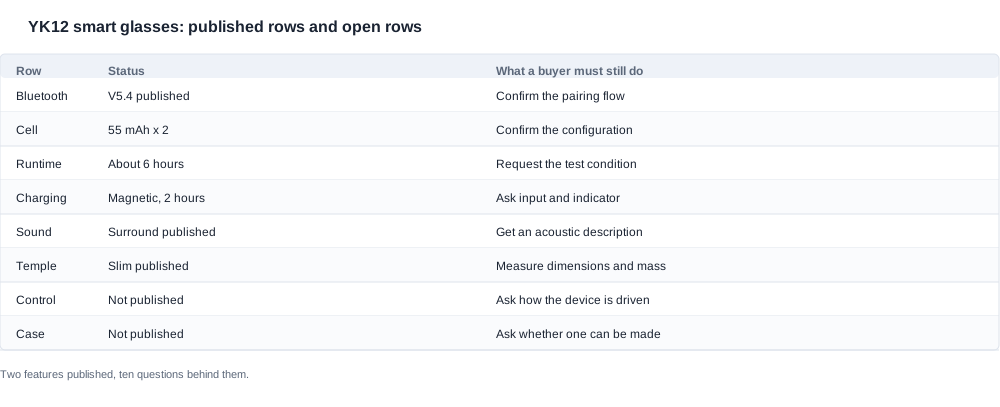
YK12 smart glasses suit a buyer who has decided that one product has to carry a sound claim and a slim silhouette, and who is prepared to own the commercial consequences of both. That is a narrow brief and a real one. The rest of this page is what those consequences actually are, what they cost, and which rows a buyer needs in writing before the purchase order is signed.
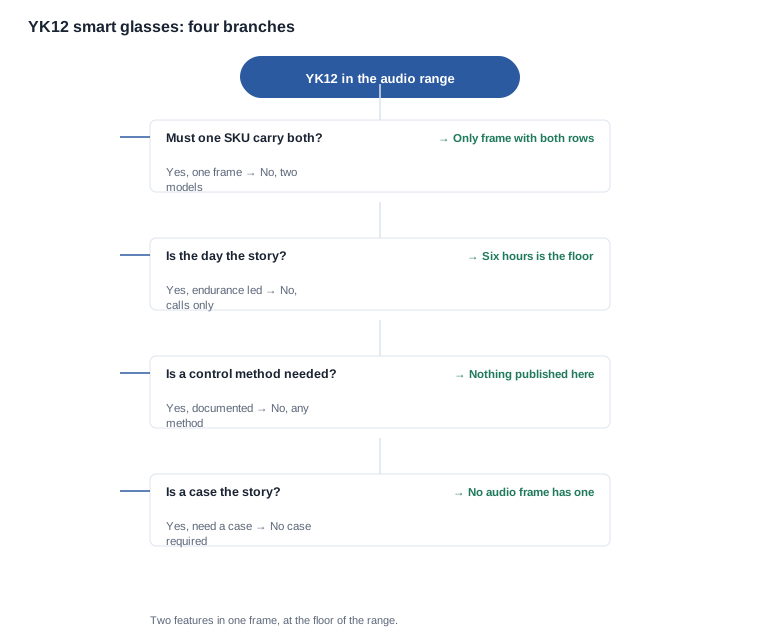
YK12 smart glasses and the two features, and what each one demands
The sound claim asks for a description rather than a number. No leakage figure, no driver size, no frequency response, no microphone count and no pickup distance is published for this model or for any other in the audio range. A listing can therefore say that the YK12 publishes surround sound and can describe the family platform, but it cannot quantify the claim. Our open-ear audio guidance covers the trade-offs that the missing numbers would have covered, and the second half of the question — what the customer actually hears differently — is a question to put to a supplier rather than a figure to assume.
The slim temple asks the customer to seat the frame. The family-level technical description includes directional audio, and directional audio works by position. A slim temple seated slightly differently on the face changes what the listener hears, and a temple that is not seated properly also changes how the frame feels over a day. On this model the adjustment instruction and the audio instruction are the same instruction, and a brand that puts one clear line in the manual — adjust the temple until the sound sits where you expect it — is doing something most open-ear listings never do.
Why that combination is commercially rare. The range has no model that publishes both rows, which means a brand that needs a sound claim and a slim silhouette in a single SKU has one candidate rather than a negotiation. That scarcity is the entire commercial case for this model, and it disappears the moment a competitor publishes a fourth row. A scarcity argument should be treated as a timing argument, not a durable one, which is why the copy built on it should be written so it can be rewritten when the range changes.
And the trade-off behind picking it over two models. A brand that takes the K01 and the G07 instead of this frame buys a documented touch control and a documented detachable temple, at the cost of one more SKU, one more packaging specification, one more accessory line and one more minimum order quantity. Those four extra costs are real and they recur on every reorder, while the benefit of this model is a single shelf position that can carry two features at once. The right comparison is not unit price against unit price; it is the annual cost of operating one extra SKU against the annual margin of one extra shelf position that can be sold two ways. Buyers who run that comparison honestly usually find that the single-SKU answer wins in a channel with slow stock turns, and loses in a channel with fast ones — because the extra SKU's cost is fixed per order while the extra shelf position's value scales with volume.
The version of this decision that goes wrong. Picking this model because it has two features and then discovering that neither can be described to a customer, because the acoustic figures are unpublished and the control method is unpublished. That outcome is entirely avoidable at the sample stage, and it is the reason the two verification questions below are the first item on the list rather than the last.
What the six-hour rating asks a buyer to accept
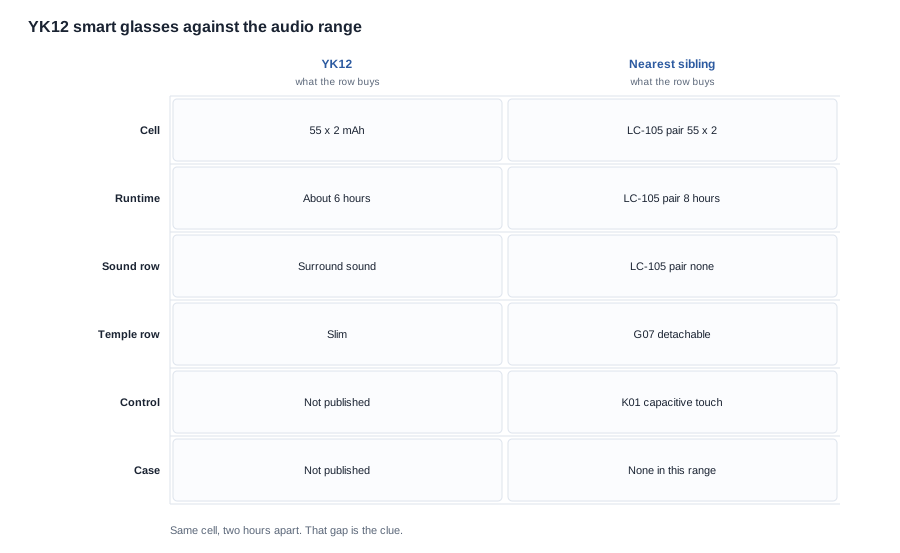
Six hours is at the bottom of the published range, and no test condition is published for any model in it. The G07, on the same 55 mAh × 2 cells, also publishes approximately six. The LC-105-1 and the LC-105-2 publish approximately eight on exactly the same cells, the same charge time and the same charging method. A two-hour spread on identical hardware cannot be explained by the product, because the electronics and the cell are the same.
The two-hour spread is the most useful piece of evidence in this model's documentation, because it points at the missing test condition rather than at a slower product. The likely explanations are all measurement conventions: continuous playback against intermittent use, a fresh cell against a cycled one, an active Bluetooth link against an idle one. None of those is published for any model in the range, which is why the method for comparing runtime figures matters more here than on any other model in the range.
The commercial consequence is a routine, not a battery. The YK12 is an all-day frame with a mid-day top-up, and the pattern that makes that work is simple: the dock lives in one place and the frame goes back on it when it comes off. The charging options analysis sets out that routine in full. A customer who expects two full days without charging is outside the published assumption, and a listing that implies otherwise produces a first-week return that no supplier policy can absorb easily.
And the rule that follows for a buyer comparing models. Do not rank this model against the LC-105 pair on runtime. Compare the answers to the same question asked identically to each supplier, and compare the answers rather than the figures. A buyer who does that will usually find that the six hours and the eight hours describe two different measurement profiles rather than two different products — and that finding is worth more than either number.

Which buyer profile closes, and which one should not, for the YK12
A brand whose product is a single hero SKU and whose customer is aesthetic-led as much as function-led. A slim temple and a sound claim together give a listing something to say that a plain frame does not, and this model is a stronger choice for an apparel or lifestyle channel than any of the plainer audio frames in the range. The six-hour figure is close to that channel's actual behaviour, because the customer in that channel is usually in and out of the product rather than in it continuously.
A brand whose product has to do two jobs at once and does not have room for two SKUs. The LC-105 models publish no feature at all; the G07 publishes a detachable temple but no sound claim; the D11 publishes a sound claim but no temple description. If the brief requires a sound claim and a slim temple in one frame, this is the only model in the range that provides both, and the alternative is two SKUs where one was planned.
A brand serving a channel where calls and meetings dominate the customer's day. A six-hour rating covers an intermittent call pattern easily, and magnetic charging means the customer can top it up between uses without finding a cable. This is the profile for which the short runtime is not the constraint it sounds like.
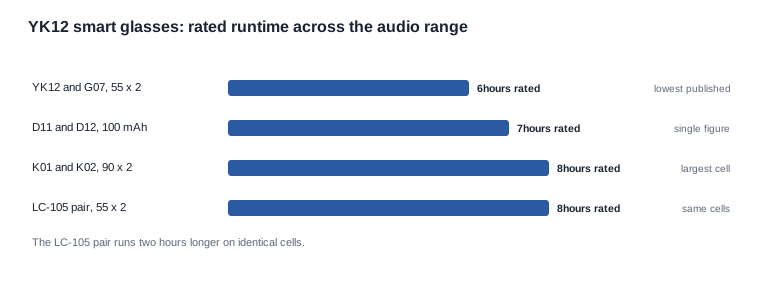
The buyer it does not suit: a brand whose product is primarily endurance. Six hours with no case is the weakest combination in the audio range. The K01 and the K02 publish approximately eight hours on the largest total capacity in the range, and the LC-105 pair publish approximately eight as well. If the customer's day is the story, this is not the frame, and the decision should be made on the runtime row before anything else is discussed.
The buyer it does not suit: a brand whose product needs a documented input method. No control method is published for this model, and the K01 is the only model in the range with capacitive touch published. A listing built on tap-to-answer is a listing about a different model, and it is one of the most common inheritance errors in the audio category.
The buyer it does not suit: a brand whose retail story is a charging case. No model in the audio range publishes one. The camera family does — the L1 Pro and the CY03, and the CY05 — each at 1400 mAh, the MT6 at 1200 mAh with a documented folding form, the L2 Utral at a 900 or 1400 mAh option — and if the case is the proposition, that is where the proposition lives.
The buyer it does not suit: any channel with an outdoor or near-water brief. No ingress rating is published for this model or for any other in the audio range, and the sport family exists precisely because that marking is available there. On this model the honest position is that the question has not been answered, and it should be asked in writing rather than inferred from the range it sits in.
Verification steps and the criteria before the purchase order for the YK12
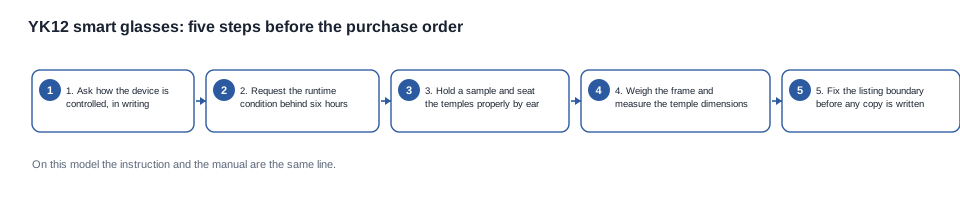
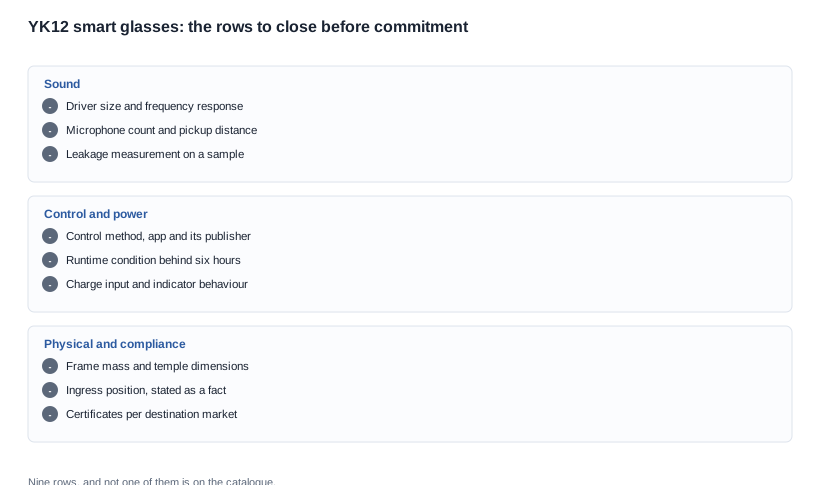
Ask the two questions nobody publishes. First, how is the device controlled — device buttons, capacitive surfaces on the temple, an application, or some combination? And if there is an application, who publishes it and who operates it, because a brand depending on somebody else's application inherits somebody else's release schedule. Second, what does the surround sound claim sound like differently, in words, on a sample, compared with the same frame without it. A brand that cannot answer both of those cannot write a defensible product page for this model, and no amount of copy skill substitutes for the answer.
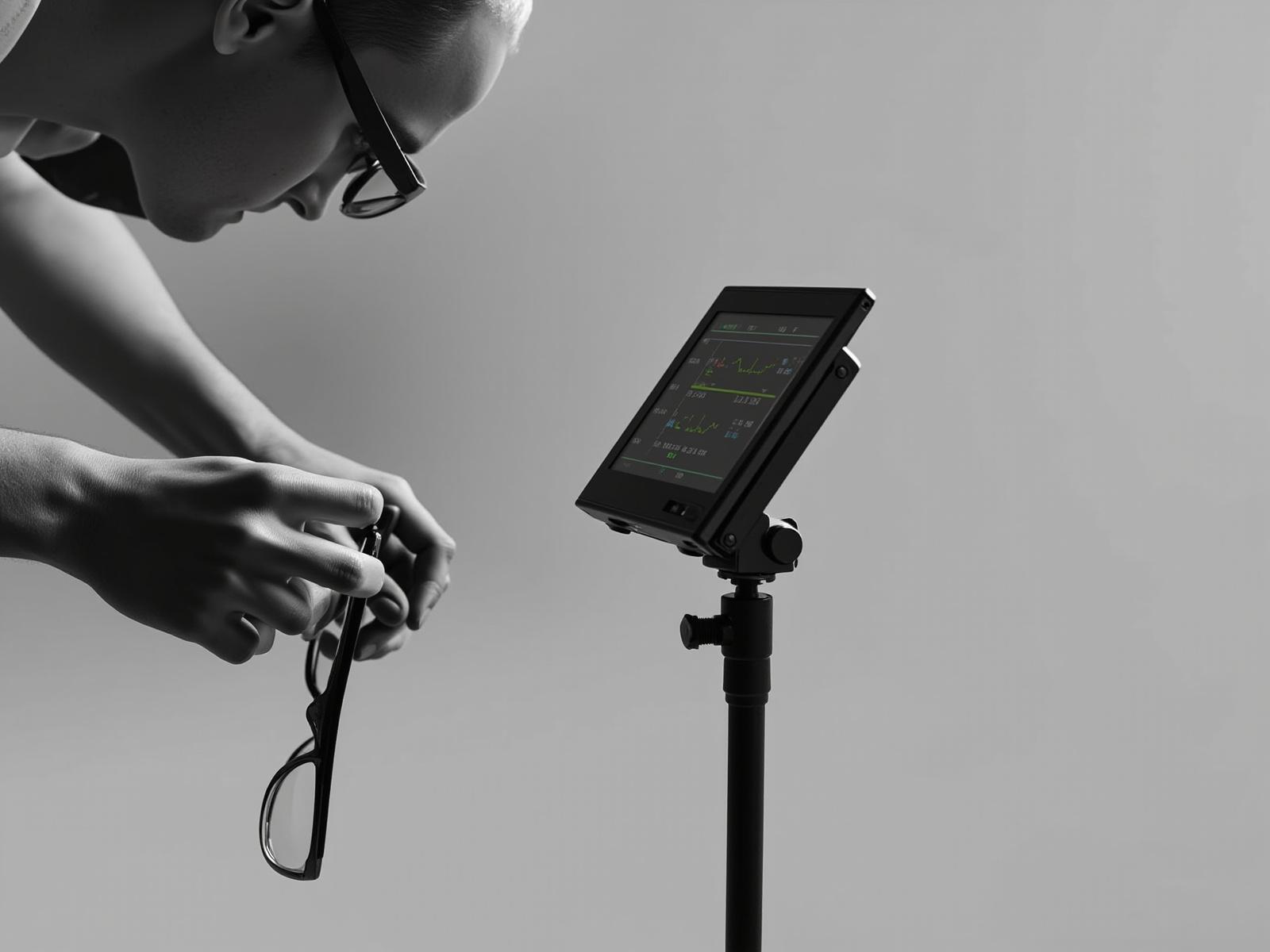
Hold a sample and seat the temples by ear. This is the test that matters most on this specific model, because the seating adjustment affects the audio as well as the overall feel. Listen with the temples seated as they would be after a day's use rather than as they arrive in the box, and record whether the sound image changes. A buyer who skips this test will write a manual that does not match the product.
Weigh the frame and measure the temples. The slim temple is a weight-related claim and the weight is not published, so the number that would substantiate the feature is exactly the number that is missing. Our weight comparison across the audio range explains why a proxy from another model cannot be used, and sizing analysis across the range covers what a sizing claim would need.
Request the runtime condition behind six hours. Ask whether the Bluetooth link was paired and active throughout, what was playing, and whether the sample was the production configuration on a new cell. Ask the same three questions of the supplier of the LC-105 pair and compare the answers. If the answers differ, the two figures describe two profiles and the model comparison is invalid.
Fix the listing boundary before the copy exists. Published rows you may print: the Bluetooth version, the charge time, the cell configuration, the rated runtime as a rating, the charging method, the surround sound claim and the slim temple. Open rows you may not: the control method, the acoustic figures, the frame mass, the temple dimensions, the ingress position, the case, the minimum order quantity, the lead time, the price and the certificate coverage.
Turn the listing boundary into a packaging check, not only a copy check. Every row on the open list has a second place it appears, and each of those is a place where an unverified feature becomes expensive. The control method appears on the packaging as an icon or a word; the runtime appears as a single number on the back panel rather than as a range in the specification table; the surround sound claim appears in a marketing line where a quantified version is easy to write by accident; the slim temple appears as a design note that implies a measured weight. A buyer who walks the artwork against the open-row list before approval catches four of these in ten minutes, and a buyer who catches them after the artwork is approved catches them through a reprint.
Terms, red flags and the position we take on the YK12
What this model's position is worth commercially. A two-feature SKU on a platform that already carries three models, which means the accessory family, the packaging format and the cell configuration are shared. For a brand building a range rather than a single product, that is the argument for choosing it; for a brand launching one product, it is a neutral fact.
Open to negotiation, and worth the time. Unit price and volume tiers across a bulk order; the magnetic dock or its equivalents as a separate accessory line with its own minimum order quantity; packaging specification; delivery splitting so a first tranche can be validated before the balance ships; payment terms with nodes against inspection rather than against shipment; the warranty period with a stated response time; return terms for defective units; and the terms of a pilot order. The dock is the line most often bundled silently into a standard package, and the question of whether it can be reordered separately decides whether a mid-season channel can serve a replacement.
One part of the cost structure is outside the negotiation entirely. Certification cost and lead time are set by the procedure and by the testing body. Tooling is the line that deserves the question instead, because it is frequently amortised across a first order while certification cost is charged per product family — and a single bundled quotation for the two hides which is which until the second order arrives.
Red flags worth naming at the quotation stage. A supplier who describes a control method without confirming it for this model. A supplier who quotes a runtime point figure where a range or an approximation is what the documentation supports. A supplier who offers a case for this model without a capacity. A supplier who quotes a frame weight by reference to a neighbouring model on the same cell. And a supplier whose minimum order quantity, lead time or price arrives without any of the three being stated as current.
An internal note we would rather state than hide. Our own internal documentation currently holds three conflicting minimum order quantity figures for models in this family that have not been arbitrated. We will say that rather than present one of the three as settled, and it is the reason any minimum order quantity in a quotation should be treated as a figure to confirm rather than one to plan a launch around.
The same caution applies to lead time and to price, for a different reason. Neither figure is published anywhere in our documentation, which means a quotation is the only source for both and the buyer is comparing a quoted number against no baseline at all. The practical instruction is to require each quotation to state its validity period, and to treat any figure that arrives without one as provisional. A price that was quoted eleven weeks ago against a raw material position that has since moved is not a price, and a buyer who accepts one has not negotiated anything.
Where we stand. Our position is that this model is the range's answer to a specific brief — one frame, a sound claim and a slim temple — and that a buyer without that brief should spend their attention on a plainer model with a longer published runtime. We will not add a number to the sound claim, we will not present six hours as a two-day battery, and we will not quote a weight, a control method or a certificate number that the documentation does not contain.
Clauses for the agreement. The published rows for the configuration ordered; the control method confirmed for this model name; the runtime condition; the acoustic description agreed in writing; the frame mass and temple dimensions as measured; the ingress position stated as a fact; the minimum order quantity, lead time and price for the configurations ordered; and the warranty period with a stated response. Clauses to leave out entirely: any quantified acoustic figure, any weather claim, any runtime figure presented as a working day, any weight not measured on your own samples, and any feature inherited from a neighbouring model in the same family.
Tell us the brief, the channel, the volume and the target market, and we will tell you whether this model fits it or whether another one in the range does. The family is on our Bluetooth audio glasses range page, the model detail behind the longer runtime is in LC-105 comparison, and the open rows are collected in YK12 limitations.
Related reading
- The model placed in the whole range — YK12 best for
- The gaps on this model — YK12 limitations
- How an open-ear frame actually behaves — open-ear audio
Tell us the brief, the channel, the volume and the target market, and we will say whether this model fits it.


