

Same platform, same 290 mAh cell, same charge ceiling, same 1400 mAh charging case, same rated runtime, and — this is the part that catches people — the same charging method gap, because our catalogue publishes no charging method row for either model. The only published difference between the CY05 and the L1 Pro is the camera: 8 megapixels against 13.
That makes this the easiest decision in the camera range and the one where a buyer's instinct is most often wrong. The instinct is that a higher pixel count means a better product, and the correct response is that a pixel count is a tier label, not a quality measurement, and that the whole argument for the 13-megapixel model rests on a sensor specification neither model publishes.
This page is written for the buyer deciding which of the two carries which listing, and it sets out the branches, the one axis that actually separates them, what the pair does not settle, and how to build a two-tier range without a quality claim you cannot support.
Cy05 and L1 Pro: one published axis and the argument it has to carry
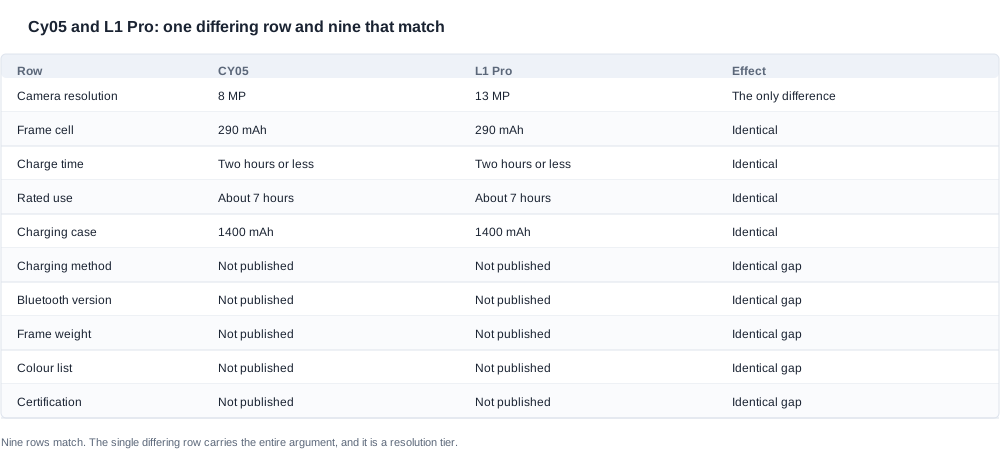
Ten rows are published across the two catalogue entries. Nine of them are identical, and one of them differs.
| Row | CY05 | L1 Pro | Effect |
|---|---|---|---|
| Camera resolution | 8 MP | 13 MP | The only difference |
| Frame cell | 290 mAh | 290 mAh | Identical |
| Charge time | Two hours or less | Two hours or less | Identical |
| Rated use | About 7 hours | About 7 hours | Identical |
| Charging case | 1400 mAh | 1400 mAh | Identical |
| Charging method | Not published | Not published | Identical gap |
| Bluetooth version | Not published | Not published | Identical gap |
| Frame weight | Not published | Not published | Identical gap |
| Colour list | Not published | Not published | Identical gap |
| Certification | Not published | Not published | Identical gap |
The single differing row has to carry the entire commercial argument for running two models, and it is a resolution tier. That is a weaker foundation than it looks, and the reason is worth stating carefully.
A megapixel count describes how many pixels a sensor has, not how large they are. A 13-megapixel sensor with small pixels can produce a worse image than an 8-megapixel sensor with large ones, because the quantity of light each pixel gathers is what sets the noise floor, the low-light behaviour and the usable detail. Neither the CY05 nor the L1 Pro publishes a sensor model, a pixel size, an aperture, a field of view, a video format or a frame rate, so the published evidence does not settle which of the two produces the better picture in any condition a buyer can describe.
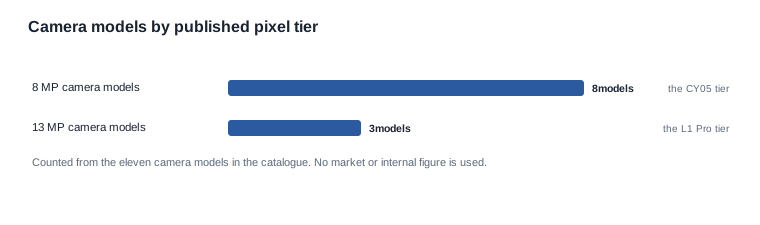
Where the tier does hold up. There is one context in which a resolution figure carries real weight: content that is published and then re-encoded. A first-person clip uploaded to a platform that re-encodes aggressively, and watched on a phone screen, benefits from more captured detail than the same clip captured at a lower resolution. That is a shelf argument, and it is a legitimate one — it just is not a quality argument, and the two should not be confused in a listing.
Four use-case branches the CY05 and L1 Pro pair can settle
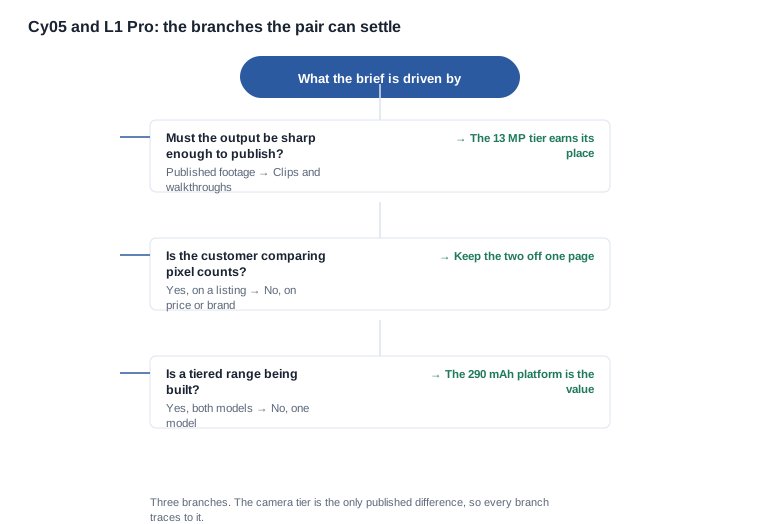
Does the output have to be sharp enough to be published? If yes, the L1 Pro is the model whose published row matches the brief. If the output is a product walkthrough, a training clip or a livestream, then nothing in the brief asks for more than the 8 MP resolution tier, and on the published rows that tier is sufficient on its own. This is the branch that decides most cases, and it is worth being honest that the decision usually goes the other way from what a buyer expects.
Is the customer comparing pixel counts in a listing? If yes, the two published rows differ by exactly one figure, 8 MP against 13 MP, and that is the only axis on which the pair is separable at all. Setting them in the same comparison table lets a customer read pixel count as the single axis, which the published rows do not support. If the customer buys on price, on the case, or on the brand, then the resolution is an internal decision about your range rather than a sales argument, and it belongs on your internal comparison sheet only.
Is the customer building a tiered range? Then both, and this is the strongest argument for the pair. The two sit on the same platform rows — 290 mAh, a rated runtime of about seven hours, a charge ceiling of two hours or less, no published charging method row, a 1400 mAh case — and the single published line that separates them is the camera resolution, 8 MP against 13 MP. A range built on that structure means one firmware branch, one app, one accessory family and one box structure. The model readiness overview sets out how that sharing works, and the OEM ready pricing tiers page covers the commercial structure around it.
Is the product used for a whole shift? Both, and this branch does not separate them at all. The same 1400 mAh case, the same 290 mAh cell and the same rated runtime are published for each model. A buyer leading a product page on endurance is not choosing between these two models, and if that is the whole of the brief, the pair is one product with two names.
The branch that is really about the brief, not the model
There is a fifth question sitting underneath all four, and it decides more of these comparisons than the pixel tier does: what does the customer actually do with the product? If the customer captures and edits at a professional standard, the camera tier matters and the missing sensor specification becomes the critical gap. If the customer captures for a listing and never touches the file, the tier barely matters and the case, the runtime and the colour line matter more.
A buyer who writes that brief down before choosing will find that the camera tier decision falls out of it, and a buyer who chooses on the tier first will find themselves with a justification rather than a brief. That ordering is the single most transferable thing on this page, because it applies to every model pair in this range.
What the CY05 and L1 Pro pair does not separate
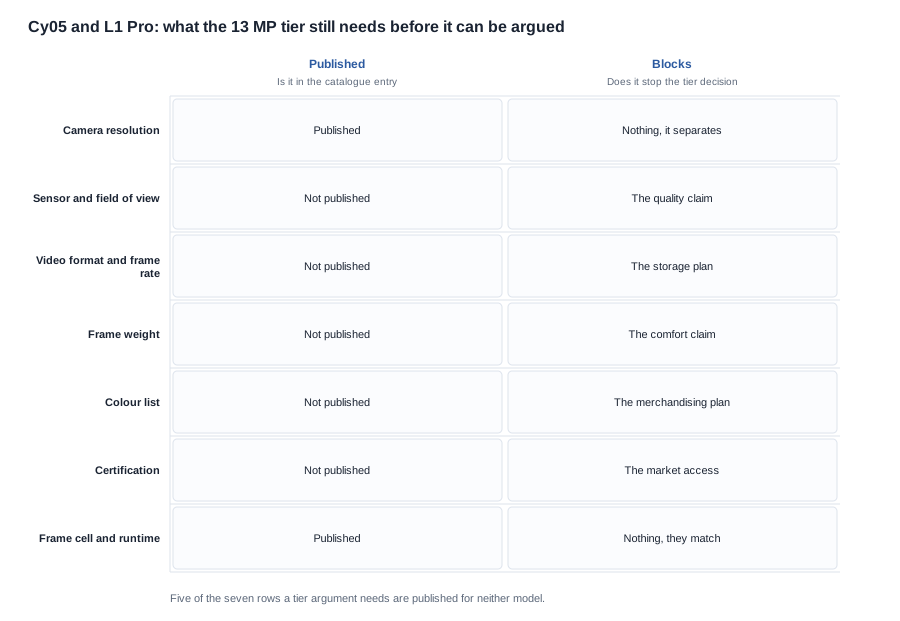
Nine rows match, and four of those matches are gaps rather than values. Those shared gaps are the part of this comparison that a buyer should plan around, because they are cheaper to close once for the platform than twice for the models.
The camera gap applies equally to both. Sensor, field of view, video format, frame rate, storage arrangement and low-light behaviour are not published for either model. The L1 Pro specification list and the CY05 specification list show the published baseline for each, and the camera imaging guidance explains why the sensor and the field of view are the two numbers that settle the argument.
Neither publishes a charging method. Across our catalogue, seventeen models publish magnetic charging and seven publish a Type-C interface, and four camera models publish nothing: the CY05 and the CY03, and the MT6 and the L1 Pro. Because both models in this pair fall into the fourth group, one request closes the gap for both of them, and the answer determines the box contents, the accessory list and the in-box cable for the whole pair.
Neither publishes a weight, a frame dimension, a colour list, an endurance test condition or a certification position. These are shared gaps too. A single company-level export certification page appears in the catalogue with images rather than text on it, and no CE, FCC or RoHS reference appears in the catalogue text; there is no per-model certification row for either model. So a certification position for the pair, in each destination market, has to be requested as written material, and a document that names one model designation does not automatically cover the other.
What a single-axis pair does to a range structure
A range built on one axis has a particular shape, and it is worth naming because it is often mistaken for a weakness when it is really a constraint.
It cannot be defended on the axis it does not have. If the two models are published side by side, the shopper compares them on the resolution row and on nothing else, because there is nothing else in the data. If the resolution difference is not visible in your channel — which it will not be, on a listing that shows a single product — then the pair is competing with itself.
It is strong everywhere else. One platform, one firmware branch, one accessory family, one packaging specification and one set of documentation means the marginal cost of the second model is a different sensor tier and a second listing, not a second product. For a brand whose operating cost is dominated by how many distinct products it has to support, that is the part of the pair that actually pays.
It needs a second axis in the copy, not in the data. The way round the first problem is not to invent a specification difference. It is to give the two listings different jobs — different use cases, different channels, different documentation packages — so that the customer arrives at one of them for a reason that is visible on the page.
The commercial cost of running two models on one axis
Before committing to the pair, it is worth writing down what running two models costs, because on a single-axis pair the fixed cost is high and the variable cost is low.
The fixed costs are platform costs, and the pair halves them. One qualification programme, one app, one firmware branch, one accessory family, one packaging specification and one certification file across both models rather than two of each. That is the argument for the pair, and it is the strongest argument available, because it is the only one that does not depend on the sensor specification we do not have.
The variable costs are listing costs, and they are not small. Two product pages, two sets of photography, two sets of artwork, two stock lines, two sets of support scripts and two returns paths. On a range where the models differ by one published row, a buyer should ask whether the volume model justifies the second listing's operating cost before asking whether the second model is better.
The risk cost is the one that gets underestimated. Two models on one axis, listed side by side in a marketplace that compares listings automatically, will be compared on the axis they share nine rows of, and the shopper will conclude they are the same product. A brand that has built a range strategy on one axis has to be certain the shopper cannot see the other nine rows, because if they can, the strategy does not survive contact with the channel.
How to evaluate that risk. Ask yourself two questions before you order. Does the customer reach both listings for different reasons, and can those reasons be written on the page in a sentence? If both answers are yes, the pair works. If either answer is no, the sensible alternative is one model on this platform and a second model from a different one where the axis is genuinely different — the 13-megapixel S7 sits on a different power block with an ingress marking and a removable inner frame, and the range selection guide covers how those axes combine.

Building a two-tier CY05 range without an image quality claim
The method for building this pair is straightforward and it has three steps.
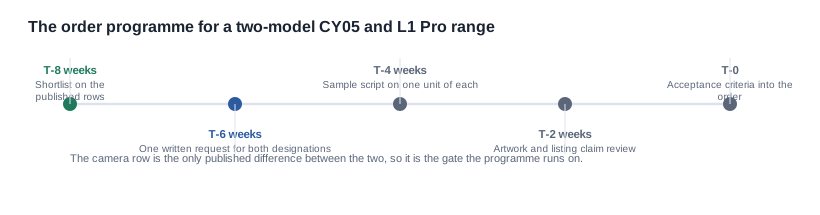
Write the use-case briefs first, one per model. Not features — situations. What the customer is doing, what they are capturing, who sees it and what happens to it afterwards. The model that matches the harder brief takes the 13-megapixel row, and the model that matches the ordinary brief takes the 8-megapixel row. If both briefs turn out to be the same, the pair is one product and the range should say so.
Then check the brief against what is published. A brief that depends on image quality needs the sensor specification, the field of view and the video format, and our catalogue publishes none of them for either model. That does not disqualify the model; it makes the sensor specification a procurement question with a deadline attached, and it is the first item on the request list.
Then write the listing so the difference is the use case, not the pixel count. "13 megapixels" on a product page invites the comparison that the data cannot win. A description of what the product is for does not. This is not a copywriting preference; it is the point at which the argument either holds or does not, because a shopper who has been told two products are for different things does not need to be persuaded about the sensor.
The five questions to close before the tier is decided
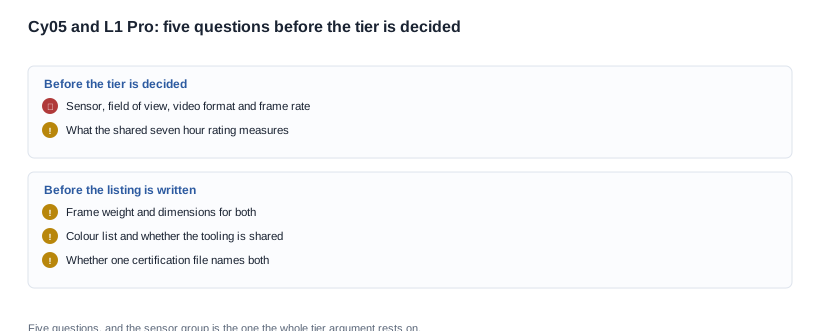
- Sensor model, field of view, video format and frame rate, for both. The tier argument cannot be made without the first two, and the storage plan cannot be made without the last two.
- The endurance test condition behind the shared seven-hour rating. Both models publish the same figure with no condition, and on a camera product the workload is the question rather than the number.
- Frame weight and dimensions, for both. These decide whether either can be sold with a number rather than a description.
- The colour list for each, and whether the tooling is shared. A range where the two models take the same colourway needs only one set of packaging.
- The certification position for each model, and whether the reports name them both. A document that names the CY05 does not automatically cover the L1 Pro.
How to evaluate the answers. Each one must be tied to a model designation, must state the configuration it was measured on, and must say what it excludes. A reply that answers at the family level has not answered, and the reason that matters here is specific: the CY03 and the L1 Pro, and the CY05 all publish identical power rows, so a family-level reply for any of them is a plausible reply for all of them. The red flags to watch for are a figure with no date, a case description given by what it does rather than by what it holds, and a certification answer that names one designation where the range needs two.
And what to do with the answers once they arrive. The criteria for the tier decision are: does the sensor specification support the use case you wrote down, does the endurance condition match the workload in that use case, does the weight figure allow the product to be described with a number, and does the certification position cover both designations in every market you intend to sell into. A buyer who assesses the replies against those four criteria can record a decision and defend it; a buyer who assesses them against the appeal of a 13-megapixel figure cannot.
The commercial terms to obtain alongside them. Our catalogue publishes no unit price, no order minimum, no lead time and no quantity break for either model, so the tier decision has to be made alongside a quotation rather than in place of one. The terms worth obtaining for both models are the order minimum at each quantity break, the production capacity and the committed lead time, the colour and packaging availability, whether the 1400 mAh case ships by default, and the certification scope per market. Ask for them as a table for the two models side by side, and a table makes the point that a paragraph hides: if the terms match as well as the rows, the pair is a platform decision rather than a product one, and it should be recorded as such.
Our Cy05 and L1 Pro position on the tier
The L1 Pro and the CY05 are the same product commercially except for one published row, and the L1 Pro's value lies in the argument it makes possible rather than in the 13-megapixel figure on its own. We will not present the 13 megapixels as an image quality claim without a sensor model and a field of view, because the published data does not support it for either model. We will not present the shared rated runtime as a reason to prefer either. We will not quote a weight, a colour list, a charging interface or a certificate number that our documentation does not contain, and we will not extend the 158 g figure published for the MT6 to either model in this pair.
We will also say plainly that if a brand intends to run both, the sensible next step is not a second quotation — it is one written request covering the sensor specification, the endurance condition, the frame weight and dimensions, the colour list, the charging method and the certification position, with the answers required at model level. Six items, one message, and the tier decision becomes a decision rather than an assumption.
The AI camera glasses range guide covers the wider range decision, and the AI camera glasses battery comparison sets out where both models sit on the published power rows. The CY05 value analysis covers what the 1400 mAh case contributes to the commercial case, and the CY05 battery life analysis takes the shared seven-hour rating in more detail.
Related reading
- The published rows for the L1 Pro — L1 Pro smart glasses specifications and features
- The published rows for the CY05 — CY05 smart glasses specifications and features
- The platform structure — OEM ready platforms which models are ready
Send us the channel, the target market and the volume, and we will tell you whether the tier ladder belongs on this platform and which figures have to be closed first.


