

The CY05 smart glasses publish five rows: 8 megapixels, a 290 mAh cell, a charge time of two hours or less, a rated runtime of about seven hours and a 1400 mAh charging case. They publish no price, no price tier and no cost per unit, so this page is not going to tell you which model is the cheapest or which is the best value. What it will do is tell you which published row settles each part of a value argument, which questions you have to ask before the argument can be made at all, and where the argument breaks down if the answers come back badly.
That distinction is worth stating at the top, because the phrase "value for money" in this category usually means one of three different things and only one of them can be answered from a specification sheet. It can mean the ratio of capability to unit price, which needs a price we do not publish. It can mean the fixed cost of adding one more model to a range that is already qualified, which can be argued entirely from published rows. And it can mean the delivered cost of a unit once the case, the carton and the transport paperwork are counted, which needs four measurements that are not published. Two of those three are worth a page each, and one of them cannot be written at all.
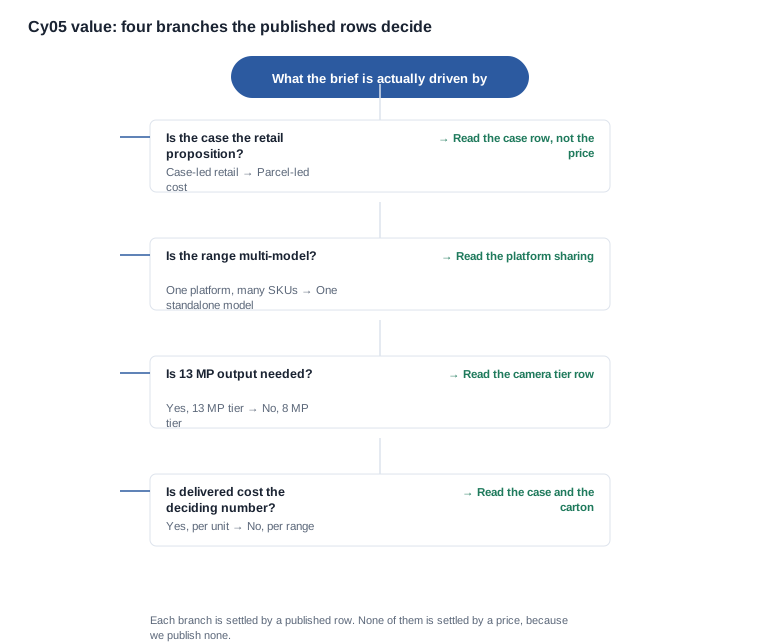
The organising idea is simple: every value claim has to name the row it is standing on. If a claim cannot be traced to a published row or to a measurement you have taken, it is not a value claim — it is a preference, and a procurement file that mixes the two is a file that cannot survive a finance review.
Four branches the CY05 published rows decide cleanly
Is the all-day case the retail proposition? Then the row that settles it is the 1400 mAh charging case, and the model carrying the largest published case capacity in the camera range is the one to look at first. That case is roughly five times the frame cell — a derived comparison, not a published figure — and it is what makes a customer believe the product can be used through a working day rather than for a session. It is also the case that appears in the product photograph, and a customer who sees it in the listing and receives it in the box is the point of the whole exercise.
Is the customer building a multi-model range? Then the row that settles it is the 290 mAh platform. The CY05 sits on the same power block as the CY03 and the L1 Pro, and the L2 Utral, which means one app, one firmware branch, one accessory family and one box structure across the four. The model readiness overview sets out how that sharing is normally structured, and the OEM ready pricing tiers page covers the commercial structure around it — where the tiers come from, and why they are not the same thing as a price tier on a single model.
Does the output have to be sharp enough to publish? Then the row that settles it is the camera tier. Eight megapixels places the CY05 in the larger of the two camera tiers in our range, alongside the CY03 and the V03 Pro, the KY06 and the MT6, and the V06 and the V03, and the MT5. Thirteen megapixels is the L2 Utral and the L1 Pro, and the S7. The L1 Pro versus CY05 use case comparison covers the decision at model level, and it is the right place to read what a tier can and cannot carry commercially.
Is the delivered cost per unit the deciding number? Then the CY05 is not where you start, because the 1400 mAh case is a second lithium cell in every unit and it changes the packed weight, the carton, the freight class and the battery transport documentation. At volume this is the largest single line in the delivered cost, and it is a line you can see in the published rows even though you cannot price it yet. The shipping weight analysis covers the arithmetic and the charging case options piece covers the accessory trade-off.
The branch that this catalogue cannot answer at all
If "value for money" means capability against unit price, then this page has nothing to offer you, and it would be dishonest to pretend otherwise. Our catalogue publishes no unit price, no minimum order quantity, no lead time and no volume tier, and we will not quote a typical figure for any of them because a typical figure you cannot verify is worse than no figure at all.
What we can do is tell you which rows to put in the spreadsheet you build once a quotation arrives, and in what order to read them, so that the comparison you make is the comparison you meant to make. The line items that decide the answer are the case, the carton, the freight class, the battery transport documentation and the certification scope — five things that appear in a quotation or in a request, and none of which appear in a catalogue.

The CY03 duplication as a range-structure cost
The CY03 and the CY05 publish identical specifications, and our catalogue does not state what differs between them. That is a range-structure problem, and it sits directly under the CY05's value case, because a brand intending to run both is effectively running two stock-keeping units of one product with an undocumented difference.
Get it in writing, and then work through the three answers rather than the one. If the answer is a colourway, a lens or a packaging tier, two models is a reasonable merchandising structure and the fixed cost of the second one is offset by a second price point. If the answer is a commercial difference such as a minimum order quantity, a lead time or a supply arrangement, two models is defensible on operational grounds even though the specification sheet cannot show it. If the answer is that nothing differs, then the second model is a freight line, an artwork line and a second listing with no axis, and the honest decision is to run one.
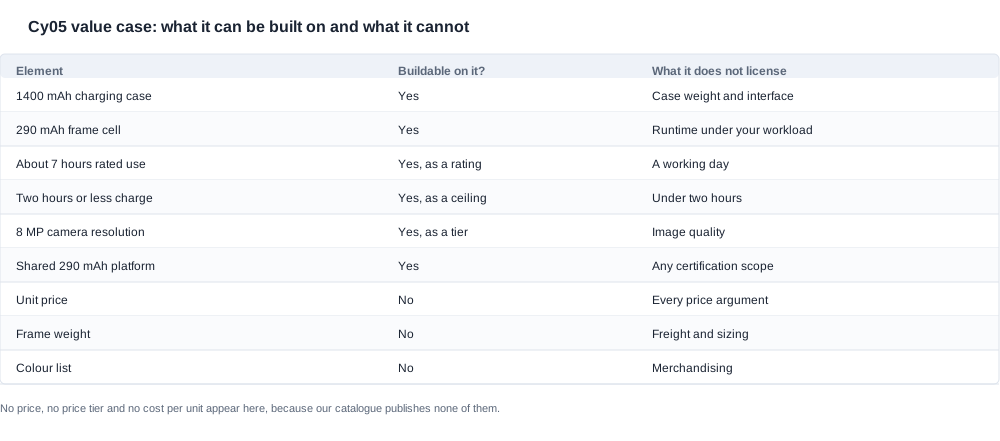
The decision has a second-order effect that is often missed: a range where two listings carry near-identical bullet points and no stated reason to choose either is not a range, it is a fragmented one. That shows up as conversion, as stock cover and as channel conflict, and all three are more expensive to fix after launch than to avoid at the shortlist stage. The CY05 versus CY03 price positioning analysis covers the commercial consequences of each answer, and the who needs the CY05 analysis covers the model decision on its own terms.
The branch that decides the range rather than the model
There is a fifth question that sits underneath all four branches and it is the one a brand of any size eventually has to answer, which is whether the range is one model or several. It is also the branch where the published rows do the most work and where a buyer's instinct does the least.
The 290 mAh platform carries four camera models — the L2 Utral and the CY05, and the L1 Pro and the CY03 — and they publish the same cell, the same charge ceiling and the same rated runtime. Three of them publish the same 1400 mAh case. That means a brand buying one model and a brand buying three models are running the same accessory chain, the same box structure and, once the paperwork is settled, the same certification file for the family.
What it does not mean is that the second and third models are free. Each additional model carries its own listing, its own artwork, its own stock and its own channel conflict, and the published rows give you no way to price that. What the rows give you is the number of platform qualifications you need, and that number is the one a finance reviewer cares about. A brand qualifying one camera model and one camera platform has made one decision about sensors, one about firmware, one about packaging and one about compliance. A brand qualifying two camera models on two platforms has made two of each.
The value question that follows from this is not "is the second model cheaper" — it is "does the second model reuse every fixed cost the first one already carried, and can it be given a reason to exist that the first one cannot serve." On the published evidence, the CY03 fails the second test until the difference question is answered, the L1 Pro passes it on the camera tier, and the L2 Utral passes it on the charging interface and the second case capacity. That is a structural reading, not a recommendation, and it is the reading to take into a quotation.

The cost drivers a buyer can see in the CY05 sheet, and the ones they cannot
The published rows are not a cost model, but they do tell you where the cost sits, and a buyer who knows where to look saves weeks.
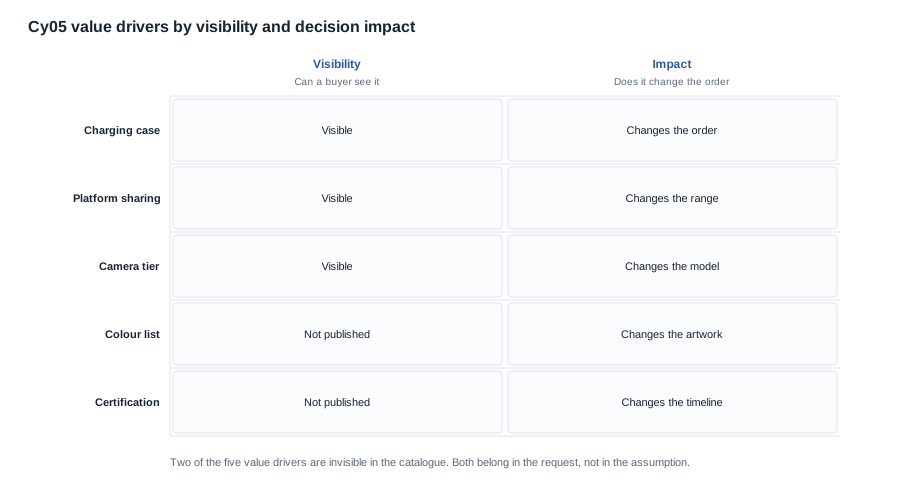
Visible in the rows. The frame cell at 290 mAh, the case at 1400 mAh, the charge ceiling at two hours or less, the rated runtime at about seven hours, and the camera tier at 8 megapixels. From these a buyer can reason about the bill of materials class, the battery transport obligation, the accessory count in the box and the likely channel positioning — all as structure, none as a price.
Visible but only as structure. The platform sharing. Four models on one power block means one accessory family, one firmware branch and one certification file, which is a fixed-cost argument a finance reviewer can accept. It is not a discount argument, and no one should present it as one.
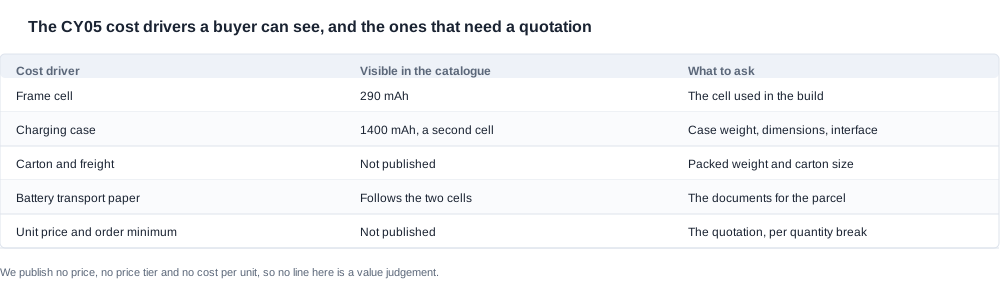
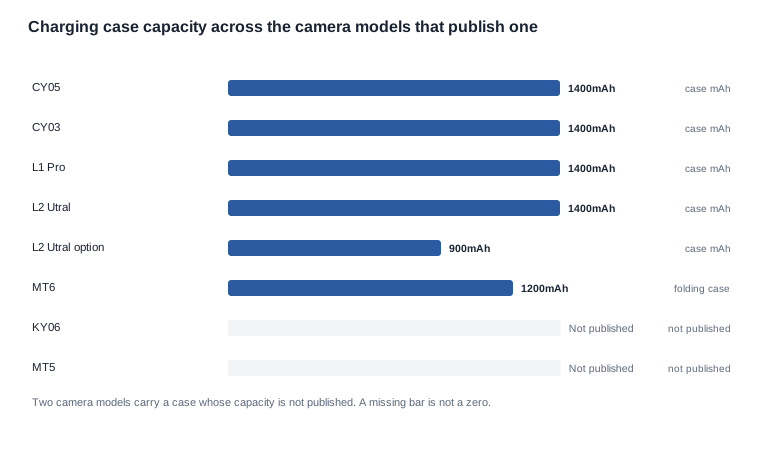
Not visible, and it matters. The frame weight, the case weight, the carton dimensions, the charging method, the colour list, the sensor specification, the endurance test condition and the certification position. Five of those eight change what you order or when; three of them change only what you write. The chart above shows the first layer of this problem across the camera range: two models carry a case whose capacity is not published, and that missing bar is not a zero — it is an open row that a buyer has to close.
Turning the visible structure into a cost model you can defend
The method is to build the model in two passes and to keep them separate, because they are answered by different documents and they arrive at different times.
The first pass uses only published rows. Write the frame cell, the case capacity, the charge ceiling and the rated runtime as published values, with the qualifier attached to each. Add the accessory count, the battery transport obligation and the range position as structural notes. This pass is complete on day one and it already tells you which models belong in the same cost conversation.
The second pass uses measurements and quotations. Add the frame weight, the case weight, the carton dimensions, the freight class, the certification scope and the unit price from the quotation. Each of these carries a source and a date. Where a value is still missing, leave the line in the model as an open item rather than deleting it, because a deleted line disappears from the total without anybody noticing, and an open line at least shows up in the review.
A buyer who follows that two-pass method ends up with a cost model that a finance reviewer can interrogate line by line, and that is a materially better position than one that arrives as a single number with no visible structure. The price comparison across the camera range works through the same structure from the range side, and the battery life analysis for the CY05 covers the endurance row in more detail.
The delivered cost line items, named individually
It helps to name the lines rather than talk about delivered cost in general, because a general figure cannot be checked and a named line can. For the CY05, the delivered cost per unit is composed of the following, and only the first is visible in the catalogue.
- The frame. Its cell capacity, camera tier, case and packaging are published; its weight, dimensions and materials are not, so the frame line is incomplete until three measurements arrive.
- The charging case. The 1400 mAh capacity is published; its mass, dimensions, charging interface and recharge time are not, so the accessory line is incomplete on four counts.
- The carton. A function of the two lines above plus the insert structure, and therefore unavailable until both are known.
- The freight class. A function of the packed weight and volume, and therefore a function of the case rather than of the frame.
- The battery transport documentation. A per-model cost that appears because of the second cell in the parcel, and a cost that a buyer looking only at the frame line will not have budgeted for.
- The certification scope. A cost that follows the model designation and the destination market, sits outside the product itself, and cannot be compressed by buying more units.
The structure of this list is the point. Three of the six lines exist because of the case, and one exists because of the certification scope. Both are properties of the range strategy rather than of the product, which means they are the two lines where a buyer's own decisions have the largest effect. That is a stronger and more actionable argument than any statement about value, and it can be made entirely from published rows.
A worked hypothetical, to show how the two passes meet
Assume a channel buyer running a two-model camera line for an e-commerce channel, with the CY05 as the volume model and a second model still open. The value question is not which is cheaper; it is whether the second model is worth its fixed cost.
The first pass, using published rows only, shows that the CY05's cell, charge ceiling, rated runtime and 1400 mAh case place it in the same cost conversation as the L1 Pro and the L2 Utral, and the CY03, and that all four share one accessory family and one box structure. It also shows that the case is the largest single cost driver visible in the catalogue, that the camera tier is the only published axis separating the CY05 from the L1 Pro, and that the certification scope is a separate cost line from the product cost. From those rows alone, the buyer can already rule out a pairing with a model on a different power block, because that would double the accessory and carton lines.
The second pass then asks for the six missing values on each shortlisted model, plus the quotation. The comparison at that point is a real comparison: two numbers on the same lines, from the same source, with the same conditions. The first pass has already done the structural work of deciding which pairs are worth pricing against each other, and it cost nothing to run.
The value conclusion that falls out of this is a statement about structure rather than about price, and it is the only kind that can honestly be made from a catalogue: the second model is worth its fixed cost if it reuses the platform and carries an axis the first one cannot serve, and the axis has to be published rather than assumed. This is a hypothetical sequence rather than a client project, and it is presented that way deliberately; the reusable part is the two-pass structure, which works for any model in this range.

Our CY05 position on what makes a model worth ordering
The CY05's value is in the case and in what the shared platform lets a brand do, not in a specification that distinguishes it from six other camera models. Eight megapixels is shared across eight of the eleven camera models in our range, and it is a resolution tier rather than a quality claim. We will not present it as one.
We will not present the about seven hours as a working day, because the test condition behind it is not published. We will not publish a unit price, a minimum order quantity, a lead time, a frame weight, a colour list or a certificate number, because our documentation does not contain them, and we will not fill an unpublished row with a typical value from another model. We will also not present the 158 g figure published for the MT6 as a proxy for this model; that figure is the MT6 glasses body including its battery and camera and excluding its folding case.
What we will do is give you the filter. If the case is the proposition, the 1400 mAh row is the one to read. If the range is the proposition, the 290 mAh platform is the one to read. If the picture is the proposition, the camera tier row is the one to read, and you will need the sensor specification to finish the conversation. If the delivered cost is the proposition, you need a quotation and six measurements, and no catalogue can substitute for them.
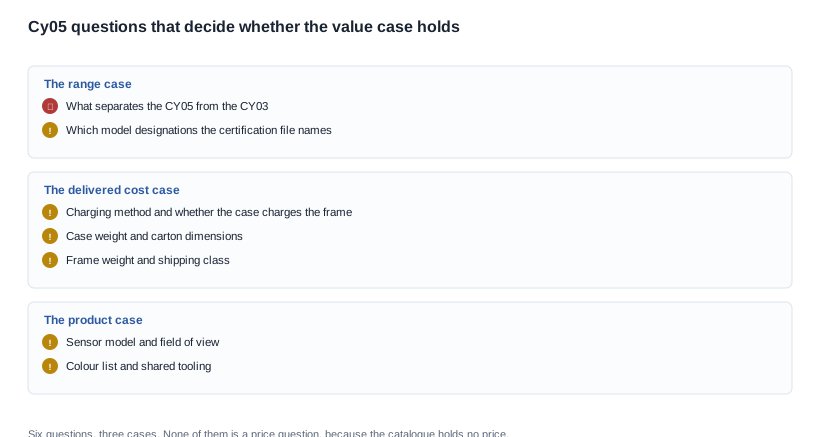
Those are the five items to close before a value case can be made on the CY05 in good faith, and the CY05 limitations analysis sets out the same register with the closure route for each one. Send us the channel, the target market and the volume, and we will tell you whether the case and the platform sharing carry this model in your range, and which figures have to be closed with the factory first.
The criteria to apply to the answers
Before you order, decide what a good answer looks like for each of the five items. That is what separates a value assessment from a preference, and it is what lets you evaluate a reply rather than react to one.
- How to evaluate the case answer: the capacity, the mass, the dimensions, the charging interface and the recharge time, with the interface stated as either magnetic or Type-C, since our catalogue publishes no charging method row for this model.
- How to evaluate the range answer: the difference between the CY05 and the CY03 in the supplier's own words, with a statement of whether it applies to the configuration being quoted.
- How to evaluate the camera answer: the sensor model, the field of view and the video format, because a resolution tier on its own does not support a capability claim.
- How to evaluate the certification answer: the market, the document, the issue date and the model designations covered, because a file that names one designation does not automatically cover another.
- How to evaluate the commercial answer: the unit price, the volume tier, the minimum order quantity and the lead time, each with a source and a date attached.
Any answer that arrives as a family-level statement rather than a model-level one should be counted as unanswered rather than as partially answered, and that is the first red flag to watch for. A supplier who volunteers the context — which model a figure applies to, which configuration it was measured on, what it excludes — is telling you the rest of the documentation will hold up under inspection.
Related reading
- The published rows for this model — CY05 smart glasses specifications and features
- The range structure around it — AI camera glasses which model to pick
- The accessory the value case depends on — AI camera glasses charging case options
Send us the channel, the target market and the volume, and we will tell you whether the case and the platform sharing carry this model in your range.


