

Customising the A06 is unusual, because the first thing you have to settle is not a design decision. Before a colour, a carton or an application treatment can be chosen, the programme has to establish what distinguishes this model from the A05, and what age band the product is for. Neither is published, and both determine everything downstream.
That makes the A06 a portfolio decision before it is a customisation decision. The published rows for the A06 and the A05 are the same — 40 mAh, about 20 hours of stated endurance, a charge time of two hours or less, magnetic charging, and the same six published feature rows — so nothing in the documentation differentiates them. A programme carrying both is carrying two designations, and the case for the second one has to be made on something the catalogue does not currently show.
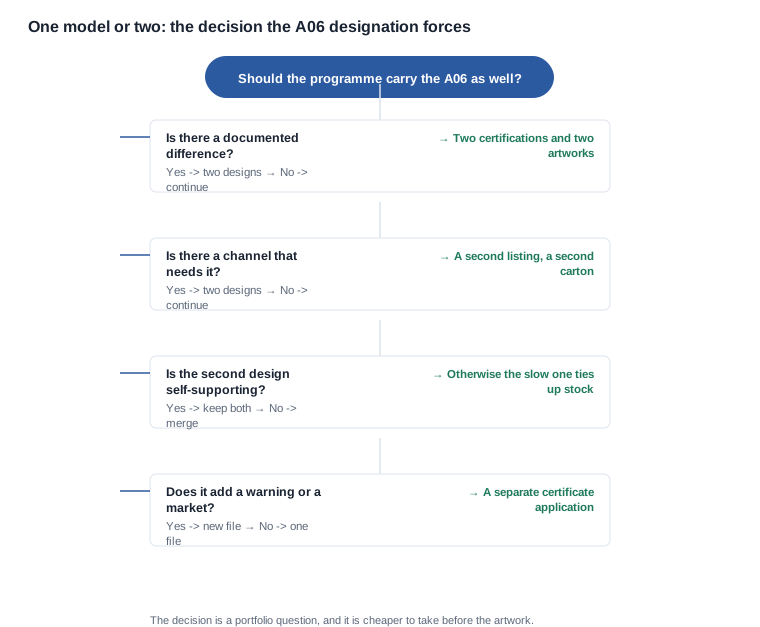
The A06 and the A05: what the published rows do and do not settle
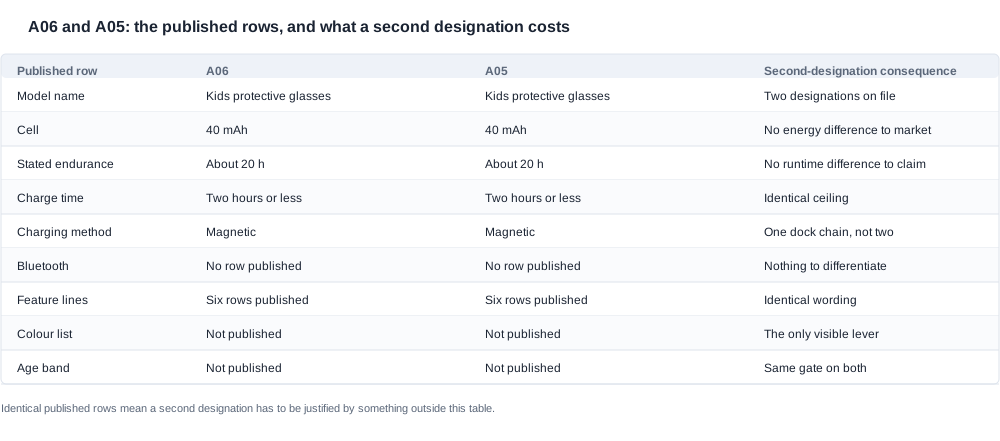
What is published for the A06
The A06 is published as a children's smart protective glasses model with a 40 mAh cell, about 20 hours of stated endurance, a charge time of two hours or less, magnetic charging, and no Bluetooth row.
The six published feature rows are the ones the A05 carries: a lens-based electronic element, a fogging unit, correct posture and distance, incorrect posture and distance, lens clarity, and lens fogging. These describe the mechanism the catalogue lists. They are not, and cannot be written as, a vision claim, an eyesight-protection claim or a prevention claim — in a children's product that boundary is not stylistic but regulatory, and the safety requirements piece covers the standards that sit behind it.
The four rows that make a second designation expensive
The A06 and the A05 publish the same cell, the same stated endurance, the same charge-time ceiling, the same charging method and the same feature rows. There is no published row on which the two can be differentiated in a listing, which means a second designation has to earn its place somewhere the catalogue is silent.
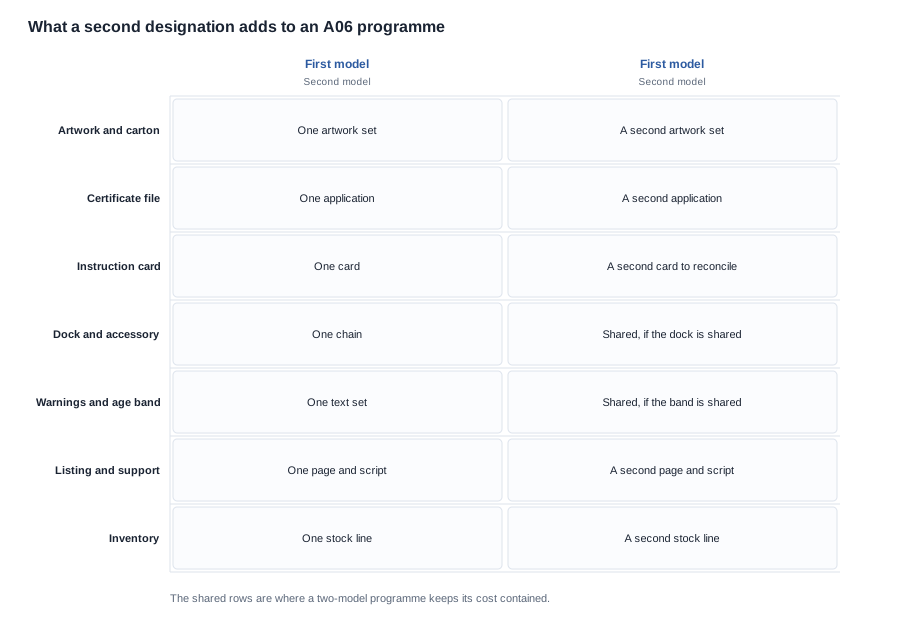
The cost of that silence falls in four places.
The certificate file. A designation is named on a certificate application, so two designations mean two applications unless the supplier's file covers both. Our catalogue carries a company-level export certification page whose content is images rather than text, and the catalogue text contains no reference to CE, FCC or RoHS. There is no per-model certification row for either model, so this is a request rather than a citation — and it is a request with a lead time.
The artwork and the carton. A second model with a different name on it needs a different artwork set and a different carton. If the only visible difference between the two is the designation, then the buyer has paid for two packaging runs to sell the same product twice.
The instruction card and the support script. If the reminder behaviour is identical between the two, the cards are identical, and any divergence between them becomes a support question. If the behaviour differs, then the difference has to be characterised on each model separately, which is a second sample and a second round of testing.
The inventory. Two designations means two stock lines. The slower one ties up working capital, and in a children's category where the compliance work is heavy, the cost of finding out which one is slow arrives late.
What is shared, and why that keeps the cost contained
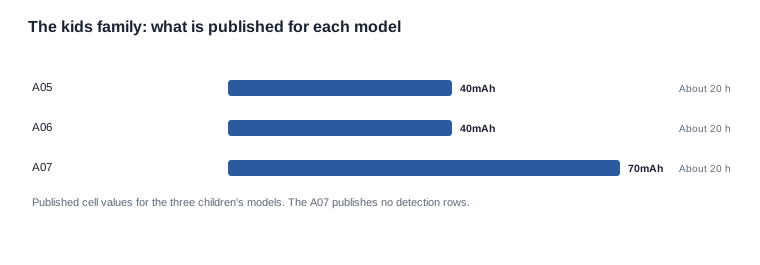
How the A06 sits inside the three children's models
The catalogue publishes three children's models, and the A06 is one of them alongside the A05 and the A07. All three publish the same stated endurance of about 20 hours, so endurance does not separate them at all. The cell is what differs: the A05 and the A06 both publish 40 mAh, while the A07 publishes 70 mAh.
The A07 is a children's smart audio glasses model, and it publishes no feature rows at all — none of the fogging, posture, distance, lens clarity or lens fogging entries that the A05 and the A06 carry. So within the family there are two shapes: two models with an identical set of published detection rows, and one model with none.
That makes the A06's position inside the family a commercial question rather than a technical one. The A06 and the A05 are not competing products, and a range carrying both is carrying two designations of the same published configuration. The A07 sits apart on the cell and on the absence of detection rows, which is a difference a buyer can actually see in a comparison.

The sequence for bringing an A06 into a kids programme
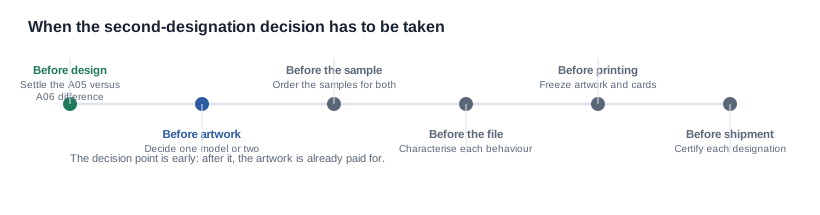
Stage one: settle the model split
Get the answer in writing before anything else, because it decides whether this is a one-model or a two-model programme and it decides how much artwork and how much certification work there will be. The A05 versus A06 specification comparison works through what the possible answers mean, and the kids buying guide covers the range decision around it.
The form of the answer matters as much as the answer itself. "A different colour" and "a different firmware with a different detection threshold" are both answers, and they lead to entirely different programmes — the first to a shared certificate and a shared instruction card, the second to two applications and two separately characterised behaviours. A buyer who asks only whether the models differ will get an answer that does not tell them what the difference costs.
Stage two: set the age band
No model in this category publishes a recommended age band, and for a children's product the band is not a marketing choice. It drives the warnings, the claims, the small-parts assessment and the standards the product has to meet in each destination market.
Establishing it takes a supplier's engineering input, a size and weight measurement, an identification of the smallest detachable part, and the standards list from a test house for the market. The age suitability analysis covers the inputs that establish it, and the safety requirements piece covers the standards list per market.
For a two-designation programme this stage carries a second question attached to it: whether the band is the same for both. If it is, one warning text serves both and the certificate scope is simpler to argue. If it is not, the programme has two age bands to document, and the difference has to be visible on the packaging rather than buried in a leaflet where nobody will read it.
Stage three: choose the colour, and the fit accessories
No colour list is published for these models, so a colour request is either an existing tooling option or a new paint or a new plastic. Neither the frame dimensions nor the weight are published either, so the fit accessories and their sizes have to be established from a sample before the box is designed.
For the A06 specifically, this is the one place where a second designation can be visibly different at no engineering cost — which is exactly why the question of whether that is enough has to be answered at stage one rather than discovered after the carton has been printed.
Stage four: write the instructions, which is the real design work
The only instruction a parent genuinely needs is what the reminder does, how often it fires and how the child turns it off. None of that is published — the detection thresholds, the intervals and the dismissal behaviour are all open — so the instruction sheet has to be written from a product that has been characterised.
That is a longer task than it sounds, because the same characterisation produces the product page, the support script and the training the distributor's staff will use. The posture monitoring analysis covers what the detection functions are designed to observe, and the A06 buyer review checklist covers the sample-stage tests that make the instructions true.
Where a two-designation programme adds work at this stage, the cost is reconciliation. Two cards exist, two scripts exist, and a distributor has to be trained on both. The saving available is to establish deliberately that the two are identical and to keep one card for both, rather than to write two cards and discover later that they contradict each other in front of a parent.
Stage five: close the data position
The source does not document an application, whether one is required, what the detection produces, whether any of it leaves the device, who operates it, where anything is stored, and what the parent can see.
For a children's product this is the part of the programme that decides whether the product is a simple wearable or an operating commitment with obligations attached. It has to be answered before the application treatment, the privacy text and the packaging can be written, because all three depend on it. The privacy considerations piece sets out the seven questions in full.
Stage six: qualify the file and lock the artwork
The model designation, the warning text for the band in each market, the operator and responsible-person details, the traceability marking, the language versions and the certification documents that name the model.
Freeze them together with the proofed sample and the production file, and store the package as one thing. The export considerations cover the market layer, and the kids box contents analysis covers the carton.
The three questions that decide whether the A06 belongs in the programme
The six stages are the machinery. These three questions are what the machinery is pointed at, and they are worth separating because each has a different failure if it is answered badly.
Does a second channel genuinely need a second product?
A buyer's own range often wants two listings — a standard one and a premium one — and the instinct is to look for two models to fill them. But a second listing does not require a second model; it requires a second product, which means something a customer can tell apart and a reason to pay more for it.
The test is whether the second designation is a product or a label. If the A06 differs from the A05 only by name, the two listings are the same product presented twice, and a channel doing that is competing with itself. If it differs in a way a customer can see and understand — a colour, a band, a feature — then the second listing has a reason to exist and the second carton is worth printing.
There is a third possibility worth naming because it is common in this category: the second designation exists for a different channel with different packaging requirements rather than for a different customer. A retail shelf, a school programme and a distributor's own-brand range can each need their own carton and their own language set from the same hardware. That is a legitimate reason to run two designations, and it is a reason that sits entirely in the packaging layer rather than in the product.
Is the second design self-supporting?
A second model has to sell at something close to the rate of the first, or the range carries dead stock. The question to ask before the order is how many units of each designation move in a first quarter, and the honest answer for a new line is usually that nobody knows, which is an argument for a small first order across both rather than a large one across one.
The reason this matters more here than in an adult category is that the fixed costs are front-loaded. The certification file, the artwork, the carton print run and the listing pages all have to be paid for before the first unit ships, so a slow second designation does not merely tie up stock — it makes the whole programme's cost per unit worse.
There is also an inventory-shaped risk specific to a two-designation programme: the two models share a dock and an accessory chain, so a buyer who stocks both has to forecast both against one shared replenishment line. If the forecast for one designation is wrong, the correction has to come out of the other.
Does the second designation add a warning, a market or a certificate?
This is the question that turns a small addition into a large one. If the A06 carries the same age band, the same warnings, the same data position and sits under a certificate file that covers both designations, then the marginal cost is artwork and packaging. If it differs on any of them, it is a second compliance scope with its own lead time, and the programme should be scoped as two products rather than one product with two SKUs.
Ask this as a single question with a single answer, in writing, before the artwork is commissioned. It is the cheapest question in this page and the most expensive to answer late, because every answer that comes back as "yes" adds a document, a file or a lead time to a programme that has already been costed.

The commercial conditions a two-designation A06 programme has to settle
The A06 programme has the same cost structure as any children's programme, with one addition: every cost that is per-designation is now paid twice.
The costs that double, and the costs that do not
Doubles with the designation. The certificate application, the artwork and the carton print run, the instruction card and its translation set, the product page and the support script, the traceability marking, and the stock line itself. These are the costs a buyer is most likely to underestimate, because each of them is small enough not to look significant on its own and large enough in aggregate to change the programme's economics.
Does not double. The dock and the magnetic charging chain, if one dock serves both frames. The age band and its warning text, if the band is shared. The detection behaviour and its characterisation, if the two models behave identically. The data position, the privacy text and the storage arrangement, if the same operator handles both. The production file and the firmware branch, if the hardware is the same.
The whole negotiation is about finding out which column each line falls into. A buyer who assumes the second designation costs half of the first will over-plan; a buyer who assumes it costs nothing will under-plan. The published rows give no guidance either way, because the catalogue publishes the same values for both models — which is precisely why the answer has to come from the supplier in writing.
Minimum order quantity, the dock and the carton
Three minimum order quantities bind this programme, and they rarely move together.
The frame minimum is the one a buyer will negotiate. The dock minimum follows from the magnetic charging method and is easy to overlook, because the dock is an accessory rather than the product, and because the packaging that ships it is usually presented as part of the frame minimum. If the dock minimum exceeds the frame minimum, then the frame minimum is not the operative constraint on how small a replenishment order can be.
The carton minimum is the one that catches a two-designation programme specifically. Two artworks means two carton print runs, each with its own minimum, and a buyer who wants a small second run of one colourway may find that the carton minimum forces an order of far more cartons than the frames need.
The question to ask is what the minimum order quantity is on the complete delivered configuration of each designation, frames plus dock plus carton, and separately for each colourway. A single number quoted for the frame is not enough to plan a replenishment cycle for two designations.
Sample flow, and the point at which the split question gets its answer
The sample is where the model split is finally settled, because it is the first time the two units can be held side by side. Two samples, one of each designation, is the minimum; three is better if a colourway question is open, because the difference may be in the finish rather than the shape.
Before the samples arrive, the buyer should have a written characterisation sheet for each one: the detection behaviour, the dismissal behaviour, the frame dimensions and weight, the colour against the approved artwork, the markings, and the packaging contents. Approving a sample against a written specification rather than an impression is what makes the qualification defensible later — when a delivered unit arrives that differs from the approved one, the question is answered by a document rather than by memory.
Ask for the model split answer in writing at the same time as the samples are ordered. A supplier who answers it verbally at the sample stage has still not produced the document the certificate file will need.
Payment nodes and inspection for a children's line
Payment tied to inspection rather than dispatch is more important in this category than in most, and the reason is specific rather than general. The rows that determine whether the product does what the listing says — the reminder behaviour, the detection thresholds, the frame size, the age band — are exactly the rows our documentation does not publish. The buyer is therefore approving against a characterisation of a sample rather than against a specification.
The inspection points that matter are therefore behavioural rather than dimensional: that the reminder fires at the characterised interval, that the dismissal behaviour matches the written instruction card, that the markings and the warning text are correct for the market, and that the packaging contents match the approved carton. Those points should be named in the agreement, because they are the ones where a specification gap turns into a customer complaint.

What to lock in a custom A06 order
Six items have to be locked before the first shipment, and the order among them matters because two of them carry external lead times.
- The model split, described in the supplier's own words — what separates the A06 from the A05, and whether the certificate scope covers both.
- The age band and the standards behind it, market by market, plus the warning text written for it.
- The characterisation of the reminder behaviour for each designation, and the instruction card that describes it.
- The data position — the operator, the storage jurisdiction, and what a parent can see.
- The colour list, the fit accessories and the frame measurements, taken from the samples.
- The designation, the marking, the language versions and the certificate file, frozen with the proofed sample and the production file.
Five clauses for the agreement
- The published rows of the exact configuration ordered, and the six published feature rows quoted as the catalogue lists them.
- The certificate scope, stated as either one file covering both designations or one file per designation.
- The age band and the warning text per market, with the operator and responsible-person details.
- The characterisation of the reminder behaviour, and the wording that appears on the card, the page and the support script.
- The data position: what is collected, what leaves the device, who operates the application, and where it is stored.
What must be left out
Any vision claim, any eyesight-protection claim, any prevention claim, and any statement that the detection functions produce an outcome for the wearer. The published rows describe what the catalogue lists, and that is the boundary.
Also excluded: a recommended age band the documentation does not support, the 20-hour figure restated as an active-use duration, a colour list that has not been confirmed, a frame weight that has not been measured, and any certification number that has not been supplied in writing.
Four ways a two-designation A06 programme goes wrong
The second designation was assumed rather than established. The symptom is a range with two listings, two cartons and two certificate applications for one product, and a channel competing with itself. The root cause is treating a model name as a product difference. The prevention is to settle the split question in writing at stage one, before any artwork is commissioned.
The marginal cost was assumed to be half. The symptom is a programme that only works at a volume the channel will not reach, because the second artwork, the second carton run and the second stock line were not in the cost model. The root cause is assuming shared rows imply shared costs. The prevention is to work through the doubling table before the order, and to plan a first order sized for both designations rather than for one.
The shared rows were assumed where they were not. The symptom is two instruction cards that say different things about the same reminder, and a distributor unable to answer a parent's question about which model is which. The root cause is assuming the detection behaviour and the age band are identical because the published values match. The prevention is to characterise each sample separately and to keep one card for both only after establishing that they are the same.
The programme was scoped as one product with two SKUs when it was two products. The symptom is a second designation that needed its own warnings or its own certificate scope, discovered after the artwork was paid for. The root cause is deciding the scope question late. The prevention is to ask whether the second designation adds a warning, a market or a certificate before the design is commissioned.
Where CYNRIN stands on customising the A06
The A06 is a capable product whose programme is limited more by its documentation than by its hardware, and the first two stages of this sequence are the ones that cannot be parallelised because everything else waits on them. We will not describe the detection functions as producing any vision, health or prevention outcome, we will not publish a recommended age band that our documentation does not support, and we will not present the 20-hour endurance figure as an active-use figure.
Where our own documentation is incomplete — the certification numbers for specific models, the minimum order quantity, the lead time, the unit cost, the colour list and the frame measurements — we will say it is incomplete rather than offer an estimate that becomes a commitment. That matters more for the A06 than for a model with a clear published position, because the A06's programme depends on knowing what is shared with the A05, and an estimate in either direction would corrupt the whole scoping exercise.
What we will do is tell you which of the six items are already defined and which have to be closed first, and where the answer to the split question changes the shape of the programme rather than just its paperwork.
Six items to settle before the first order
- What differs between the A05 and the A06, in writing.
- The recommended age band, and the standard list for each market.
- The colour list, the fit accessories and the frame measurements.
- The reminder behaviour, written as an instruction.
- The data position, with the operator and the storage jurisdiction.
- The model designation, the per-market warning text and the certificate file, stored with the proofed sample.
Related reading
- The model duplication — A06 versus A05 specification comparison
- The age question — kids smart glasses age suitability
- The data question — kids smart glasses privacy considerations
- The sample-stage work — A06 smart glasses buyer review checklist
Send us the buyer, the target age band, the markets and the volumes, and we will tell you which of the six stages are already defined and which have to be closed first.
The rows that can be shared are the ones that do not name the model: the dock and the magnetic charging chain, the age band and its warning text if the band is the same, the detection behaviour if it is the same, the data position and its privacy text, and the certification file if the supplier's file covers both designations.
The question to ask in writing is therefore not per-model but per-designation: does anything change between the A05 and the A06 that forces a separate file, a separate card or a separate carton? If the answer is no — same band, same warnings, same behaviour, one certificate covering both — then the marginal cost of the second designation is close to one artwork set and one carton, which is a cost a channel with two genuinely different buyers can absorb.
If the answer is yes on any of those, the second designation is a separate product programme, and it has to be scoped as one.


