

Capacity is the number that decides whether an order is a scheduled production run or a negotiated exception, and it is the number a factory is least willing to publish. The test is not whether a capacity figure exists. The test is whether the supplier can show how the figure was derived and what happens to your order when the month is full.
The exposure in this category is reducible, and the reduction comes from three places. The first is the shape of the order, because an order with more configurations than the line can absorb in one window consumes the slot the buyer was counting on. The second is the constraint itself, which in this category is more often a purchased component than the assembly line, and a buyer who knows where the constraint sits can plan around it instead of around a figure. The third is priority, which is a contract term rather than a courtesy and has to be written down before the month in question is the month that matters.
Our own position has to be stated first, because it is the part that is genuinely not publishable. Our catalogue describes the facility — founded in 2018, a 20,000 square metre production base, more than 200 staff including a research and development team of over 30. It does not publish a per-model output figure, a line count, a shift pattern or a production lead time, and we will not quote a capacity number we cannot derive in front of the buyer. A buyer planning a launch needs the second kind of number, and the first kind is not a substitute for it.
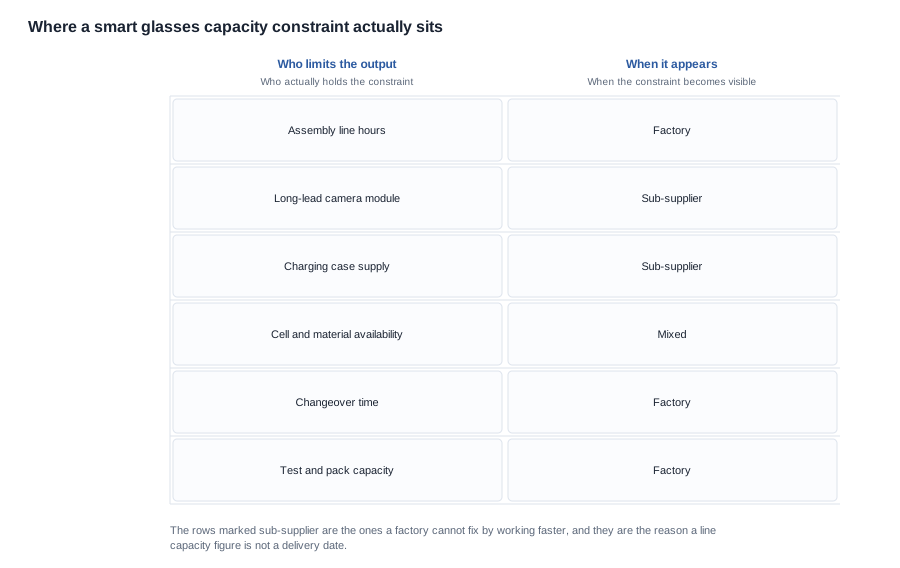
Smart glasses production capacity: where the constraint actually sits
The reader here is a brand-side procurement lead, a channel buyer or an importer, and the situation is one of three: a quoted lead time is longer than the launch window allows and the buyer needs to know whether it can be compressed; a first order went through on time and the reorder is quoting two months later for no stated reason; or a supplier has offered a capacity commitment and the buyer has to decide whether it means anything.
Underneath all three is the same question, and it is not about the factory's size. It is: what would actually stop this order from being built in the window, and who holds that thing? The commercial fear underneath a capacity conversation is rarely that the factory is small. It is that the factory is busy — busy with somebody else's order, busy with a different configuration, or busy waiting for a component.
The answer in this category is usually a purchased module rather than the line. A camera model in this range is built around an imaging module that is purchased, and the charging case is purchased, and the cell is purchased. The assembly operation itself is comparatively simple and comparatively fast. What limits the output of a smart glasses line in a constrained month is very often the availability of one of those modules, and a factory that quotes line capacity while a sub-supplier holds the real limit has described the wrong bottleneck.
That is a commercial fact with a practical consequence. If the constraint is a purchased module, then the buyer's levers are the configuration count and the timing of the order, not the speed of the factory. Asking the factory to work faster does nothing. Asking the factory which module binds, and how long its lead time is, tells the buyer what to do.
Why capacity in this category is rarely an assembly problem
It is worth being explicit about the shape of the supply chain, because it explains why the capacity conversation goes the way it does. A smart glasses programme is built from three very different kinds of supply, and each one behaves differently under pressure.
The assembly operation is the least constrained. Putting together a housing, a board, a battery and an optical module is fast, repeatable and easy to add a shift to, which is why a factory will always be able to describe its assembly capacity accurately. A buyer who negotiates against the assembly number is negotiating against the one number that is not the problem.
The purchased modules are the middle case. The imaging module, the charging case and the cell all come from sub-suppliers with their own minimum purchase quantities and their own lead times, and a factory's ability to build is bounded by what has been ordered against it. A capacity figure that has not been checked against module availability is a line-hours figure, not an output figure.
The finished-goods and packaging materials are the third case, and they behave in a way that surprises buyers. Custom carton, printed artwork and the retail packaging for a specific market can carry a longer lead time than the electronics, because they are made to a print-ready file that does not exist until the artwork is approved. A buyer who freezes the artwork late has moved the packaging constraint to the front of the schedule without changing anything about the factory.
The commercial consequence is that a capacity conversation that starts from the assembly number and argues about it is arguing about the wrong resource. The three questions worth asking in the first round are which module binds, how long its lead time is, and whether the packaging materials are ordered against the artwork or against the build. The answers move the schedule; the assembly number does not.
Reducing the exposure: three levers that work
Reduce the configuration count in the window. This is the same lever as in the minimum order conversation and it works here for the same underlying reason. Each configuration is a separate run with a setup in front of it, and three runs in a window that was planned for two is a schedule requirement hiding inside an order. A buyer who consolidates the launch to fewer colourways and adds them at reorder is not only reducing the minimum; it is reducing the changeovers, and therefore the capacity the order consumes.
Change the timing of the order rather than its size. Capacity in this category is rarely flat across a quarter, because the modules and the cells arrive on their own cycles and because a factory runs seasonal demand patterns. An order placed into a window that is already committed is an order that competes. An order placed into a quieter window for the same quantity costs less in priority pressure and sometimes in price, and the buyer's lever here is the forecast rather than the negotiation.
Reduce the dependency on the constrained part. Where the constraint is a purchased module or a case, a buyer who is willing to accept a published configuration that uses an already-available module removes their own order from the queue. This is a product decision with a supply consequence, and it is one of the few places in this category where the buyer's configuration choice moves the schedule.

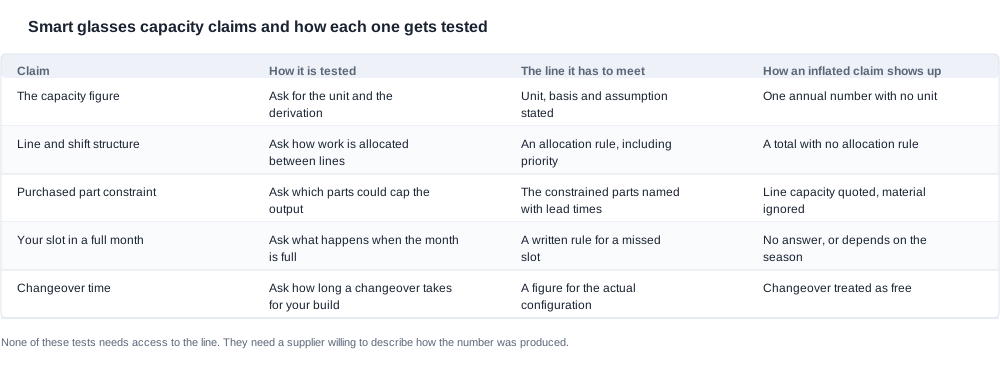
The threshold set for a capacity claim
A capacity claim is testable without visiting the factory. The table below is the working criteria set; each row states how the claim is measured, the line it has to meet, and how an inflated claim shows up.
| Claim | How it is tested | The line it has to meet | How an inflated claim shows up |
|---|---|---|---|
| The capacity figure | Ask for the unit and the derivation | Unit, basis and assumption all stated | One annual number with no unit |
| Line and shift structure | Ask how work is allocated between lines | An allocation rule, including priority | A total with no allocation rule |
| Purchased part constraint | Ask which parts could cap the output | The constrained parts named with their lead times | Line capacity quoted, material ignored |
| Your slot in a full month | Ask what happens when the month is full | A written rule for a missed slot | No answer, or it depends on the season |
| Changeover impact | Ask how long a changeover takes for your build | A figure for the actual configuration | Changeover treated as free and unlimited |
| Longest run length | Ask how many units of one configuration can run together | A number for your build | No answer, because it varies by configuration |
Two rows carry most of the weight. The allocation rule is the one that separates a factory a buyer can plan around from one that decides each month, and it is almost never written down before the month is contested. The changeover row is the one that catches a buyer whose order does not fit the line's rhythm: a build with three colourways in one window consumes the slot that the order assumed was free, because each colourway is a separate run with a setup in front of it.
There is a third test that is not about the factory at all, and it is the most reliable of the three: sanity-check the figure against the buyer's own order size. A factory that quotes a monthly output many times larger than the largest order it has ever been asked to build has quoted a theoretical figure, and the number a buyer should plan against is the demonstrated one.
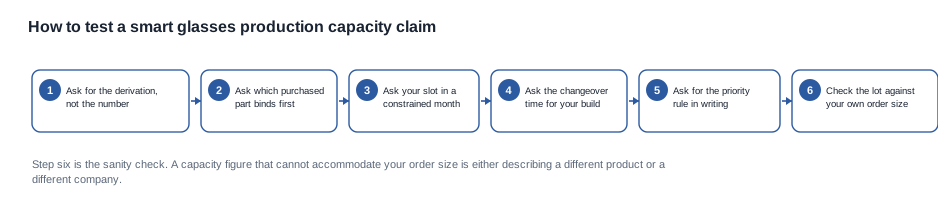
Verifying a capacity figure before the deposit
Verification in this category is a set of questions and a consistency check, and it works best before the order rather than after it.
- Ask for the derivation, not the conclusion. A figure that came from a line count, a shift pattern and a cycle time can be checked against the buyer's own order. One that came from a sales figure cannot.
- Ask where the constraint actually sits. In this category it is more often a purchased module than the assembly line. Ask which parts constrain output and carry their lead times.
- Ask what the buyer's allocation would be in a full month, and get it in writing. A factory with a documented priority rule is a factory that can be planned around. A factory without one decides each month.
- Ask for the changeover time and the longest run length for the buyer's specific configuration. A programme needing three colourways in one month has a schedule requirement that a single capacity number hides.
- Ask what happens when a slot is missed. Release notice, re-sequence, and whether the deposit moves with it. The answer matters more than the capacity figure, because the missed slot is the case the buyer will actually face.
- Compare the claim against the buyer's own volume. The sanity check, and the one that most often exposes a theoretical figure.
The questions to ask are worth putting in the first enquiry round, because each one changes either the price or the date:
- What is the unit of the capacity figure, and how was it derived?
- Which purchased parts could limit output below that figure?
- What is our slot in a constrained month, and what is the priority rule?
- How long is a changeover for our configuration, and what is the longest run length?
- What happens to the order if the slot is missed, and what notice is given?
- How does the answer change if our order carries one configuration instead of three?
A buyer who asks all six in the first round is establishing which quotation is complete, because a capacity comparison only works between two suppliers who have answered the same questions. The production capacity step-by-step article covers the planning side, and the production capacity typical range article is the comparison tool.

Priority is a contract term, not a courtesy
The commercial question attached to capacity is priority, and it has to be written down. The lines worth having are the date the slot was reserved, the priority rule that applies in a constrained month, the notice period for a slot release, and the remedy for a slot missed through the factory's own scheduling.
Volume commitments can be used to obtain priority, but a volume forecast that is not a commitment buys no priority at all. Where a launch date is fixed, the price of that certainty is a premium, and it should be quoted as a separate line rather than buried in the unit price — otherwise the buyer cannot tell whether the factory's schedule is a promise or a hope.
One term is worth resisting: an open-ended priority clause. A supplier who reserves the right to reallocate the buyer's slot at its discretion has kept the risk and passed the consequence. Where a fixed priority cannot be obtained, the next best thing is a written release notice and a defined re-sequence, plus the schedule risk priced into the buyer's own model rather than assumed away.
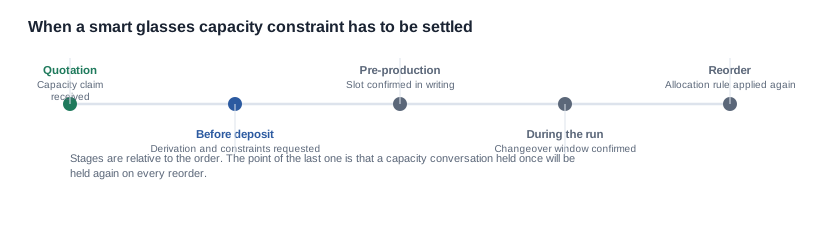

Where a capacity conversation goes wrong
The capacity number that came from sales. A figure was quoted without a unit or a derivation, and it was several times the achievable output. Require the unit, the derivation and the assumption, and sanity-check the number against the buyer's own order size.
The month that was already full. The order was scheduled into a period with no allocation available. Ask for the priority rule and for the slot in writing, and book the slot before the programme is announced.
The component that capped the line. Assembly capacity was available and a single purchased part set the real limit. Ask which parts constrain output and carry their lead times in the schedule rather than in the conversation.
The changeover nobody costed. Three colourways in one window consumed the slot the order assumed was free. Ask for the changeover time and the longest run length, and build them into the production plan.
The capacity conversation that stopped after the first order. The reorder was quoted at a longer lead time and nobody asked why, because the first order had gone well. A capacity position has to be re-established at every reorder, and the cheapest moment to do it is while the first order is still running and the factory still has the build in front of it.
None of these is a reason to change supplier. Each is a line that should have been in the order, and each is cheaper to write before the first shipment than to discover afterwards.
A capacity claim taken apart
Consider a hypothetical scenario rather than a real client project. A brand-side procurement manager has a camera model with a charging case, a quantity that fits a single quarter, and a fixed on-sale date. The supplier quotes a capacity figure, a lead time and a slot.
The claim is tested in the order the table sets out. The derivation is requested and the figure turns out to be line hours rather than output, so it does not survive the first row. The constrained part is named, and it is not the imaging module — it is the charging case, because the case is ordered on a longer cycle than the electronics and the buyer has chosen the 1400 mAh option rather than a configuration with an available case. The changeover figure for the buyer's two colourways and the longest run length confirm that the order fits a single run.
Three things follow, and none of them is "ask for more capacity". The configuration decision changes — the buyer moves to the case option that can be supplied in the window, which is a product decision with a supply consequence. The timing changes — the order is placed into the quieter part of the quarter rather than into the committed window. And the commercial term changes — the priority rule, the slot reservation date and the consequence of a missed slot go into the order form, because the buyer has now seen that this is exactly the month where those three terms decide the outcome.
The total cost of the capacity conversation, measured properly, is the administration time it took plus the schedule risk it removed. Compared with the cost of the same conversation after the order was placed — when the buyer has no leverage left and no alternative month to move to — the arithmetic is not close. That is the trade-off the red flags describe: a capacity claim taken apart before the deposit is a term you can write; the same claim taken apart after it is a complaint you can make.
What we publish about capacity, and what we will not
The boundary we hold: a capacity number without a derivation is a sales figure wearing a technical label, and a buyer who plans against one has planned against nothing. We publish the specification rows and the configuration options that a capacity conversation actually turns on, and we will not fill an open row with a typical figure from a supplier's general data.
What that means practically, for this range: the camera resolution tier per model, with eight camera models at 8 MP and three at 13 MP, is the input that decides which imaging module a configuration consumes. The battery capacity, runtime, charge time and charging method per model are the inputs for the cell and the charge interface. The charging case capacity — 1400 mAh, 900 or 1400 mAh, and the foldable 1200 mAh case on the MT6 — is the input for the case supply. The ingress marking on the two models that carry one, the V06 and the S7, and the unit weight of the one model where a weight is published, the MT6 at 158 g for the glasses body including battery and camera and excluding the foldable case, are the inputs for the packaging and the logistics plan.
What we do not publish: output figures, line counts, shift patterns, minimum run lengths, changeover times, production lead times, minimum order quantities or unit prices. What we will do is take a configuration, a quantity, a target window and a market, and tell you which part of the build is most likely to bind, what should be asked about the slot, and which terms would put priority on a contractual footing.
The production capacity assessment section sets out the wider framework, the procurement risk overview covers the surrounding picture, and the lead time section covers the schedule these numbers have to fit into.
Send us the models, the configurations, the quantities and the window you are working back from, and we will tell you which part of the build is most likely to constrain it.
Send the configuration, the quantity and the window, and we will name the part of the build most likely to bind it.


