
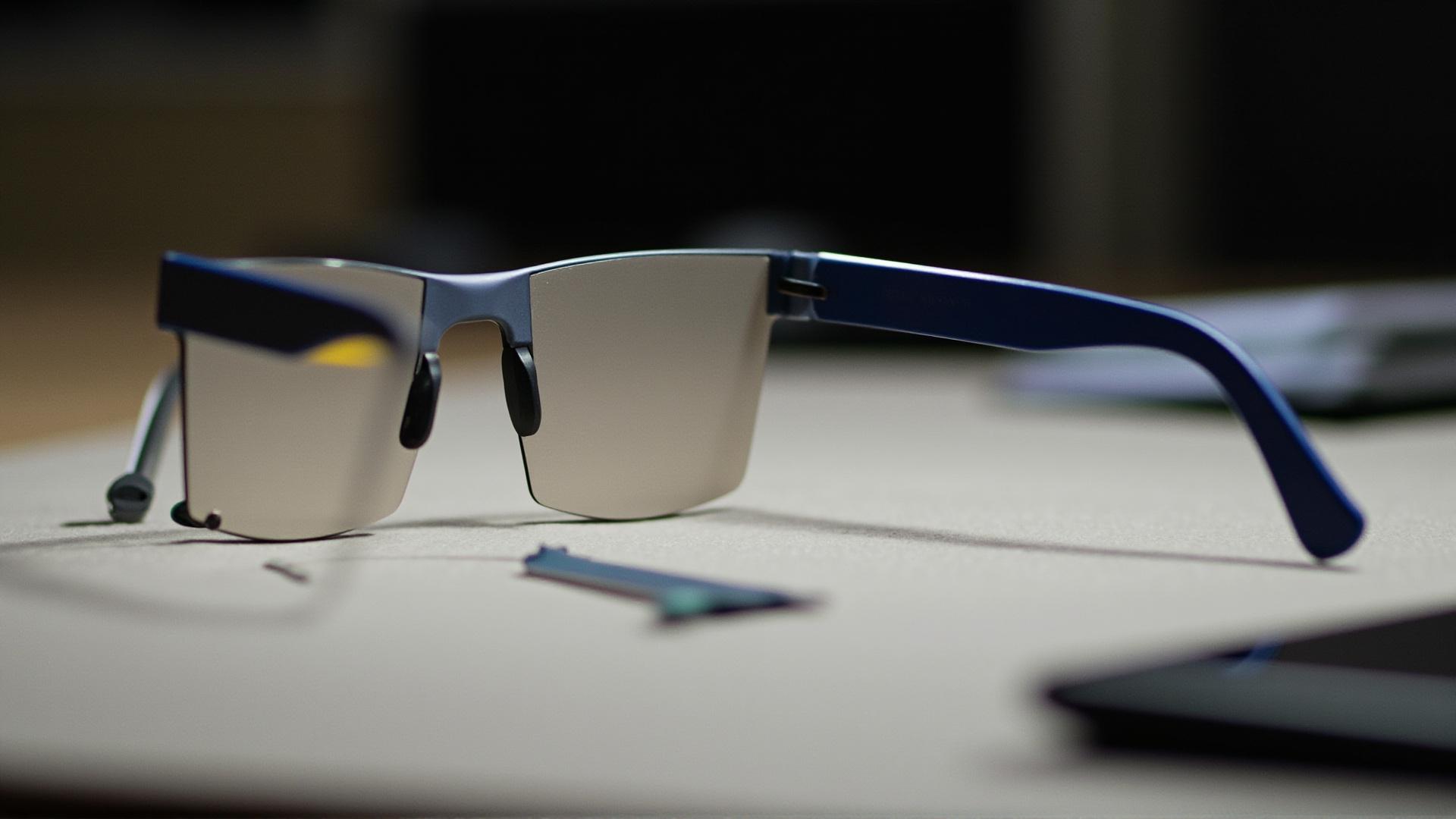
Eight megapixels is what our catalogue gives for the V06, alongside a 260 mAh cell; charging runs magnetically and is capped at two hours, the endurance range is five to eight hours, and the published feature notes are an ergonomic design, a removable inner frame, an IP54 marking and four colourways. It is the most fully described sport camera platform in our catalogue, and the consequence is that the interesting procurement question is not what the product does but what happens to it afterwards. An IP54 marking, a removable inner frame and four colourways together describe a unit that is meant to be used hard, returned, checked and put back into service — and that cycle is where a buyer either protects the published rating or quietly voids it. The routine below is built around that cycle rather than around the first ten minutes with the box.
V06 smart glasses how to use: a cleaning regime that protects the IP54 marking
A published ingress marking is a warranty on a specific configuration, and it is voided by the handling that follows the sale rather than by the handling that precedes it. The V06 is one of only two models in our catalogue that carries an IP54 marking, and because the other one is a separate product with a separate published set of rows, this model carries the marking on its own terms. An ingress rating carries two digits under IEC 60529, one for solid particles and one for water, so the marking on this model combines a fifth-level dust protection with a fourth-level water protection. The water side of the marking is a fourth-level rating, which covers splashing from any direction and no more. It is not a submersion rating, it is not a washing rating, and it is not a statement that the product can be rinsed, soaked, held under a tap or used in sustained heavy rain.
None of those limits is a defect in the product. They are the boundaries of the published claim, and a maintenance regime that stays inside them is what converts the marking from a catalogue line into a product a channel can defend for twelve months. So the routine for this model is not primarily a shooting routine. It is a preservation routine, and the shooting sits inside it.
The three things that erode a published marking are mechanical, chemical and thermal, and each needs a different rule. The mechanical one is the removable inner frame: a part that is taken out and put back repeatedly is a repeated interference fit, and an interference fit that is forced, or that is refitted when contaminated, is a wear event at exactly the joint a buyer would least want to fail on a unit that is still in warranty. The chemical one is the cleaning agent, and the catalogue publishes no lens material, no temple finish and no coating for this model, so any solvent in the routine is an unverified assumption. The thermal one is storage, and a unit left in a hot vehicle or in direct sun on a shelf is being held outside the temperature range that the rating was established against, whatever that range is.
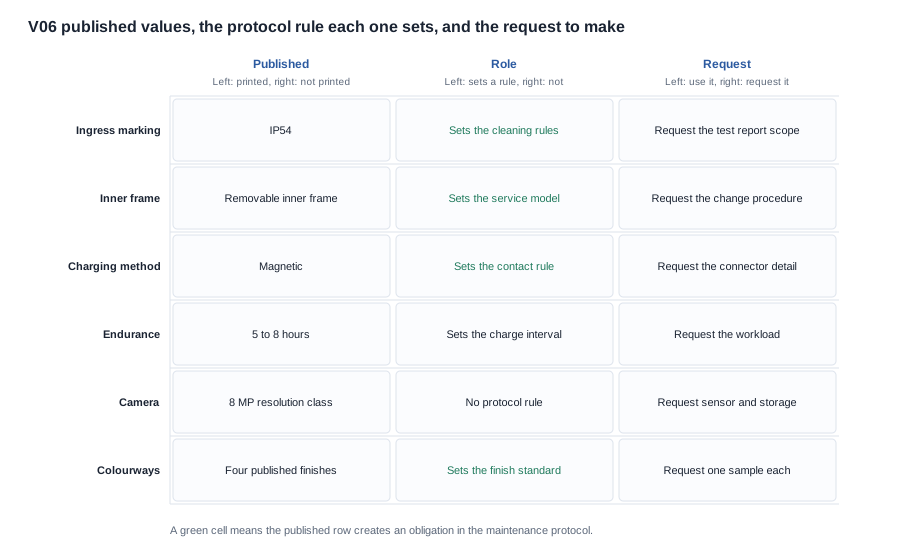
The protocol that follows from those three is short, and it is the sort of thing a procurement team can write and a quality team can audit. It has four parts: a wipe-down at defined intervals, a drying step that is not optional, a storage condition, and an inspection at defined points. The intervals are the buyer's decision, because the catalogue publishes no cleaning interval and no service schedule; the criteria are the buyer's decision, because the catalogue publishes no definition of a defective enclosure, no definition of a defective contact and no definition of a defective inner-frame joint. What the catalogue supplies is the published configuration those criteria are written against.

The cycle above is written to be run per unit and per session, which means it is a cost, and a buyer should price it as one. A wipe-down takes time; a drying step takes more time than people assume; an inspection takes longer still. A channel that runs a fleet of these units needs to know what the handling cost per unit per week is, because a maintenance regime that nobody has budgeted is a regime that will not be followed, and a regime that is not followed is a rating that is not being protected. That number is not published anywhere and it has to be built from the buyer's own time and labour rates, which is a good reason to keep the protocol to four parts rather than fifteen.
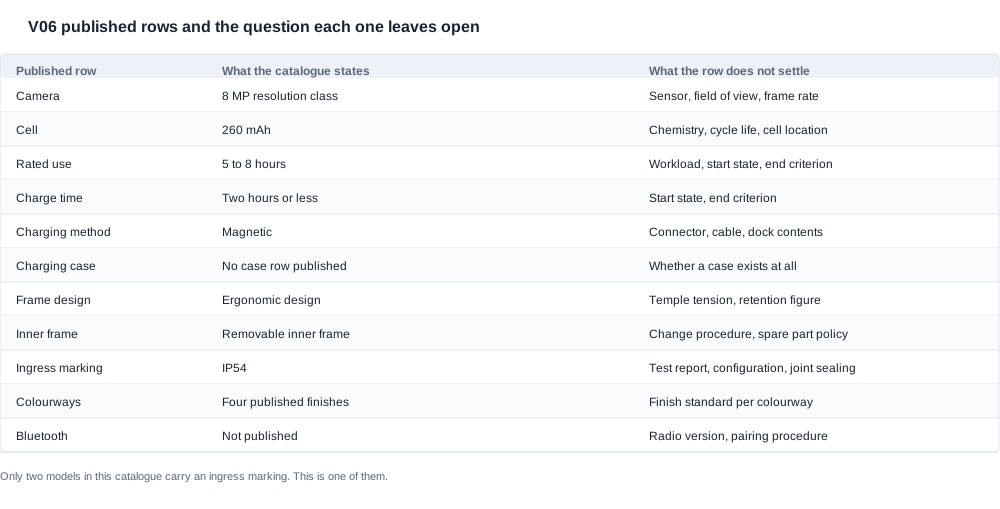
What the V06 publishes, and the rows that shape the protocol
Each row in the table is paired with the gap it leaves, and for the camera that gap follows the pattern used across the whole range: it prints no sensor, no optics, no capture rate, no recording format, no stabilisation, no storage capacity and no low-light figure For a maintenance protocol that matters in a specific way. If a unit has been used hard and then comes back for inspection, the buyer cannot compare the recorded output against a reference specification, because there is no published specification for the recorded output beyond the resolution class. What the buyer can compare is the physical condition, and that is what the inspection step has to be built on.
Two published rows are worth reading as protocol instructions rather than as features. The first is the long-endurance note that appears alongside the frame description, which is a qualitative descriptor on a model whose endurance row is a five-to-eight-hour range. A qualitative endurance note and a quantitative range are not the same kind of statement, and a listing that upgrades the note into a number has crossed a line the catalogue did not cross. The second is the ergonomic frame design, which is a design descriptor with no published retention figure, no temple tension value, no adjustment range and no frame weight. In a protocol context, the ergonomic row is relevant for a reason that is not about comfort: it identifies the parts of the unit that carry load during use, and those are the parts an inspection has to look at.
The colourways are the fourth published feature and they are the one that changes how the protocol has to be built. Four colourways are published for this model — orange, ice blue, black and black-ice-blue. A maintenance regime for a single SKU is a regime for a single finish, and a regime that has to work across four finishes is a different piece of work, because the visible surfaces differ, the wear patterns differ, and the sample used to write the inspection criteria is unlikely to be representative of the whole assortment. A buyer running four colourways has to decide whether the inspection criteria are finish-specific, and if so, has to sample each finish, which is a cost that has to appear in the quality plan rather than being discovered when the first returns arrive.
The case row for this model is one of the three camera models where the catalogue prints no charging-case row at all, and the discipline again applies: a row that is not printed says nothing either way, and stating that the item is confirmed absent is a different claim altogether. A buyer who plans a case programme for this model on the strength of an unprinted row is planning something the catalogue does not support. Everything our catalogue prints for this model is on the sport smart glasses range page and in V06 smart glasses specifications and features, with the gaps appearing in V06 smart glasses common questions.

The removable inner frame: the part that decides the service model
The removable inner frame is the most consequential published feature on this model, and it is worth separating two questions that are usually run together. The first is what the part does for the product, and the catalogue answers that with a single row. The second is what the part does for the channel, and the catalogue does not answer it at all, because it publishes no change procedure, no spare-part availability, no tool, no cycle rating and no service position.
Operationally, a removable inner frame is an interference fit that is expected to be assembled and disassembled repeatedly. That expectation creates three failure categories the buyer has to define, and the definitions have to exist before the first return arrives rather than after. The first is a joint that will not seat, which presents as a frame that looks misaligned and behaves as if it were. The second is a joint that seats but has lost its interference, which presents as a frame that rotates or slips under load and is far harder to diagnose because it looks fine. The third is a wear surface: if the inner frame is a separate piece, it is the piece that wears, and it may be the part a channel can replace rather than the part it must scrap. Whether it is replaceable is a question for the supplier, and it is the single most commercially valuable answer in this whole protocol, because it is the difference between a serviceable product and a disposable one.
The catalogue's silence on the service position has a second-order effect that a buyer should price in. If the inner frame turns out not to be replaceable, then a unit returned with a damaged inner frame is a write-off regardless of how good the rest of the unit is, and the write-off rate is a function of how the product is used in the field, which is a function of how the protocol is written. If it is replaceable, the channel needs a spare-parts line, a stock level and a replacement procedure, and the buyer needs to know the minimum order quantity and the lead time for that part. Both answers change the total cost of ownership; only one of them is visible in a sample order, and the other requires asking.
There is a third reason the inner frame matters for this model specifically, and it is the one that ties the part to the published marking. A repeated interference fit at a joint is a joint that has a path into the enclosure, and a path into the enclosure is exactly what an ingress rating is about. The catalogue publishes no statement about whether the IP54 marking was established with the inner frame fitted, and it publishes no statement about the sealing of the joint itself. That is a fair and specific question to put to the supplier, and it is different from asking for the rating — it is asking which configuration the rating applies to, and whether a customer who removes the inner frame is still inside the published claim. The verification discipline for this kind of question is in how an ingress claim is tested before an order, and the commercial framing of it in what an ingress rating is worth to a channel.

Wiping, drying and storing: a protocol the buyer can specify
The protocol has four parts and each of them needs a criterion, a frequency and an owner, because a protocol without those three is a suggestion. The criteria come from the buyer's own acceptance file, the frequency from the deployment, and the owner from the operating arrangement the channel already has.
The first part is the wipe. The criterion is simple and conservative: a soft, dry or lightly dampened cloth, no solvent, no abrasive, nothing sprayed onto the product. The reason is not caution for its own sake. Our catalogue publishes no lens material, no temple finish and no coating for this model, and cleaning agents that are entirely suitable for one combination of lens and finish will permanently haze another. A buyer who writes "isopropyl alcohol wipe" into a protocol is introducing a chemical specification the catalogue does not support, and the failure it produces — a hazed lens on a model whose distinguishing feature is the lens — is not recoverable. If a solvent is genuinely required, the supplier has to name it, and the request is a line in the technical file rather than an assumption in an instruction.
The second part is drying, and it is the step most often dropped because it produces no visible result. The criterion is that the unit is dry before it is refitted, stored or returned, and the reason is that the residue involved is not simply water. Salt residue in a joint, in a contact, or on a lens surface is harder to remove once it has dried than while it is still damp, and dried residue in a charging contact presents as an intermittent charge rather than as a fault. The frequency follows the sessions. A protocol that specifies a wipe and omits the dry has specified half a routine, and the half it has omitted is the half that determines whether the contacts keep conducting.
The third part is storage, and it has three components: the physical state, the environment and the interval. The physical state is the frame stowed with the temples relaxed and the inner frame seated, not folded against the lens and not left half-assembled. The environment is a range the catalogue does not publish, which is why the request for the storage temperature range belongs in the same technical file as the cleaning agent. The interval is the maximum time a unit may sit between charges before it is recharged, which is a figure the supplier publishes and the catalogue does not, and it is the figure that matters for a channel with slow-moving stock, because a unit that has been on a shelf for eight months is a unit whose first customer finds a flat battery, and that is a returns event rather than a product event.
The fourth part is the inspection, and it is the only part that leaves a record. The inspection criteria are the buyer's own definitions of a defective enclosure, a defective contact and a defective inner-frame joint, written before the first shipment so that a returns decision is a comparison against a standard rather than an argument. The general return-handling discipline is in how the camera range handles faults and the camera-range quality file in the quality-control file for the camera range.
The protocol as a whole has to be priced, and this is where buyers most often forget. The wipe costs time per unit, the drying costs time per unit, the inspection costs time per unit, and none of it is zero. A channel that has not costed the maintenance regime will discover it in the returns rate, and a channel that discovers it there will have already lost the margin. The questions to raise with a supplier before the first order are therefore as much about the protocol as about the product: what the recommended agent is, what the storage temperature range is, what the maximum interval between charges is, and whether the supplier's own documentation for this model already contains a maintenance procedure that can be adopted rather than written.
The V06 quality file: inspections before shipment and on return
The criteria for cleaning, storage and the inner frame
- The recommended cleaning agent for the lens, the temples and the charging contacts, and any material the agent must not touch.
- The cleaning interval for a unit in continuous use, and the maximum interval between charges for a unit in storage.
- The storage temperature range, and the maximum time a unit may sit uncharged.
- The change procedure for the inner frame, whether replacement units are available, and the minimum order quantity and lead time for that part.
- The ingress test report, stating which configuration was tested and whether the marking holds with the inner frame removed.
- The sealing arrangement at the inner-frame joint, and whether it is a serviceable seal.
- The supplier's own maintenance documentation for this model, if it exists, so the protocol can be adopted rather than written.
- The outgoing inspection record format, and whether records are retained for each production lot.
- The camera details the catalogue omits, together with the radio version.
The question that has to be answered for this model is narrower than for a product with no ingress marking, and it is worth being exact about it. An ingress marking is a statement about a tested configuration, so the file has to say which configuration was tested: the frame as supplied, the frame with a particular inner frame fitted, and whether the marking is claimed for the frame alone or for the frame in its assembled state. Our catalogue publishes an IP54 marking for this model and nothing about the test behind it — no report reference, no tested configuration, no joint sealing arrangement, and no statement of what the marking excludes. A buyer therefore cannot narrow the claim to its components without a document, and a document that does not narrow the claim is a document that cannot be quoted in a listing beyond the four characters the catalogue prints.
An ingress rating and a battery file are two separate lines of documentation, and conflating them is the specific error this model invites because it carries an ingress marking and a cell at the same time. Not one of our published pages states that this model holds CE, FCC or RoHS certification, the catalogue as a whole contains no certification line for any single model, and the export-certification page within it is a set of images rather than readable text, so it falls to the supplier to produce both the technical file and the declaration of conformity. Any radio sold into the European Union sits under the Radio Equipment Directive (EU) 2014/53/EU, and a buyer verifies Bluetooth membership separately, through the member database. The two lines matter here because the ingress document answers what the enclosure keeps out, the transport document answers what the cell may do in transit, and a buyer who asks for the certificate and receives one of the two has not obtained the other. The correct request names both: the ingress test report and the declaration of conformity, and separately the cell's transport test summary. Each of the three answers a different question and none of them substitutes for another.
Before the shipment leaves the factory
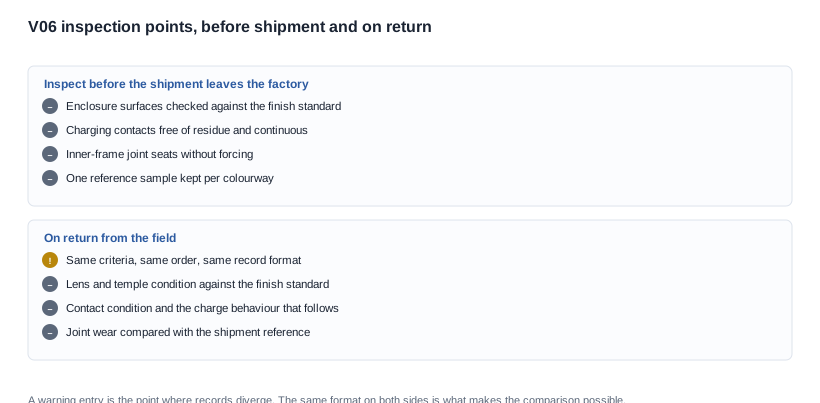
A pre-shipment inspection is the cheapest point at which to establish the baseline that every later inspection is compared against, and for this model the baseline has to cover the parts the protocol will look at later. The enclosure surfaces, because they carry the published marking and because a mark or a deformation visible at shipment is the difference between a warranty argument and a shipping error. The charging contacts, because an unclean contact at shipment is a charge fault that will appear in the field as a product fault. The inner-frame joint, because a joint that does not seat cleanly at shipment will not seat cleanly later, and because the buyer needs a reference state for the wear inspection. The lens and the temple surfaces, against the finish standard for the specific colourway, because four colourways means four finish standards and one reference sample per finish is the minimum.
The supplier's own outgoing quality file is the first thing to request, and it is worth asking for the actual records rather than a description of the checks. A checklist that says "contacts clean" is a claim; a record that shows the inspection was carried out is evidence. For a buyer who intends to run an aftersales service, the difference between the two determines whether the first return can be handled as a data point or as an argument.
On return from the field
A returned unit should be inspected against the same criteria in the same order, and the record should be the same format, so that the two records can be compared. In practice the useful output of a returns inspection is not the individual verdict but the pattern: a cluster of units failing the same point, from the same colourway, after the same number of sessions, is a signal about the product or the protocol, and a pattern is what a buyer can act on. A quality team that files each return separately loses that signal, and a channel that loses the signal will keep shipping into the same failure.
The link between the protocol and the commercial position is direct. A published rating that is preserved by a protocol is a rating a channel can advertise, and a rating that is voided in the field is a return reason and a marketing problem. That is the entire reason to spend the effort on a wipe-down that nobody sees.
The limits of the published rows on this model
Five specification rows and four feature notes are printed for this product, and nothing here extends them into a cleaning agent, a cleaning interval, a storage temperature range, a maximum interval between charges, a definition of a defective enclosure, a service position for the inner frame, a camera specification, a frame weight, and we do not make a certification claim. The V06 is not placed against the other sport models either, and the reason is that the decisive rows are not printed and a ranking built on documentation depth would be a ranking of paperwork rather than of product.
What the published configuration does support is a strong, coherent position for a channel that sells into outdoor and working environments. An IP54 marking, a removable inner frame, four colourways, a magnetic interface and a five-to-eight-hour range describe a product that is meant to be used hard, and the buyer's job is to make sure it survives that use. A maintenance protocol is the part of the product that a channel owns, and the fact that the catalogue does not publish one is not an omission in the product — it is the part of the work the channel has to do.
If the V06 is on your shortlist, send us the quantity band, the deployment and its environmental conditions, the finish assortment you intend to carry, and the listing copy you intend to publish. We will separate the lines a published row supports from the ones a supplier document has to supply and from the ones we would not print at all. The broader sourcing questions sit in the channel-level sourcing questions, the shipping figures in the shipping figures for the camera range, the fit questions in the fit and sizing guidance for the range, and a platform programme as an alternative to a single order in running a platform instead of a single order.


