

A rating is a type test, and a type test is a photograph of one unit on one day. IP rating smart glasses quality control is therefore the set of line-side controls that turn that photograph into a product specification, and the question a buyer should be asking is not "does it have a rating" but "what holds the rating on unit ten thousand".
The distinction is not academic. A type test tells you the enclosure design is capable of passing. A control plan tells you the process that builds the enclosure keeps producing that capability, batch after batch, after a component supplier changes and a gasket batch arrives with a slightly different hardness. The first is a one-off event with a date on it. The second is a routine with a frequency, a record and an owner, and it is the second one that a buyer's repeat order depends on.
In our own catalogue the IP54 marking appears on the V06 and the S7, as an annotation without a third-party test report number behind it. The rest of the range publishes no ingress rating at all. We are not in a position to publish our own line-side controls, our sampling frequencies or our test reports, because the company has not confirmed them, and a rating without a documented process behind it is exactly the thing this article is about.
IP rating quality control: photograph versus process
The short answer, and the question that sorts a supplier
The question that sorts a supplier in this category is whether they can describe the controls in terms of method, frequency, sample size and record. A supplier who describes them in terms of intention — "we check every batch", "high quality seals", "fully sealed design" — has given you a type test. A supplier who can produce a torque log from a real production run, a leak test record with a stated frequency, and a retained unit you can hold in your hand has given you a process.
That distinction is worth more than it appears, because the buyer who cannot make it will keep buying on the basis of the type test indefinitely. Each repeat order is treated as a fresh chance that the design will hold, when in fact the design held or did not hold months ago and the question is whether the process still reproduces it. The evidence for that answer is not in the type test at all; it is in the records.
The buyer deciding whether a rating is a process or a result
The buyer asking this question is usually deciding whether a supplier's ingress claim describes a design or a manufacturing operation, and is holding a quotation, a sample, a target price and a channel plan. What they will not be holding is the factory's control plan, because it is not normally shared, and because "we check every batch" sounds like an answer.
It is not an answer. A control that is not specified, not measured and not logged is an intention. The way to tell the difference is to ask for the method, the instrument, the acceptance limit, the frequency and the record, and the supplier who has a control will answer all five without difficulty, because the control is a document they already keep.
The four failure points, and why they are not where buyers look
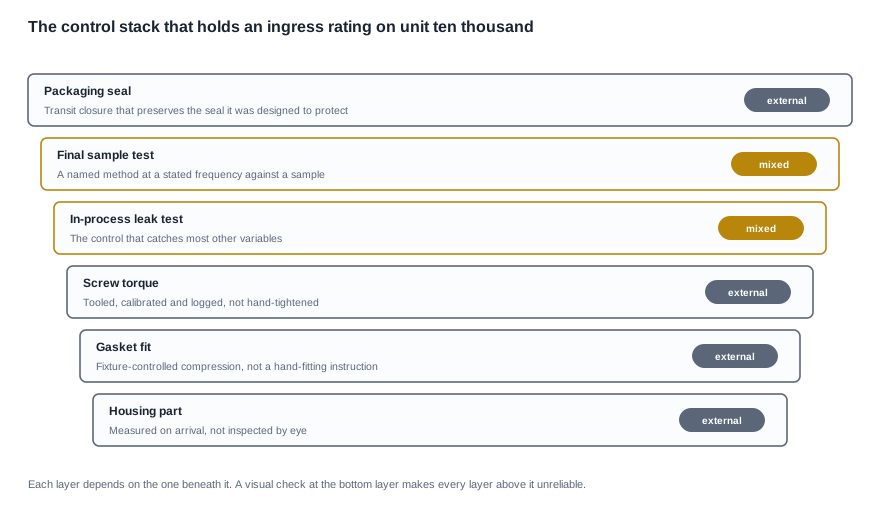
Buyers tend to look for the failure point in the laboratory, because that is where the number came from. It is not there. A rating is lost on the line, and it is lost at four specific points.
The first is the housing part. A housing that is checked by eye on arrival is not a controlled input, and dimensional drift in the housing shows up later as a sealing problem that nobody connects to the part that caused it. The second is the gasket fit. A gasket fitted by hand without a controlled pinch rate is a variable process, and the pinch rate is the seal compression, and the seal compression is the rating. The third is the screw torque. A torque that is not tooled, not calibrated and not logged is not controlled at all. The fourth is the packaging, which is the one point most buyers never think of: a rated product shipped in a closure that leaks in the container has lost the rating somewhere else entirely, and the customer experiences it as a defective product.

The control rows a supplier has to answer in writing
The eight questions, and the record that proves each one
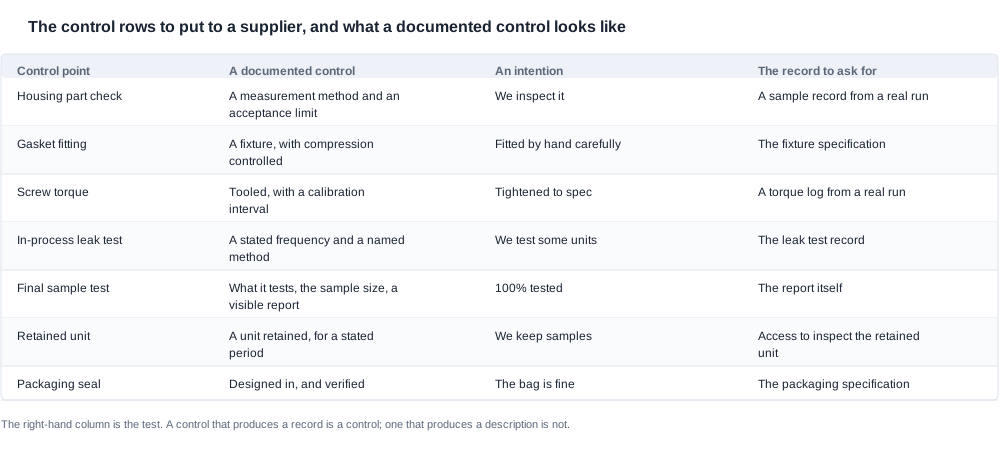
The table below is the request to put to a supplier. The right-hand column is the test, because it is the only column that distinguishes a documented control from an intention. The fourth column is what to ask for, and in every case it is a document rather than an assurance.
| Control point | A documented control | An intention | The record to ask for |
|---|---|---|---|
| Housing part check on arrival | A measurement method with an acceptance limit | We inspect it | A sample record from a real run |
| Gasket fitting | A fixture with compression controlled | Fitted by hand carefully | The fixture specification |
| Screw torque | Tooled, with a calibration interval | Tightened to spec | A torque log from a real run |
| In-process leak test | A stated frequency and a named method | We test some units | The leak test record |
| Final sample test | What it tests against, the sample size, a visible report | 100% tested | The report itself |
| Retained unit | A unit retained, for a stated period | We keep samples | Access to inspect the retained unit |
| Packaging seal | Designed in, and verified | The bag is fine | The packaging specification |
| Change control on seal parts | A process for notifying a change of gasket, screw, housing or torque | Not offered | The procedure, and the owner of it |
The thresholds that separate a control from a habit
The criteria in the third column deserve a word each, because each of them is a place where a real process is quietly replaced by a habit, and the replacement is invisible until the returns start.
A visual check is not a measurement. Ask for the method, the instrument and the acceptance limit, and the answer tells you whether the housing part is dimensionally verified or merely looked at. Only one of those two holds a rating, and only one of them produces a record when something goes wrong.
A gasket fitted by hand is a variable process. If the answer is that it is done by hand, the next question is how the compression is controlled, because compression is the seal and the seal is the rating. A fixture specification is the document that answers it.
A torque that is not tooled is not controlled. Ask to see a log from a real run. A torque driver with no calibration interval is a torque driver, and a hand torque wrench is a variable with a name.
The in-process leak test is the control that catches most of the others. If there is a leak test at a stated frequency with a named method, most of the other variables get caught by it, because a leak test is agnostic about why the unit is leaking. If there is not, every other control has to be individually reliable, which is a much higher bar than most production lines are actually running.
A retained unit is what makes drift visible. Without one, a component substitution and a process change both go unnoticed, and the first evidence of either is a customer complaint rather than an internal observation.
The packaging question, which is a design question
The packaging seal deserves separate treatment because buyers consistently classify it as a procurement detail when it is a design decision. If the transit closure is specified to preserve the seal, it is a specification with an acceptance criterion. If it is assumed, it is a cost line waiting to become a return rate, and the cost arrives through the channel rather than through the supplier's quality report.

Auditing a control plan without a factory visit
Five checks, and the ones that work remotely
Most buyers cannot visit the factory, and a control plan is in principle auditable from a distance because it produces records. How to evaluate one without a visit is a question of evidence rather than of access, and the five checks below are all remote. The first two are the ones that discriminate most sharply.
The first check is to ask for a log from a real run. Torque logs, leak test records, the final sample test report — any one of them. A supplier with a process has these, and asking for one is the fastest way to find out which kind of supplier you are dealing with. The second check is to ask for the retained unit and to look at it. A golden sample that you can hold is worth a great deal, because it is the reference against which every incoming lot can be compared for the rest of the programme.
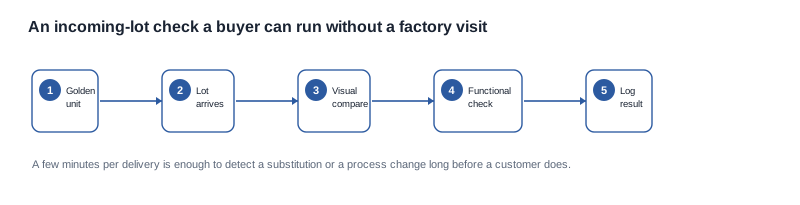
The third check is the change-control question: a new gasket, a new screw, a new housing supplier or a different torque driver each changes the configuration the rating applies to, and each of them needs a notice obligation. The fourth is the packaging, which the buyer can inspect directly on the first delivery. The fifth is to run an incoming check against the retained unit — even a simple visual and functional comparison on a sample of each lot tells you whether the process is still running, and it costs a few minutes per delivery.
An incoming-lot check you can run on your own floor
The incoming check is worth spelling out because it is the only control the buyer owns outright. Take the golden unit. Take a sample from the arriving lot. Compare the interface, the button seals, the parting line and the visible seal condition. Run a functional check that includes charging and a short use cycle. Log the result against the lot identifier and the delivery date.
The criteria for a good incoming check are that it is short enough to be done every time, that it compares against a fixed reference rather than against the last delivery, and that it produces a record you can show a supplier when a question arises. Six comparisons against a reference unit is enough to detect the substitutions and process changes that matter, and it converts a future argument into a present observation.
The audit questions to put in writing
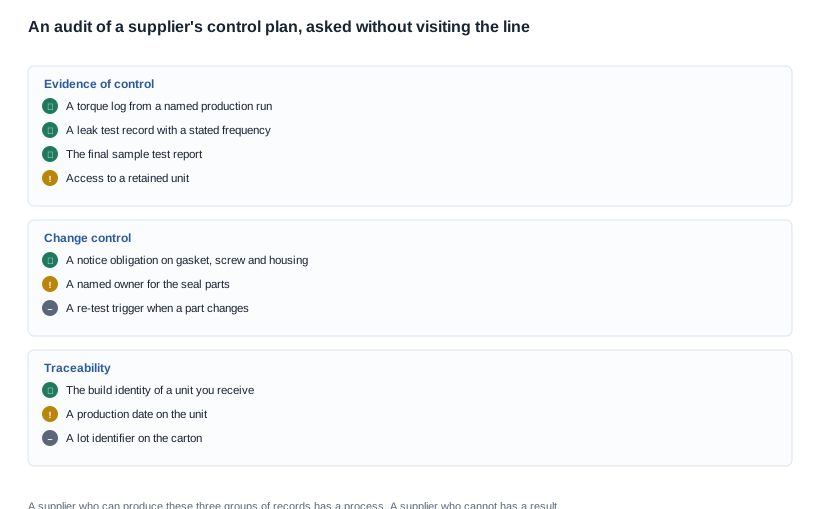
The questions below are ordered by how much they disqualify, which is why the first one is about evidence rather than about description.
| Audit area | Question | What a complete answer contains |
|---|---|---|
| Evidence of control | Can you show a torque log from a named production run | A log with a date, a line and a build reference |
| Evidence of control | What is the leak test method and frequency | A named method at a stated frequency |
| Evidence of control | Can we see the final sample test report | A report naming what was tested and the sample size |
| Evidence of control | Is a unit retained, and can we inspect it | An access arrangement and a retention period |
| Change control | Who owns the seal parts | A named function rather than a department |
| Change control | What triggers a re-test | A written trigger, such as a change of gasket specification |
| Change control | How are we notified | A notice obligation attached to the purchase order |
| Traceability | What build identity arrives on the goods | A date or lot reference that can be tied to a production run |
| Traceability | Is there a lot identifier on the carton | Something the warehouse can record |

Five ways a line-side control quietly stops running
The rating holds for a year and the returns start in the second. The symptom is a drift in the return rate with no cluster to investigate. The root cause is that a component was substituted or a process step was changed, and nobody was watching. The prevention is change control with a notice obligation, a retained unit, and an incoming check against it.
The units leak in the container and the customer thinks the product is faulty. The symptom is a freight-related complaint that is classified as a product defect and therefore charged to the quality function. The root cause is that the packaging seal was assumed rather than designed. The prevention is to specify the packaging seal as part of the design and to verify it on a transit simulation.
The supplier cannot show a log. The symptom is an audit that produces no artefacts and therefore no conclusions. The root cause is that the control is a visual check, and a visual check does not produce a record. The prevention is to ask for the method, the frequency and the record and to treat the absence as a finding in its own right rather than as a delay.
A production change invalidates the rating and nobody notices. The symptom is a report that names a configuration the current units do not match, discovered during a customs query. The root cause is an ownership split: the rating is owned by engineering, the seal parts are owned by purchasing, and nobody owns the interface between them. The prevention is to put the seal parts on the change-control list with a notice obligation to the buyer.
The rating is used to win a tender and the evidence is a catalogue line. The symptom is a contract that commits to an ingress rating with no process behind it. The root cause is that the type test was treated as a process. The prevention is to ask what holds the rating on unit ten thousand and to treat the answer, or the absence of one, as the qualification itself.
What a control plan buys you commercially, and what our range does not publish
The commercial terms that apply to a controlled programme
A supplier with a documented process is a different commercial proposition from one without, and the negotiation should reflect that. The term with the most weight is the retention: a deposit, a balance on inspection before shipment, and a retention held against the documentation and control package protect the buyer on the failure that costs most, which is a product that arrives with a marking nobody can evidence.
The per-variant cost of a documentation-only change is usually negotiable, because no hardware is touched. The number of units per variant is negotiable, and more so on a repeat order than on a first. Delivery splitting against a quality-review milestone is often granted more easily than a price concession, because it moves the risk onto the review where it belongs.
What is not negotiable is the certification cost and the certification time, which are a per-configuration cost and a laboratory queue respectively. Moulding and sealing tooling are one-off charges that are normally spread across the first order; what deserves a place in the enquiry is the volume the spread covers and whether the tooling and the sealing tooling remain needed once the programme stops. And the seal and the interface are not negotiable either: a supplier who will not change the seal material, the port design or the charging contacts is telling you that the ingress performance is fixed, which is also a statement that the control plan is fixed.
A worked scenario: two suppliers, one factory audit, one catch on the buyer's own floor
This is a hypothetical case rather than a client project, and it is here to show how the control audit changes a supplier comparison.
Assume a brand qualifying two suppliers for a repeat-order sports line, with a budget for one factory audit and no appetite for a second. The first supplier quotes a lower unit price and answers the control questions with descriptions; the second quotes higher and answers with a torque log, a leak test record and an offer to retain a unit.
The first decision is where to spend the audit. The evidence points at the second supplier, because a supplier who produces records has something to show on site, whereas a supplier whose controls are descriptions has nothing to show regardless of how carefully the auditor looks. So the audit goes to the second supplier, where it can confirm the process rather than merely look for one.
The second decision is what to do with the first supplier's answer. The audit questions and the incoming-lot check become the alternative to a factory visit, and the buyer accepts the risk explicitly: the first supplier ships, the buyer runs the incoming check on every lot against a retained unit, and the purchase order carries the change notification obligation. That is a real risk with a real cost, and it is now a documented decision rather than an assumption.
The third decision is the contract. The buyer asks the second supplier for the notice obligation on seal parts, the retained-unit access and the incoming test result on lots, and ties a retention to the control package. The fourth decision is the packaging. Because the packaging seal was flagged as the least-specified control in the audit, the buyer specifies the transit closure as an acceptance criterion and tests it on a transit simulation rather than accepting it.
The fifth decision is the repeat order. On the second order the buyer's incoming check finds a housing part that looks slightly different from the golden unit — a substitution, caught on the buyer's own floor rather than by a customer. The change-control obligation means it is raised with the supplier, the configuration question is asked, and the rating's continued applicability is confirmed before the units ship. The cost of that catch is one afternoon and one email. The cost of not catching it is the second-year return drift described above.
What our range does and does not publish
The working rule we apply: an ingress rating is only as good as the process that maintains it, and a supplier claiming a rating without being able to describe the line-side controls has given you a test result rather than a product specification. We publish the IP54 marking on the V06 and the S7 because that is what the catalogue states, and we publish no rating for the other models because none is stated.
We will also be candid that we cannot publish our own line-side controls, our sampling frequencies or our test reports, because the company has not confirmed them to us. That is the same gap we publish for the marking itself, and a buyer who is asking a supplier for a documented process should be able to ask us the same question and get the same kind of honest answer.
We publish the unit weight for exactly one model in the whole catalogue, and we publish no seal material, no interface protection method and no seal service life for any model. If your qualification depends on those rows, they have to come from the supplier as part of the technical file rather than from a product page.
Four requests to make before the first order in a control-led programme
Ask for one artefact, not a description: a torque log, a leak test record or the final sample test report. What to ask for is the same in every case — a record from a named production run, not an assurance that records exist. Then ask for the retained unit and inspect it. Put the change-control obligation into the purchase order before the first variant is ordered, and run the incoming-lot check against the golden unit from the first delivery onward.
What we can do is give you the eight questions to put to a supplier, and tell you which of the four points — housing part, gasket fit, screw torque, packaging — is the most likely place for a given configuration to lose its rating. The background is under IP ratings and durability, the process route is under OEM and ODM process, the alternative form factor is open-ear audio, and the range is sport smart glasses.
Where the control list comes from
Send us the supplier's answer to the eight questions and we will tell you which of the controls is missing.


