

Searching for lc-105-2 smart glasses best for usually arrives with a request for a recommendation, and it usually turns into a request for a specification sheet. The catalogue page for this model can carry the first request only part of the way. It publishes five rows — a cell configuration, a rated endurance, a charge time, a charging method and a Bluetooth version — and it publishes no feature descriptor of any kind. Everything a procurement team needs to place the model inside a range sits on that page. Everything it needs to write a complete data sheet has to be requested in writing before an order is placed.
This page walks the LC-105-2 the way a sourcing team meets it: first the rows the catalogue prints, then where the model sits among the eight audio models, then the two rows that decide it for most channels, then the questions the catalogue cannot close, and last the sequence that turns a channel requirement into a shortlist. Nothing about price, order quantity or delivery timing is published for any audio model, so what follows is assembled from the printed specification and from the written questions that close the remaining gaps.
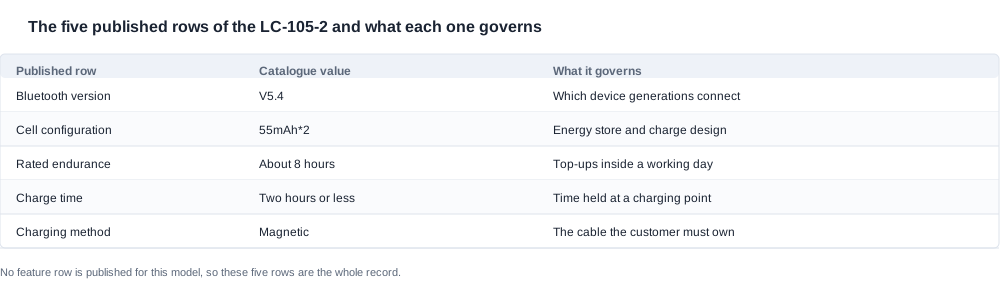
What the LC-105-2 publishes
Five rows is the whole of the LC-105-2 record that can be quoted without a supplier conversation, and each of the five answers a different part of a buying decision. The cell configuration states how the energy is stored. The rated endurance states how long the product claims to run. The charge time states how long the frame occupies a charging point. The charging method states what the customer has to plug in. The Bluetooth version states which device generations can connect to it. A specification built from those five lines is complete as far as the catalogue goes, and it is also the limit of what the catalogue goes.
The published LC-105-2 specification list sets the same five rows out in the order the catalogue uses, and the chart above pairs each one with the channel question it answers. Read together they describe a product with two 55 mAh cells, a stated endurance of about eight hours, a charge time of two hours or less, magnetic charging and Bluetooth V5.4. They do not describe a product with any named acoustic behaviour, any temple or frame descriptor, any control method, any camera and any sensing hardware, because the catalogue publishes no such row for this model.
Five of the eight audio models publish no feature row at all: the LC-105-2 and the D12, the K02 and the K01, and the LC-105-1. The other three do publish one. The D11 carries a surround-sound line and a long-battery line, the G07 carries an ultra-slim detachable temple, and the YK12 carries a surround-sound line and a slim temple. For a channel that sells on a named acoustic or design descriptor, that gap settles the shortlist before the energy rows are read at all, and the G07 selection note covers the model that publishes a design line.
A second fact shapes every comparison of this model: the LC-105-1 and the LC-105-2 publish the same five rows, verbatim. The catalogue publishes no row that separates the two, and it publishes no line explaining what the second version changes. A buyer writing a specification that names the LC-105-2 is describing a record that also describes the LC-105-1, so any claim that one of the two is the faster, the lighter or the newer unit has to arrive as a written answer rather than as a catalogue reading.
Two consequences follow for the way this model is quoted. The five rows are stable enough to build a comparison sheet from, and identical enough that the sheet cannot rank the two LC models against each other. And the absence of a feature row leaves nothing to write on a product page except the published numbers themselves, which is a workable position for a channel whose proposition is endurance and charging simplicity and a thin one for a channel whose listing needs a feature name in the title.
Where the LC-105-2 sits among the eight audio models
The audio group holds eight models: the K01 and the YK12, the LC-105-1 and the D11, the K02 and the LC-105-2, and the G07 and the D12. Every one of them publishes the same five rows, which makes the group directly comparable on those rows and on nothing else. The comparison below is the working sheet a procurement team would build, and it is also the point at which the LC-105-2 stops being one model and becomes one position inside a range.
| Model | Cell configuration | Rated endurance | Charge time | Charging method | Bluetooth version |
|---|---|---|---|---|---|
| K02 | 90mAh*2 | About 8 hours | Two hours or less | Magnetic | V5.3 |
| K01 | 90mAh*2 | About 8 hours | Two hours or less | Magnetic | V5.3 |
| D11 | 100 mAh | About 7 hours | Two hours or less | Type-C | V5.4 |
| D12 | 100 mAh | About 7 hours | Two hours or less | Type-C | V5.4 |
| LC-105-1 | 55mAh*2 | About 8 hours | Two hours or less | Magnetic | V5.4 |
| LC-105-2 | 55mAh*2 | About 8 hours | Two hours or less | Magnetic | V5.4 |
| G07 | 55mAh*2 | About 6 hours | Two hours or less | Magnetic | V5.4 |
| YK12 | 55mAh*2 | About 6 hours | Two hours or less | Magnetic | V5.4 |
On rated endurance the group divides into three bands. Four models publish about eight hours — the LC-105-1 and the K01, and the LC-105-2 and the K02. Two publish about seven hours — the D11 and the D12. Two publish about six hours — the G07 and the YK12. The LC-105-2 therefore shares its band with three other models, and the two models sitting on the same 55mAh*2 cell configuration publish about six hours, so the endurance row is what separates the LC-105-2 from the G07 and the YK12 inside its own cell group.
Cell configuration separates the group more sharply. Two audio models publish 90mAh2 — the K02 and the K01. Four publish 55mAh2 — the LC-105-1 and the YK12, and the G07 and the LC-105-2. The D11 and the D12 publish 100 mAh each. Inside the 55mAh*2 group the stated endurance spans about six to about eight hours, so a buyer reading only the cell row would group four models together and miss the fact that the published runtime separates them.
The about-eight-hour figure reaches wider than the audio group. Six models in the catalogue publish it: four audio models — the LC-105-1 and the K01, and the K02 and the LC-105-2 — together with the YKC02 and the ZH12 from the sport group. Those six span four cell configurations, from two 90 mAh cells through two 55 mAh cells and two 70 mAh cells to a single 100 mAh cell, and not one of them publishes the condition the figure was measured under. A number that travels across four cell configurations without a test condition is a claim to compare against, not a measurement to plan a shift around.
Charging divides the group in one direction and case capacity not at all. Six of the eight audio models publish magnetic charging — the LC-105-1 and the G07, the LC-105-2 and the YK12, and the K02 and the K01 — and the D11 and the D12 are the only audio models publishing a Type-C row. No audio model publishes a charging-case row, which is an absence of a published row rather than a statement that no case exists. No audio model publishes an ingress row either: the IP54 marking in the catalogue belongs to the V06 and the S7.
One difference inside the group is worth isolating, because it is the only specification difference between the D11 and the D12 and it is easy to read backwards. The D11 publishes a surround-sound line and the D12 does not, and the D12 is the one audio model in the group with no surround-sound row. Everything else about those two models reads the same — a 100 mAh cell, about seven hours, a charge time of two hours or less and Type-C charging. The LC-105-2 sits well away from that pair, on magnetic charging and about eight hours.
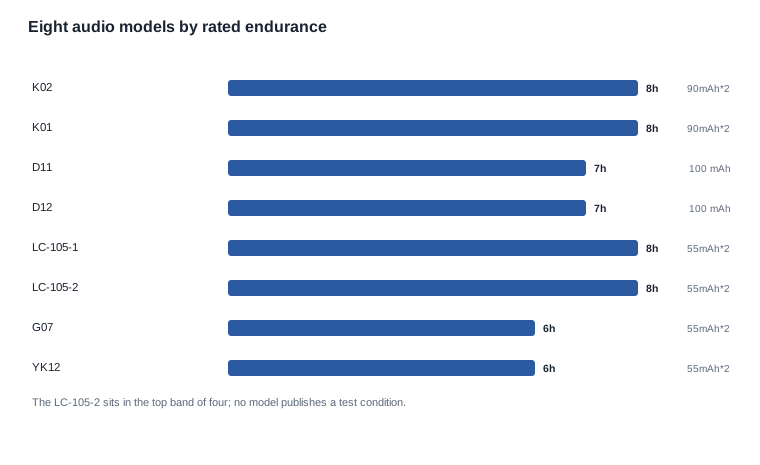
The position that falls out of this is worth stating plainly: the LC-105-2 publishes 55mAh*2, about eight hours, a charge time of two hours or less, magnetic charging and Bluetooth V5.4, and it publishes no feature row. It shares the first four of those with the LC-105-1 exactly, shares the fifth with five other models, and shares the absence of a feature row with four others. The audio group selection note takes the same eight models through the same rows, while the endurance comparison across the range collects the three bands in a single table.

The rows that decide the LC-105-2 for most channels
Three published rows carry most of the decision weight for this model, and they work in different directions. The charging-method row removes models outright. The Bluetooth-version row narrows a list without removing anything, because it separates one compatibility statement from another. The third is a value in the form of an absence: the missing feature row, which decides a channel whose proposition depends on a named descriptor and does not decide a channel whose proposition is endurance.
Charging is the row to apply first. A channel whose customers expect to reach a USB-C socket holds a requirement that only the D11 and the D12 satisfy inside the audio group, because those two are the only audio models publishing a Type-C row. On that requirement the LC-105-2 does not qualify, and no cell configuration or endurance figure changes the answer. Where magnetic charging is accepted the model stays on the list, and the channel inherits a magnetic dock and the lead that reaches it, which belongs in the carton, the accessory list and the support script rather than in a discovery after the first returns arrive.
The Bluetooth-version row cuts across in a quieter way. The K02 and the K01 publish V5.3, and the other six audio models publish V5.4, so the LC-105-2 shares its token with the YK12 and the D11, the D12 and the G07, and the LC-105-1. A brand that has already published a compatibility statement, a product page or a retailer listing naming a version is naming a row, and that row has to survive the comparison. What that line publishes is a token and nothing more. There is no profile list attached to it, no count of connected devices, no multi-device behaviour, and no test condition of any kind. A channel with a compatibility claim to defend therefore has a question to put to the supplier rather than a value it can quote.
Endurance is the row that separates this model from its own cell group. Inside the four 55mAh*2 models the stated runtime runs from about eight hours on the LC-105-1 and the LC-105-2 down to about six hours on the G07 and the YK12. That is a published difference and it is the cleanest argument this model has, but it carries no test condition, so it separates the two halves of the group on paper only. A channel whose requirement names a working day needs a protocol before it needs a figure, and the method for building that protocol is set out in the battery life comparison method.
The missing feature row is the deciding row for a third group of channels. A retailer whose listing needs a descriptor in the title, a distributor whose range sheet groups models by acoustic behaviour, or a brand whose differentiation plan rests on a named surround or temple feature has nothing to publish for the LC-105-2. The catalogue does not publish a feature row for this model, and it does not publish one for the K02, the K01, the D12 or the LC-105-1 either, so the answer to such a channel is not that the model is excluded but that the model has no copy to offer on that axis.
A fourth point belongs with the three rows, and it is a procurement point rather than a specification point. When a channel writes specifications against the model itself — a product page, a carton, a customs declaration, a distributor price list that names a model — the identical rows of the LC-105-1 and the LC-105-2 become a risk inside the file rather than a coincidence. Two model names printing the same five rows cannot be told apart by a reader, a warehouse or a customs broker, and the difference between them has to be established in writing and recorded in the specification before any artwork is drawn.
What an LC-105-2 buyer cannot settle from the catalogue
Several items a procurement team normally expects in a specification sheet are absent for the LC-105-2, and several are absent for every model in the catalogue. The distinction matters more here than anywhere else in the file, because a blank in a catalogue reads in two opposite ways — as a defect in the product, or as permission to assume. A buyer who treats an unpublished row as permission ends up with a specification sheet carrying claims nobody at the factory has confirmed.
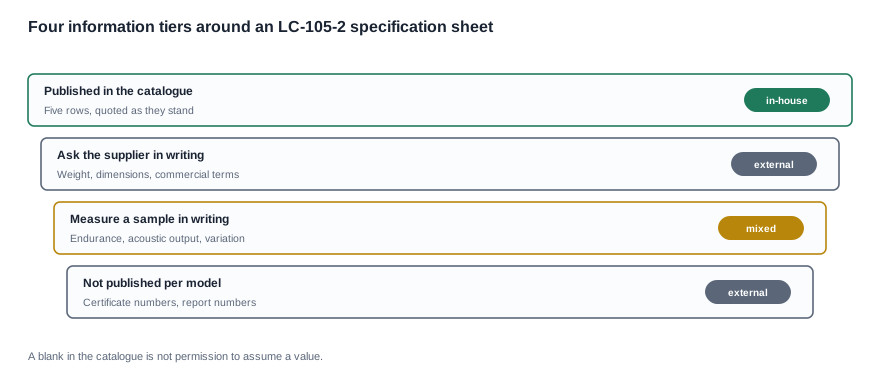
Four information tiers are worth keeping apart, and this model sits in all four of them. The top tier holds what the catalogue publishes and a specification can quote directly, which for this model is the five rows above. The second holds what a supplier can be asked for in writing and will normally answer: frame weight, frame and temple dimensions, the commercial terms, the warranty, the conformity documents for the destination market. The third holds what only a measured sample can settle. The fourth holds what the catalogue does not publish for any model and what the buyer has to define before the question can even be asked.
Take the weight as the worked example, because it is the row most often filled in by assumption. The catalogue publishes a weight for one model in the entire range, and that figure belongs to the MT6 glasses body — the eyewear unit with its battery and camera inside, excluding the foldable charging case. It cannot be carried across to the LC-105-2, and no bare frame weight appears anywhere in the catalogue. Any specification that needs the weight of this model has to ask for it, in grams, with the battery in place and any case excluded.
Endurance sits in the third tier because the published figure is nominal rather than measured under a stated condition. No catalogue row states what that run was: not the volume, not the source material, not the ambient conditions, and not the point at which the clock stops. A buyer who wants to compare this model against another writes the protocol first, runs the sample against it, and then files the written protocol beside the result.
Acoustic output stays in that group for a different reason: sound is a property of the physical unit, it shifts from one unit to the next, and no acoustic figure is published for this model anywhere.
Certification is the clearest case of the fourth tier. Nothing in the catalogue text refers to CE, FCC or RoHS, no model carries a certification row, and no certificate number, issuing body or validity period is attached to anything in the range. Two frameworks can be named in a request — the Radio Equipment Directive (EU) 2014/53/EU and the EMC Directive (EU) 2014/32/EU — so the conformity position of the LC-105-2 in a given destination market is a document to be obtained and filed, checked against that market before it is quoted on a listing. A buyer who asks for that file before the sample is ordered converts an open risk into a supplier deliverable.
The commercial rows sit in the second tier and have to be quoted rather than read. Unit price, minimum order quantity, lead time, warranty terms and defect handling are not published for this model or for any other audio model, and the same applies to the sensor, storage and dimension rows a camera-oriented buyer would look for. Nothing in that list is unusual to ask for, and none of it can be answered by comparison with a neighbouring model.
The order of the questions below is deliberate. The first has to be settled before the second, because a channel that cannot say which of the two LC models it is ordering cannot ask for a weight that means anything. The commercial rows come last because they are quotation items rather than catalogue rows, and the certification request comes before the order because a file that arrives after the shipment is not evidence in the market the product was bought for.
- The written difference between the LC-105-1 and the LC-105-2, if any exists, and the reason for it.
- The frame weight in grams with the battery in place and any case excluded, plus the frame dimensions and temple length.
- The endurance test condition behind the published figure: volume level, audio profile, ambient conditions and the end point.
- Whether a charging case is supplied with this configuration, and if it is, its capacity and its own runtime.
- The unit price, minimum order quantity, lead time, warranty terms and the defect and replacement procedure, as quotation items.
- The conformity documents held for this model, referenced to the destination market and to the two directives named above.
- The playback profile behind the eight-hour figure: whether it was measured with a single source, and at what volume.
The LC-105-2 smart glasses best for: matching a channel to the model
Matching a channel to the LC-105-2 turns on three questions, and the sequence matters because each answer eliminates work rather than adding words to a brief. No model in the audio group has a published unit price, a published minimum order quantity or a published lead time, so this section ranks nothing and recommends nothing. The three questions below are answered from the printed rows, and each one ends in a request the buyer has to put in writing.
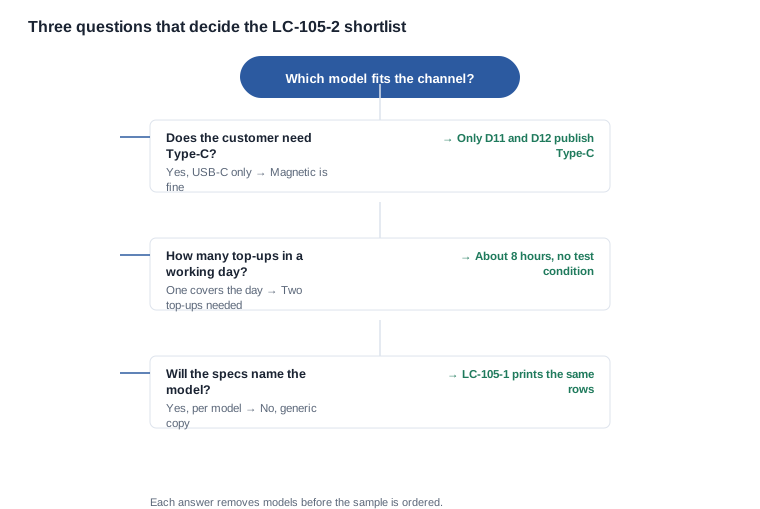
The first question is whether the customer needs a named Type-C interface. If the requirement names USB-C, the LC-105-2 leaves the shortlist inside the audio group, because the D11 and the D12 are the only two audio models publishing a Type-C row. If magnetic charging is acceptable, the model stays on the list and the channel takes on the accessory, packaging and support consequences of a magnetic dock. A requirement that never names a connector is not answered by the catalogue at all, because the published row describes the frame and not the customer.
The second question is how many top-ups a working day involves. The LC-105-2 publishes about eight hours, the same figure as the K02, the K01 and the LC-105-1, while the D11 and the D12 publish about seven hours and the G07 and the YK12 publish about six. Whether about eight hours covers a shift depends on a test condition the catalogue does not publish, so the answer to this question is a protocol for the sample round rather than a number for the specification. The LC-105-2 battery life analysis sets the nominal figure in context, and the comparison against the D12 covers the alternative architecture in the group.
The third question is whether the channel intends to write specifications against the model itself. A channel that publishes one generic listing for the whole audio group can work with five rows and no feature line, and it inherits a simple proposition that is easy to describe and easy to keep consistent across a range. A channel that writes model-level text — a product page, a carton, a distributor sheet — needs more, and the gap it meets is that the catalogue publishes nothing to separate the LC-105-2 from the LC-105-1 and no descriptor to give either of them a line of copy. That gap is closed by a written answer, not by a page.
Running the matching is a short sequence, and each step removes work rather than adding paragraphs to a brief.
- Write the channel requirement as one sentence that names no product.
- Attach each term of that sentence to the one catalogue row that would answer it.
- Flag every term the catalogue leaves unanswered, and treat it as a question for the supplier.
- Apply the charging-method row first, because it removes models faster than any other row.
- Apply the endurance row and the Bluetooth-version row against the remaining names, and keep the comparison in a dated sheet.
- Send the open rows to the supplier as written questions, version the answers, and attach them to the specification sheet.
Two conditions close the matching for a channel that has reached the LC-105-2 on published rows. The first: a quotation is only defensible when every number in it matches the row it came from, which means the five published rows are transcribed rather than summarised. The second: the rows the catalogue leaves empty are not a barrier to ordering at all. They are the substance of the supplier conversation, and a buyer who requests them in writing ahead of the sample converts an open specification into a finished one.
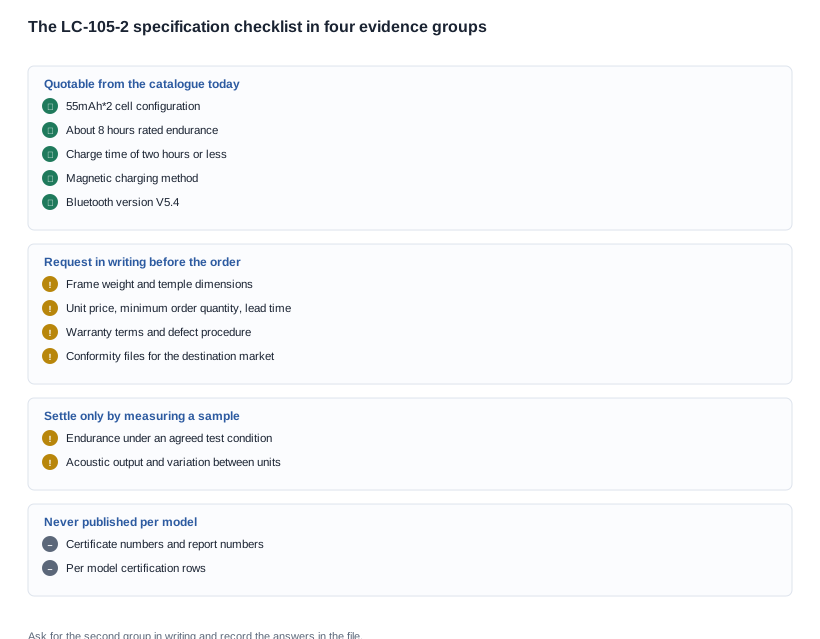
The checklist above is the same four groups written as a sheet a sourcing team can work from: the rows that can be quoted today, the rows that have to be requested in writing, the rows that only a measured sample can settle, and the rows that the catalogue does not publish for this model or for any other. A specification built that way carries evidence rather than assertion, and it can be handed to a supplier, a customs broker and a customer without anyone having to guess which lines were measured and which lines were assumed.
A channel building a brand on this platform has two further references to read: the note on the customisation path for this model, which sets out the options that have to be raised with a supplier rather than taken for granted, and the readiness note for the range, which shows where platform sharing is documented. Neither reference adds a published row to the specification, and both belong in the enquiry list rather than in the specification sheet.
One closing point concerns the two LC models. Because the LC-105-1 and the LC-105-2 publish identical rows, the selection difference between them cannot be written from the catalogue. It can only be written from a supplier answer to a specific question, and it then has to appear in the specification, on the artwork and on the purchase order in the same words. The comparison between the two LC models covers what the possible answers mean, and the charging options for this model sets the magnetic row in context.
Related reading
- The published rows for this model — LC-105-2 smart glasses specifications and features
- The nominal endurance figure in context — LC-105-2 smart glasses battery life
- The charging row in context — LC-105-2 smart glasses charging options
- The wider selection question — Bluetooth audio glasses which model to pick
Tell us the channel, the connector it has to support and the markets it ships to, and we will send back the published rows that decide the model together with the items that only a supplier answer can close.


