

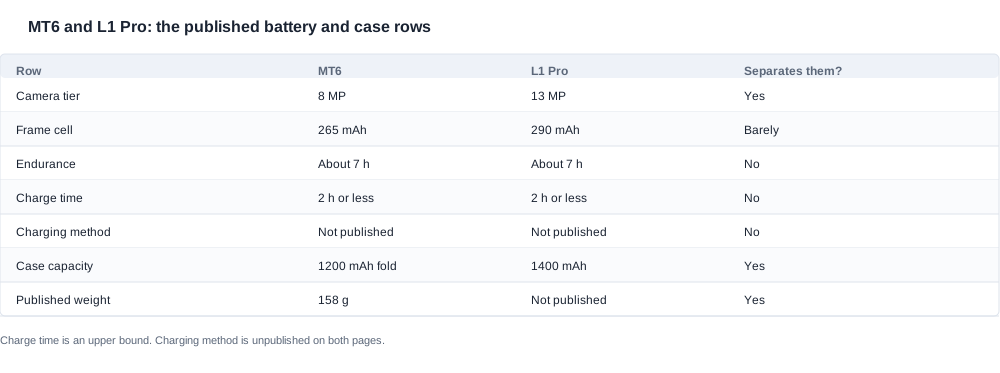
MT6 smart glasses vs L1 Pro is a comparison that most buyers expect to turn on battery figures, and that is precisely why it is worth reading carefully: on the published rows, the two models are close to identical. Both sit in the roughly seven hour endurance class, both publish a charge time of two hours or less, both carry a charging case whose capacity is stated, and — this is the detail that catches people out — neither model publishes a charging method at all. The real differences between them live in the camera tier, the case construction and the single published weight figure in the entire catalogue. This piece sets out which published rows settle the question, which rows cannot be pushed further than they reach, and what a procurement team should put in writing before either quotation goes into a shortlist.
MT6 smart glasses vs L1 Pro: four rows that come out level
Pull the catalogue pages for the two models and the battery block reads almost symmetrically. The frame cell is 265 mAh on the MT6 and 290 mAh on the L1 Pro. The stated endurance is about seven hours on both. The stated charge time is two hours or less on both. The charging case capacity is published on both — 1200 mAh on the MT6, 1400 mAh on the L1 Pro. That is the whole of the published battery comparison, and it is a short list.
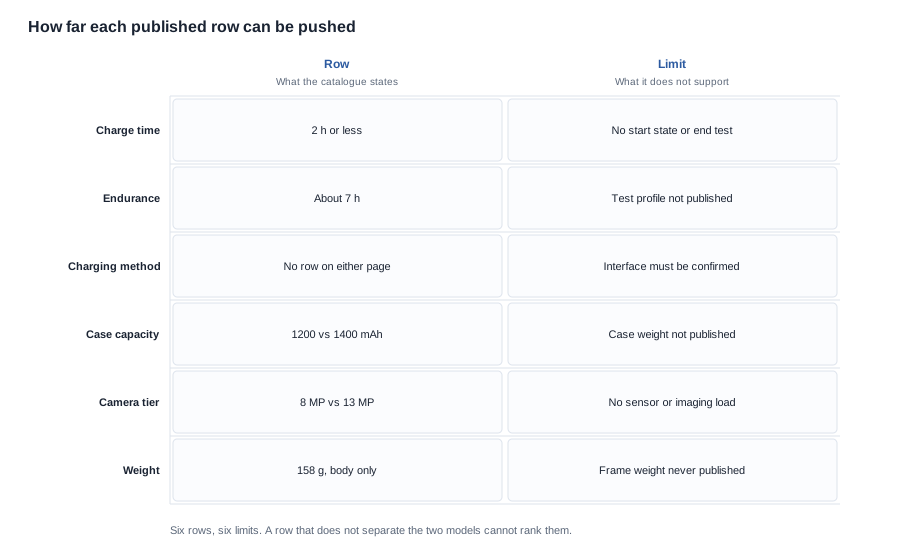
Two of those rows deserve a buyer to slow down before treating them as equivalent. The first is the charge time, which is published across the range as an upper bound rather than a measured value. Two hours or less allows exactly two hours; it does not assert a specific figure, and it does not state the state of charge the clock starts from or the criterion that decides the charge is complete. The second is the charging method, which is absent from both models' pages. The MT6 page publishes the cell, the endurance figure, the charge time and a foldable 1200 mAh case. The L1 Pro page publishes the cell, the endurance figure, the charge time and a 1400 mAh case. Neither page carries a charging interface row.
That absence is a documented gap rather than a claim that the models charge some particular way. Across the eleven camera models in this range, the charging method splits into three states: published as magnetic on some pages, published as Type-C on two pages, and unpublished on four — the CY03 and the CY05, and the MT6 and the L1 Pro. A buyer comparing these two models is therefore comparing two products whose charging interface is equally undocumented. You cannot assume they match, and you cannot assume they differ. Both answers require a written answer from the supplier.
Why the charge-time row cannot become a shift-length claim
The published endurance figure is about seven hours on both models. Read as a working-day statement, it is not defensible, for three separate reasons, and each of them is a documentation gap rather than a criticism of the product.
The first is the test condition. The catalogue publishes the figure without stating what the device was doing during the measurement — camera idle, camera recording, audio playing, or a mixed profile. For two camera models whose imaging subsystems sit at different resolution tiers, an unspecified profile means the two figures are not measured on a common basis. You cannot adjust them for the difference without the load data, and the load data is not published.
The second is the interaction with the camera. The MT6 publishes an eight megapixel camera and the L1 Pro publishes a thirteen megapixel camera. Those are the two resolution classes in the camera range, eight megapixel across eight models and thirteen megapixel across three. A higher resolution class does not by itself tell you the drain, because neither model publishes a sensor model, a field of view, a frame rate, a video format or a stabilisation arrangement. The imaging load is therefore unknown for both, and it is precisely the load most likely to move the endurance figure in real use.
The third is the case. A published case capacity is not the same as a published off-rig runtime. Case capacity tells you the size of the reserve cell in the parcel. It does not tell you how many complete charge cycles a user gets from it, how quickly the case itself refills, what interface the case uses to refill, or how much energy the case loses in conversion. None of those are published for either model.
The wider battery picture across the camera range, including where the published figures are internally consistent and where the labels diverge, is set out in the AI camera glasses battery comparison. For this pair specifically, the honest reading is that the battery rows confirm the two models are in the same class, and they do not provide a basis for choosing between them.
The case: capacity, fold mechanics and the parcel
The charging case is where the two models separate on published facts, and it is the only part of the battery system that does.
The MT6 publishes a 1200 mAh case and, uniquely in this range, describes it as foldable alongside its portable and ultralight descriptors. That folding construction is a genuine packaging decision with three consequences. It reduces the volume of the parcel, which matters when the unit is being shipped in volume or carried as a sample. It introduces a hinge, which becomes a transit-cycle durability question the supplier should answer rather than the buyer guessing. And it changes the returned-goods path, because a folding case that arrives damaged creates a warranty event that the buyer absorbs unless the terms address it.
The L1 Pro publishes a 1400 mAh case, the larger of the two. A larger reserve cell in every shipped unit affects the parcel weight and the lithium content per unit, both of which feed into freight and compliance handling. It also affects the after-sales economics, because a larger cell is a larger failure surface if the case is the component that fails.
Two points of care sit underneath both. First, the case capacity is published but the case weight is not, for either model, so a parcel calculation cannot be completed from the catalogue. Second, the camera range's case information has four distinct states, and buyers routinely misread them. Five models publish a case capacity. Two — the KY06 and the MT5 — are described with a case but no capacity. Three — the V03 and the S7, and the V06 — have no case row on their pages at all, which is an unpublished gap rather than proof of absence. One — the V03 Pro — is explicitly published without a case. Both models in this comparison fall into the first group, where the capacity is stated.
The economics of the accessory itself, and the questions worth putting to a supplier about how the case is charged and packed, are covered in the MT6 charging options analysis and, for the neighbouring case-equipped model, in the CY05 charging options analysis. The parcel arithmetic across this group is worked through in the AI camera glasses shipping weight note.

The 158 gram row and the three claims it carries
The MT6 publishes 158 grams. It is the only weight figure anywhere in this catalogue, and its scope matters more than its existence.
The published figure is the weight of the MT6 eyewear body, including the 265 mAh cell and the camera, and excluding the foldable charging case. The case is a separate 1200 mAh unit and its weight is not published. The catalogue does not publish a bare frame weight for any model in the range, so this figure cannot be read as a frame weight, and it cannot be compared against a frame-weight figure for another product without knowing what that other figure measures.
Used carefully, one published weight does three things. It gives the buyer a starting parcel weight for the device alone. It supports a portability argument that the competing model cannot make, because no weight is published for the L1 Pro at all. And it gives a buyer something concrete to ask about: a packed unit weight including the case, for both models, measured rather than estimated.
What it does not do is settle the comparison. The L1 Pro's absence of a published weight is a documentation gap, not a physical disadvantage, and a buyer who treats it as one will either overpay for the published figure or discount a product they have not measured. The honest position is that the MT6 can carry a weight claim and the L1 Pro cannot, and that any weight comparison between them is currently impossible from published data.
The published rows for each model are set out in the MT6 specification list and the L1 Pro specification list. How the MT6 sits against the wider range is covered in the MT6 how it compares note, and the neighbouring platform decision is taken from the other direction in the L1 Pro versus CY05 use case fit piece.


What has to arrive in writing before either model is shortlisted
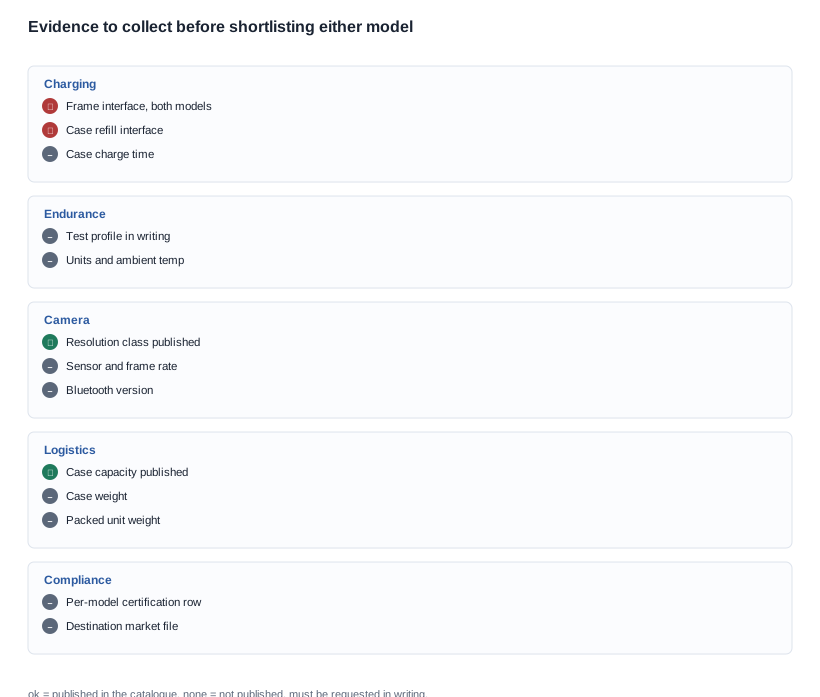
Because the published rows are so close, the comparison is decided almost entirely by information the catalogue does not contain. That makes the request list the real work of this evaluation. The following items are not a formality; each one closes a specific gap identified above.
Charging interface, for both models, in the same sentence. Neither model publishes one. Ask which interface is fitted to the frame, whether it is a proprietary contact or a standard one, and what cable or dock a technician needs to service a unit. An answer that describes one model and leaves the other open is not an answer for a two-model decision.
The endurance test condition, asked in identical words for both models. Ask what the device was doing while the figure was measured, at what ambient temperature, from what starting state of charge, and how many units were tested. Two figures collected under different profiles cannot be compared, and the comparison is the entire purpose of the exercise.
Imaging load data for both. Sensor model, field of view, frame rate, video format and the resolution behaviour under continuous recording. The catalogue publishes the resolution class and nothing beyond it for either model. Without load data, the seven hour figure cannot be adjusted for the thirteen megapixel tier.
Case details for both. Case weight, external dimensions, the interface used to refill the case, the case's own charge time, and whether the fold on the MT6 case is rated for a stated number of open-close cycles or transit cycles. Ask for a cycle figure rather than accepting the word durable.
A measured packed unit weight for each configuration, frame plus case plus packaging, for the shipping configuration you would actually order. The published 158 grams covers the MT6 eyewear body only.
The certification position for each model in each destination market, as documentation rather than as an assurance. This catalogue carries a company-level export certification page whose content is images rather than text, and its text contains no reference to CE, FCC or RoHS anywhere. There is no per-model certification row for any model, including these two. The export certification page shows ten patent certificates — eight appearance-design patents and two utility-model patents — which is a statement about intellectual property, not about market access. Any per-model conformity claim for a destination market is material you must request in writing before you rely on it. The documentation requirements around that request are treated in the export documentation note.
Bluetooth and touch behaviour, because both are commonly assumed and neither is published. None of the eleven camera models publishes a Bluetooth version. No model in the catalogue publishes a touch row at all, so whether the temple carries a touch surface, and how it is configured, has to come from the supplier as a factual question.
A label trap worth knowing before you read any page
Before building a request list, it helps to know how the source pages are labelled, because the same word is used for two different quantities across this range. On the audio and general pages, the charging time is the charging time. On three camera pages — the MT5 and the KY06, and the V03 — the word that appears against a duration of five to eight hours or six to eight hours is the same word other pages use for charge time, and those three pages carry a separate charging-time row alongside it. In other words, the endurance label and the charge-time label overlap on a small number of pages.
This matters for the present comparison because it is exactly the kind of detail that gets transcribed into a spreadsheet incorrectly and then defended in a supplier meeting. When you extract the endurance figure for either model, confirm which row it came from and whether that page carries a second duration row. The published endurance figures across the eleven camera models fall into three groups — four models at five to eight hours, two models at six to eight hours, and five models at about seven hours — and the two models in this comparison sit in the third group. Reading a charge-time value out of that group by mistake would produce a number roughly a quarter of the real figure and would survive review unnoticed.
Sequencing the requests so answers arrive in a usable order
The seven items above are not equally urgent, and issuing them in the wrong order wastes a cycle. Ask first for the items that determine whether a comparison is possible at all: the charging interface for both models and the endurance test condition for both models. If either comes back unanswerable, the two-model comparison collapses into a single-model evaluation and the rest of the list changes shape.
Ask second for the items that affect cost and logistics: the case details and the measured packed unit weight. These rarely block a decision, but they change a freight quotation and a retail shipping tier, so they should be in hand before a commercial model is built.
Ask third for the items that protect the launch: the per-model certification documentation for each destination market, the imaging load data, the Bluetooth position, and the touch configuration. These are the items most likely to surface a contradiction between two suppliers, which is valuable information precisely because it is uncomfortable to receive.
Record the answers against the row they belong to rather than in a free-text document. When the same question is put to a second supplier later, a row-by-row record makes the two answers comparable. A narrative summary of what one supplier said about charging tells you very little when the other supplier's answer arrives six weeks later.
Scoring two quotations built on the same published rows
When both quotations are built on the same published battery block, the differences you can legitimately evaluate are the ones the documentation exposes: the resolution tier, the case capacity and construction, the single published weight, and the completeness of the supplier's answers to the list above.
A workable method is to score each supplier on documentation completeness before scoring either product. For each of the seven request categories, record whether the answer arrived in writing, whether it was specific enough to verify, and whether it contradicted anything on the published pages. A supplier who answers six of seven clearly is a different commercial proposition from one who answers two vaguely, and that difference usually dominates the specification difference between two models that sit in the same endurance class.
The second step is to price the consequence of the gaps that remain. If the charging interface is still unknown at order stage, the risk is that a spare-unit or service workflow is designed around the wrong dock. If the endurance profile is still unknown, the risk is that field expectations were built on a figure measured under a profile the product will never see. If the packed weight is still unknown, the risk sits in the freight quotation and in any retailer shipping tier calculation built on it. These are commercial exposures, and they can be priced into a decision even when the technical answer is unavailable.
The third step is to write the limits of the comparison into the evaluation record. This pair does not separate on battery figures. It separates on camera tier, on case capacity and fold construction, and on whether a weight claim is available. Any evaluation that ranks these two on endurance alone has used a row that does not separate them, and that is the single most common error in a two-model shortlist of this kind.
For the wider question of how a range like this maps onto different commercial briefs, the AI camera glasses which model to pick note works from the specification structure rather than from a recommendation, because this catalogue does not publish prices, price tiers or a ranked line-up, and a comparison that resolves into a ranked answer would have to invent the ranking.
Related reading
- The published rows for the MT6 — MT6 smart glasses specifications and features
- The published rows for the L1 Pro — L1 Pro smart glasses specifications and features
- How the accessories price out — MT6 smart glasses charging options
- The full battery grid — AI camera glasses battery comparison
If you send us the channel, the destination markets and the packaging configuration you need, we will tell you which of the published rows above actually change your decision and which of the gaps have to be closed by written answer before either model goes on a shortlist.


