

Smart glasses ai features smart glasses glossary is a page for a buyer who is about to sit in a meeting where everyone else has already learned the vocabulary, and the most useful thing such a page can do is not define the terms but say which of them have any contractual meaning in this category. Most of them do not, and the buyer who knows that in advance is the one who can tell a real capability from a slogan.
The published position in our range is a very short paragraph, and the glossary is built around it. The AI voice assistant is a listed key technology across the camera tier and the audio tier. AI translation is a listed feature on the K01, which is an audio model. The smart noise reduction technique is published for the Bluetooth audio family. Nothing else about the AI feature is published for any model: no provider, no model, no language list, no latency, no offline behaviour, no data path, no retention policy and no accuracy figure. Every term below therefore has a status column that says whether we can state it, and the honest answer for most of them is that we cannot.
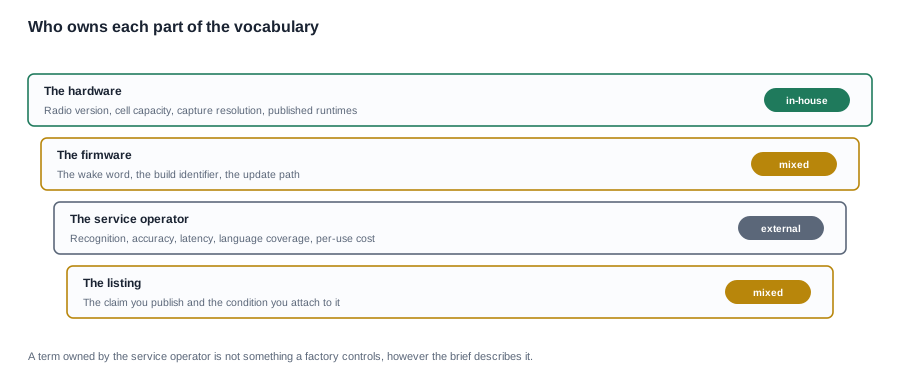
Smart glasses ai features: read the owner column
Every term in this category belongs to one of four parties: the hardware, the firmware, the service operator, or the listing. A term that belongs to the service operator is not something a factory controls, and a term that belongs to the listing is something the brand controls entirely. A great deal of confusion in an AI feature conversation comes from treating a service term as a product term, and the fastest way to catch that in a meeting is to ask the ownership question before the definition question.
The hardware owns the rows you can verify with a sample. The radio version, the charge time, the cell capacity, the published runtime, the capture resolution, the charging case capacity and the accessory list. These are the rows we publish, and the ones we will stand behind. When a supplier and a buyer agree on a number, it is almost always one of these, because they are the only numbers that exist in both organisations.
The firmware owns the trigger, the build and the update route. The wake word, the build identifier, the update mechanism and the notice period before a behaviour changes. These are partly the factory's and partly the manufacturer's, which is why a firmware change can alter a claim without anyone deciding to alter it.
The service operator owns the intelligence. Recognition, accuracy, latency, language coverage, the per-use cost and the offline behaviour. Every published gap in our range sits in this band, and the practical consequence is that a procurement conversation about an AI feature is really a conversation about a party who is not in the transaction.
The listing owns the claim. The wording, the condition attached to it, the models it applies to and the models it does not. This is the part the brand controls most easily and forgets most often, and it is where the claim risk sits. The practical version of that is in the buying checklist.
The cost side of the service-operator band is set out in AI cost factors, because a term you cannot verify is usually a term you cannot price either, and the regulatory question about what a claim may say is in how regulations affect this.

The terms that belong to the hardware
The vocabulary of the hardware is the part of the glossary a buyer can act on today, because these terms have published rows attached to them and the rows can be quoted on a product page.
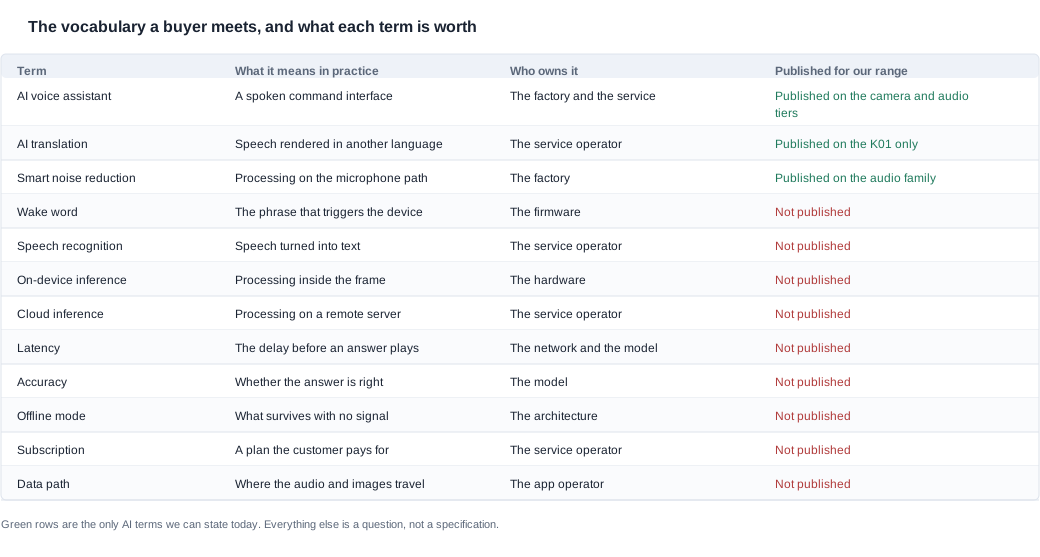
The table below is the working glossary, and the right-hand column is the part that matters: for each term, whether we can state it for our range today.
| Term | What it means in practice | Who owns it | Published for our range |
|---|---|---|---|
| AI voice assistant | A spoken command interface | The factory and the service | Published on the camera and audio tiers |
| AI translation | Speech rendered in another language | The service operator | Published on the K01 only |
| Smart noise reduction | Processing on the microphone path | The factory | Published on the audio family |
| Wake word | The phrase that triggers the device | The firmware | Not published |
| Speech recognition | Speech turned into text | The service operator | Not published |
| On-device inference | Processing inside the frame | The hardware | Not published |
| Cloud inference | Processing on a remote server | The service operator | Not published |
| Latency | The delay before an answer plays | The network and the model | Not published |
| Accuracy | Whether the answer is right | The model | Not published |
| Offline mode | What survives with no signal | The architecture | Not published |
| Subscription | A plan the customer pays for | The service operator | Not published |
| Data path | Where the audio and images travel | The app operator | Not published |
Three of the hardware-side terms deserve a note, because they are the ones a buyer is most likely to use in the wrong way.
"On-device" and "cloud" describe where the processing happens, and they determine what the product does with no network. For our range the behaviour offline is not published for any model, which means a buyer cannot currently write a sentence about what the product does in a basement. That single gap is the reason the internet dependency question is the first one to ask, and it is also the reason a buyer should not use either word in a listing until the behaviour is enumerated.
"Live translation" describes a capability, not an implementation. A capability without a language list and a latency figure is an aspiration. The K01 publishes AI translation as a feature and publishes the language list as not published, and that is the whole of our position on it.
"Always-on" describes whether the product is listening and what it listens for. Whether a product is always-on, and what it does with the audio in between, is not published for any model in this range. It is also the term that most often turns into a privacy question, because a microphone that is always listening is a microphone that is always collecting.
The terms that belong to the service operator and to your listing
This is where every published gap in our range sits, and it is the band that a buyer should be negotiating about rather than reading about.
"Cloud inference" and "on-device inference" are the same term pair seen from opposite ends. Whichever one a supplier uses, the two questions behind it are: what happens to the product with no network, and where does the audio go. A supplier who names the architecture but not the data path has answered half the question, and the half they answered is the easy one.
"Accuracy" is a category of measurement rather than a figure. To be usable, an accuracy claim needs the method, the phrase or task set, the language, and the assessor. "High accuracy" is not a measurement; "94 per cent on a fixed 200-phrase set in the buyer's market language, assessed by a native speaker" is a measurement, and the second one can go into a purchase order.
"Latency" is a figure with a network state attached. Measured end to end on a congested venue network, it is a different number from the same measurement on an office network, and the difference is usually larger than the difference between two suppliers. This is why the threshold and the network condition have to travel together in the same sentence.
"Edge" and "hybrid" are architecture words, not capability words. A hybrid arrangement, where part of the work is on the device and part is off it, has the properties of both, and the properties a buyer cares about — the offline behaviour, the data path and the latency — are the ones the label hides. The useful question is always the same: which specific functions run locally.
"Model" is overloaded, and the two meanings need separating. A hardware model, like the K01 or the L1 Pro, is a catalogue designation. A language model is the thing doing the recognition. "Which model" is ambiguous in a conversation with a supplier, and the ambiguity is worth resolving in writing, because the answer to one of them is a row in our catalogue and the answer to the other is not published for any model.
"Token" and "embedding" are vocabulary from the service side that has no equivalent in the hardware catalogue. They describe how the service accounts for and represents the input. A buyer who hears them in a quotation has learnt something real about where the intelligence lives, and that is useful — but neither term can be checked on a sample, so neither can be put on a product page.
The terms that belong to your listing, and the ones to avoid
The listing is where the terms finally become commitments, and it is the only band the brand fully controls. Three terms are dangerous there for specific reasons.
"Offline" is a capability word with a legal shape. A claim of offline use is a claim about a defined condition, and the condition is yours to define and then to keep. If you publish "works offline" and the enumeration shows that only capture and playback survive, the page is describing a product that does not exist. The safe form is the enumeration itself.
"Real-time" is a latency claim with no threshold. It tells a customer that a response is immediate. Whether it is — measured end to end, on the network the customer has — is a different question, and it is the question that generates a complaint. If the threshold cannot be stated, the word should come off the page.
"Seamless" and "effortless" carry no operational content at all. They are the words most used in this category and the ones with the least published support behind them, and they are unanswerable in a negotiation because there is no fact to agree on. A buyer who asks for a definition of each of them gets a much better answer than a buyer who asks for a demonstration, and a supplier who cannot define a word is telling you the word is doing the work that a fact should be doing.
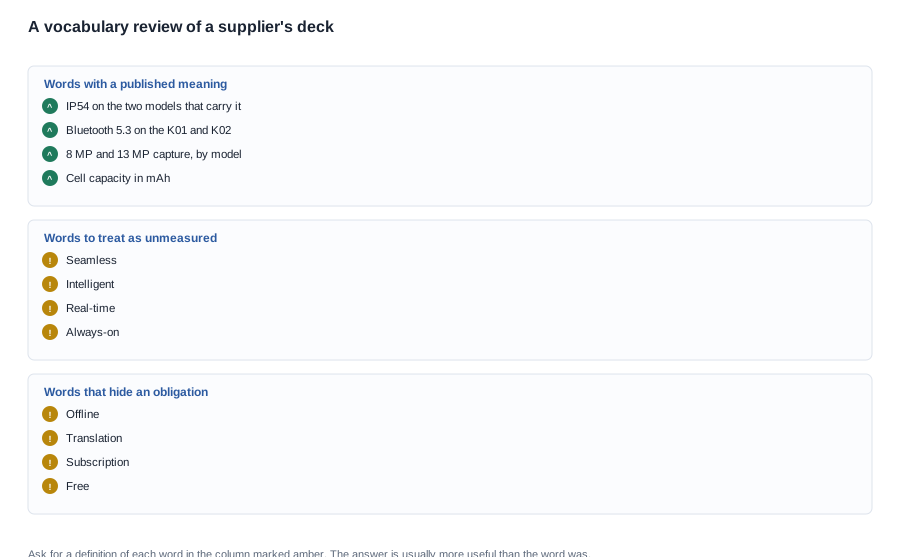
The three groups in that checklist are the ones to run over a deck before you sign anything. The first group is the vocabulary you can use today, because a published figure is attached to it. The second group is the vocabulary that looks precise and is not, and it is the group that ends up on a product page. The third group is the vocabulary that hides an obligation, and each of those four words has a document behind it somewhere in the supplier's organisation.

Which terms you can close yourself, and which you cannot
The most practical use of a glossary is as a way of dividing a conversation into the part you can settle on a sample and the part you have to settle in a contract.
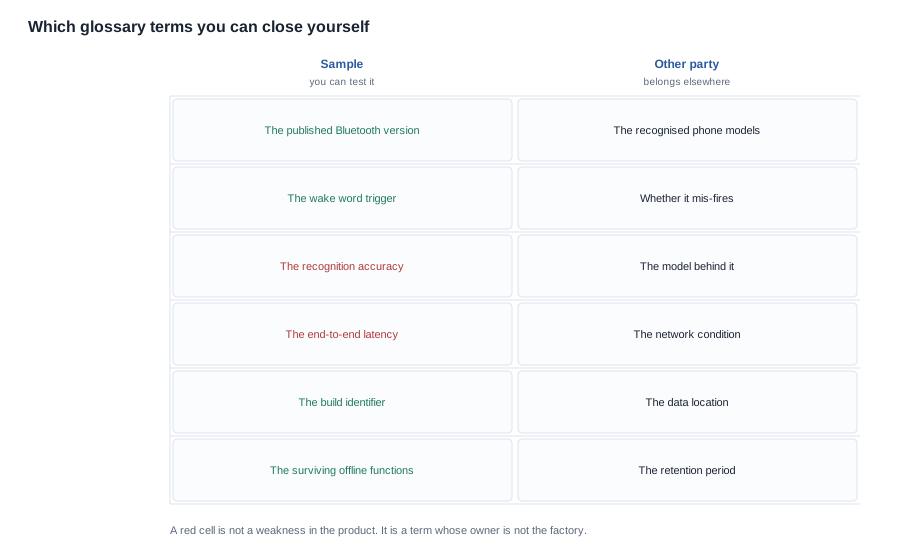
The terms you can close on your own units are the radio version, the wake word trigger, the build identifier, the surviving offline functions, and the data path you observe in practice. None of these requires the supplier's cooperation beyond sending a sample, and all five are the terms that generate customer complaints.
The terms you can close with a document are the published hardware rows, the accessory list, the charging case capacities, the published runtime bands, the certificate numbers, the app distribution method and the notice period. These are already written somewhere, and asking for them costs a question.
The terms you cannot close at all, and must accept or negotiate around, are the recognition accuracy, the end-to-end latency, the language coverage, the retention period and the cost per use. They are properties of a party who is not in the transaction, and the honest way to handle them is to write them as dated observations rather than as guarantees, and to decide in advance which ones you are willing to carry as an open risk.
That last group is the one buyers most often try to close by asking a supplier for a number, and it is worth being explicit about why that does not work: a number produced under conditions you did not specify, on a network you did not control, is not a specification, and the first time it does not reproduce, it is a defect report against you rather than a conversation with the supplier.

Running the glossary over a supplier's deck
A glossary is only useful if it gets applied to something. The practical version is a forty-minute pass over the deck, the quotation and the draft listing, with the terms in this article as the working list and three marks going on each of them.
Pass one: mark the owner. Every technical term in the document gets a band — hardware, firmware, service operator, or listing. This pass is fast and it is the one that changes how the rest of the meeting goes, because it identifies immediately which terms nobody in the room is able to commit to.
Pass two: mark the verifiability. For each term, one of three marks: a published figure attached to it, a test you can run on a sample, or a negotiation. The second mark is the most useful one, because it converts a supplier's answer into an afternoon of your own work, and the third is the one that has to be written into the agreement.
Pass three: mark the claim. For each term that reaches a customer-facing document, one of three results: publish it as it stands, publish it with a condition attached, or take it out. The third result is the one that takes courage, and it is also the one that prevents a reprint.
Two pieces of advice about the order of the three passes. Run the owner pass first, because it tells you which questions are worth asking. And run the claim pass over your own copy as well as the supplier's, because the terms that cause trouble are usually the ones that arrived in your document by implication rather than by decision — a word on a slide that ended up on a product page without anyone choosing it.
The terms that belong to the firmware
The firmware band is small, and that makes it easy to overlook, which is a mistake because the firmware band is where a claim can change without anybody deciding to change it.
The wake word is the phrase or signal that triggers the device, and the term behind it is "always-on". Whether the device is listening continuously, what it does with the audio in between, and how often it mis-fires are three different questions, and only the first has a vocabulary word. We publish none of the three for any model in this range, and the privacy answer in particular belongs to whoever operates the application rather than to the factory.
The build identifier is the number that tells you which software a shipped unit is running. It matters to a buyer for one reason: a firmware release can change the behaviour of a feature you are marketing on, and without a build identifier and a notice period you will not know that it happened. The build and the notice period are cheap to ask for and expensive to discover.
"Firmware" and "model" are two different words and they are routinely confused. A hardware model is a catalogue row, which for us means a designation you can quote and a specification you can check. A firmware build is a software state. A buyer who hears "the V03 has the assistant" has been told about a hardware model; a buyer who hears "the assistant is in the latest build" has been told about firmware, and has been told nothing about which units in the field actually have it. The criteria for telling them apart are simple: if the statement survives a factory reset and appears on a production unit, it is a hardware claim; if it can change on a unit that has already shipped, it is a firmware claim and it needs a notice period.
The words to stop using in a purchase order
A purchase order is a different document from a product page, and the vocabulary that works on one does not work on the other. Three changes make the difference.
Replace every unqualified capability word with a term and a condition. "Supports AI translation" becomes "the K01 performs translation between the named pairs, subject to network availability". The second version is longer and it is enforceable, because it names a product, a scope and a condition.
Replace every soft word with a number, or delete it. "Fast", "accurate", "seamless" and "lightweight" have no counterpart in a contract, and a clause containing them is a clause that cannot be disputed, which is to say that it cannot be relied on. If the number cannot be supplied, the word has to go.
Attach an owner to every term that appears. The owner is what turns a term into a commitment: the factory for the hardware rows, the operator for the service terms, and the brand for the listing. A purchase order where every term has an owner is short, and a purchase order where no term has an owner is longer and worth nothing.
The rule we apply to our own pages is the same one: we publish the terms we can evidence, we mark the ones we cannot, and we say plainly which part of the vocabulary belongs to a party the buyer has to contract with rather than a party the buyer can test. A term with an owner is a term a buyer can manage. A term without one is a term a buyer has to hope about.
Where the vocabulary comes from
Send the vocabulary your supplier uses and we will tell you which terms in it are published for our range and which are not.


