

A d12 smart glasses vs lc-105-1 use case fit is not settled by a scorecard, because the catalogue gives the two models almost the same five rows and no scenario descriptor at all. What it can be settled by is a mapping: take the scenario the channel actually sells into, find the published row that constrains it, and read the two models against that row. On this pair the mapping is unusually short, because the two models agree on more than they differ.
The published position of the pair. The D12 states Bluetooth V5.4, a 100 mAh cell, a charge time of two hours or less, about seven hours of use and Type-C charging, with no feature row. The LC-105-1 states Bluetooth V5.4, two 55 mAh cells, a charge time of two hours or less, about eight hours of use and magnetic charging, also with no feature row. Identical radio generation, identical charge-time ceiling, identical absence of features. The interface, the cell configuration and the use-time figure are the three rows where the two models part company.
D12 and LC-105-1: mapping a scenario to a published row
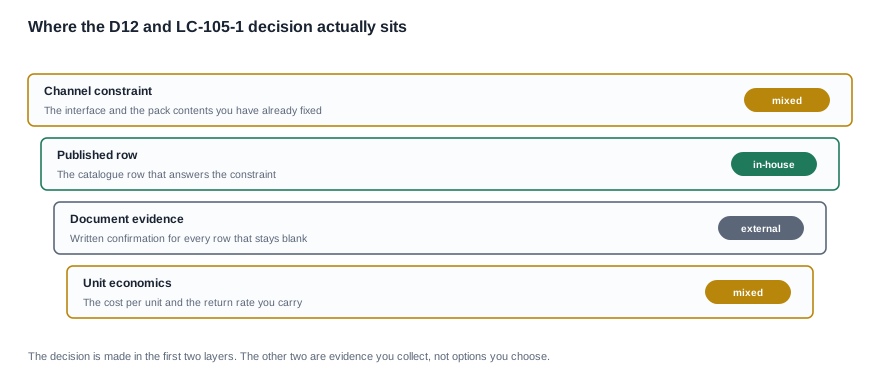
The layers diagram above is the mental model for the whole comparison. The top layer is the channel scenario, which a buyer already owns and does not need a supplier to define. The second layer is the published row that constrains it. The third layer is the evidence, and it is the layer where the effort goes, because the catalogue is generous with specification rows and stingy with the conditions and documents that make them usable.
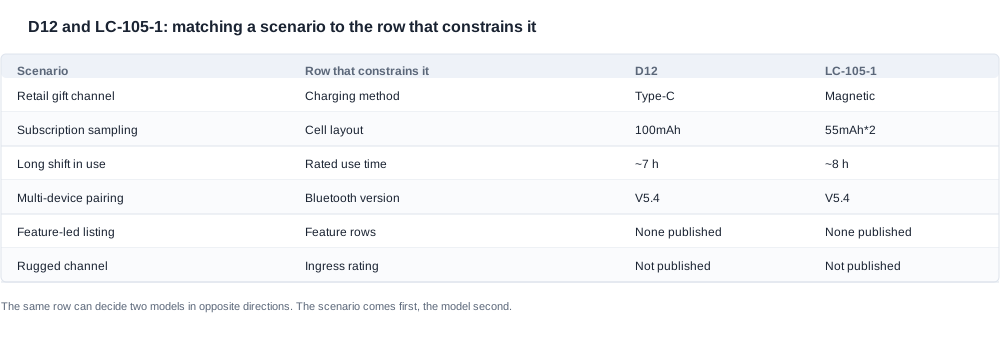
The table reads left to right in the order a buyer should work. A scenario, then the row that constrains it, then what each model prints against that row. Notice what is missing from the right-hand columns: there is no column for price, because the catalogue publishes no price and this comparison is not a value judgement. There is no column for weight, because neither page publishes one.
Why the scenario has to come first
Models are usually compared first, and that is why so much of this category's buying goes wrong. A buyer who starts from the model develops a preference, and then discovers that the preference has no published row behind it and quietly picks the closest thing. Starting from the scenario produces the opposite result: the scenario produces a constraint, the constraint produces a row, and the row produces a shortlist that can be defended in a review meeting.
The practical version of this is a one-page document. Three to six scenarios, each with the constraint it implies, each with the row that answers it. Nothing in that document is a preference and nothing in it is a promise; it is a translation layer between what the channel does and what the catalogue prints. The D12 specifications and features page collects the published rows for the D12 in one place, and the LC-105-1 model page is the equivalent for the other side of the comparison.
The three scenarios that separate this pair
A channel that ships a cable in the box and has no dock in the distribution network. The interface row decides this scenario immediately. The D12 is Type-C and the LC-105-1 is magnetic, and a channel without a dock ecosystem pays for a magnetic model in a dock line item, an accessory category and a support script. The D12 charging options piece sets out that arithmetic in more detail.
A channel whose product page leads on hours of use. The LC-105-1 publishes about eight hours against the D12's about seven, an hour apart on a claim that neither model conditions. This is a decision about the copy, and it is legitimate as one, as long as the word "about" survives the marketing review.
A channel that cannot ship a dock at all. Retail and promotional channels frequently cannot. In that case the interface question is not a preference but a constraint, and it removes one of the two models from the shortlist before any other row is read.
The scenarios that do not separate this pair are worth naming as well, because they are the ones buyers spend time on for no return. Colour, finish, ergonomics and personalisation are not in the catalogue for either model. Feature differentiators are not in the catalogue for either model. The radio generation is identical for both. A buyer who spends the week on those questions has produced a shortlist of two with no difference between them.

The channel scenarios that decide these two models
Once the scenarios are written down, the comparison reduces to three questions, and the decision chart below is the shortest honest form of them.
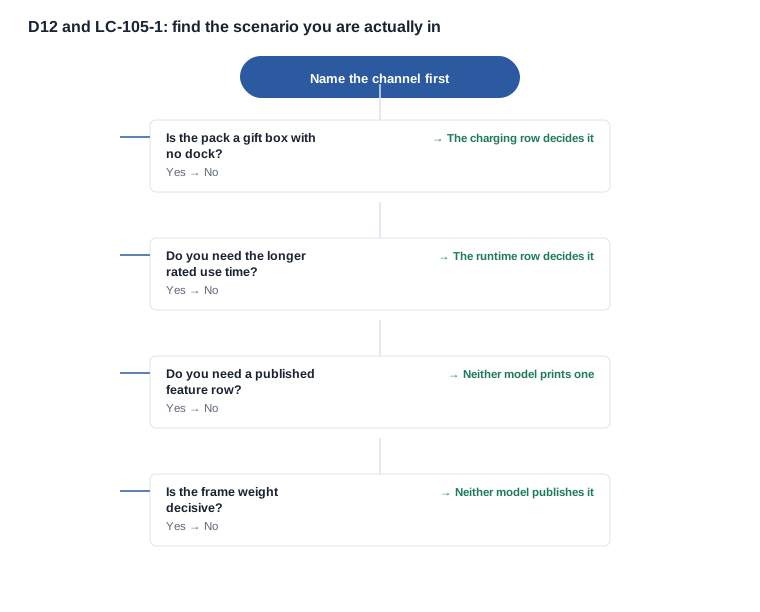
Each branch of that chart ends in a row rather than in a model, which is deliberate. The output of the method is "the interface row decides it" or "the runtime row decides it", and the model that survives is a consequence of which row the channel turned out to weigh. A buyer who applies the chart to two different channels, or to the same channel in two different markets, can arrive at two different models from the same published data, and that is not a contradiction.
Scenario one: a subscription or sampling channel
Channels that put a sample in a customer's hand and expect it to be used every day are the ones for which the published use-time figure does the most work. The LC-105-1's about eight hours covers a working day; the D12's about seven covers most of one. The difference in what a customer experiences is real, if the published condition is the condition the customer meets.
There is a second-order effect that a buyer should price in. In a sampling channel, the cost of a customer who charges the product once and then leaves it flat for a month is the cost of the sample plus the cost of the acquisition, and the published use-time figure is the only thing standing between the customer and that outcome. That is a reason to prefer the longer published figure in this specific scenario, and it is not a general reason to prefer a model in every scenario.
Scenario two: a promotional or retail channel
Here the pack is the product, and the pack is where the interface decision lands. A magnetic interface in a retail box means either a dock in every unit, which is visible in the box and in the shipping cost, or a model that arrives without the means to charge it, which is a refund waiting to happen. A Type-C interface means a cable in the box, which is a small, familiar, replaceable item.
The same retail channel also has an interest in the unboxing that our documentation cannot serve. There is no published photograph, no finish, no colour and no packaging specification for either model in the range, so a retail buyer is sourcing those from the supplier as a separate workstream with its own sample rounds. The materials and ergonomics page covers the physical side of that workstream, and the logistics page covers the shipping and carton decisions that follow from it.
Scenario three: an outdoor or active channel
An outdoor buyer will ask about water. The catalogue publishes an ingress protection marking on exactly two models in the whole range, the V06 and the S7, and both are camera models. Neither the D12 nor the LC-105-1 carries an ingress rating, so an outdoor channel has no durability claim to make for either of them, and the only route to one is a test report that the supplier has to produce. The IP ratings page sets out what a marking would and would not establish if one were ever published for these models.
This is the scenario where the absence of a feature row is most awkward. A customer shopping an outdoor category expects the product page to say something about resistance to water and dust, and there is nothing in either model that supports a sentence on the subject. The alternative is to position the product on what it does publish, which is connectivity, interface and use time, and to let the channel decide how much of the outdoor context it wants to claim without a supporting document.

Why the eight hour rating and the cell count pull in opposite directions
The most interesting thing about this pair is that the two models point in opposite directions on two rows at once, and a buyer who reads only one of them will reach a confident and wrong conclusion.
The LC-105-1 publishes the longer use time, about eight hours against about seven. It also publishes the smaller cell figure: two 55 mAh cells, which add to 110 mAh in total, against the D12's single 100 mAh cell. If a buyer reads capacity as the explanation for runtime, the pair appears inconsistent, and it is worth sitting with that for a moment rather than resolving it by assumption.
Capacity does not predict the use-time row here
Read across the audio group in the catalogue and the pattern breaks in several places. The G07 and the YK12 publish the same two 55 mAh cells as the LC-105 pair, and they publish about six hours rather than about eight. The K01 and the K02 publish two 90 mAh cells at about eight hours. The D11 and the D12 publish a single 100 mAh cell at about seven hours. The D17, in the sport group, publishes a single 115 mAh cell at about seven hours with a charge time of about one hour, a combination no audio model offers.
So the published cell figure and the published use time are two separate rows, and neither one predicts the other in this catalogue. A buyer who tells a supplier "the D12 has a 100 mAh cell so it should run past the LC-105-1" is making an argument the documentation contradicts. The defensible position is simpler: these are the numbers each model publishes, and neither of us has a published test condition to explain the difference.
The cell count still has a commercial meaning
The cell configuration matters even when the capacity does not, because it is a description of the hardware. One cell in the frame means one charging path and one point of failure. Two cells, one per temple, mean two cells to age, two sets of contacts, and a design where the two halves of the frame are no longer interchangeable in a repair scenario. For a channel with a repair and refurbishment programme, that is a real line in the cost model. For a channel that ships sealed units, it matters less.
The two-cell arrangement also changes the docking question. A magnetic dock for a two-cell model has to present two pairs of contacts correctly, which is a tighter tolerance and a more expensive part than a single-cell equivalent. A buyer who is costing the dock line should ask whether the dock is model-specific or shared across the range, because the answer changes the volume at which the tooling pays for itself. The procurement page on production capacity is the right place to plan that question with the supplier.

The two questions the catalogue leaves open for both models
Both models in this comparison share the same two gaps, and both gaps are the kind that only close with a document or a measurement.
The frame weight
Neither page publishes a weight. Not the frame alone, not the frame with the cell fitted, not the temples separately. The catalogue publishes a weight for exactly one model in the entire range, the MT6, and even there it is the 158 g figure for the eye glasses body excluding the folding charging case, with the case capacity listed separately at 1200 mAh. That single data point in 28 models is a useful reminder of how rarely the figure exists at all.
For this pair, the weight question is not academic. One cell against two cells means the mass is arranged differently across the frame, and the balance point, not the total, is what a customer reacts to in the first minute. A sample settles it in five minutes with a scale. A specification sheet settles it in one line. The D12 limitations page collects the other rows that are blank for this model, and the buyer review checklist is written as a pass to close them.
The per-model certification scope
The catalogue has no per-model certification row for any of the 28 models, and its export certification page is a company-level page whose content is images rather than text. A document that names a sibling model does not cover this one, and a family-level claim covers nothing in particular. The certification checklist sets out the order in which to request documents, and the point that matters most for a comparison like this one is simple: the same document has to be checked against the D12 and against the LC-105-1 separately, because the two models sit on different supply lines and nothing in the catalogue links their compliance status.
Putting a scenario to work without naming a winner
On the D12 and the LC-105-1, our position is that this is a scenario question rather than a product question, and that the catalogue gives a buyer enough to answer it. It gives the radio generation, the cell values and cell counts, the charge-time ceiling, the published use time, the charging method and the feature rows, which on this pair are empty for both. It does not give the weight, the acoustic behaviour, the ingress rating, the colour options, the control method or the per-model certification scope, and it does not give a price.
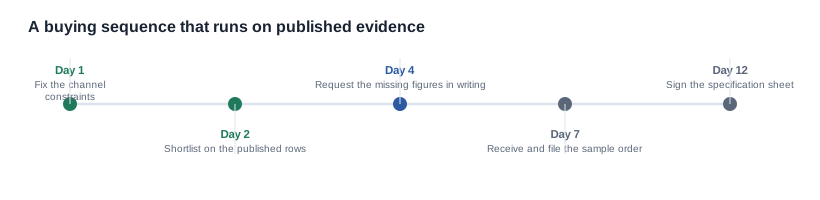
So the useful output of this comparison is a shortlist with conditions attached, and the conditions are the same on both sides. Whichever model survives the interface and runtime questions, the buyer still has to close the weight question on a sample, the acoustic questions with a written specification, the certification questions with documents, and the commercial questions with a quotation that states the minimum order quantity, the sample cost, the production capacity and the delivery plan. The pricing and payment terms pages and the risk page are the two that most often get skipped and most often cause trouble later.
The commercial terms that have to be negotiated rather than read
The specification rows and the commercial terms are different kinds of document, and mixing them is a common source of disappointment. A published row is a fact that is already settled and that you either accept or route around. A commercial term is an agreement that has not been made yet, and a buyer who treats it like a published fact is relying on a conversation that may have been forgotten.
Five terms in this category are negotiated every time, and none of them appears in the catalogue for either model.
- The minimum order quantity, and the pack size it applies to. The quantity question interacts with the interface decision, because a dock and a device rarely share an order quantity. The minimum order quantity page covers the structure of that negotiation, and the practical advice is to get the dock quantity and the device quantity written as two lines rather than one.
- The sample cost and the sample lead time. A sample order is a small transaction with a large informational value, and the terms for it are usually negotiable in a way the main order is not. The sample procedure covers what to extract from the sample beyond the device itself, including the packing list and the accessory set.
- The production capacity and the delivery plan. Both are quoted per order and both change. What matters is whether the plan is a commitment, a forecast or an estimate, and whether the document says so. The production capacity page is where that distinction is usually settled.
- The warranty term and the return rate basis. A warranty term is an agreement, not a catalogue row, and the number that matters commercially is the return rate assumption behind the cost model. The quality consistency page covers how that assumption is usually built.
- The payment milestones and the incoterm. The payment terms page and the logistics page cover the two sides of that conversation. Getting them written down is what stops a reorder from becoming a negotiation from scratch.
If you want a second opinion on the same data, the mirror comparison is the LC-105-1 against the D12, the battery question on the other side of the pair is covered in D12 and LC-105-2 battery and charging, and the neighbouring comparison on the radio generation is D12 and K02 which one to choose.
Tell us the scenarios your channel sells into, the pack you ship, the markets you ship to and the quantity, and we will map each scenario to the row that constrains it, show you what each model prints against that row, and name the rows that stay open on both.
Related reading
- The range both models belong to — Bluetooth audio glasses
- The two models as product pages — the D12 and the LC-105-1
- The battery side of this pair — D12 and LC-105-2 battery and charging
- Where the certification trail starts — certification checks
Send us the scenarios, the pack, the markets and the quantity, and we will map each scenario to the published row that constrains it.


