

A d12 smart glasses vs lc-105-2 battery and charging comparison is the narrowest of the comparisons in this group, and that narrowness is the point. There are three published electrical rows that differ between these two models, one that is identical, and a set of conditions that neither model publishes. Reading those rows correctly takes longer than reading the rows themselves, because two of them are ceilings and one of them is a cell count rather than a capacity.
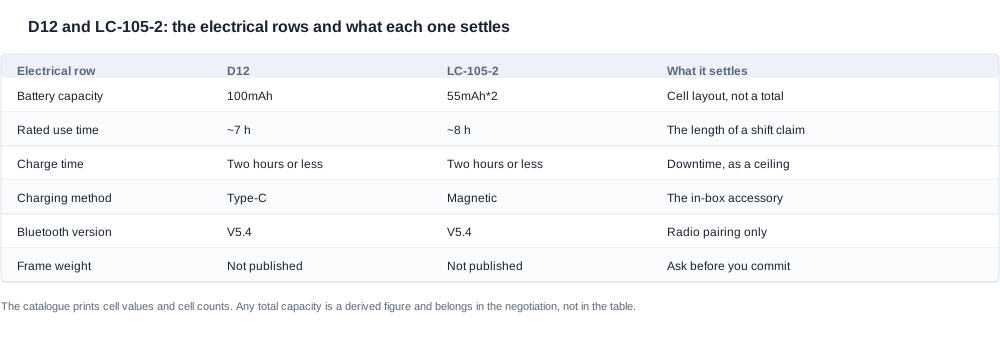
The electrical position. The D12 publishes a single 100 mAh cell, a charge time of two hours or less, about seven hours of use, Type-C charging and Bluetooth V5.4. The LC-105-2 publishes two 55 mAh cells, the same charge-time ceiling of two hours or less, about eight hours of use, magnetic charging and the same Bluetooth V5.4. Both models publish no feature row. That is the whole of the published electrical difference between them.
D12 and LC-105-2: the electrical rows and the questions they answer
Four rows carry the whole of the energy argument, and each one answers a different procurement question. Treating them as one block of figures is what produces a bad specification sheet, because a cell count answers a service question, a use-time figure answers a copy question, a charge-time ceiling answers a downtime question, and the charging method answers an accessory question.
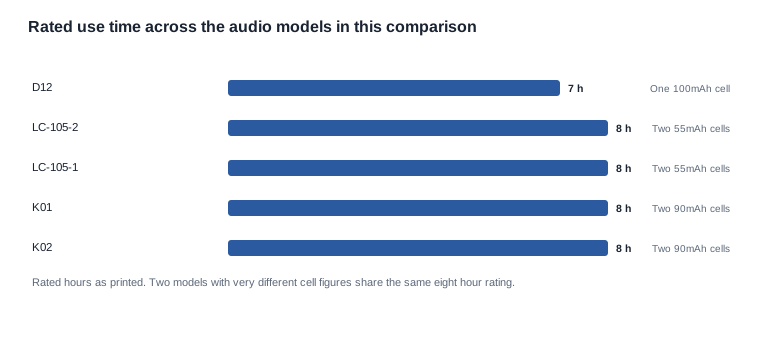
The chart above sets the two models in the context of the audio group, and it is worth pausing on what the chart does not show. The LC-105-2 publishes about eight hours from two 55 mAh cells. The G07 and the YK12 publish the same two-cell configuration and about six hours. The K01 and the K02 publish two 90 mAh cells at about eight hours. The D11 and the D12 publish a single 100 mAh cell at about seven hours. A published capacity figure does not produce a published use time in this catalogue, and a comparison that treats one as the explanation for the other is building on sand.
The cell count is a service question, not a capacity question
The D12's 100 mAh is a single cell in the frame. The LC-105-2's 55 mAh × 2 is two cells, one per temple. The catalogue publishes cell values and cell counts; it publishes a derived total of 110 mAh for neither, and a derived total of 100 mAh for the D12 is a single cell, so there is nothing to derive there. Where a total is needed for an energy calculation, it has to be labelled as a derived figure every time it appears, in the specification sheet, in the quotation and on the product page. A bare 110 mAh in a table of catalogue figures will be read as a published specification within a month, and it is not one.
What the cell count settles is the service and repair path, and that is a real line in the cost model for a channel that handles warranty returns.
- One cell means one charging path, one set of contacts, one component to diagnose and one to replace.
- Two cells means two cells to age, two sets of contacts, and a design where the two halves of the frame are no longer interchangeable in a swap. A refurbishment programme has to hold parts for two configurations rather than one.
The D12 battery life piece covers the endurance side of the same cell in more detail, and the D17 battery article shows what the catalogue looks like when a model does publish a fast charge time alongside a single cell.
The use-time row answers a copy question
About seven hours against about eight hours. Neither figure has a published condition, so the hour between them is a difference in two undocumented test procedures rather than a measured advantage, and the only honest way to write it in channel copy is to keep the word "about" attached to it. A buyer who wants to promote a number needs a condition first: the start state of the cell, the volume level, the audio content, the radio state and the ambient temperature. Ask for those and they will usually arrive in a single paragraph, because suppliers have them, they simply did not print them.
The battery life technical page covers the general treatment of use-time claims, and the LC-105-2 battery article works through the same row from the other side of the pair.

One cell against two, and what the difference costs in the field
The interesting question in this pair is not which cell is larger. It is what changes when the energy sits in one place in the frame rather than in two, and how a charging accessory design follows from that.
The recharge interval, worked through the day
Both models publish a charge time ceiling of two hours or less, so the recharge opportunity is the same size on paper. What differs is the moment in the day when that recharge has to happen, because a shift that ends when the battery ends is a different operating problem from a shift that ends before the battery does.
A model published at about seven hours fits a channel whose working period is shorter than a full day with a recharge point built in. A model published at about eight hours fits a longer one. Neither number is a promise, and the gap between them is small enough that a channel with a mixed shift pattern will find that the recharge window, rather than the use-time figure, is the thing that actually determines whether the product is usable in the field. That is a scheduling question the buyer answers, and it needs both numbers with their conditions attached.
The two-cell balance question
Two cells, one per temple, spread the mass. The catalogue publishes no weight for the LC-105-2, and it publishes a weight for exactly one model in the whole range, so the figure a buyer needs is not available from documentation at all. That matters more for a two-cell frame than for a single-cell one, because the distributed arrangement changes where the mass sits relative to the ear and how the frame behaves over a long session.
This is a two-minute measurement on a sample and a five-minute check in a store, and it is also the number that produces the highest share of returns in this category, because a customer who finds the frame uncomfortable in the first hour does not return it at the end of the warranty. No weight figure is published for this model, and any figure a supplier quotes has to be measured on the actual sample rather than taken from a family average. The materials and ergonomics page covers what to measure and how to record it, and the D12 limitations page sets out the full list of rows that are blank for the D12.
What the two-cell arrangement does to the dock
A magnetic interface for a two-cell model has to present two pairs of contacts, correctly, every time. That is a tighter tolerance than a single-cell equivalent, a more expensive moulded part, and a dock that is specific to the model rather than shareable across the range. Three consequences follow, and all three are questions for the supplier rather than rows in a catalogue.
- Is the dock shared across models or specific to this one? A shared dock amortises tooling across volume. A model-specific dock does not.
- What is the dock's own minimum order quantity, and how does it relate to the device quantity? The two are usually different, and the smaller one is the constraint.
- What happens to a customer who loses the dock? That is an accessory replacement question, and its answer decides whether the dock is an accessory line in your catalogue or a hidden cost inside your support budget.
Type-C against magnetic: the accessory, the logistics and the support line
The charging method is where this comparison stops being technical and becomes commercial, and it is the row most likely to be decided by the wrong people in an organisation.
What the Type-C route commits the channel to
A Type-C device needs a cable. The cable is either in the box or it is not, and that single decision produces a small chain of consequences: the cable specification, its length, its current rating, its unit cost, the packing instruction, the customer expectation and the replacement accessory business. It also means the customer can charge the product from a laptop, a power bank or a wall adapter they already own, which removes a category of support contact entirely, because there is nothing to explain.
The cost side of the same decision is a line item in every unit plus a specification to manage. A buyer should ask for the cable specification in writing rather than accepting whatever is in the carton, because the cable is the one component a customer will judge the product by.
What the magnetic route commits the channel to
A magnetic device needs a dock. The dock is either in every box, which is a packing cost, a visible object in the unboxing and a logistics cost, or it is a separate line item with its own order quantity and its own shipping profile. A customer who receives a model that cannot be charged and has no dock is a refund, and a customer who has to find a compatible dock is a support contact and a delay before first use.
The second cost of the magnetic route is the alignment habit. A magnetic contact has to be seated correctly, and a customer who seats it wrongly on the first attempt will assume the product is faulty. That produces early-life contacts which are not defects in any engineering sense and still land in your support statistics, and it is the reason a channel with a high share of first-time buyers should cost the dock and the instruction time before it chooses the interface.
The row that a buyer should not let the interface decide
Neither model's published use time is a function of its charging method in the catalogue, and there is no published data linking the two. A buyer who assumes that a magnetic interface implies a longer use time, or that a Type-C port implies a faster one, is reading a relationship into the table that the table does not contain. The interface row settles accessories, logistics and support. It settles nothing about endurance.
The D12 charging options piece covers the same trade from the D12's side, and the LC-105-2 charging options article covers it from the other.

Charge time ceilings: what two hours or less does and does not license
Both models publish the same charge-time figure, and it is a ceiling rather than a measurement. That distinction is worth more attention than it usually gets, because it is the kind of wording that gets lost between the catalogue, the specification sheet and the product page.
What the ceiling permits. A charge time of two hours or less means the device reaches its published charge state in no more than two hours. It permits exactly two hours. It does not permit a promise of under two hours, and it does not permit a promise of less than two hours, because a device that takes exactly two hours satisfies the published ceiling and breaks both of those promises.
What the ceiling does not tell you. It does not state the start state, so a charge from an empty cell and a charge from a partly charged cell are not distinguished. It does not state the end criterion, so it is not clear whether the device reports full at a set voltage, a set percentage or a temperature plateau, and a device that ends its charge early and a device that ends it at the same point can both be described by the same ceiling. It does not state the input current, so the figure cannot be reproduced without knowing the charger. And it does not name a charging protocol, so the figure cannot be described in the copy as fast charging, because fast charging is a protocol claim and this is a duration claim.
How to convert the ceiling into something usable. Ask the supplier for the test condition behind the published figure and write it into the specification sheet: the start state, the end criterion, the input current and the charger used. Then decide internally whether the claim is the catalogue ceiling or the measured figure from your own sample. The two are often different, and the internal figure is the one your support team should hold. A useful criterion, before you order, is to write down which of the two numbers each surface will use, so the product page, the training material and the support script cannot drift apart.
Why this matters more for a two-cell model. A two-cell frame charges both cells, and a pair of cells with slightly different states can take longer to balance than a single cell does. That is a design expectation rather than a published fact, and it is exactly the kind of expectation that should be tested on a sample rather than assumed. Running the charge cycle on two or three units and recording the spread is cheap, and it is the difference between a claim that holds and one that produces a complaint.

The verification sequence above is the order we would use with a supplier. The first step is the one that most often gets skipped, and it is the step that makes the rest reproducible: writing the charge time as a ceiling in the specification sheet, in the same words the catalogue uses. Once that is done, every downstream claim, on the product page, in the training material and in the support script, inherits the correct wording for free.

The evidence file that makes the battery claim defensible
An energy claim is only as good as the file behind it, and for a B2B channel the file is what a retailer's compliance team, an insurer or a market authority will ask for months later.
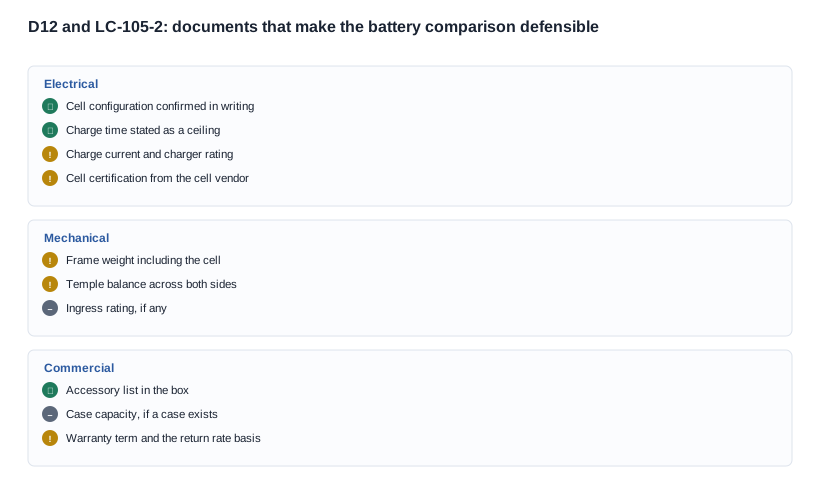
The checklist above separates the items into three groups, and the grouping matters. The electrical group is about the device and can be closed on a sample and a written specification. The mechanical group is about the physical unit and can be closed on a sample, with the weight requiring a measurement because the catalogue publishes none for either model. The commercial group is about the transaction, and the two lines marked as not published are the ones that only a document can close.
The two items that only a document can close. A charging case is a question, not an absence. The catalogue does not publish a case row for the LC-105-2, and for a magnetic interface a case is a natural expectation, so a buyer should establish whether one exists, at what capacity, and whether it is included at the quantity being ordered. A case capacity is a published figure on several camera models in the range, so the number is not a secret, it simply is not printed against this model. The second item is the cell's own certification. Whatever cells a model uses, the cell supplier keeps a test file for them, and the buyer should ask to see the relevant part of it, because the transport and safety conversation for a battery is a conversation about the cell rather than about the finished product.
The warranty and return-rate line. A warranty term is an agreement and it is never a catalogue row, and the number that matters commercially is the return-rate assumption behind the cost model. A model with a shorter published use time in a channel where the battery is the main point of contact will carry a different return rate, and that assumption should be built from your own sample rather than assumed to be the same for both models. The quality consistency page covers how that assumption is usually constructed.
The records to keep. The charge cycle timing, the measured frame weight, the conditions, the unit identifiers and the dates. Six lines in a table per sample unit, kept for the life of the product, are enough to answer a complaint about a battery two years later. The buyer review checklist is written for exactly this record, and the contract terms page is where the claims, the warranty and the documentation obligation are usually written into the agreement. Two questions to ask in writing before you commit to either model are worth more than any further reading of the catalogue rows: what the cell supplier's test file covers, and what the case position is.
What the published rows settle, and what has to be evidenced separately
The D12 and the LC-105-2 differ in a way that a buyer can act on, but that the difference is about the accessory and the service path rather than about the endurance. We will quote the cell values and cell counts exactly as the catalogue prints them, the charge-time ceiling in the wording the catalogue uses, and the use-time figure with its "about" attached. We will not quote a derived total without its derivation, we will not describe the charge time as fast charging, and we will not rank the two models on a runtime difference that no published condition explains.
One further note belongs in this piece, because it affects how the pair is sourced. The catalogue prints the LC-105-1 and the LC-105-2 with identical published rows: the same Bluetooth version, the same two 55 mAh cells, the same charge-time ceiling, the same use time and the same charging method, with no feature row on either page. Nothing in the documentation distinguishes them, which means the choice between them cannot be made from the catalogue and has to be made from the supplier, the sample and the commercial terms. The D12 and LC-105-1 use case fit piece covers the scenario side of the same family, and the mirror comparison is the LC-105-2 against the D12.
Tell us the shift length your channel actually runs, the pack you intend to ship, the markets and the quantity, and we will tell you which of the two models the published electrical rows keep in scope, what has to be measured on a sample, and what has to be obtained as a document.
Related reading
- The range both models belong to — Bluetooth audio glasses
- The two models as product pages — the D12 and the LC-105-2
- The interface argument in full — D12 charging options
- The same rows on the other side of the family — D12 and LC-105-1 use case fit
Send us the shift length, the pack, the markets and the quantity, and we will tell you what the published electrical rows do and do not settle.


